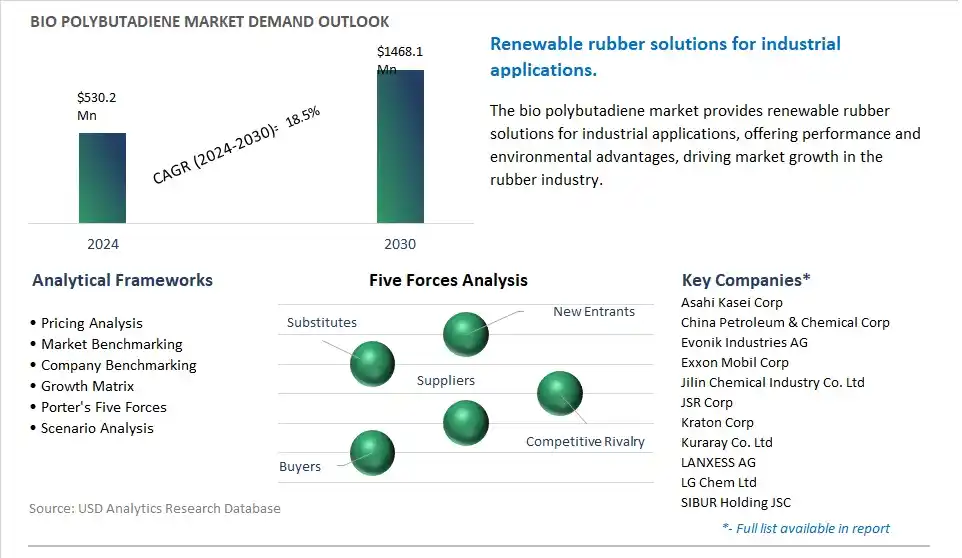
The global Bio Polybutadiene Market is poised to register a 18.5% CAGR from $530.2 Million in 2024 to $1468.1 Million in 2030.
The global Bio Polybutadiene Market Study analyzes and forecasts the market size across 6 regions and 24 countries for diverse segments -By Product (High Cis Polybutadiene, Low Cis Polybutadiene, High Vinyl Polybutadiene, High Trans Polybutadiene), By Application (Tire Manufacturing, Polymer Modification, Industrial Rubber Manufacturing).
An Introduction to Global Bio Polybutadiene Market in 2024
The market for bio polybutadiene is gaining traction as industries seek renewable alternatives to conventional polybutadiene rubber for applications such as tires, automotive parts, industrial goods, and consumer products. Key trends shaping the future of this industry include the development of polybutadiene polymers derived from renewable feedstocks such as plant-based oils, biomass, and recycled materials, offering advantages in terms of biodegradability, carbon neutrality, and reduced environmental impact compared to petroleum-based polybutadiene. Additionally, advancements in polymerization techniques, catalysts, and material engineering enable the production of bio-based polybutadiene with properties and performance comparable to traditional rubber, meeting the diverse needs of end-users and brand owners. Moreover, the adoption of sustainability certifications, eco-labeling initiatives, and circular economy strategies drives market demand for bio-based polybutadiene, fostering innovation and market expansion in this sector. As industries strive to reduce dependence on fossil fuels and address environmental concerns, the demand for bio-based polybutadiene is expected to continue growing, driving further innovation and market development in sustainable rubber materials.
Bio Polybutadiene Market Competitive Landscape
The market report analyses the leading companies in the industry including Asahi Kasei Corp, China Petroleum & Chemical Corp, Evonik Industries AG, Exxon Mobil Corp, Jilin Chemical Industry Co. Ltd, JSR Corp, Kraton Corp, Kuraray Co. Ltd, LANXESS AG, LG Chem Ltd, SIBUR Holding JSC, The Goodyear Tire & Rubber Company, Trinseo LLC, Versalis S.p.A., Zeon Corp.
Bio Polybutadiene Market Dynamics
Bio polybutadiene Market Trend: Rising Demand for Sustainable Rubber Alternatives
A prominent trend in the market for bio polybutadiene is the rising demand for sustainable rubber alternatives. Polybutadiene is a key component in the production of synthetic rubber, widely used in tires, automotive parts, industrial goods, and consumer products. With increasing concerns about environmental sustainability and the carbon footprint of traditional rubber production, there is a notable shift towards replacing petroleum-based polybutadiene with bio-based alternatives. Bio polybutadiene, derived from renewable biomass sources such as plant oils or bio-based intermediates, offers a sustainable solution with reduced carbon emissions and lower environmental impact. As industries and consumers prioritize sustainability, the demand for bio polybutadiene is expected to grow, driving market expansion and innovation in the rubber industry.
Bio polybutadiene Market Driver: Regulatory Initiatives and Sustainability Goals
A key driver behind the demand for bio polybutadiene is regulatory initiatives and sustainability goals aimed at reducing carbon emissions and promoting the use of renewable resources. Governments worldwide are implementing regulations and policies to address climate change and promote the adoption of bio-based materials in various industries, including rubber production. Additionally, companies are setting sustainability targets and commitments to reduce their environmental footprint and enhance their corporate social responsibility (CSR) efforts. Bio polybutadiene aligns with these regulatory requirements and sustainability objectives by offering a renewable and eco-friendly alternative to conventional polybutadiene derived from fossil fuels. As regulatory pressure increases and companies seek to meet sustainability goals, the demand for bio polybutadiene is expected to rise, driving market growth and investment in the industry.
Bio polybutadiene Market Opportunity: Collaboration for Technology Advancement and Market Adoption
An emerging opportunity in the market for bio-polybutadiene lies in collaboration for technology advancement and market adoption. While bio-polybutadiene offers environmental benefits, challenges remain in terms of technological scalability, cost competitiveness, and market acceptance. Opportunities exist for collaboration between technology developers, rubber manufacturers, and end-users to advance research and development efforts in bio-based polybutadiene production. By leveraging innovations in biotechnology, catalysis, and process engineering, stakeholders can optimize biomass conversion pathways, improve polybutadiene yield and quality, and reduce production costs. Additionally, partnerships with tire manufacturers, automotive companies, and other rubber product industries can drive market adoption strategies, enabling manufacturers of bio-polybutadiene to capitalize on new opportunities and accelerate the transition toward sustainable rubber materials.
Bio Polybutadiene Market Ecosystem
The market Ecosystem of the Bio-Polybutadiene (Bio-PBD) market delineates various stages, beginning with feedstock production sourced from sugarcane, corn starch, or potential microbial fermentation. Pre-treatment processes are facilitated by specialized companies including LIG Renewable Fuels to prepare biomass for conversion, potentially leading to integrated bio-PBD producers with pre-treatment capabilities.
Current industrial processes involve the conversion of feedstocks into bio-based intermediates for Bio-PBD production, although emerging technologies aim to directly convert feedstocks into bio-based butadiene. Companies including Genomatica and LanzaTech are pioneering this approach.
As the technology matures, established chemical companies including BASF and LyondellBasell could adapt to produce bio-based butadiene, supported by catalyst development by companies including Albemarle and Clariant. Polymerization, quality control, distribution, and manufacturing for various applications follow, with potential future involvement of bio-PBD producers across these stages.
Bio-polybutadiene Market Share Analysis: High Cis Polybutadiene held the dominant revenue share in 2024
Among the products in the Bio-polybutadiene Market, the High Cis Polybutadiene segment is the largest, driven by diverse significant factors contributing to its dominance. High cis polybutadiene is a versatile synthetic rubber widely used in the production of tires, footwear, industrial products, and adhesives due to its excellent abrasion resistance, high tensile strength, and good elasticity. The dominance of the High Cis Polybutadiene segment can be attributed to its superior mechanical properties and performance characteristics compared to other types of polybutadiene. Additionally, high cis polybutadiene offers advantages such as low rolling resistance, which enhances fuel efficiency in tires, and excellent wet grip, contributing to improved safety and handling in automotive applications. In addition, the growing demand for bio-based and sustainable materials in various industries, coupled with regulatory initiatives promoting the use of renewable resources, further drives the adoption of bio-based high cis polybutadiene. As industries continue to prioritize sustainability and seek alternatives to conventional rubber, the High Cis Polybutadiene segment in the Bio-polybutadiene Market is expected to maintain its leading position, offering manufacturers and suppliers significant opportunities for growth and market expansion.
Bio-polybutadiene Market Share Analysis: Polymer Modification is the fastest growing market segment over the forecast period to 2030
Among the applications in the Bio-polybutadiene Market, the Polymer Modification segment is the fastest-growing, driven by diverse key factors contributing to its rapid expansion. Polymer modification involves the incorporation of polybutadiene into various polymer matrices to enhance their mechanical properties, such as toughness, impact resistance, and flexibility. The rapid growth of the Polymer Modification segment can be attributed to the increasing demand for bio-based and sustainable materials in polymer manufacturing industries. Bio-based polybutadiene offers manufacturers an eco-friendly alternative to petroleum-based polybutadiene, aligning with the growing sustainability initiatives across industries. Additionally, the versatility of polybutadiene in modifying a wide range of polymers, including thermoplastics and thermosets, makes it a preferred choice for enhancing the performance and properties of various end products. In addition, advancements in bio-based polybutadiene technology and processing methods have improved its compatibility with different polymer matrices, further driving its adoption in polymer modification applications. As industries continue to seek greener solutions and strive for product differentiation, the Polymer Modification segment in the Bio-polybutadiene Market is expected to experience sustained growth, presenting significant opportunities for manufacturers and suppliers to cater to this growing demand.
Bio Polybutadiene Market Report Scope-
By Product
High Cis Polybutadiene
Low Cis Polybutadiene
High Vinyl Polybutadiene
High Trans Polybutadiene
By Application
Tire Manufacturing
Polymer Modification
Industrial Rubber Manufacturing
Bio Polybutadiene Market Companies Profiled
Asahi Kasei Corp
China Petroleum & Chemical Corp
Evonik Industries AG
Exxon Mobil Corp
Jilin Chemical Industry Co. Ltd
JSR Corp
Kraton Corp
Kuraray Co. Ltd
LANXESS AG
LG Chem Ltd
SIBUR Holding JSC
The Goodyear Tire & Rubber Company
Trinseo LLC
Versalis S.p.A.
Zeon Corp
*- List Not Exhaustive
TABLE OF CONTENTS
1 Introduction to 2024 Bio Polybutadiene Market
1.1 Market Overview
1.2 Quick Facts
1.3 Scope/Objective of the Study
1.4 Market Definition
1.5 Countries and Regions Covered
1.6 Units, Currency, and Conversions
1.7 Industry Value Chain
2 Research Methodology
2.1 Market Size Estimation
2.2 Sources and Research Methodology
2.3 Data Triangulation
2.4 Assumptions and Limitations
3 Executive Summary
3.1 Global Bio Polybutadiene Market Size Outlook, $ Million, 2021 to 2030
3.2 Bio Polybutadiene Market Outlook by Type, $ Million, 2021 to 2030
3.3 Bio Polybutadiene Market Outlook by Product, $ Million, 2021 to 2030
3.4 Bio Polybutadiene Market Outlook by Application, $ Million, 2021 to 2030
3.5 Bio Polybutadiene Market Outlook by Key Countries, $ Million, 2021 to 2030
4 Market Dynamics
4.1 Key Driving Forces of Bio Polybutadiene Industry
4.2 Key Market Trends in Bio Polybutadiene Industry
4.3 Potential Opportunities in Bio Polybutadiene Industry
4.4 Key Challenges in Bio Polybutadiene Industry
5 Market Factor Analysis
5.1 Value Chain Analysis
5.2 Competitive Landscape
5.2.1 Global Bio Polybutadiene Market Share by Company (%), 2023
5.2.2 Product Offerings by Company
5.3 Porter’s Five Forces Analysis
5.4 Pricing Analysis and Outlook
6 Growth Outlook Across Scenarios
6.1 Growth Analysis-Case Scenario Definitions
6.2 Low Growth Scenario Forecasts
6.3 Reference Growth Scenario Forecasts
6.4 High Growth Scenario Forecasts
7 Global Bio Polybutadiene Market Outlook by Segments
7.1 Bio Polybutadiene Market Outlook by Segments, $ Million, 2021- 2030
By Product
High Cis Polybutadiene
Low Cis Polybutadiene
High Vinyl Polybutadiene
High Trans Polybutadiene
By Application
Tire Manufacturing
Polymer Modification
Industrial Rubber Manufacturing
8 North America Bio Polybutadiene Market Analysis and Outlook To 2030
8.1 Introduction to North America Bio Polybutadiene Markets in 2024
8.2 North America Bio Polybutadiene Market Size Outlook by Country, 2021-2030
8.2.1 United States
8.2.2 Canada
8.2.3 Mexico
8.3 North America Bio Polybutadiene Market size Outlook by Segments, 2021-2030
By Product
High Cis Polybutadiene
Low Cis Polybutadiene
High Vinyl Polybutadiene
High Trans Polybutadiene
By Application
Tire Manufacturing
Polymer Modification
Industrial Rubber Manufacturing
9 Europe Bio Polybutadiene Market Analysis and Outlook To 2030
9.1 Introduction to Europe Bio Polybutadiene Markets in 2024
9.2 Europe Bio Polybutadiene Market Size Outlook by Country, 2021-2030
9.2.1 Germany
9.2.2 France
9.2.3 Spain
9.2.4 United Kingdom
9.2.4 Italy
9.2.5 Russia
9.2.6 Norway
9.2.7 Rest of Europe
9.3 Europe Bio Polybutadiene Market Size Outlook by Segments, 2021-2030
By Product
High Cis Polybutadiene
Low Cis Polybutadiene
High Vinyl Polybutadiene
High Trans Polybutadiene
By Application
Tire Manufacturing
Polymer Modification
Industrial Rubber Manufacturing
10 Asia Pacific Bio Polybutadiene Market Analysis and Outlook To 2030
10.1 Introduction to Asia Pacific Bio Polybutadiene Markets in 2024
10.2 Asia Pacific Bio Polybutadiene Market Size Outlook by Country, 2021-2030
10.2.1 China
10.2.2 India
10.2.3 Japan
10.2.4 South Korea
10.2.5 Indonesia
10.2.6 Malaysia
10.2.7 Australia
10.2.8 Rest of Asia Pacific
10.3 Asia Pacific Bio Polybutadiene Market size Outlook by Segments, 2021-2030
By Product
High Cis Polybutadiene
Low Cis Polybutadiene
High Vinyl Polybutadiene
High Trans Polybutadiene
By Application
Tire Manufacturing
Polymer Modification
Industrial Rubber Manufacturing
11 South America Bio Polybutadiene Market Analysis and Outlook To 2030
11.1 Introduction to South America Bio Polybutadiene Markets in 2024
11.2 South America Bio Polybutadiene Market Size Outlook by Country, 2021-2030
11.2.1 Brazil
11.2.2 Argentina
11.2.3 Rest of South America
11.3 South America Bio Polybutadiene Market size Outlook by Segments, 2021-2030
By Product
High Cis Polybutadiene
Low Cis Polybutadiene
High Vinyl Polybutadiene
High Trans Polybutadiene
By Application
Tire Manufacturing
Polymer Modification
Industrial Rubber Manufacturing
12 Middle East and Africa Bio Polybutadiene Market Analysis and Outlook To 2030
12.1 Introduction to Middle East and Africa Bio Polybutadiene Markets in 2024
12.2 Middle East and Africa Bio Polybutadiene Market Size Outlook by Country, 2021-2030
12.2.1 Saudi Arabia
12.2.2 UAE
12.2.3 Oman
12.2.4 Rest of Middle East
12.2.5 Egypt
12.2.6 Nigeria
12.2.7 South Africa
12.2.8 Rest of Africa
12.3 Middle East and Africa Bio Polybutadiene Market size Outlook by Segments, 2021-2030
By Product
High Cis Polybutadiene
Low Cis Polybutadiene
High Vinyl Polybutadiene
High Trans Polybutadiene
By Application
Tire Manufacturing
Polymer Modification
Industrial Rubber Manufacturing
13 Company Profiles
13.1 Company Snapshot
13.2 SWOT Profiles
13.3 Products and Services
13.4 Recent Developments
13.5 Financial Profile
Asahi Kasei Corp
China Petroleum & Chemical Corp
Evonik Industries AG
Exxon Mobil Corp
Jilin Chemical Industry Co. Ltd
JSR Corp
Kraton Corp
Kuraray Co. Ltd
LANXESS AG
LG Chem Ltd
SIBUR Holding JSC
The Goodyear Tire & Rubber Company
Trinseo LLC
Versalis S.p.A.
Zeon Corp
14 Appendix
14.1 Customization Offerings
14.2 Subscription Services
14.3 Related Reports
14.4 Publisher Expertise
By Product
High Cis Polybutadiene
Low Cis Polybutadiene
High Vinyl Polybutadiene
High Trans Polybutadiene
By Application
Tire Manufacturing
Polymer Modification
Industrial Rubber Manufacturing
Countries Analyzed
North America (US, Canada, Mexico)
Europe (Germany, UK, France, Spain, Italy, Russia, Rest of Europe)
Asia Pacific (China, India, Japan, South Korea, Australia, South East Asia, Rest of Asia)
South America (Brazil, Argentina, Rest of South America)
Middle East and Africa (Saudi Arabia, UAE, Rest of Middle East, South Africa, Egypt, Rest of Africa)
