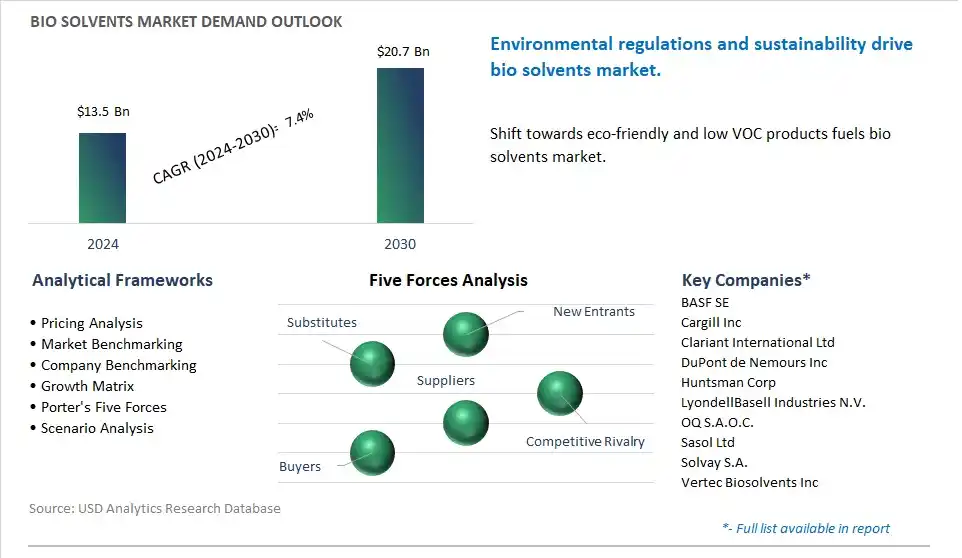
The global Bio Solvents Market is poised to register a 7.4% CAGR from $13.5 Billion in 2024 to $20.7 Billion in 2030.
The global Bio Solvents Market Study analyzes and forecasts the market size across 6 regions and 24 countries for diverse segments -By Product (Lactate Ester, Soy Methyl Ester, Alcohol, Glycols, Others), By Application (Paints & Coatings, Adhesives & Sealants, Printing Inks, Others).
An Introduction to Global Bio Solvents Market in 2024
The bio solvents market is witnessing steady growth driven by increasing regulatory pressure, environmental concerns, and consumer demand for safer and sustainable alternatives to conventional solvents. Key trends shaping the future of the industry include the growing adoption of bio-based solvents derived from renewable feedstocks such as ethanol, glycerol, and citrus oils, offering low toxicity, biodegradability, and reduced environmental impact compared to petrochemical-derived solvents. Moreover, there's a rising emphasis on bio solvents' excellent performance in cleaning, degreasing, and coating applications across various industries including paints and coatings, pharmaceuticals, and personal care products. Additionally, there's a growing trend towards the development of bio solvent blends and formulations tailored to specific end-use requirements, enabling manufacturers to achieve desired performance while minimizing environmental footprint. Furthermore, advancements in bio solvent production processes, purification techniques, and solvent recovery systems are driving innovation and market expansion, facilitating the transition towards greener and more sustainable solvent solutions in the global bio solvents market.
Bio Solvents Market Competitive Landscape
The market report analyses the leading companies in the industry including BASF SE, Cargill Inc, Clariant International Ltd, DuPont de Nemours Inc, Huntsman Corp, LyondellBasell Industries N.V., OQ S.A.O.C., Sasol Ltd, Solvay S.A., Vertec Biosolvents Inc.
Bio Solvents Market Dynamics
Bio Solvents Market Trend: Shift Towards Environmentally Friendly and Sustainable Solutions
A prominent trend in the bio solvents market is the shift towards environmentally friendly and sustainable solutions. Bio solvents, derived from renewable resources such as plant-based feedstocks, agricultural waste, or bio-based chemicals, offer a greener alternative to traditional solvents derived from petroleum. With increasing regulatory pressures to reduce volatile organic compound (VOC) emissions, minimize environmental impact, and promote circular economy principles, there is a growing demand for bio solvents in various industries such as paints and coatings, cleaning products, pharmaceuticals, and cosmetics. Companies are increasingly adopting bio solvents to meet sustainability goals, comply with regulations, and address consumer preferences for eco-friendly products, driving market growth and innovation in bio-based solvents.
Bio Solvents Market Driver: Regulatory Restrictions on Conventional Solvents and Hazardous Chemicals
A primary driver fueling the bio solvents market is regulatory restrictions on conventional solvents and hazardous chemicals. Governments and regulatory agencies worldwide are implementing stringent regulations and standards to limit the use of toxic and environmentally harmful solvents, such as volatile organic compounds (VOCs), glycol ethers, and chlorinated solvents, in industrial processes and consumer products. Additionally, initiatives promoting safer alternatives and sustainable chemistry practices are encouraging industries to transition towards bio-based solvents that offer lower toxicity, reduced emissions, and improved environmental performance. By complying with regulatory requirements and replacing hazardous chemicals with bio solvents, companies can mitigate compliance risks, reduce environmental liabilities, and gain competitive advantage in the evolving market landscape.
Bio Solvents Market Opportunity: Expansion into New Applications and End-Use Industries
An opportunity within the bio solvents market lies in the expansion into new applications and end-use industries to diversify product portfolios and capture emerging market segments. While bio solvents are commonly used in traditional applications such as paints, coatings, and cleaning products, there is potential to explore niche markets and specialty applications where bio-based solvents can offer unique performance benefits. Industries such as personal care, agrochemicals, pharmaceuticals, and electronics present opportunities for bio solvents to replace conventional chemicals and address specific requirements such as low toxicity, biodegradability, and compatibility with sensitive materials. Moreover, there is potential to develop customized bio solvent formulations tailored to the needs of specific applications and collaborate with industry partners to create innovative solutions that meet evolving customer demands. By expanding into new applications and end-use industries, companies can diversify their revenue streams, penetrate untapped market segments, and position themselves as leaders in the growing bio solvents market.
Bio Solvents Market Share Analysis: Alcohol Segment generated the highest revenue in the industry
The alcohol segment is the largest segment in the Bio Solvents Market for diverse compelling reasons. The alcohols, such as ethanol and isopropanol, are among the most widely used bio-based solvents due to their excellent solvent properties, versatility, and compatibility with various applications and substrates. These solvents find extensive use in industries such as paints and coatings, cleaning products, pharmaceuticals, personal care, and automotive, among others. Additionally, alcohols are effective in dissolving a wide range of substances, including oils, greases, resins, and organic compounds, making them suitable for numerous cleaning, degreasing, and solvent extraction applications. In addition, the production of alcohol-based bio solvents from renewable biomass sources, such as corn, sugarcane, or cellulosic feedstocks, offers environmental benefits compared to conventional petroleum-based solvents. As a result, alcohol-based bio solvents align with sustainability goals and regulatory requirements, driving their adoption in various industries seeking more eco-friendly alternatives. Further, the widespread availability and cost-effectiveness of alcohol-based bio solvents compared to other bio-based solvents make them a preferred choice for manufacturers and end-users. Over the forecast period, the combination of excellent solvent properties, versatility, sustainability, and cost-effectiveness positions the alcohol segment as the largest in the Bio Solvents Market.
Bio Solvents Market Share Analysis: Paints & Coatings Segment is poised to register the fastest growth rate (CAGR) over the forecast period to 2030
The Paints & Coatings segment is the fastest-growing segment in the Bio Solvents Market for diverse significant reasons. The there is a growing demand for environmentally friendly and sustainable solutions in the paints and coatings industry driven by stringent regulations, consumer preferences, and corporate sustainability initiatives. Bio-based solvents offer a viable alternative to conventional petroleum-based solvents, reducing VOC (volatile organic compound) emissions and environmental impact. In addition, bio solvents derived from renewable biomass sources such as ethanol, glycols, or lactate esters offer comparable performance to their petroleum-based counterparts while offering environmental benefits. Additionally, bio-based solvents exhibit excellent compatibility with various resins, binders, and pigments commonly used in paints and coatings formulations, ensuring high-quality finishes and performance. Further, the paints and coatings industry's ongoing expansion, particularly in construction, automotive, and industrial sectors, drives the demand for bio-based solvents. As sustainability concerns become increasingly important across industries, the paints and coatings segment is experiencing a shift towards bio-based solvents to meet regulatory requirements and consumer demands for eco-friendly products. As a result, the Paints & Coatings segment is experiencing rapid growth in the Bio Solvents Market, driven by the increasing adoption of bio-based solvents in formulations and the industry's transition towards more sustainable practices.
Bio Solvents Market Report Segmentation
By Product
Lactate Ester
Soy Methyl Ester
Alcohol
Glycols
Others
By Application
Paints & Coatings
Adhesives & Sealants
Printing Inks
Others
Regions Included
North America (US, Canada, Mexico)
Europe (Germany, UK, France, Spain, Italy, Russia, Rest of Europe)
Asia Pacific (China, India, Japan, South Korea, Australia, South East Asia, Rest of Asia)
South America (Brazil, Argentina, Rest of South America)
Middle East and Africa (Saudi Arabia, UAE, Rest of Middle East, South Africa, Egypt, Rest of Africa)
Bio Solvents Companies Profiled in the Market Study
BASF SE
Cargill Inc
Clariant International Ltd
DuPont de Nemours Inc
Huntsman Corp
LyondellBasell Industries N.V.
OQ S.A.O.C.
Sasol Ltd
Solvay S.A.
Vertec Biosolvents Inc
*- List Not Exhaustive
TABLE OF CONTENTS
1 Introduction to 2024 Bio Solvents Market
1.1 Market Overview
1.2 Quick Facts
1.3 Scope/Objective of the Study
1.4 Market Definition
1.5 Countries and Regions Covered
1.6 Units, Currency, and Conversions
1.7 Industry Value Chain
2 Research Methodology
2.1 Market Size Estimation
2.2 Sources and Research Methodology
2.3 Data Triangulation
2.4 Assumptions and Limitations
3 Executive Summary
3.1 Global Bio Solvents Market Size Outlook, $ Million, 2021 to 2030
3.2 Bio Solvents Market Outlook by Type, $ Million, 2021 to 2030
3.3 Bio Solvents Market Outlook by Product, $ Million, 2021 to 2030
3.4 Bio Solvents Market Outlook by Application, $ Million, 2021 to 2030
3.5 Bio Solvents Market Outlook by Key Countries, $ Million, 2021 to 2030
4 Market Dynamics
4.1 Key Driving Forces of Bio Solvents Industry
4.2 Key Market Trends in Bio Solvents Industry
4.3 Potential Opportunities in Bio Solvents Industry
4.4 Key Challenges in Bio Solvents Industry
5 Market Factor Analysis
5.1 Value Chain Analysis
5.2 Competitive Landscape
5.2.1 Global Bio Solvents Market Share by Company (%), 2023
5.2.2 Product Offerings by Company
5.3 Porter’s Five Forces Analysis
5.4 Pricing Analysis and Outlook
6 Growth Outlook Across Scenarios
6.1 Growth Analysis-Case Scenario Definitions
6.2 Low Growth Scenario Forecasts
6.3 Reference Growth Scenario Forecasts
6.4 High Growth Scenario Forecasts
7 Global Bio Solvents Market Outlook by Segments
7.1 Bio Solvents Market Outlook by Segments, $ Million, 2021- 2030
By Product
Lactate Ester
Soy Methyl Ester
Alcohol
Glycols
Others
By Application
Paints & Coatings
Adhesives & Sealants
Printing Inks
Others
8 North America Bio Solvents Market Analysis and Outlook To 2030
8.1 Introduction to North America Bio Solvents Markets in 2024
8.2 North America Bio Solvents Market Size Outlook by Country, 2021-2030
8.2.1 United States
8.2.2 Canada
8.2.3 Mexico
8.3 North America Bio Solvents Market size Outlook by Segments, 2021-2030
By Product
Lactate Ester
Soy Methyl Ester
Alcohol
Glycols
Others
By Application
Paints & Coatings
Adhesives & Sealants
Printing Inks
Others
9 Europe Bio Solvents Market Analysis and Outlook To 2030
9.1 Introduction to Europe Bio Solvents Markets in 2024
9.2 Europe Bio Solvents Market Size Outlook by Country, 2021-2030
9.2.1 Germany
9.2.2 France
9.2.3 Spain
9.2.4 United Kingdom
9.2.4 Italy
9.2.5 Russia
9.2.6 Norway
9.2.7 Rest of Europe
9.3 Europe Bio Solvents Market Size Outlook by Segments, 2021-2030
By Product
Lactate Ester
Soy Methyl Ester
Alcohol
Glycols
Others
By Application
Paints & Coatings
Adhesives & Sealants
Printing Inks
Others
10 Asia Pacific Bio Solvents Market Analysis and Outlook To 2030
10.1 Introduction to Asia Pacific Bio Solvents Markets in 2024
10.2 Asia Pacific Bio Solvents Market Size Outlook by Country, 2021-2030
10.2.1 China
10.2.2 India
10.2.3 Japan
10.2.4 South Korea
10.2.5 Indonesia
10.2.6 Malaysia
10.2.7 Australia
10.2.8 Rest of Asia Pacific
10.3 Asia Pacific Bio Solvents Market size Outlook by Segments, 2021-2030
By Product
Lactate Ester
Soy Methyl Ester
Alcohol
Glycols
Others
By Application
Paints & Coatings
Adhesives & Sealants
Printing Inks
Others
11 South America Bio Solvents Market Analysis and Outlook To 2030
11.1 Introduction to South America Bio Solvents Markets in 2024
11.2 South America Bio Solvents Market Size Outlook by Country, 2021-2030
11.2.1 Brazil
11.2.2 Argentina
11.2.3 Rest of South America
11.3 South America Bio Solvents Market size Outlook by Segments, 2021-2030
By Product
Lactate Ester
Soy Methyl Ester
Alcohol
Glycols
Others
By Application
Paints & Coatings
Adhesives & Sealants
Printing Inks
Others
12 Middle East and Africa Bio Solvents Market Analysis and Outlook To 2030
12.1 Introduction to Middle East and Africa Bio Solvents Markets in 2024
12.2 Middle East and Africa Bio Solvents Market Size Outlook by Country, 2021-2030
12.2.1 Saudi Arabia
12.2.2 UAE
12.2.3 Oman
12.2.4 Rest of Middle East
12.2.5 Egypt
12.2.6 Nigeria
12.2.7 South Africa
12.2.8 Rest of Africa
12.3 Middle East and Africa Bio Solvents Market size Outlook by Segments, 2021-2030
By Product
Lactate Ester
Soy Methyl Ester
Alcohol
Glycols
Others
By Application
Paints & Coatings
Adhesives & Sealants
Printing Inks
Others
13 Company Profiles
13.1 Company Snapshot
13.2 SWOT Profiles
13.3 Products and Services
13.4 Recent Developments
13.5 Financial Profile
BASF SE
Cargill Inc
Clariant International Ltd
DuPont de Nemours Inc
Huntsman Corp
LyondellBasell Industries N.V.
OQ S.A.O.C.
Sasol Ltd
Solvay S.A.
Vertec Biosolvents Inc
14 Appendix
14.1 Customization Offerings
14.2 Subscription Services
14.3 Related Reports
14.4 Publisher Expertise
By Product
Lactate Ester
Soy Methyl Ester
Alcohol
Glycols
Others
By Application
Paints & Coatings
Adhesives & Sealants
Printing Inks
Others
Countries Analyzed
North America (US, Canada, Mexico)
Europe (Germany, UK, France, Spain, Italy, Russia, Rest of Europe)
Asia Pacific (China, India, Japan, South Korea, Australia, South East Asia, Rest of Asia)
South America (Brazil, Argentina, Rest of South America)
Middle East and Africa (Saudi Arabia, UAE, Rest of Middle East, South Africa, Egypt, Rest of Africa)
