
The Bioabsorbable Stents Market study analyzes and forecasts the market size across 6 regions and 24 countries for diverse segments- By Product (Polymer-based, Metal-based), By Application (Coronary Artery Disease, Peripheral Artery Disease), By Absorption Rate (Slow Absorption Rate, Fast Absorption Rate).
Bioabsorbable stents represent a revolutionary advancement in interventional cardiology, offering a temporary scaffold for coronary arteries that gradually dissolves over time, leaving behind restored vessel function and reduced long-term complications. In 2024, bioabsorbable stents utilize biocompatible polymers such as polylactic acid (PLA) or polyglycolic acid (PGA) to provide mechanical support to the artery during the healing process, then gradually degrade and metabolize within the body. Unlike traditional metal stents, bioabsorbable stents avoid the long-term risks of restenosis and thrombosis associated with permanent implants. With ongoing research and development efforts focused on optimizing stent design, polymer composition, and drug elution strategies, bioabsorbable stents continue to evolve, offering patients safer and more effective alternatives for the treatment of coronary artery disease. As healthcare systems worldwide prioritize value-based care and personalized medicine, bioabsorbable stents hold promise as a transformative technology in interventional cardiology, improving patient outcomes and quality of life.
One prominent trend in the bioabsorbable stents market is the shift towards minimally invasive cardiac interventions. With advancements in interventional cardiology and increasing patient preference for less invasive treatment options, there is a growing adoption of bioabsorbable stents as an alternative to traditional metallic stents in coronary artery disease (CAD) management. Bioabsorbable stents offer the advantage of temporary scaffolding support to the vessel wall while gradually degrading over time, reducing the risk of long-term complications such as in-stent restenosis and thrombosis. This trend reflects the evolving landscape of cardiovascular care towards less invasive procedures that minimize patient discomfort, shorten recovery times, and improve long-term outcomes, driving the demand for bioabsorbable stents in interventional cardiology practice.
A significant driver in the bioabsorbable stents market is the concern over long-term complications associated with metallic stents. While metallic drug-eluting stents (DES) have been widely used in percutaneous coronary interventions (PCI) to treat CAD, they are associated with potential drawbacks such as late stent thrombosis, no atherosclerosis, and stent restenosis. Bioabsorbable stents offer a promising solution to address these concerns by providing temporary support to the vessel wall during the healing process and gradually resorbing into the body, leaving behind a restored vessel with improved long-term outcomes. The desire to reduce the risk of adverse events and improve patient safety drives the adoption of bioabsorbable stents as a viable alternative to metallic stents in PCI procedures, fueling market growth and innovation in bioresorbable scaffold technologies.
An emerging opportunity in the bioabsorbable stents market is the development of next-generation bioabsorbable technologies. While bioabsorbable stents have shown promise in addressing some of the limitations of metallic stents, there is ongoing research and development efforts to enhance their performance, safety, and efficacy. Opportunities exist for innovating bioabsorbable materials, coating technologies, and stent designs to optimize bioabsorption kinetics, reduce inflammatory response, and improve vessel healing and remodeling. Additionally, there is potential to integrate advanced drug delivery systems, bioactive coatings, and imaging technologies into bioabsorbable stents to enhance therapeutic efficacy and personalize treatment approaches for individual patients. By investing in the development of next-generation bioabsorbable technologies, medical device manufacturers can differentiate their products, address unmet clinical needs, and drive advancements in interventional cardiology practice, ultimately improving patient outcomes in CAD management.
Among the segments in the Bioabsorbable Stents Market, the Polymer-based segment is experiencing the fastest growth. This growth can be attributed to several factors driving the demand for polymer-based bioabsorbable stents. Polymer-based bioabsorbable stents offer several advantages over metal-based stents, including reduced risk of long-term complications such as in-stent restenosis and thrombosis. Additionally, polymer-based stents gradually degrade over time, allowing the vessel to return to its natural state and potentially reducing the need for long-term dual antiplatelet therapy. Furthermore, advancements in polymer technology have led to the development of stents with improved biocompatibility, mechanical properties, and degradation profiles, enhancing their safety and efficacy in the treatment of coronary artery disease and peripheral artery disease. As healthcare providers increasingly recognize the benefits of polymer-based bioabsorbable stents in reducing the risk of adverse events and improving patient outcomes, the Polymer-based segment is expected to sustain its rapid growth in the Bioabsorbable Stents Market.
The market research study provides in-depth insights into leading companies including the SWOT analyses, product profile, financial details, and recent developments acrossAbbott Laboratories Inc, Amaranth Medical Inc, Arterius Ltd, Biotronik SE & Co. KG, Boston Scientific Corp, Elixir Medical Corp, Kyoto Medical Planning Co. Ltd, Lepu Medical Technology Co. LTD, Meril Life Sciences Pvt. Ltd, Reva Medical Inc, Svelte Medical Systems Inc, Terumo Corp
By Product
Polymer-based
Metal-based
By Application
Coronary Artery Disease
Peripheral Artery Disease
By Absorption Rate
Slow Absorption Rate
Fast Absorption Rate
Geographical Analysis
North America (United States, Canada, Mexico)
Europe (Germany, France, United Kingdom, Spain, Italy, Rest of Europe)
Asia Pacific (China, India, Japan, South Korea, Rest of Asia Pacific)
South America (Brazil, Argentina, Rest of South America)
Middle East and Africa (Saudi Arabia, UAE, Rest of Middle East, South Africa, Egypt, Rest of Africa)
Abbott Laboratories Inc
Amaranth Medical Inc
Arterius Ltd
Biotronik SE & Co. KG
Boston Scientific Corp
Elixir Medical Corp
Kyoto Medical Planning Co. Ltd
Lepu Medical Technology Co. LTD
Meril Life Sciences Pvt. Ltd
Reva Medical Inc
Svelte Medical Systems Inc
Terumo Corp
• Deepen your industry insights and navigate uncertainties for strategy formulation, CAPEX, and Operational decisions
• Gain access to detailed insights on the Bioabsorbable Stents Market, encompassing current market size, growth trends, and forecasts till 2030.
• Access detailed competitor analysis, enabling competitive advantage through a thorough understanding of market players, strategies, and potential differentiation opportunities
• Stay ahead of the curve with insights on technological advancements, innovations, and upcoming trends
• Identify lucrative investment avenues and expansion opportunities within the Bioabsorbable Stents Market industry, guided by robust, data-backed analysis.
• Understand regional and global markets through country-wise analysis, regional market potential, regulatory nuances, and dynamics
• Execute strategies with confidence and speed through information, analytics, and insights on the industry value chain
• Corporate leaders, strategists, financial experts, shareholders, asset managers, and governmental representatives can make long-term planning scenarios and build an integrated and timely understanding of market dynamics
• Benefit from tailored solutions and expert consultation based on report insights, providing personalized strategies aligned with specific business needs.
TABLE OF CONTENTS
1 Introduction to 2024 Bioabsorbable Stents Market
1.1 Market Overview
1.2 Quick Facts
1.3 Scope/Objective of the Study
1.4 Market Definition
1.5 Countries and Regions Covered
1.6 Units, Currency, and Conversions
1.7 Industry Value Chain
2 Research Methodology
2.1 Market Size Estimation
2.2 Sources and Research Methodology
2.3 Data Triangulation
2.4 Assumptions and Limitations
3 Executive Summary
3.1 Global Bioabsorbable Stents Market Size Outlook, $ Million, 2021 to 2030
3.2 Bioabsorbable Stents Market Outlook by Type, $ Million, 2021 to 2030
3.3 Bioabsorbable Stents Market Outlook by Product, $ Million, 2021 to 2030
3.4 Bioabsorbable Stents Market Outlook by Application, $ Million, 2021 to 2030
3.5 Bioabsorbable Stents Market Outlook by Key Countries, $ Million, 2021 to 2030
4 Market Dynamics
4.1 Key Driving Forces of Bioabsorbable Stents Industry
4.2 Key Market Trends in Bioabsorbable Stents Industry
4.3 Potential Opportunities in Bioabsorbable Stents Industry
4.4 Key Challenges in Bioabsorbable Stents Industry
5 Market Factor Analysis
5.1 Value Chain Analysis
5.2 Competitive Landscape
5.2.1 Global Bioabsorbable Stents Market Share by Company (%), 2023
5.2.2 Product Offerings by Company
5.3 Porter’s Five Forces Analysis
5.4 Pricing Analysis and Outlook
6 Growth Outlook Across Scenarios
6.1 Growth Analysis-Case Scenario Definitions
6.2 Low Growth Scenario Forecasts
6.3 Reference Growth Scenario Forecasts
6.4 High Growth Scenario Forecasts
7 Global Bioabsorbable Stents Market Outlook by Segments
7.1 Bioabsorbable Stents Market Outlook by Segments, $ Million, 2021- 2030
By Product
Polymer-based
Metal-based
By Application
Coronary Artery Disease
Peripheral Artery Disease
By Absorption Rate
Slow Absorption Rate
Fast Absorption Rate
8 North America Bioabsorbable Stents Market Analysis and Outlook To 2030
8.1 Introduction to North America Bioabsorbable Stents Markets in 2024
8.2 North America Bioabsorbable Stents Market Size Outlook by Country, 2021-2030
8.2.1 United States
8.2.2 Canada
8.2.3 Mexico
8.3 North America Bioabsorbable Stents Market size Outlook by Segments, 2021-2030
By Product
Polymer-based
Metal-based
By Application
Coronary Artery Disease
Peripheral Artery Disease
By Absorption Rate
Slow Absorption Rate
Fast Absorption Rate
9 Europe Bioabsorbable Stents Market Analysis and Outlook To 2030
9.1 Introduction to Europe Bioabsorbable Stents Markets in 2024
9.2 Europe Bioabsorbable Stents Market Size Outlook by Country, 2021-2030
9.2.1 Germany
9.2.2 France
9.2.3 Spain
9.2.4 United Kingdom
9.2.4 Italy
9.2.5 Russia
9.2.6 Norway
9.2.7 Rest of Europe
9.3 Europe Bioabsorbable Stents Market Size Outlook by Segments, 2021-2030
By Product
Polymer-based
Metal-based
By Application
Coronary Artery Disease
Peripheral Artery Disease
By Absorption Rate
Slow Absorption Rate
Fast Absorption Rate
10 Asia Pacific Bioabsorbable Stents Market Analysis and Outlook To 2030
10.1 Introduction to Asia Pacific Bioabsorbable Stents Markets in 2024
10.2 Asia Pacific Bioabsorbable Stents Market Size Outlook by Country, 2021-2030
10.2.1 China
10.2.2 India
10.2.3 Japan
10.2.4 South Korea
10.2.5 Indonesia
10.2.6 Malaysia
10.2.7 Australia
10.2.8 Rest of Asia Pacific
10.3 Asia Pacific Bioabsorbable Stents Market size Outlook by Segments, 2021-2030
By Product
Polymer-based
Metal-based
By Application
Coronary Artery Disease
Peripheral Artery Disease
By Absorption Rate
Slow Absorption Rate
Fast Absorption Rate
11 South America Bioabsorbable Stents Market Analysis and Outlook To 2030
11.1 Introduction to South America Bioabsorbable Stents Markets in 2024
11.2 South America Bioabsorbable Stents Market Size Outlook by Country, 2021-2030
11.2.1 Brazil
11.2.2 Argentina
11.2.3 Rest of South America
11.3 South America Bioabsorbable Stents Market size Outlook by Segments, 2021-2030
By Product
Polymer-based
Metal-based
By Application
Coronary Artery Disease
Peripheral Artery Disease
By Absorption Rate
Slow Absorption Rate
Fast Absorption Rate
12 Middle East and Africa Bioabsorbable Stents Market Analysis and Outlook To 2030
12.1 Introduction to Middle East and Africa Bioabsorbable Stents Markets in 2024
12.2 Middle East and Africa Bioabsorbable Stents Market Size Outlook by Country, 2021-2030
12.2.1 Saudi Arabia
12.2.2 UAE
12.2.3 Oman
12.2.4 Rest of Middle East
12.2.5 Egypt
12.2.6 Nigeria
12.2.7 South Africa
12.2.8 Rest of Africa
12.3 Middle East and Africa Bioabsorbable Stents Market size Outlook by Segments, 2021-2030
By Product
Polymer-based
Metal-based
By Application
Coronary Artery Disease
Peripheral Artery Disease
By Absorption Rate
Slow Absorption Rate
Fast Absorption Rate
13 Company Profiles
13.1 Company Snapshot
13.2 SWOT Profiles
13.3 Products and Services
13.4 Recent Developments
13.5 Financial Profile
List of Companies
Abbott Laboratories Inc
Amaranth Medical Inc
Arterius Ltd
Biotronik SE & Co. KG
Boston Scientific Corp
Elixir Medical Corp
Kyoto Medical Planning Co. Ltd
Lepu Medical Technology Co. LTD
Meril Life Sciences Pvt. Ltd
Reva Medical Inc
Svelte Medical Systems Inc
Terumo Corp
14 Appendix
14.1 Customization Offerings
14.2 Subscription Services
14.3 Related Reports
14.4 Publisher Expertise
By Product
Polymer-based
Metal-based
By Application
Coronary Artery Disease
Peripheral Artery Disease
By Absorption Rate
Slow Absorption Rate
Fast Absorption Rate
Countries Analyzed
North America (United States, Canada, Mexico)
Europe (Germany, France, United Kingdom, Spain, Italy, Rest of Europe)
Asia Pacific (China, India, Japan, South Korea, Rest of Asia Pacific)
South America (Brazil, Argentina, Rest of South America)
Middle East and Africa (Saudi Arabia, UAE, Rest of Middle East, South Africa, Egypt, Rest of Africa)
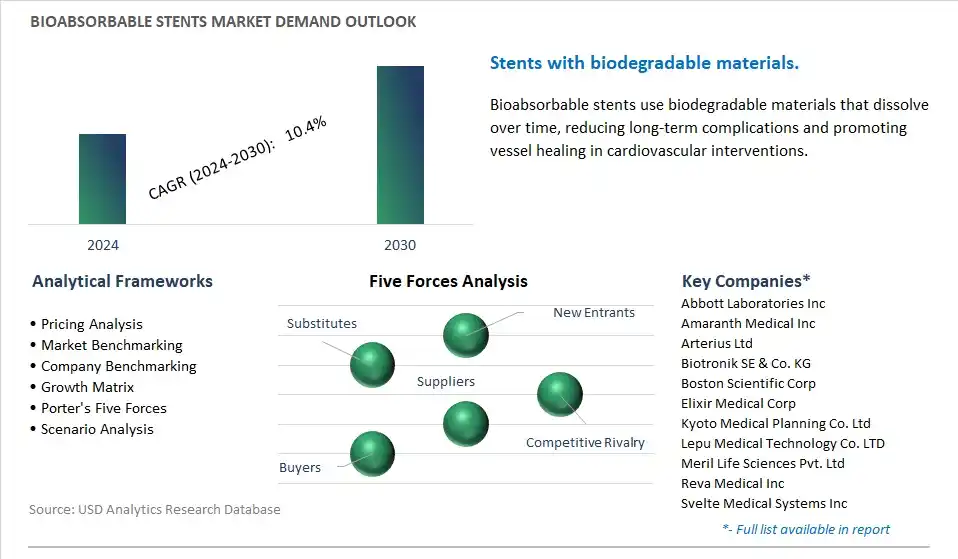
The global Bioabsorbable Stents Market is one of the lucrative growth markets, poised to register a 10.4% growth (CAGR) between 2024 and 2030.
Emerging Markets across Asia Pacific, Europe, and Americas present robust growth prospects.
Abbott Laboratories Inc, Amaranth Medical Inc, Arterius Ltd, Biotronik SE & Co. KG, Boston Scientific Corp, Elixir Medical Corp, Kyoto Medical Planning Co. Ltd, Lepu Medical Technology Co. LTD, Meril Life Sciences Pvt. Ltd, Reva Medical Inc, Svelte Medical Systems Inc, Terumo Corp
Base Year- 2023; Estimated Year- 2024; Historic Period- 2018-2023; Forecast period- 2024 to 2030; Currency: USD; Volume