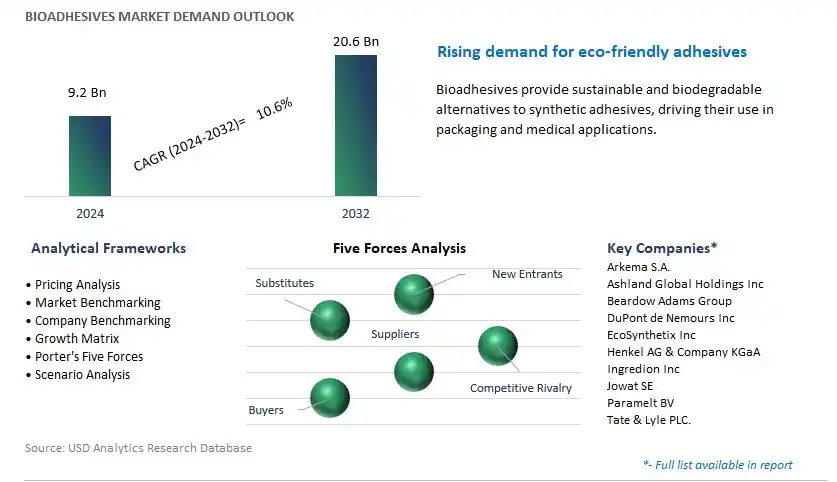
Global Bioadhesives Market Size is valued at $9.2 Billion in 2024 and is forecast to register a growth rate (CAGR) of 10.6% to reach $20.6 Billion by 2032.
The global Bioadhesives Market Study analyzes and forecasts the market size across 6 regions and 24 countries for diverse segments -By Type (Plant based, Animal based), By Application (Paper & Packaging, Construction, Woodworking, Personal Care, Medical, Others).
An Introduction to Bioadhesives Market in 2024
Bioadhesives are adhesives derived from renewable and sustainable sources, such as plant-based polymers, starches, proteins, or natural resins. These adhesives offer environmentally friendly alternatives to petroleum-based adhesives, reducing dependency on fossil fuels and minimizing environmental impact. The market for bioadhesives is driven by the growing demand for eco-friendly and non-toxic bonding solutions in various industries, including packaging, construction, woodworking, and automotive. Bioadhesives can be formulated as water-based dispersions, solvent-based solutions, or hot melt adhesives, offering properties such as strong adhesion, flexibility, and biodegradability. Additionally, bioadhesives can be used in a wide range of applications, including paperboard lamination, wood bonding, packaging assembly, and textile bonding. Further, advancements in bioadhesive formulations, processing technologies, and performance additives are driving innovation and market growth. As sustainability becomes a key focus for consumers and businesses, bioadhesives provide a sustainable solution to reduce environmental impact and promote circularity in adhesive applications.
Bioadhesives Market Competitive Landscape
The market report analyses the leading companies in the industry including Arkema S.A., Ashland Global Holdings Inc, Beardow Adams Group, DuPont de Nemours Inc, EcoSynthetix Inc, Henkel AG & Company KGaA, Ingredion Inc, Jowat SE, Paramelt BV, Tate & Lyle PLC., and others.
Bioadhesives Market Dynamics
Market Trend: Growing Demand for Sustainable Bonding Solutions
A prominent market trend for Bioadhesives is the growing demand for sustainable bonding solutions driven by environmental awareness, regulatory requirements, and consumer preferences for eco-friendly products. Bioadhesives, derived from renewable biomass sources such as plant-based polymers, starches, and proteins, offer a more environmentally friendly alternative to conventional adhesives made from petrochemicals. With increasing concerns about climate change, plastic pollution, and resource depletion, there is a rising interest in bioadhesives that reduce carbon footprint, minimize environmental impact, and support circular economy principles. This trend reflects a broader industry movement towards sustainable manufacturing practices, green chemistry solutions, and corporate sustainability goals, influencing the adoption of bioadhesives across various sectors including packaging, construction, automotive, and woodworking.
Market Driver: Regulatory Support and Sustainability Initiatives
A key market driver for Bioadhesives is the regulatory support and sustainability initiatives provided by governments, industry associations, and corporate entities to promote the use of renewable resources, reduce emissions, and advance the adoption of eco-friendly adhesives. Regulatory frameworks such as VOC (volatile organic compound) regulations, REACH (Registration, Evaluation, Authorization and Restriction of Chemicals) directives, and LEED (Leadership in Energy and Environmental Design) certification requirements incentivize the transition to bioadhesives as they offer lower VOC emissions, reduced toxicity, and improved indoor air quality compared to traditional solvent-based adhesives. Additionally, corporate sustainability commitments, supply chain transparency initiatives, and consumer demand for greener products further drive the adoption of bioadhesives, creating opportunities for market growth and innovation in the global adhesives industry.
Market Opportunity: Expansion into New Applications and Market Segments
An attractive opportunity in the Bioadhesives market lies in the expansion into new applications and market segments beyond traditional uses in packaging and construction. As bioadhesive technology advances and performance improves, there is potential to develop new bio-based adhesive formulations with tailored properties suitable for applications such as automotive assembly, electronics manufacturing, medical devices, and textiles. Opportunities exist to collaborate with end-users, OEMs, and industry partners to co-develop bioadhesive solutions, address unmet needs, and capitalize on emerging trends such as bio-based packaging, electric vehicle manufacturing, and medical device fabrication. By leveraging the advantages of bio-based feedstocks, optimizing adhesive formulations, and demonstrating performance advantages, companies can capture market share, penetrate new markets, and differentiate themselves in the rapidly evolving bioadhesives industry.
Bioadhesives Market Share Analysis: Plant-based segment generated the highest revenue in 2024
Plant-based bioadhesives emerge as the largest segment in the bioadhesives market. Plant-based bioadhesives are derived from renewable plant sources such as starch, cellulose, soy, and lignin, offering advantages such as biodegradability, non-toxicity, and sustainability compared to animal-based alternatives. These bioadhesives find extensive applications in industries such as packaging, construction, woodworking, and papermaking, where they are used as environmentally friendly alternatives to synthetic adhesives derived from petrochemicals. Moreover, increasing environmental awareness and regulations promoting the use of sustainable materials drive the demand for plant-based bioadhesives. Additionally, advancements in bioadhesive technology and formulation techniques further enhance the performance and versatility of plant-based bioadhesives, contributing to their market dominance. With their eco-friendly properties, broad application spectrum, and growing consumer preference for sustainable solutions, plant-based bioadhesives stand as the largest segment within the bioadhesives market.
Bioadhesives Market Share Analysis: Medical is poised to register the fastest CAGR over the forecast period
The medical segment is the fastest-growing segment in the bioadhesives market. Bioadhesives play a crucial role in various medical applications such as wound closure, tissue bonding, and surgical procedures. With the increasing demand for minimally invasive surgeries and advanced wound care solutions, there is a growing preference for bioadhesives over traditional sutures and staples due to their ability to provide strong, flexible, and biocompatible adhesion. Additionally, bioadhesives offer advantages such as reduced scarring, faster healing times, and improved patient comfort. Moreover, the development of bioadhesives derived from natural polymers such as gelatin, chitosan, and fibrinogen further enhances their biocompatibility and tissue adhesion properties, driving their adoption in medical applications. Furthermore, the rising incidence of chronic diseases, surgeries, and traumatic injuries necessitates the use of advanced bioadhesive technologies in wound management and surgical procedures, contributing to the fast growth of the medical segment within the bioadhesives market.
Bioadhesives Market
By Type
Plant based
Animal based
By Application
Paper & Packaging
Construction
Woodworking
Personal Care
Medical
Others
Countries Analyzed
North America (US, Canada, Mexico)
Europe (Germany, UK, France, Spain, Italy, Russia, Rest of Europe)
Asia Pacific (China, India, Japan, South Korea, Australia, South East Asia, Rest of Asia)
South America (Brazil, Argentina, Rest of South America)
Middle East and Africa (Saudi Arabia, UAE, Rest of Middle East, South Africa, Egypt, Rest of Africa)
Bioadhesives Companies Profiled in the Study
Arkema S.A.
Ashland Global Holdings Inc
Beardow Adams Group
DuPont de Nemours Inc
EcoSynthetix Inc
Henkel AG & Company KGaA
Ingredion Inc
Jowat SE
Paramelt BV
Tate & Lyle PLC.
*- List Not Exhaustive
TABLE OF CONTENTS
1 Introduction to 2024 Bioadhesives Market
1.1 Market Overview
1.2 Quick Facts
1.3 Scope/Objective of the Study
1.4 Market Definition
1.5 Countries and Regions Covered
1.6 Units, Currency, and Conversions
1.7 Industry Value Chain
2 Research Methodology
2.1 Market Size Estimation
2.2 Sources and Research Methodology
2.3 Data Triangulation
2.4 Assumptions and Limitations
3 Executive Summary
3.1 Global Bioadhesives Market Size Outlook, $ Million, 2021 to 2032
3.2 Bioadhesives Market Outlook by Type, $ Million, 2021 to 2032
3.3 Bioadhesives Market Outlook by Product, $ Million, 2021 to 2032
3.4 Bioadhesives Market Outlook by Application, $ Million, 2021 to 2032
3.5 Bioadhesives Market Outlook by Key Countries, $ Million, 2021 to 2032
4 Market Dynamics
4.1 Key Driving Forces of Bioadhesives Industry
4.2 Key Market Trends in Bioadhesives Industry
4.3 Potential Opportunities in Bioadhesives Industry
4.4 Key Challenges in Bioadhesives Industry
5 Market Factor Analysis
5.1 Value Chain Analysis
5.2 Competitive Landscape
5.2.1 Global Bioadhesives Market Share by Company (%), 2023
5.2.2 Product Offerings by Company
5.3 Porter’s Five Forces Analysis
5.4 Pricing Analysis and Outlook
6 Growth Outlook Across Scenarios
6.1 Growth Analysis-Case Scenario Definitions
6.2 Low Growth Scenario Forecasts
6.3 Reference Growth Scenario Forecasts
6.4 High Growth Scenario Forecasts
7 Global Bioadhesives Market Outlook by Segments
7.1 Bioadhesives Market Outlook by Segments, $ Million, 2021- 2032
By Type
Plant based
Animal based
By Application
Paper & Packaging
Construction
Woodworking
Personal Care
Medical
Others
8 North America Bioadhesives Market Analysis and Outlook To 2032
8.1 Introduction to North America Bioadhesives Markets in 2024
8.2 North America Bioadhesives Market Size Outlook by Country, 2021-2032
8.2.1 United States
8.2.2 Canada
8.2.3 Mexico
8.3 North America Bioadhesives Market size Outlook by Segments, 2021-2032
By Type
Plant based
Animal based
By Application
Paper & Packaging
Construction
Woodworking
Personal Care
Medical
Others
9 Europe Bioadhesives Market Analysis and Outlook To 2032
9.1 Introduction to Europe Bioadhesives Markets in 2024
9.2 Europe Bioadhesives Market Size Outlook by Country, 2021-2032
9.2.1 Germany
9.2.2 France
9.2.3 Spain
9.2.4 United Kingdom
9.2.4 Italy
9.2.5 Russia
9.2.6 Norway
9.2.7 Rest of Europe
9.3 Europe Bioadhesives Market Size Outlook by Segments, 2021-2032
By Type
Plant based
Animal based
By Application
Paper & Packaging
Construction
Woodworking
Personal Care
Medical
Others
10 Asia Pacific Bioadhesives Market Analysis and Outlook To 2032
10.1 Introduction to Asia Pacific Bioadhesives Markets in 2024
10.2 Asia Pacific Bioadhesives Market Size Outlook by Country, 2021-2032
10.2.1 China
10.2.2 India
10.2.3 Japan
10.2.4 South Korea
10.2.5 Indonesia
10.2.6 Malaysia
10.2.7 Australia
10.2.8 Rest of Asia Pacific
10.3 Asia Pacific Bioadhesives Market size Outlook by Segments, 2021-2032
By Type
Plant based
Animal based
By Application
Paper & Packaging
Construction
Woodworking
Personal Care
Medical
Others
11 South America Bioadhesives Market Analysis and Outlook To 2032
11.1 Introduction to South America Bioadhesives Markets in 2024
11.2 South America Bioadhesives Market Size Outlook by Country, 2021-2032
11.2.1 Brazil
11.2.2 Argentina
11.2.3 Rest of South America
11.3 South America Bioadhesives Market size Outlook by Segments, 2021-2032
By Type
Plant based
Animal based
By Application
Paper & Packaging
Construction
Woodworking
Personal Care
Medical
Others
12 Middle East and Africa Bioadhesives Market Analysis and Outlook To 2032
12.1 Introduction to Middle East and Africa Bioadhesives Markets in 2024
12.2 Middle East and Africa Bioadhesives Market Size Outlook by Country, 2021-2032
12.2.1 Saudi Arabia
12.2.2 UAE
12.2.3 Oman
12.2.4 Rest of Middle East
12.2.5 Egypt
12.2.6 Nigeria
12.2.7 South Africa
12.2.8 Rest of Africa
12.3 Middle East and Africa Bioadhesives Market size Outlook by Segments, 2021-2032
By Type
Plant based
Animal based
By Application
Paper & Packaging
Construction
Woodworking
Personal Care
Medical
Others
13 Company Profiles
13.1 Company Snapshot
13.2 SWOT Profiles
13.3 Products and Services
13.4 Recent Developments
13.5 Financial Profile
Arkema S.A.
Ashland Global Holdings Inc
Beardow Adams Group
DuPont de Nemours Inc
EcoSynthetix Inc
Henkel AG & Company KGaA
Ingredion Inc
Jowat SE
Paramelt BV
Tate & Lyle PLC.
14 Appendix
14.1 Customization Offerings
14.2 Subscription Services
14.3 Related Reports
14.4 Publisher Expertise
By Type
Plant based
Animal based
By Application
Paper & Packaging
Construction
Woodworking
Personal Care
Medical
Others
Countries Analyzed
North America (US, Canada, Mexico)
Europe (Germany, UK, France, Spain, Italy, Russia, Rest of Europe)
Asia Pacific (China, India, Japan, South Korea, Australia, South East Asia, Rest of Asia)
South America (Brazil, Argentina, Rest of South America)
Middle East and Africa (Saudi Arabia, UAE, Rest of Middle East, South Africa, Egypt, Rest of Africa)
