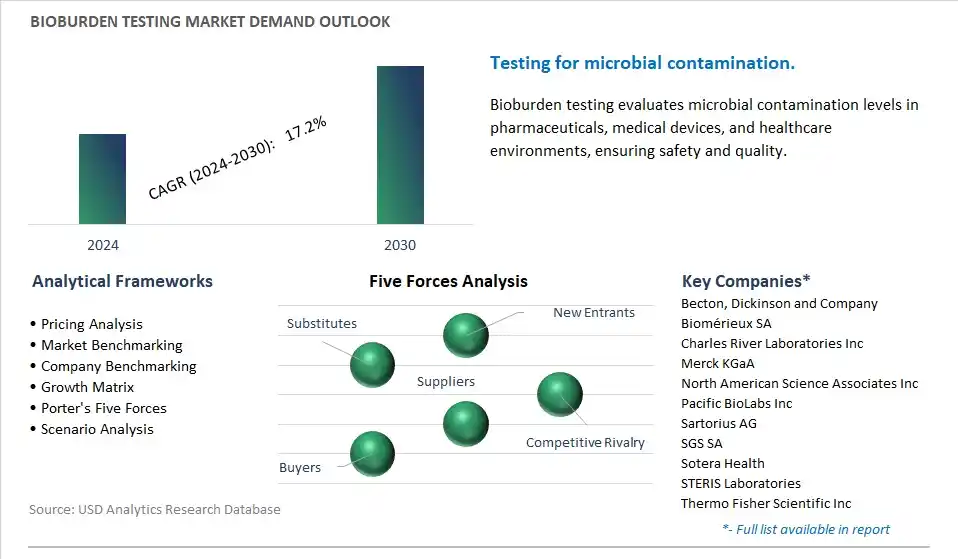
Bioburden Testing Market is estimated to increase at a Compounded Annual Growth Rate of 17.2% CAGR over the forecast period from 2024 to 2030
The Bioburden Testing Market study analyzes and forecasts the market size across 6 regions and 24 countries for diverse segments- By Product (Consumables, Instruments), By Enumeration Method (Membrane Filtration, Plate Count Method, Most Probable Number (MPN), Others), By Application (Raw Material Testing, Medical Devices Testing, In-process Testing, Equipment Cleaning Validation, Others).
An Introduction to Bioburden Testing Market in 2024
Bioburden testing is a crucial quality control measure used in pharmaceutical, medical device, and biotechnology industries to assess the level of microbial contamination on products, equipment, and manufacturing facilities. In 2024, the importance of bioburden testing remains paramount, especially with the increasing emphasis on infection control, patient safety, and regulatory compliance. By quantifying the microbial load present in raw materials, intermediates, and finished products, bioburden testing helps ensure the effectiveness of sterilization processes and the microbiological quality of healthcare products. Moreover, with advancements in rapid microbiological methods, automation, and data analysis software, bioburden testing has become more efficient, accurate, and reliable, allowing manufacturers to detect and mitigate contamination risks more effectively. By safeguarding product quality and patient safety, bioburden testing plays a critical role in preventing product recalls, minimizing the risk of healthcare-associated infections, and maintaining compliance with regulatory requirements, ultimately contributing to the delivery of safe and effective healthcare products to patients worldwide.
Market Trend: Increasing Stringency of Regulatory Standards
A significant trend in the bioburden testing market is the increasing stringency of regulatory standards governing the microbiological quality control of pharmaceuticals, medical devices, and biotechnology products. Regulatory authorities, such as the FDA and EMA, continue to emphasize the importance of ensuring product safety and efficacy through comprehensive bioburden testing protocols. As a result, there is a growing demand for advanced bioburden testing methods and technologies that provide accurate and reliable detection of microbial contamination in manufacturing processes and finished products. This trend towards stricter regulatory standards drives the adoption of validated bioburden testing methodologies and drives market growth as manufacturers seek to comply with regulatory requirements and maintain product quality and safety standards.
Market Driver: Rising Focus on Quality Assurance and Patient Safety
The primary driver fueling the growth of the bioburden testing market is the rising focus on quality assurance and patient safety in the healthcare and pharmaceutical industries. Microbial contamination poses significant risks to patient health and safety, potentially leading to infections, product recalls, and regulatory sanctions. Consequently, there is a heightened awareness among healthcare providers, pharmaceutical manufacturers, and regulatory agencies regarding the importance of implementing robust bioburden testing programs to detect and mitigate microbial risks throughout the product lifecycle. The imperative to ensure product quality and safety drives the demand for bioburden testing services, consumables, and instrumentation, as companies invest in proactive measures to safeguard patient health, maintain regulatory compliance, and protect their brand reputation.
Market Opportunity: Adoption of Rapid Microbiological Methods (RMMs) and Automation
A potential opportunity lies in the adoption of rapid microbiological methods (RMMs) and automation technologies to streamline bioburden testing workflows and improve operational efficiency. Traditional microbiological testing methods, such as plate counting and membrane filtration, are time-consuming, labor-intensive, and prone to variability, leading to delays in product release and increased costs for manufacturers. RMMs, such as polymerase chain reaction (PCR), flow cytometry, and ATP bioluminescence, offer rapid and automated alternatives to traditional culture-based methods, enabling faster detection and enumeration of microbial contaminants in pharmaceutical and healthcare products. Furthermore, the integration of automation technologies, such as robotic sample preparation, liquid handling systems, and data management software, enhances the reproducibility, accuracy, and throughput of bioburden testing workflows, reducing manual intervention and improving laboratory productivity. By embracing RMMs and automation solutions, companies can optimize bioburden testing processes, accelerate time-to-results, and enhance the efficiency of quality control operations, presenting opportunities for growth and innovation in the bioburden testing market.
Bioburden Testing Market Share Analysis: Polymerase Chain Reaction (PCR) Systems is the fastest growing segment over the forecast period to 2030
Among the segments in the Bioburden Testing Market, Polymerase Chain Reaction (PCR) Systems emerge as the fastest-growing, primarily due to their ability to provide rapid and precise microbial detection and enumeration. PCR systems offer advantages such as high sensitivity, specificity, and automation, making them indispensable tools for bioburden testing across various applications including raw material testing, medical devices testing, and equipment cleaning validation. With the increasing emphasis on product quality and safety in industries such as pharmaceuticals, biotechnology, and medical devices, there is a growing demand for efficient and reliable bioburden testing methods. PCR systems fulfill this demand by enabling quick and accurate identification of microorganisms, facilitating timely intervention and ensuring compliance with regulatory standards. As the need for robust microbial monitoring solutions continues to escalate, driven by stringent regulatory requirements and the imperative for contamination control, the PCR Systems segment is poised for sustained growth in the Bioburden Testing Market.
Bioburden Testing Competitive Analysis
The market research study provides in-depth insights into leading companies including the SWOT analyses, product profile, financial details, and recent developments acrossBecton, Dickinson and Company, Biomérieux SA, Charles River Laboratories Inc, Merck KGaA, North American Science Associates Inc, Pacific BioLabs Inc, Sartorius AG, SGS SA, Sotera Health, STERIS Laboratories, Thermo Fisher Scientific Inc, WuXi AppTec Co. Ltd
Bioburden Testing Market Segmentation
By Product
Consumables
-Culture Media and Reagents
-Others
Instrument
-Automated Microbial Identification Systems
-Polymerase Chain Reaction (PCR) Systems
-Microscopes
-Others
By Enumeration Method
Membrane Filtration
Plate Count Method
Most Probable Number (MPN)
Others
By Application
Raw Material Testing
Medical Devices Testing
In-process Testing
Equipment Cleaning Validation
Others
Geographical Analysis
North America (United States, Canada, Mexico)
Europe (Germany, France, United Kingdom, Spain, Italy, Rest of Europe)
Asia Pacific (China, India, Japan, South Korea, Rest of Asia Pacific)
South America (Brazil, Argentina, Rest of South America)
Middle East and Africa (Saudi Arabia, UAE, Rest of Middle East, South Africa, Egypt, Rest of Africa)
Bioburden Testing Market Companies
Becton, Dickinson and Company
Biomérieux SA
Charles River Laboratories Inc
Merck KGaA
North American Science Associates Inc
Pacific BioLabs Inc
Sartorius AG
SGS SA
Sotera Health
STERIS Laboratories
Thermo Fisher Scientific Inc
WuXi AppTec Co. Ltd
Reasons to Buy the Bioburden Testing Market Study
• Deepen your industry insights and navigate uncertainties for strategy formulation, CAPEX, and Operational decisions
• Gain access to detailed insights on the Bioburden Testing Market, encompassing current market size, growth trends, and forecasts till 2030.
• Access detailed competitor analysis, enabling competitive advantage through a thorough understanding of market players, strategies, and potential differentiation opportunities
• Stay ahead of the curve with insights on technological advancements, innovations, and upcoming trends
• Identify lucrative investment avenues and expansion opportunities within the Bioburden Testing Market industry, guided by robust, data-backed analysis.
• Understand regional and global markets through country-wise analysis, regional market potential, regulatory nuances, and dynamics
• Execute strategies with confidence and speed through information, analytics, and insights on the industry value chain
• Corporate leaders, strategists, financial experts, shareholders, asset managers, and governmental representatives can make long-term planning scenarios and build an integrated and timely understanding of market dynamics
• Benefit from tailored solutions and expert consultation based on report insights, providing personalized strategies aligned with specific business needs.
TABLE OF CONTENTS
1 Introduction to 2024 Bioburden Testing Market
1.1 Market Overview
1.2 Quick Facts
1.3 Scope/Objective of the Study
1.4 Market Definition
1.5 Countries and Regions Covered
1.6 Units, Currency, and Conversions
1.7 Industry Value Chain
2 Research Methodology
2.1 Market Size Estimation
2.2 Sources and Research Methodology
2.3 Data Triangulation
2.4 Assumptions and Limitations
3 Executive Summary
3.1 Global Bioburden Testing Market Size Outlook, $ Million, 2021 to 2030
3.2 Bioburden Testing Market Outlook by Type, $ Million, 2021 to 2030
3.3 Bioburden Testing Market Outlook by Product, $ Million, 2021 to 2030
3.4 Bioburden Testing Market Outlook by Application, $ Million, 2021 to 2030
3.5 Bioburden Testing Market Outlook by Key Countries, $ Million, 2021 to 2030
4 Market Dynamics
4.1 Key Driving Forces of Bioburden Testing Industry
4.2 Key Market Trends in Bioburden Testing Industry
4.3 Potential Opportunities in Bioburden Testing Industry
4.4 Key Challenges in Bioburden Testing Industry
5 Market Factor Analysis
5.1 Value Chain Analysis
5.2 Competitive Landscape
5.2.1 Global Bioburden Testing Market Share by Company (%), 2023
5.2.2 Product Offerings by Company
5.3 Porter’s Five Forces Analysis
5.4 Pricing Analysis and Outlook
6 Growth Outlook Across Scenarios
6.1 Growth Analysis-Case Scenario Definitions
6.2 Low Growth Scenario Forecasts
6.3 Reference Growth Scenario Forecasts
6.4 High Growth Scenario Forecasts
7 Global Bioburden Testing Market Outlook by Segments
7.1 Bioburden Testing Market Outlook by Segments, $ Million, 2021- 2030
By Product
Consumables
-Culture Media and Reagents
-Others
Instrument
-Automated Microbial Identification Systems
-Polymerase Chain Reaction (PCR) Systems
-Microscopes
-Others
By Enumeration Method
Membrane Filtration
Plate Count Method
Most Probable Number (MPN)
Others
By Application
Raw Material Testing
Medical Devices Testing
In-process Testing
Equipment Cleaning Validation
Others
8 North America Bioburden Testing Market Analysis and Outlook To 2030
8.1 Introduction to North America Bioburden Testing Markets in 2024
8.2 North America Bioburden Testing Market Size Outlook by Country, 2021-2030
8.2.1 United States
8.2.2 Canada
8.2.3 Mexico
8.3 North America Bioburden Testing Market size Outlook by Segments, 2021-2030
By Product
Consumables
-Culture Media and Reagents
-Others
Instrument
-Automated Microbial Identification Systems
-Polymerase Chain Reaction (PCR) Systems
-Microscopes
-Others
By Enumeration Method
Membrane Filtration
Plate Count Method
Most Probable Number (MPN)
Others
By Application
Raw Material Testing
Medical Devices Testing
In-process Testing
Equipment Cleaning Validation
Others
9 Europe Bioburden Testing Market Analysis and Outlook To 2030
9.1 Introduction to Europe Bioburden Testing Markets in 2024
9.2 Europe Bioburden Testing Market Size Outlook by Country, 2021-2030
9.2.1 Germany
9.2.2 France
9.2.3 Spain
9.2.4 United Kingdom
9.2.4 Italy
9.2.5 Russia
9.2.6 Norway
9.2.7 Rest of Europe
9.3 Europe Bioburden Testing Market Size Outlook by Segments, 2021-2030
By Product
Consumables
-Culture Media and Reagents
-Others
Instrument
-Automated Microbial Identification Systems
-Polymerase Chain Reaction (PCR) Systems
-Microscopes
-Others
By Enumeration Method
Membrane Filtration
Plate Count Method
Most Probable Number (MPN)
Others
By Application
Raw Material Testing
Medical Devices Testing
In-process Testing
Equipment Cleaning Validation
Others
10 Asia Pacific Bioburden Testing Market Analysis and Outlook To 2030
10.1 Introduction to Asia Pacific Bioburden Testing Markets in 2024
10.2 Asia Pacific Bioburden Testing Market Size Outlook by Country, 2021-2030
10.2.1 China
10.2.2 India
10.2.3 Japan
10.2.4 South Korea
10.2.5 Indonesia
10.2.6 Malaysia
10.2.7 Australia
10.2.8 Rest of Asia Pacific
10.3 Asia Pacific Bioburden Testing Market size Outlook by Segments, 2021-2030
By Product
Consumables
-Culture Media and Reagents
-Others
Instrument
-Automated Microbial Identification Systems
-Polymerase Chain Reaction (PCR) Systems
-Microscopes
-Others
By Enumeration Method
Membrane Filtration
Plate Count Method
Most Probable Number (MPN)
Others
By Application
Raw Material Testing
Medical Devices Testing
In-process Testing
Equipment Cleaning Validation
Others
11 South America Bioburden Testing Market Analysis and Outlook To 2030
11.1 Introduction to South America Bioburden Testing Markets in 2024
11.2 South America Bioburden Testing Market Size Outlook by Country, 2021-2030
11.2.1 Brazil
11.2.2 Argentina
11.2.3 Rest of South America
11.3 South America Bioburden Testing Market size Outlook by Segments, 2021-2030
By Product
Consumables
-Culture Media and Reagents
-Others
Instrument
-Automated Microbial Identification Systems
-Polymerase Chain Reaction (PCR) Systems
-Microscopes
-Others
By Enumeration Method
Membrane Filtration
Plate Count Method
Most Probable Number (MPN)
Others
By Application
Raw Material Testing
Medical Devices Testing
In-process Testing
Equipment Cleaning Validation
Others
12 Middle East and Africa Bioburden Testing Market Analysis and Outlook To 2030
12.1 Introduction to Middle East and Africa Bioburden Testing Markets in 2024
12.2 Middle East and Africa Bioburden Testing Market Size Outlook by Country, 2021-2030
12.2.1 Saudi Arabia
12.2.2 UAE
12.2.3 Oman
12.2.4 Rest of Middle East
12.2.5 Egypt
12.2.6 Nigeria
12.2.7 South Africa
12.2.8 Rest of Africa
12.3 Middle East and Africa Bioburden Testing Market size Outlook by Segments, 2021-2030
By Product
Consumables
-Culture Media and Reagents
-Others
Instrument
-Automated Microbial Identification Systems
-Polymerase Chain Reaction (PCR) Systems
-Microscopes
-Others
By Enumeration Method
Membrane Filtration
Plate Count Method
Most Probable Number (MPN)
Others
By Application
Raw Material Testing
Medical Devices Testing
In-process Testing
Equipment Cleaning Validation
Others
13 Company Profiles
13.1 Company Snapshot
13.2 SWOT Profiles
13.3 Products and Services
13.4 Recent Developments
13.5 Financial Profile
List of Companies
Becton, Dickinson and Company
Biomérieux SA
Charles River Laboratories Inc
Merck KGaA
North American Science Associates Inc
Pacific BioLabs Inc
Sartorius AG
SGS SA
Sotera Health
STERIS Laboratories
Thermo Fisher Scientific Inc
WuXi AppTec Co. Ltd
14 Appendix
14.1 Customization Offerings
14.2 Subscription Services
14.3 Related Reports
14.4 Publisher Expertise
By Product
Consumables
-Culture Media and Reagents
-Others
Instrument
-Automated Microbial Identification Systems
-Polymerase Chain Reaction (PCR) Systems
-Microscopes
-Others
By Enumeration Method
Membrane Filtration
Plate Count Method
Most Probable Number (MPN)
Others
By Application
Raw Material Testing
Medical Devices Testing
In-process Testing
Equipment Cleaning Validation
Others
Countries Analyzed
North America (United States, Canada, Mexico)
Europe (Germany, France, United Kingdom, Spain, Italy, Rest of Europe)
Asia Pacific (China, India, Japan, South Korea, Rest of Asia Pacific)
South America (Brazil, Argentina, Rest of South America)
Middle East and Africa (Saudi Arabia, UAE, Rest of Middle East, South Africa, Egypt, Rest of Africa)
