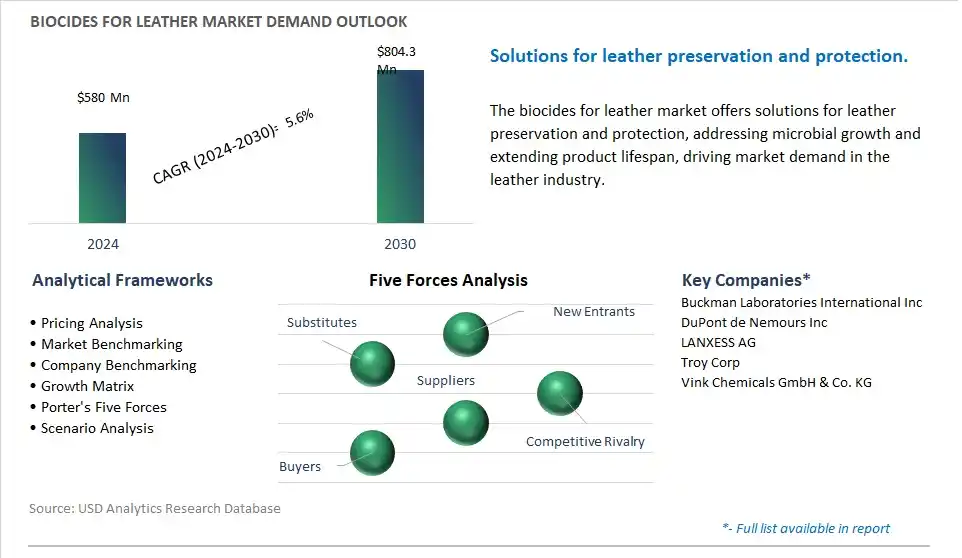
The global Biocides for Leather Market is poised to register a 5.6% CAGR from $580 Million in 2024 to $804.3 Million in 2030.
The global Biocides for Leather Market Study analyzes and forecasts the market size across 6 regions and 24 countries for diverse segments -By Product (Bactericides, Fungicides), By Process (Curing, Tanning & Dyeing, Beamhouse, Finishing).
An Introduction to Global Biocides for Leather Market in 2024
The market for biocides for leather is evolving as industries seek effective antimicrobial solutions while addressing environmental and regulatory concerns associated with biocide usage. Key trends shaping the future of this industry include the development of biocide formulations with enhanced efficacy against microbial contamination, fungal growth, and odor formation in leather products, while minimizing adverse effects on human health and the environment. Additionally, advancements in biocide chemistry, encapsulation techniques, and delivery systems enable the controlled release and targeted action of biocides, optimizing their performance and reducing overall usage levels. Moreover, the adoption of sustainable biocide alternatives, such as natural antimicrobial agents and bio-based preservatives, aligns with industry efforts to minimize environmental footprint and promote eco-friendly leather manufacturing practices. As consumer awareness of environmental and health issues grows, the demand for biocides for leather that strike a balance between performance and sustainability is expected to increase, driving further innovation and market development in this sector.
Biocides for Leather Market Competitive Landscape
The market report analyses the leading companies in the industry including Buckman Laboratories International Inc, DuPont de Nemours Inc, LANXESS AG, Troy Corp, Vink Chemicals GmbH & Co. KG.
Biocides for Leather Market Dynamics
Biocides For Leather Market Trend: Increasing Demand for Sustainable Leather Treatment Solutions
A prominent trend in the market for biocides for leather is the increasing demand for sustainable leather treatment solutions. Leather is a widely used material in fashion, automotive, and furniture industries, but traditional leather treatment processes often involve the use of toxic chemicals and biocides that pose environmental and health risks. With growing awareness of sustainability and environmental concerns, there is a notable shift towards replacing conventional biocides with eco-friendly alternatives in leather manufacturing. Biocides for leather that are derived from natural sources or produced using green chemistry principles offer a sustainable solution with reduced environmental impact and improved safety for workers and consumers. As companies in the leather industry prioritize sustainability and eco-conscious consumers demand greener products, the demand for biocides for leather is expected to rise, driving market growth and innovation in the sector.
Biocides For Leather Market Driver: Stringent Regulations and Consumer Preferences for Eco-Friendly Products
A key driver behind the demand for biocides for leather is stringent regulations and consumer preferences for eco-friendly products. Regulatory agencies worldwide are imposing stricter restrictions on the use of hazardous chemicals and biocides in leather manufacturing to protect human health and the environment. Additionally, consumers are increasingly choosing products that are produced using sustainable and environmentally responsible practices. Leather manufacturers are under pressure to comply with these regulations and meet consumer demand for eco-friendly leather products. Bio-based biocides offer a viable solution to address these challenges by providing effective antimicrobial and preservative properties while meeting regulatory requirements and consumer preferences for sustainability. As regulations become more stringent and consumer awareness grows, the demand for biocides for leather is expected to increase, driving market growth and adoption of sustainable leather treatment solutions.
Biocides For Leather Market Opportunity: Development of Specialty Biocides for High-Value Leather Applications
An emerging opportunity in the market for biocides for leather lies in the development of specialty biocides for high-value leather applications. While bio-based biocides offer environmental benefits, there is potential for growth in catering to the specific needs and requirements of premium leather products. Opportunities exist to develop biocides with tailored properties and functionalities to address the unique challenges associated with luxury leather goods, exotic leathers, and specialty finishes. Specialty biocides can offer enhanced efficacy against microbial growth, mold, and mildew, as well as provide additional benefits such as color retention, UV protection, and water resistance. By collaborating with leather manufacturers and brand owners, suppliers of biocides for leather can capitalize on new opportunities and differentiate their products in the market, driving value-added solutions and revenue growth in the leather industry.
Biocides for Leather Market Share Analysis: Bactericides held the dominant revenue share in 2024
Among the products in the Biocides for Leather Market, the Bactericides segment is the largest, driven by diverse significant factors contributing to its dominance. Bactericides are chemical agents specifically formulated to target and eliminate bacteria, which are known to cause various forms of deterioration and degradation in leather products. The dominance of the Bactericides segment can be attributed to the critical role of bacteria in leather degradation processes, such as discoloration, odor formation, and structural damage. Bacteria thrive in the warm and moist environments commonly found in leather processing and storage facilities, leading to microbial contamination and spoilage of leather goods. Bactericides play a crucial role in preserving the quality and longevity of leather by inhibiting the growth of harmful bacteria and preventing microbial-induced damage. In addition, stringent regulatory requirements and consumer expectations for high-quality and hygienic leather products further drive the demand for bactericides in leather processing and finishing applications. As industries continue to prioritize product quality and consumer safety, the Bactericides segment in the Biocides for Leather Market is expected to maintain its leading position, offering manufacturers and tanneries significant opportunities to ensure the durability and microbial resistance of leather goods.
Biocides for Leather Market Share Analysis: Tanning and Dyeing is the fastest growing market segment over the forecast period to 2030
Among the processes in the Biocides for Leather Market, the Tanning and Dyeing segment is the fastest-growing, driven by diverse key factors contributing to its rapid expansion. Tanning and dyeing processes are essential steps in leather production, involving the treatment of raw hides or skins with chemicals to impart color, texture, and durability. The rapid growth of the Tanning and Dyeing segment can be attributed to the increasing demand for leather products across various industries, including fashion, automotive, and upholstery. As consumer preferences evolve and trends favor eco-friendly and sustainable materials, leather remains a sought-after choice due to its timeless appeal and versatility. However, the tanning and dyeing processes pose significant challenges in terms of microbial contamination and spoilage, leading to quality issues and product defects. Biocides play a crucial role in addressing these challenges by inhibiting the growth of bacteria, fungi, and other microorganisms that can compromise the quality and aesthetics of leather. In addition, stringent regulatory requirements and quality standards in the leather industry drive the adoption of biocides to ensure compliance with hygiene and safety standards. As tanneries and leather manufacturers prioritize product quality and consumer satisfaction, the Tanning and Dyeing segment in the Biocides for Leather Market is expected to experience sustained growth, presenting significant opportunities for biocide suppliers and manufacturers to meet the evolving needs of the leather industry.
Biocides for Leather Market Report Scope-
By Product
Bactericides
Fungicides
By Process
Curing
Tanning & Dyeing
Beamhouse
Finishing
Biocides for Leather Market Companies Profiled
Buckman Laboratories International Inc
DuPont de Nemours Inc
LANXESS AG
Troy Corp
Vink Chemicals GmbH & Co. KG
*- List Not Exhaustive
TABLE OF CONTENTS
1 Introduction to 2024 Biocides for Leather Market
1.1 Market Overview
1.2 Quick Facts
1.3 Scope/Objective of the Study
1.4 Market Definition
1.5 Countries and Regions Covered
1.6 Units, Currency, and Conversions
1.7 Industry Value Chain
2 Research Methodology
2.1 Market Size Estimation
2.2 Sources and Research Methodology
2.3 Data Triangulation
2.4 Assumptions and Limitations
3 Executive Summary
3.1 Global Biocides for Leather Market Size Outlook, $ Million, 2021 to 2030
3.2 Biocides for Leather Market Outlook by Type, $ Million, 2021 to 2030
3.3 Biocides for Leather Market Outlook by Product, $ Million, 2021 to 2030
3.4 Biocides for Leather Market Outlook by Application, $ Million, 2021 to 2030
3.5 Biocides for Leather Market Outlook by Key Countries, $ Million, 2021 to 2030
4 Market Dynamics
4.1 Key Driving Forces of Biocides for Leather Industry
4.2 Key Market Trends in Biocides for Leather Industry
4.3 Potential Opportunities in Biocides for Leather Industry
4.4 Key Challenges in Biocides for Leather Industry
5 Market Factor Analysis
5.1 Value Chain Analysis
5.2 Competitive Landscape
5.2.1 Global Biocides for Leather Market Share by Company (%), 2023
5.2.2 Product Offerings by Company
5.3 Porter’s Five Forces Analysis
5.4 Pricing Analysis and Outlook
6 Growth Outlook Across Scenarios
6.1 Growth Analysis-Case Scenario Definitions
6.2 Low Growth Scenario Forecasts
6.3 Reference Growth Scenario Forecasts
6.4 High Growth Scenario Forecasts
7 Global Biocides for Leather Market Outlook by Segments
7.1 Biocides for Leather Market Outlook by Segments, $ Million, 2021- 2030
By Product
Bactericides
Fungicides
By Process
Curing
Tanning & Dyeing
Beamhouse
Finishing
8 North America Biocides for Leather Market Analysis and Outlook To 2030
8.1 Introduction to North America Biocides for Leather Markets in 2024
8.2 North America Biocides for Leather Market Size Outlook by Country, 2021-2030
8.2.1 United States
8.2.2 Canada
8.2.3 Mexico
8.3 North America Biocides for Leather Market size Outlook by Segments, 2021-2030
By Product
Bactericides
Fungicides
By Process
Curing
Tanning & Dyeing
Beamhouse
Finishing
9 Europe Biocides for Leather Market Analysis and Outlook To 2030
9.1 Introduction to Europe Biocides for Leather Markets in 2024
9.2 Europe Biocides for Leather Market Size Outlook by Country, 2021-2030
9.2.1 Germany
9.2.2 France
9.2.3 Spain
9.2.4 United Kingdom
9.2.4 Italy
9.2.5 Russia
9.2.6 Norway
9.2.7 Rest of Europe
9.3 Europe Biocides for Leather Market Size Outlook by Segments, 2021-2030
By Product
Bactericides
Fungicides
By Process
Curing
Tanning & Dyeing
Beamhouse
Finishing
10 Asia Pacific Biocides for Leather Market Analysis and Outlook To 2030
10.1 Introduction to Asia Pacific Biocides for Leather Markets in 2024
10.2 Asia Pacific Biocides for Leather Market Size Outlook by Country, 2021-2030
10.2.1 China
10.2.2 India
10.2.3 Japan
10.2.4 South Korea
10.2.5 Indonesia
10.2.6 Malaysia
10.2.7 Australia
10.2.8 Rest of Asia Pacific
10.3 Asia Pacific Biocides for Leather Market size Outlook by Segments, 2021-2030
By Product
Bactericides
Fungicides
By Process
Curing
Tanning & Dyeing
Beamhouse
Finishing
11 South America Biocides for Leather Market Analysis and Outlook To 2030
11.1 Introduction to South America Biocides for Leather Markets in 2024
11.2 South America Biocides for Leather Market Size Outlook by Country, 2021-2030
11.2.1 Brazil
11.2.2 Argentina
11.2.3 Rest of South America
11.3 South America Biocides for Leather Market size Outlook by Segments, 2021-2030
By Product
Bactericides
Fungicides
By Process
Curing
Tanning & Dyeing
Beamhouse
Finishing
12 Middle East and Africa Biocides for Leather Market Analysis and Outlook To 2030
12.1 Introduction to Middle East and Africa Biocides for Leather Markets in 2024
12.2 Middle East and Africa Biocides for Leather Market Size Outlook by Country, 2021-2030
12.2.1 Saudi Arabia
12.2.2 UAE
12.2.3 Oman
12.2.4 Rest of Middle East
12.2.5 Egypt
12.2.6 Nigeria
12.2.7 South Africa
12.2.8 Rest of Africa
12.3 Middle East and Africa Biocides for Leather Market size Outlook by Segments, 2021-2030
By Product
Bactericides
Fungicides
By Process
Curing
Tanning & Dyeing
Beamhouse
Finishing
13 Company Profiles
13.1 Company Snapshot
13.2 SWOT Profiles
13.3 Products and Services
13.4 Recent Developments
13.5 Financial Profile
Buckman Laboratories International Inc
DuPont de Nemours Inc
LANXESS AG
Troy Corp
Vink Chemicals GmbH & Co. KG
14 Appendix
14.1 Customization Offerings
14.2 Subscription Services
14.3 Related Reports
14.4 Publisher Expertise
By Product
Bactericides
Fungicides
By Process
Curing
Tanning & Dyeing
Beamhouse
Finishing
Countries Analyzed
North America (US, Canada, Mexico)
Europe (Germany, UK, France, Spain, Italy, Russia, Rest of Europe)
Asia Pacific (China, India, Japan, South Korea, Australia, South East Asia, Rest of Asia)
South America (Brazil, Argentina, Rest of South America)
Middle East and Africa (Saudi Arabia, UAE, Rest of Middle East, South Africa, Egypt, Rest of Africa)
