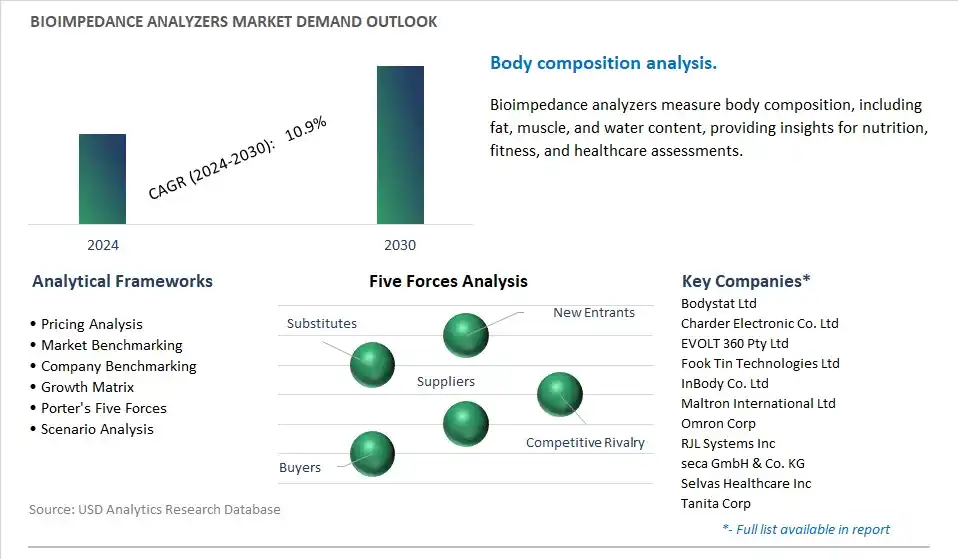
Bioimpedance Analyzers Market is estimated to increase at a Compounded Annual Growth Rate of 10.9% CAGR over the forecast period from 2024 to 2030
The Bioimpedance Analyzers Market study analyzes and forecasts the market size across 6 regions and 24 countries for diverse segments- By Product (Multi-frequency, Single-frequency, Dual-frequency), By Modality (Wired, Wireless), By Usage (Consumer Grade, Professional Grade), By Application (Whole-body Measurement, Segmental Body Measurement), By End-User (Hospitals, Clinics, Fitness Clubs & Wellness Centers, Others).
An Introduction to Bioimpedance Analyzers Market in 2024
Bioimpedance analyzers are non-invasive medical devices that measure the electrical impedance of biological tissues to assess body composition, hydration status, and cellular health. In 2024, bioimpedance analyzers utilize electrodes placed on the body to send low-frequency electrical currents through tissues and measure the impedance or resistance encountered. These measurements are then used to estimate parameters such as fat mass, lean body mass, total body water, and cellular integrity. Bioimpedance analysis has applications in clinical settings for assessing nutritional status, monitoring fluid balance, and evaluating metabolic health. With advancements in sensor technology, signal processing algorithms, and user-friendly interfaces, bioimpedance analyzers offer convenient and reliable tools for healthcare providers, researchers, and fitness professionals to assess and monitor body composition and physiological status. As interest in preventive healthcare and personalized nutrition grows, bioimpedance analyzers play an increasingly important role in promoting wellness, optimizing athletic performance, and managing chronic diseases such as obesity and diabetes.
Market Trend: Integration of Bioimpedance Analysis in Wearable Health Devices
One prominent trend in the bioimpedance analyzers market is the integration of bioimpedance analysis (BIA) technology into wearable health devices. With the increasing popularity of wearable fitness trackers, smartwatches, and health monitoring devices, there is a growing demand for non-invasive and convenient methods to assess body composition, hydration status, and metabolic health. Bioimpedance analyzers offer a portable and user-friendly solution for measuring bioelectrical impedance and deriving various health parameters such as body fat percentage, muscle mass, and fluid balance. The integration of BIA technology into wearable devices enables individuals to track their health metrics in real-time, monitor changes over time, and make informed decisions about diet, exercise, and lifestyle modifications, driving the adoption of bioimpedance analyzers in consumer wellness applications.
Market Driver: Growing Emphasis on Preventive Healthcare and Wellness Monitoring
A significant driver in the bioimpedance analyzers market is the growing emphasis on preventive healthcare and wellness monitoring. With the rising prevalence of chronic diseases, obesity, and lifestyle-related health conditions, there is a shift towards proactive health management strategies that focus on early detection, prevention, and lifestyle interventions. Bioimpedance analyzers play a valuable role in assessing body composition, nutritional status, and hydration levels, providing individuals, healthcare professionals, and fitness enthusiasts with valuable insights into their overall health and well-being. The increasing awareness of the importance of maintaining a healthy lifestyle and the availability of user-friendly bioimpedance analyzers contribute to the market growth, driving the adoption of BIA technology in home healthcare, fitness centers, and wellness clinics.
Market Opportunity: Expansion into Healthcare Monitoring and Clinical Applications
An emerging opportunity in the bioimpedance analyzers market is the expansion into healthcare monitoring and clinical applications. While bioimpedance analysis has primarily been used in fitness and wellness settings, there is potential to leverage BIA technology for medical monitoring and clinical diagnostics. Bioimpedance analyzers can provide valuable information about fluid status, tissue hydration, and nutritional status, making them useful tools for assessing patients' health status, monitoring disease progression, and guiding treatment decisions in various healthcare settings. Opportunities exist to develop specialized bioimpedance analyzers for specific clinical applications such as assessing edema in heart failure patients, monitoring fluid balance in dialysis patients, and evaluating nutritional status in malnourished individuals. By expanding into healthcare monitoring and clinical applications, bioimpedance analyzer manufacturers can tap into new market segments, address unmet clinical needs, and contribute to improved patient care and outcomes.
Bioimpedance Analyzers Market Share Analysis: Wireless Multi-frequency Bioimpedance Analyzers is the fastest growing segment over the forecast period to 2030
Among the segments in the Bioimpedance Analyzers Market, the Wireless Multi-frequency segment is experiencing the fastest growth. This growth can be attributed to several factors driving the demand for wireless multi-frequency bioimpedance analyzers. Firstly, wireless technology eliminates the need for cumbersome cables and allows for greater flexibility and mobility during measurements, making it more convenient for both patients and healthcare professionals. Additionally, multi-frequency bioimpedance analyzers provide more accurate and comprehensive body composition analysis by measuring impedance at multiple frequencies, which enables differentiation between intracellular and extracellular water compartments and improves the assessment of body fat, muscle mass, and hydration status. Furthermore, the increasing emphasis on preventive healthcare and personalized wellness drives the adoption of bioimpedance analyzers in fitness clubs, wellness centers, and home settings, where individuals seek to monitor their body composition and track changes in response to diet and exercise. As technology continues to advance and wireless connectivity becomes ubiquitous, the Wireless Multi-frequency segment is expected to sustain its rapid growth in the Bioimpedance Analyzers Market.
Bioimpedance Analyzers Competitive Analysis
The market research study provides in-depth insights into leading companies including the SWOT analyses, product profile, financial details, and recent developments acrossBodystat Ltd, Charder Electronic Co. Ltd, EVOLT 360 Pty Ltd, Fook Tin Technologies Ltd, InBody Co. Ltd, Maltron International Ltd, Omron Corp, RJL Systems Inc, seca GmbH & Co. KG, Selvas Healthcare Inc, Tanita Corp
Bioimpedance Analyzers Market Segmentation
By Product
Multi-frequency
Single-frequency
Dual-frequency
By Modality
Wired
Wireless
By Usage
Consumer Grade
Professional Grade
By Application
Whole-body Measurement
Segmental Body Measurement
By End-User
Hospitals
Clinics
Fitness Clubs & Wellness Centers
Others
Geographical Analysis
North America (United States, Canada, Mexico)
Europe (Germany, France, United Kingdom, Spain, Italy, Rest of Europe)
Asia Pacific (China, India, Japan, South Korea, Rest of Asia Pacific)
South America (Brazil, Argentina, Rest of South America)
Middle East and Africa (Saudi Arabia, UAE, Rest of Middle East, South Africa, Egypt, Rest of Africa)
Bioimpedance Analyzers Market Companies
Bodystat Ltd
Charder Electronic Co. Ltd
EVOLT 360 Pty Ltd
Fook Tin Technologies Ltd
InBody Co. Ltd
Maltron International Ltd
Omron Corp
RJL Systems Inc
seca GmbH & Co. KG
Selvas Healthcare Inc
Tanita Corp
Reasons to Buy the Bioimpedance Analyzers Market Study
• Deepen your industry insights and navigate uncertainties for strategy formulation, CAPEX, and Operational decisions
• Gain access to detailed insights on the Bioimpedance Analyzers Market, encompassing current market size, growth trends, and forecasts till 2030.
• Access detailed competitor analysis, enabling competitive advantage through a thorough understanding of market players, strategies, and potential differentiation opportunities
• Stay ahead of the curve with insights on technological advancements, innovations, and upcoming trends
• Identify lucrative investment avenues and expansion opportunities within the Bioimpedance Analyzers Market industry, guided by robust, data-backed analysis.
• Understand regional and global markets through country-wise analysis, regional market potential, regulatory nuances, and dynamics
• Execute strategies with confidence and speed through information, analytics, and insights on the industry value chain
• Corporate leaders, strategists, financial experts, shareholders, asset managers, and governmental representatives can make long-term planning scenarios and build an integrated and timely understanding of market dynamics
• Benefit from tailored solutions and expert consultation based on report insights, providing personalized strategies aligned with specific business needs.
TABLE OF CONTENTS
1 Introduction to 2024 Bioimpedance Analyzers Market
1.1 Market Overview
1.2 Quick Facts
1.3 Scope/Objective of the Study
1.4 Market Definition
1.5 Countries and Regions Covered
1.6 Units, Currency, and Conversions
1.7 Industry Value Chain
2 Research Methodology
2.1 Market Size Estimation
2.2 Sources and Research Methodology
2.3 Data Triangulation
2.4 Assumptions and Limitations
3 Executive Summary
3.1 Global Bioimpedance Analyzers Market Size Outlook, $ Million, 2021 to 2030
3.2 Bioimpedance Analyzers Market Outlook by Type, $ Million, 2021 to 2030
3.3 Bioimpedance Analyzers Market Outlook by Product, $ Million, 2021 to 2030
3.4 Bioimpedance Analyzers Market Outlook by Application, $ Million, 2021 to 2030
3.5 Bioimpedance Analyzers Market Outlook by Key Countries, $ Million, 2021 to 2030
4 Market Dynamics
4.1 Key Driving Forces of Bioimpedance Analyzers Industry
4.2 Key Market Trends in Bioimpedance Analyzers Industry
4.3 Potential Opportunities in Bioimpedance Analyzers Industry
4.4 Key Challenges in Bioimpedance Analyzers Industry
5 Market Factor Analysis
5.1 Value Chain Analysis
5.2 Competitive Landscape
5.2.1 Global Bioimpedance Analyzers Market Share by Company (%), 2023
5.2.2 Product Offerings by Company
5.3 Porter’s Five Forces Analysis
5.4 Pricing Analysis and Outlook
6 Growth Outlook Across Scenarios
6.1 Growth Analysis-Case Scenario Definitions
6.2 Low Growth Scenario Forecasts
6.3 Reference Growth Scenario Forecasts
6.4 High Growth Scenario Forecasts
7 Global Bioimpedance Analyzers Market Outlook by Segments
7.1 Bioimpedance Analyzers Market Outlook by Segments, $ Million, 2021- 2030
By Product
Multi-frequency
Single-frequency
Dual-frequency
By Modality
Wired
Wireless
By Usage
Consumer Grade
Professional Grade
By Application
Whole-body Measurement
Segmental Body Measurement
By End-User
Hospitals
Clinics
Fitness Clubs & Wellness Centers
Others
8 North America Bioimpedance Analyzers Market Analysis and Outlook To 2030
8.1 Introduction to North America Bioimpedance Analyzers Markets in 2024
8.2 North America Bioimpedance Analyzers Market Size Outlook by Country, 2021-2030
8.2.1 United States
8.2.2 Canada
8.2.3 Mexico
8.3 North America Bioimpedance Analyzers Market size Outlook by Segments, 2021-2030
By Product
Multi-frequency
Single-frequency
Dual-frequency
By Modality
Wired
Wireless
By Usage
Consumer Grade
Professional Grade
By Application
Whole-body Measurement
Segmental Body Measurement
By End-User
Hospitals
Clinics
Fitness Clubs & Wellness Centers
Others
9 Europe Bioimpedance Analyzers Market Analysis and Outlook To 2030
9.1 Introduction to Europe Bioimpedance Analyzers Markets in 2024
9.2 Europe Bioimpedance Analyzers Market Size Outlook by Country, 2021-2030
9.2.1 Germany
9.2.2 France
9.2.3 Spain
9.2.4 United Kingdom
9.2.4 Italy
9.2.5 Russia
9.2.6 Norway
9.2.7 Rest of Europe
9.3 Europe Bioimpedance Analyzers Market Size Outlook by Segments, 2021-2030
By Product
Multi-frequency
Single-frequency
Dual-frequency
By Modality
Wired
Wireless
By Usage
Consumer Grade
Professional Grade
By Application
Whole-body Measurement
Segmental Body Measurement
By End-User
Hospitals
Clinics
Fitness Clubs & Wellness Centers
Others
10 Asia Pacific Bioimpedance Analyzers Market Analysis and Outlook To 2030
10.1 Introduction to Asia Pacific Bioimpedance Analyzers Markets in 2024
10.2 Asia Pacific Bioimpedance Analyzers Market Size Outlook by Country, 2021-2030
10.2.1 China
10.2.2 India
10.2.3 Japan
10.2.4 South Korea
10.2.5 Indonesia
10.2.6 Malaysia
10.2.7 Australia
10.2.8 Rest of Asia Pacific
10.3 Asia Pacific Bioimpedance Analyzers Market size Outlook by Segments, 2021-2030
By Product
Multi-frequency
Single-frequency
Dual-frequency
By Modality
Wired
Wireless
By Usage
Consumer Grade
Professional Grade
By Application
Whole-body Measurement
Segmental Body Measurement
By End-User
Hospitals
Clinics
Fitness Clubs & Wellness Centers
Others
11 South America Bioimpedance Analyzers Market Analysis and Outlook To 2030
11.1 Introduction to South America Bioimpedance Analyzers Markets in 2024
11.2 South America Bioimpedance Analyzers Market Size Outlook by Country, 2021-2030
11.2.1 Brazil
11.2.2 Argentina
11.2.3 Rest of South America
11.3 South America Bioimpedance Analyzers Market size Outlook by Segments, 2021-2030
By Product
Multi-frequency
Single-frequency
Dual-frequency
By Modality
Wired
Wireless
By Usage
Consumer Grade
Professional Grade
By Application
Whole-body Measurement
Segmental Body Measurement
By End-User
Hospitals
Clinics
Fitness Clubs & Wellness Centers
Others
12 Middle East and Africa Bioimpedance Analyzers Market Analysis and Outlook To 2030
12.1 Introduction to Middle East and Africa Bioimpedance Analyzers Markets in 2024
12.2 Middle East and Africa Bioimpedance Analyzers Market Size Outlook by Country, 2021-2030
12.2.1 Saudi Arabia
12.2.2 UAE
12.2.3 Oman
12.2.4 Rest of Middle East
12.2.5 Egypt
12.2.6 Nigeria
12.2.7 South Africa
12.2.8 Rest of Africa
12.3 Middle East and Africa Bioimpedance Analyzers Market size Outlook by Segments, 2021-2030
By Product
Multi-frequency
Single-frequency
Dual-frequency
By Modality
Wired
Wireless
By Usage
Consumer Grade
Professional Grade
By Application
Whole-body Measurement
Segmental Body Measurement
By End-User
Hospitals
Clinics
Fitness Clubs & Wellness Centers
Others
13 Company Profiles
13.1 Company Snapshot
13.2 SWOT Profiles
13.3 Products and Services
13.4 Recent Developments
13.5 Financial Profile
List of Companies
Bodystat Ltd
Charder Electronic Co. Ltd
EVOLT 360 Pty Ltd
Fook Tin Technologies Ltd
InBody Co. Ltd
Maltron International Ltd
Omron Corp
RJL Systems Inc
seca GmbH & Co. KG
Selvas Healthcare Inc
Tanita Corp
14 Appendix
14.1 Customization Offerings
14.2 Subscription Services
14.3 Related Reports
14.4 Publisher Expertise
By Product
Multi-frequency
Single-frequency
Dual-frequency
By Modality
Wired
Wireless
By Usage
Consumer Grade
Professional Grade
By Application
Whole-body Measurement
Segmental Body Measurement
By End-User
Hospitals
Clinics
Fitness Clubs & Wellness Centers
Others
Countries Analyzed
North America (United States, Canada, Mexico)
Europe (Germany, France, United Kingdom, Spain, Italy, Rest of Europe)
Asia Pacific (China, India, Japan, South Korea, Rest of Asia Pacific)
South America (Brazil, Argentina, Rest of South America)
Middle East and Africa (Saudi Arabia, UAE, Rest of Middle East, South Africa, Egypt, Rest of Africa)
