
The Biological Implants Market study analyzes and forecasts the market size across 6 regions and 24 countries for diverse segments including By Product (Autografts, Allografts, Xenografts), By Application (Cardiovascular Implants, Orthopedic Implants, Others), By Mode of Administration (Surgical, Injectable).
The Biological Implants market in 2024 is characterized by a paradigm shift towards regenerative medicine approaches, fostering the development of innovative biological scaffolds, tissue-engineered constructs, and cell-based therapies for tissue repair and organ replacement. Biological implants hold immense potential in orthopedics, cardiology, and reconstructive surgery, offering enhanced biocompatibility, integration, and functional restoration compared to traditional prosthetic devices. Advances in biomaterials science, 3D bioprinting technologies, and stem cell research drive the evolution of biological implants, addressing unmet clinical needs and expanding treatment options for patients. Regulatory agencies emphasize safety, efficacy, and quality standards to ensure the clinical translation of novel biological implants, fostering collaboration between academia, industry, and healthcare stakeholders to accelerate innovation and improve patient outcomes.
A prominent trend in the Biological Implants market is the increasing demand for biocompatible and biodegradable implants. As patients seek safer and more sustainable treatment options, there is growing interest in biological implants that mimic the natural properties of human tissues and organs. Biocompatible implants reduce the risk of adverse reactions and implant rejection, while biodegradable implants offer the advantage of gradual degradation and integration with surrounding tissues, eliminating the need for implant removal surgeries. This trend is driving innovation in biomaterials and tissue engineering techniques, leading to the development of advanced biological implants with enhanced biocompatibility, durability, and regenerative capabilities.
The primary driver for the Biological Implants market is the aging population and the rising prevalence of chronic diseases. With the global population aging rapidly and the burden of chronic conditions such as osteoarthritis, cardiovascular diseases, and diabetes increasing, there is a growing need for effective treatment options to improve patient outcomes and quality of life. Biological implants, including tissue-engineered constructs, organoids, and regenerative implants, offer promising solutions for restoring tissue function and addressing age-related degenerative conditions. The demographic shift towards an older population, coupled with the escalating incidence of chronic diseases, is fueling the demand for biological implants as a means to alleviate symptoms, restore mobility, and enhance overall health and well-being.
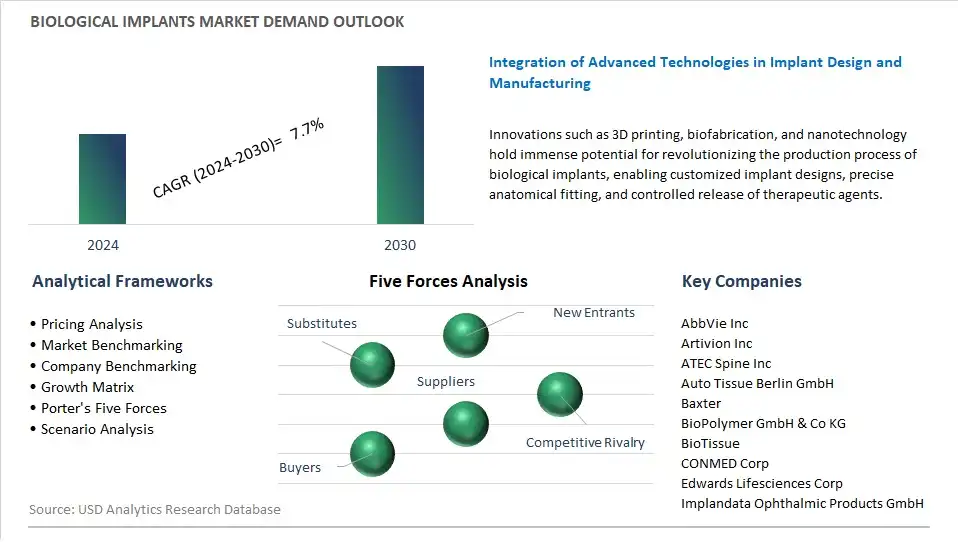
An opportunity in the Biological Implants market lies in the integration of advanced technologies in implant design and manufacturing. Innovations such as 3D printing, biofabrication, and nanotechnology hold immense potential for revolutionizing the production process of biological implants, enabling customized implant designs, precise anatomical fitting, and controlled release of therapeutic agents. By leveraging these technologies, manufacturers can optimize implant performance, enhance patient outcomes, and streamline the production workflow, leading to increased efficiency and cost-effectiveness. Additionally, the incorporation of smart biomaterials and bioactive coatings into biological implants can impart unique functionalities such as drug delivery, antimicrobial properties, and real-time monitoring capabilities, further expanding the application scope of biological implants in regenerative medicine, orthopedics, and tissue repair. Investing in research and development efforts to harness the full potential of advanced technologies presents a strategic opportunity for stakeholders in the Biological Implants market to gain a competitive edge and address evolving clinical needs.
By Product
Autografts
Allografts
Xenografts
By Application
Cardiovascular Implants
Orthopedic Implants
Others
By Mode of Administration
Surgical
Injectable
Geographical Analysis
North America (United States, Canada, Mexico)
Europe (Germany, France, United Kingdom, Spain, Italy, Rest of Europe)
Asia Pacific (China, India, Japan, South Korea, Rest of Asia Pacific)
South America (Brazil, Argentina, Rest of South America)
Middle East and Africa (Saudi Arabia, UAE, Rest of Middle East, South Africa, Egypt, Rest of Africa)
AbbVie Inc
Artivion Inc
ATEC Spine Inc
Auto Tissue Berlin GmbH
Baxter
BioPolymer GmbH & Co KG
BioTissue
CONMED Corp
Edwards Lifesciences Corp
Implandata Ophthalmic Products GmbH
Integra LifeSciences
Johnson & Johnson Private Ltd
LifeCell International Pvt. Ltd
Maxigen Biotech Inc
Medtronic
MIMEDX Group Inc
NuVasive Inc
Organogenesis Inc
Osteotec Ltd
RTI Surgical
Smith+Nephew
Stryker
Vericel
• Deepen your industry insights and navigate uncertainties for strategy formulation, CAPEX, and Operational decisions
• Gain access to detailed insights on the Biological Implants Market, encompassing current market size, growth trends, and forecasts till 2030.
• Access detailed competitor analysis, enabling competitive advantage through a thorough understanding of market players, strategies, and potential differentiation opportunities
• Stay ahead of the curve with insights on technological advancements, innovations, and upcoming trends
• Identify lucrative investment avenues and expansion opportunities within the Biological Implants Market industry, guided by robust, data-backed analysis.
• Understand regional and global markets through country-wise analysis, regional market potential, regulatory nuances, and dynamics
• Execute strategies with confidence and speed through information, analytics, and insights on the industry value chain
• Corporate leaders, strategists, financial experts, shareholders, asset managers, and governmental representatives can make long-term planning scenarios and build an integrated and timely understanding of market dynamics
• Benefit from tailored solutions and expert consultation based on report insights, providing personalized strategies aligned with specific business needs.
TABLE OF CONTENTS
1 Introduction to 2024 Biological Implants Market
1.1 Market Overview
1.2 Quick Facts
1.3 Scope/Objective of the Study
1.4 Market Definition
1.5 Countries and Regions Analyzed
1.6 Units, Currency, and Conversions
1.7 Industry Value Chain
2 Research Methodology
2.1 Market Size Estimation
2.2 Sources and Research Methodology
2.3 Data Triangulation
2.4 Assumptions and Limitations
3 Executive Summary
3.1 Global Biological Implants Market Size Outlook, $ Million, 2021 to 2030
3.2 Biological Implants Market Outlook by Type, $ Million, 2021 to 2030
3.3 Biological Implants Market Outlook by Product, $ Million, 2021 to 2030
3.4 Biological Implants Market Outlook by Application, $ Million, 2021 to 2030
3.5 Biological Implants Market Outlook by Key Countries, $ Million, 2021 to 2030
4 Market Dynamics
4.1 Key Driving Forces of Biological Implants Market Industry
4.2 Key Market Trends in Biological Implants Market Industry
4.3 Potential Opportunities in Biological Implants Market Industry
4.4 Key Challenges in Biological Implants Market Industry
5 Market Factor Analysis
5.1 Competitive Landscape
5.1.1 Global Biological Implants Market Share by Company (%), 2023
5.1.2 Product Offerings by Company
5.2 Porter’s Five Forces Analysis
6 Growth Outlook Across Scenarios
6.1 Growth Analysis-Case Scenario Definitions
6.2 Low Growth Scenario Forecasts
6.3 Reference Growth Scenario Forecasts
6.4 High Growth Scenario Forecasts
7 Global Biological Implants Market Outlook By Segments
7.1 Biological Implants Market Outlook by Segments
By Product
Autografts
Allografts
Xenografts
By Application
Cardiovascular Implants
Orthopedic Implants
Others
By Mode of Administration
Surgical
Injectable
8 North America Biological Implants Market Analysis And Outlook To 2030
8.1 Introduction to North America Biological Implants Markets in 2024
8.2 North America Biological Implants Market Size Outlook by Country, 2021-2030
8.2.1 United States
8.2.2 Canada
8.2.3 Mexico
8.3 North America Biological Implants Market size Outlook by Segments, 2021-2030
By Product
Autografts
Allografts
Xenografts
By Application
Cardiovascular Implants
Orthopedic Implants
Others
By Mode of Administration
Surgical
Injectable
9 Europe Biological Implants Market Analysis And Outlook To 2030
9.1 Introduction to Europe Biological Implants Markets in 2024
9.2 Europe Biological Implants Market Size Outlook by Country, 2021-2030
9.2.1 Germany
9.2.2 France
9.2.3 Spain
9.2.4 United Kingdom
9.2.4 Italy
9.2.5 Russia
9.2.6 Norway
9.2.7 Rest of Europe
9.3 Europe Biological Implants Market Size Outlook By Segments, 2021-2030
By Product
Autografts
Allografts
Xenografts
By Application
Cardiovascular Implants
Orthopedic Implants
Others
By Mode of Administration
Surgical
Injectable
10 Asia Pacific Biological Implants Market Analysis And Outlook To 2030
10.1 Introduction to Asia Pacific Biological Implants Markets in 2024
10.2 Asia Pacific Biological Implants Market Size Outlook by Country, 2021-2030
10.2.1 China
10.2.2 India
10.2.3 Japan
10.2.4 South Korea
10.2.5 Indonesia
10.2.6 Malaysia
10.2.7 Australia
10.2.8 Rest of Asia Pacific
10.3 Asia Pacific Biological Implants Market size Outlook by Segments, 2021-2030
By Product
Autografts
Allografts
Xenografts
By Application
Cardiovascular Implants
Orthopedic Implants
Others
By Mode of Administration
Surgical
Injectable
11 South America Biological Implants Market Analysis And Outlook To 2030
11.1 Introduction to South America Biological Implants Markets in 2024
11.2 South America Biological Implants Market Size Outlook by Country, 2021-2030
11.2.1 Brazil
11.2.2 Argentina
11.2.3 Rest of South America
11.3 South America Biological Implants Market size Outlook by Segments, 2021-2030
By Product
Autografts
Allografts
Xenografts
By Application
Cardiovascular Implants
Orthopedic Implants
Others
By Mode of Administration
Surgical
Injectable
12 Middle East And Africa Biological Implants Market Analysis And Outlook To 2030
12.1 Introduction to Middle East and Africa Biological Implants Markets in 2024
12.2 Middle East and Africa Biological Implants Market Size Outlook by Country, 2021-2030
12.2.1 Saudi Arabia
12.2.2 UAE
12.2.3 Oman
12.2.4 Rest of Middle East
12.2.5 Egypt
12.2.6 Nigeria
12.2.7 South Africa
12.2.8 Rest of Africa
12.3 Middle East and Africa Biological Implants Market size Outlook by Segments, 2021-2030
By Product
Autografts
Allografts
Xenografts
By Application
Cardiovascular Implants
Orthopedic Implants
Others
By Mode of Administration
Surgical
Injectable
13 Company Profiles
13.1 Company Snapshot
13.2 SWOT Profiles
13.3 Products and Services
13.4 Recent Developments
13.5 Financial Profile
List of Companies
AbbVie Inc
Artivion Inc
ATEC Spine Inc
Auto Tissue Berlin GmbH
Baxter
BioPolymer GmbH & Co KG
BioTissue
CONMED Corp
Edwards Lifesciences Corp
Implandata Ophthalmic Products GmbH
Integra LifeSciences
Johnson & Johnson Private Ltd
LifeCell International Pvt. Ltd
Maxigen Biotech Inc
Medtronic
MIMEDX Group Inc
NuVasive Inc
Organogenesis Inc
Osteotec Ltd
RTI Surgical
Smith+Nephew
Stryker
Vericel
14 Appendix
14.1 Customization Offerings
14.2 Subscription Services
14.3 Related Reports
14.4 Publisher Expertise
By Product
Autografts
Allografts
Xenografts
By Application
Cardiovascular Implants
Orthopedic Implants
Others
By Mode of Administration
Surgical
Injectable
The global Biological Implants Market is one of the lucrative growth markets, poised to register a 7.7% growth (CAGR) between 2024 and 2032.
Emerging Markets across Asia Pacific, Europe, and Americas present robust growth prospects.
AbbVie Inc, Artivion Inc, ATEC Spine Inc, Auto Tissue Berlin GmbH, Baxter, BioPolymer GmbH & Co KG, BioTissue, CONMED Corp, Edwards Lifesciences Corp, Implandata Ophthalmic Products GmbH, Integra LifeSciences, Johnson & Johnson Private Ltd, LifeCell International Pvt. Ltd, Maxigen Biotech Inc, Medtronic, MIMEDX Group Inc, NuVasive Inc, Organogenesis Inc, Osteotec Ltd, RTI Surgical, Smith+Nephew, Stryker, Vericel
Base Year- 2023; Estimated Year- 2024; Historic Period- 2018-2023; Forecast period- 2024 to 2030; Currency: USD; Volume