Biosimilar Monoclonal Antibodies Market is estimated to increase at a growth rate of 21.5% CAGR over the forecast period from 2024 to 2030.
The Biosimilar Monoclonal Antibodies Market study analyzes and forecasts the market size across 6 regions and 24 countries for diverse segments including By Product (Infliximab, Rituximab, Abciximab, Trastuzumab, Adalimumab, Bevacizumab, Others), By Application (Oncology, Chronic & Autoimmune Diseases, Others).
An Introduction to Biosimilar Monoclonal Antibodies Market in 2024
The Biosimilar Monoclonal Antibodies market in 2024 experiences rapid growth driven by the increasing demand for cost-effective biologic therapies and the expiry of patents for blockbuster monoclonal antibodies. Biosimilars, bioequivalent versions of originator biologics, offer comparable safety, efficacy, and quality at lower costs, addressing unmet medical needs and expanding patient access to life-saving treatments. Regulatory pathways for biosimilar approval mature, providing clarity and incentives for manufacturers to invest in biosimilar development. Market competition intensifies as pharmaceutical companies race to introduce biosimilar versions of high-value monoclonal antibodies used in oncology, autoimmune diseases, and inflammatory disorders. Strategic partnerships, market consolidation, and pricing strategies shape the competitive landscape, driving innovation and affordability in the biosimilar monoclonal antibodies market.
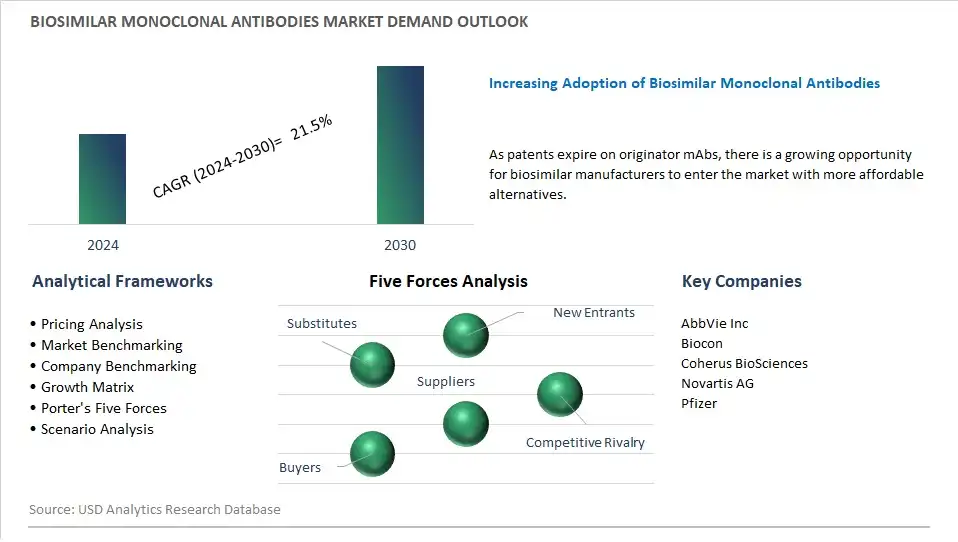
Biosimilar Monoclonal Antibodies Market Trend: Increasing Adoption of Biosimilar Monoclonal Antibodies
A prominent trend in the Biosimilar Monoclonal Antibodies market is the increasing adoption of biosimilar versions of monoclonal antibodies (mAbs) for the treatment of various diseases. As patents expire on originator mAbs, there is a growing opportunity for biosimilar manufacturers to enter the market with more affordable alternatives. Healthcare systems and payers are increasingly incentivizing the use of biosimilars to reduce healthcare costs while maintaining treatment efficacy, driving the uptake of biosimilar mAbs across different therapeutic areas.
Biosimilar Monoclonal Antibodies Market Driver: Expanding Pipeline of Biologic Drugs and Expiring Patents
The primary driver for the Biosimilar Monoclonal Antibodies market is the expanding pipeline of biologic drugs and the expiration of patents for originator mAbs. As biologic drugs, including mAbs, continue to gain importance in the treatment of various diseases such as cancer, autoimmune disorders, and inflammatory conditions, the demand for biosimilar versions is increasing. Additionally, as patents for blockbuster mAbs reach their expiration dates, biosimilar manufacturers have the opportunity to enter the market and offer more cost-effective alternatives, driving market growth.
Biosimilar Monoclonal Antibodies Market Opportunity: Therapeutic Expansion and Market Access
An opportunity in the Biosimilar Monoclonal Antibodies market lies in therapeutic expansion and market access. While biosimilar adoption has been significant in certain therapeutic areas such as oncology and autoimmune diseases, there is potential for expansion into other therapeutic areas where mAbs play a crucial role in treatment. By developing biosimilar versions of mAbs used in niche or underserved therapeutic areas, manufacturers can address unmet medical needs and capture additional market share. Furthermore, focusing on strategies to improve market access, including pricing strategies, reimbursement agreements, and regulatory pathways, can facilitate broader adoption of biosimilar mAbs and enhance market penetration.
Biosimilar Monoclonal Antibodies Market Segmentation
By Product
Infliximab
Rituximab
Abciximab
Trastuzumab
Adalimumab
Bevacizumab
Others
By Application
Oncology
Chronic & Autoimmune Diseases
Others
Geographical Analysis
North America (United States, Canada, Mexico)
Europe (Germany, France, United Kingdom, Spain, Italy, Rest of Europe)
Asia Pacific (China, India, Japan, South Korea, Rest of Asia Pacific)
South America (Brazil, Argentina, Rest of South America)
Middle East and Africa (Saudi Arabia, UAE, Rest of Middle East, South Africa, Egypt, Rest of Africa)
Biosimilar Monoclonal Antibodies Market Companies
AbbVie Inc
Biocon
Coherus BioSciences
Novartis AG
Pfizer
Reasons to Buy the Biosimilar Monoclonal Antibodies Market Study
• Deepen your industry insights and navigate uncertainties for strategy formulation, CAPEX, and Operational decisions
• Gain access to detailed insights on the Biosimilar Monoclonal Antibodies Market, encompassing current market size, growth trends, and forecasts till 2030.
• Access detailed competitor analysis, enabling competitive advantage through a thorough understanding of market players, strategies, and potential differentiation opportunities
• Stay ahead of the curve with insights on technological advancements, innovations, and upcoming trends
• Identify lucrative investment avenues and expansion opportunities within the Biosimilar Monoclonal Antibodies Market industry, guided by robust, data-backed analysis.
• Understand regional and global markets through country-wise analysis, regional market potential, regulatory nuances, and dynamics
• Execute strategies with confidence and speed through information, analytics, and insights on the industry value chain
• Corporate leaders, strategists, financial experts, shareholders, asset managers, and governmental representatives can make long-term planning scenarios and build an integrated and timely understanding of market dynamics
• Benefit from tailored solutions and expert consultation based on report insights, providing personalized strategies aligned with specific business needs.
TABLE OF CONTENTS
1 Introduction to 2024 Biosimilar Monoclonal Antibodies Market
1.1 Market Overview
1.2 Quick Facts
1.3 Scope/Objective of the Study
1.4 Market Definition
1.5 Countries and Regions Analyzed
1.6 Units, Currency, and Conversions
1.7 Industry Value Chain
2 Research Methodology
2.1 Market Size Estimation
2.2 Sources and Research Methodology
2.3 Data Triangulation
2.4 Assumptions and Limitations
3 Executive Summary
3.1 Global Biosimilar Monoclonal Antibodies Market Size Outlook, $ Million, 2021 to 2030
3.2 Biosimilar Monoclonal Antibodies Market Outlook by Type, $ Million, 2021 to 2030
3.3 Biosimilar Monoclonal Antibodies Market Outlook by Product, $ Million, 2021 to 2030
3.4 Biosimilar Monoclonal Antibodies Market Outlook by Application, $ Million, 2021 to 2030
3.5 Biosimilar Monoclonal Antibodies Market Outlook by Key Countries, $ Million, 2021 to 2030
4 Market Dynamics
4.1 Key Driving Forces of Biosimilar Monoclonal Antibodies Market Industry
4.2 Key Market Trends in Biosimilar Monoclonal Antibodies Market Industry
4.3 Potential Opportunities in Biosimilar Monoclonal Antibodies Market Industry
4.4 Key Challenges in Biosimilar Monoclonal Antibodies Market Industry
5 Market Factor Analysis
5.1 Competitive Landscape
5.1.1 Global Biosimilar Monoclonal Antibodies Market Share by Company (%), 2023
5.1.2 Product Offerings by Company
5.2 Porter’s Five Forces Analysis
6 Growth Outlook Across Scenarios
6.1 Growth Analysis-Case Scenario Definitions
6.2 Low Growth Scenario Forecasts
6.3 Reference Growth Scenario Forecasts
6.4 High Growth Scenario Forecasts
7 Global Biosimilar Monoclonal Antibodies Market Outlook By Segments
7.1 Biosimilar Monoclonal Antibodies Market Outlook by Segments
By Product
Infliximab
Rituximab
Abciximab
Trastuzumab
Adalimumab
Bevacizumab
Others
By Application
Oncology
Chronic & Autoimmune Diseases
Others
8 North America Biosimilar Monoclonal Antibodies Market Analysis And Outlook To 2030
8.1 Introduction to North America Biosimilar Monoclonal Antibodies Markets in 2024
8.2 North America Biosimilar Monoclonal Antibodies Market Size Outlook by Country, 2021-2030
8.2.1 United States
8.2.2 Canada
8.2.3 Mexico
8.3 North America Biosimilar Monoclonal Antibodies Market size Outlook by Segments, 2021-2030
By Product
Infliximab
Rituximab
Abciximab
Trastuzumab
Adalimumab
Bevacizumab
Others
By Application
Oncology
Chronic & Autoimmune Diseases
Others
9 Europe Biosimilar Monoclonal Antibodies Market Analysis And Outlook To 2030
9.1 Introduction to Europe Biosimilar Monoclonal Antibodies Markets in 2024
9.2 Europe Biosimilar Monoclonal Antibodies Market Size Outlook by Country, 2021-2030
9.2.1 Germany
9.2.2 France
9.2.3 Spain
9.2.4 United Kingdom
9.2.4 Italy
9.2.5 Russia
9.2.6 Norway
9.2.7 Rest of Europe
9.3 Europe Biosimilar Monoclonal Antibodies Market Size Outlook By Segments, 2021-2030
By Product
Infliximab
Rituximab
Abciximab
Trastuzumab
Adalimumab
Bevacizumab
Others
By Application
Oncology
Chronic & Autoimmune Diseases
Others
10 Asia Pacific Biosimilar Monoclonal Antibodies Market Analysis And Outlook To 2030
10.1 Introduction to Asia Pacific Biosimilar Monoclonal Antibodies Markets in 2024
10.2 Asia Pacific Biosimilar Monoclonal Antibodies Market Size Outlook by Country, 2021-2030
10.2.1 China
10.2.2 India
10.2.3 Japan
10.2.4 South Korea
10.2.5 Indonesia
10.2.6 Malaysia
10.2.7 Australia
10.2.8 Rest of Asia Pacific
10.3 Asia Pacific Biosimilar Monoclonal Antibodies Market size Outlook by Segments, 2021-2030
By Product
Infliximab
Rituximab
Abciximab
Trastuzumab
Adalimumab
Bevacizumab
Others
By Application
Oncology
Chronic & Autoimmune Diseases
Others
11 South America Biosimilar Monoclonal Antibodies Market Analysis And Outlook To 2030
11.1 Introduction to South America Biosimilar Monoclonal Antibodies Markets in 2024
11.2 South America Biosimilar Monoclonal Antibodies Market Size Outlook by Country, 2021-2030
11.2.1 Brazil
11.2.2 Argentina
11.2.3 Rest of South America
11.3 South America Biosimilar Monoclonal Antibodies Market size Outlook by Segments, 2021-2030
By Product
Infliximab
Rituximab
Abciximab
Trastuzumab
Adalimumab
Bevacizumab
Others
By Application
Oncology
Chronic & Autoimmune Diseases
Others
12 Middle East And Africa Biosimilar Monoclonal Antibodies Market Analysis And Outlook To 2030
12.1 Introduction to Middle East and Africa Biosimilar Monoclonal Antibodies Markets in 2024
12.2 Middle East and Africa Biosimilar Monoclonal Antibodies Market Size Outlook by Country, 2021-2030
12.2.1 Saudi Arabia
12.2.2 UAE
12.2.3 Oman
12.2.4 Rest of Middle East
12.2.5 Egypt
12.2.6 Nigeria
12.2.7 South Africa
12.2.8 Rest of Africa
12.3 Middle East and Africa Biosimilar Monoclonal Antibodies Market size Outlook by Segments, 2021-2030
By Product
Infliximab
Rituximab
Abciximab
Trastuzumab
Adalimumab
Bevacizumab
Others
By Application
Oncology
Chronic & Autoimmune Diseases
Others
13 Company Profiles
13.1 Company Snapshot
13.2 SWOT Profiles
13.3 Products and Services
13.4 Recent Developments
13.5 Financial Profile
List of Companies
AbbVie Inc
Biocon
Coherus BioSciences
Novartis AG
Pfizer
14 Appendix
14.1 Customization Offerings
14.2 Subscription Services
14.3 Related Reports
14.4 Publisher Expertise
By Product
Infliximab
Rituximab
Abciximab
Trastuzumab
Adalimumab
Bevacizumab
Others
By Application
Oncology
Chronic & Autoimmune Diseases
Others
