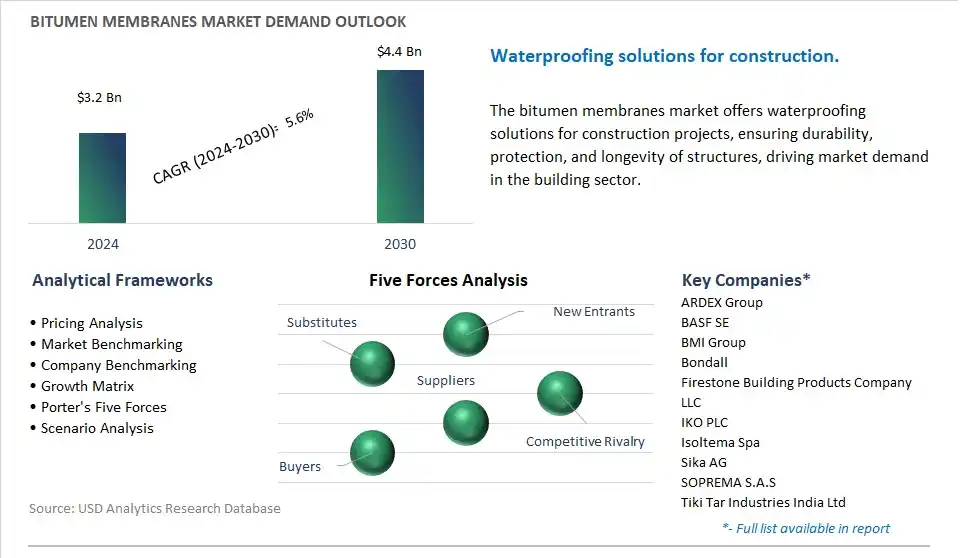
The global Bitumen Membranes Market is poised to register a 5.6% CAGR from $3.2 Billion in 2024 to $4.4 Billion in 2030.
The global Bitumen Membranes Market Study analyzes and forecasts the market size across 6 regions and 24 countries for diverse segments -By Grade (Atactic Polypropylene, Styrene-Butadiene-Styrene, Others), By Product (Sheets, Liquids), By End-User (Construction, Automotive, Others).
An Introduction to Global Bitumen Membranes Market in 2024
The market for bitumen membranes is enhancing durability and waterproofing in construction by offering high-performance materials for various roofing and waterproofing applications. Key trends shaping the future of this industry include the development of bitumen membranes with advanced properties such as UV resistance, flexibility, and tear resistance, ensuring long-lasting protection against water infiltration and weathering. Additionally, advancements in membrane manufacturing technologies, polymer-modified bitumen formulations, and installation techniques enable the production and installation of bitumen membranes that meet the stringent requirements of building codes and construction standards. Moreover, the adoption of sustainable construction practices, energy-efficient building designs, and green building certifications drives market demand for bitumen membranes, fostering innovation and market expansion in this sector. As architects, contractors, and building owners prioritize building durability, energy efficiency, and environmental sustainability, the demand for bitumen membranes is expected to continue growing, driving further innovation and development of advanced waterproofing solutions in the construction industry.
Bitumen Membranes Market Competitive Landscape
The market report analyses the leading companies in the industry including ARDEX Group, BASF SE, BMI Group, Bondall, Firestone Building Products Company LLC, IKO PLC, Isoltema Spa, Sika AG, SOPREMA S.A.S, Tiki Tar Industries India Ltd, Totalenergies.
Bitumen Membranes Market Dynamics
Bitumen Membranes Market Trend: Growing Demand for Waterproofing Solutions in Construction
A prominent trend in the market for bitumen membranes is the growing demand for waterproofing solutions in the construction industry. With the increasing focus on infrastructure development and urbanization, there is a rising need to protect buildings, bridges, and other structures from water damage and moisture infiltration. Bitumen membranes, also known as bituminous membranes or asphalt membranes, are widely used for waterproofing applications due to their excellent waterproofing properties, durability, and ease of installation. As construction projects become more complex and stringent building codes require enhanced waterproofing solutions, the demand for bitumen membranes is expected to continue increasing, driving market growth and innovation in the construction sector.
Bitumen Membranes Market Driver: Infrastructure Investments and Urbanization
A key driver behind the demand for bitumen membranes is infrastructure investments and urbanization trends. Governments worldwide are investing in infrastructure projects such as roads, bridges, tunnels, and buildings to support economic growth, improve connectivity, and enhance living standards in urban areas. Additionally, rapid urbanization and population growth are driving the construction of residential, commercial, and industrial buildings in both developed and emerging markets. Bitumen membranes play a crucial role in waterproofing infrastructure and buildings, protecting them from water damage, corrosion, and deterioration. As infrastructure investments continue to grow and urbanization trends persist, the demand for bitumen membranes is expected to remain strong, driving market expansion and investment in construction materials.
Bitumen Membranes Market Opportunity: Development of High-Performance and Sustainable Membrane Technologies
An emerging opportunity in the market for bitumen membranes lies in the development of high-performance and sustainable membrane technologies. While traditional bitumen membranes offer effective waterproofing solutions, there is potential for growth in improving their performance characteristics, durability, and environmental sustainability. Opportunities exist to develop advanced bitumen membrane formulations with enhanced properties such as increased tensile strength, elongation, UV resistance, and resistance to temperature extremes. Additionally, innovations in sustainable materials and manufacturing processes can reduce the environmental impact of bitumen membranes and enhance their eco-friendliness. By investing in research and development of innovative membrane technologies and collaborating with construction companies and engineering firms, suppliers of bitumen membranes can capitalize on new opportunities and drive market growth in the construction industry, contributing to more resilient and sustainable infrastructure development.
Bitumen Membranes Market Ecosystem
In the bitumen membranes market, the Ecosystem encompasses diverse key stages involving various companies. It begins with raw material suppliers providing essential components including bitumen from oil & gas giants including ExxonMobil and Shell, reinforcements from textile manufacturers including Compagnie de Saint-Gobain or Owens Corning, fillers from mining companies, and additives from chemical firms including BASF or Ashland. These materials are then utilized in the manufacturing phase, where established roofing material manufacturers including Icopal and Johns Manville, along with specialty producers including Bauder and Siplast, blend bitumen with other components and apply them to reinforcement fabrics through coating processes.
Quality control and testing follow suit, ensuring that bitumen membranes meet rigorous waterproofing standards and mechanical properties, overseen by internal labs of manufacturers or independent testing laboratories certified for construction materials including ASTM International.
Installation is then characterized by the presence of roofing contractors specialized in waterproofing or construction companies with qualified roofing crews, involving surface preparation, adhesion methods, and seaming techniques. Optionally, maintenance and aftercare services are provided by roofing maintenance service providers or building owners and facility maintenance teams to ensure the prolonged performance and lifespan of bitumen membranes.
Bitumen Membranes Market Share Analysis: Styrene-Butadiene-Styrene (SBS) held the dominant revenue share in 2024
Within the Bitumen Membranes Market, the Styrene-Butadiene-Styrene (SBS) segment is the largest and most significant category. SBS-modified bitumen membranes offer exceptional properties that make them highly suitable for various applications in the construction industry. SBS enhances the elasticity, flexibility, and durability of bitumen membranes, providing excellent resistance to temperature variations, UV radiation, and mechanical stress. These characteristics make SBS membranes ideal for waterproofing applications in roofing, foundation, and civil engineering projects. Additionally, SBS-modified bitumen membranes exhibit superior adhesion to substrates, ensuring long-term performance and reliability in challenging environmental conditions. The versatility of SBS membranes extends their use across a wide range of construction projects, including residential, commercial, and industrial applications. Further, advancements in SBS technology continue to drive innovation, leading to the development of high-performance membranes with enhanced features and improved installation efficiency. Therefore, the Styrene-Butadiene-Styrene (SBS) segment holds a dominant position in the Bitumen Membranes Market, driven by its superior properties and extensive application in the construction sector.
Bitumen Membranes Market Share Analysis: Sheets is the fastest growing market segment over the forecast period to 2030
The "Sheets" segment is the fastest-growing category in the Bitumen Membranes Market. This rapid growth can be attributed to diverse key factors. Firstly, bitumen sheets offer superior waterproofing properties compared to liquid membranes, making them highly desirable for various construction applications, such as roofing and foundation waterproofing. Additionally, bitumen sheets are easier and quicker to install, reducing labor costs and project timelines. In addition, advancements in manufacturing technologies have led to the development of innovative bitumen sheet products with enhanced durability, flexibility, and resistance to environmental factors such as UV radiation and temperature fluctuations. These improved features make bitumen sheets increasingly popular among contractors and builders seeking reliable and long-lasting waterproofing solutions. Further, the growing demand for sustainable and eco-friendly construction materials has further boosted the adoption of bitumen sheets, as they are often manufactured using recycled materials and are recyclable at the end of their service life. Therefore, the Sheets segment is experiencing rapid growth in the Bitumen Membranes Market due to its superior performance, ease of installation, and increasing emphasis on sustainability in construction practices.
Bitumen Membranes Market Share Analysis: Construction is the fastest growing market segment over the forecast period to 2030
Construction is the fastest growing market segment over the forecast period to 2030In the Bitumen Membranes Market, the construction sector is the fastest-growing segment, and this growth can be attributed to diverse key factors. Firstly, the increasing urbanization and infrastructure development projects worldwide drive the demand for bitumen membranes in construction applications such as waterproofing roofs, basements, and foundations. Additionally, the growing awareness regarding the importance of sustainable construction practices has led to the adoption of bitumen membranes due to their durability, energy efficiency, and recyclability. In addition, the rise in extreme weather events due to climate change necessitates robust waterproofing solutions, further boosting the demand for bitumen membranes in construction projects. Further, technological advancements in manufacturing processes have improved the quality and performance of bitumen membranes, making them more appealing to construction companies. Overall, with these combined factors, the construction segment is experiencing rapid growth within the Bitumen Membranes Market, and this trend is expected to continue in the foreseeable future.
Bitumen Membranes Market Report Scope-
By Grade
Atactic Polypropylene
Styrene-Butadiene-Styrene
Others
By Product
Sheets
Liquids
By End-User
Construction
Automotive
Others
Bitumen Membranes Market Companies Profiled
ARDEX Group
BASF SE
BMI Group
Bondall
Firestone Building Products Company LLC
IKO PLC
Isoltema Spa
Sika AG
SOPREMA S.A.S
Tiki Tar Industries India Ltd
Totalenergies
*- List Not Exhaustive
TABLE OF CONTENTS
1 Introduction to 2024 Bitumen Membranes Market
1.1 Market Overview
1.2 Quick Facts
1.3 Scope/Objective of the Study
1.4 Market Definition
1.5 Countries and Regions Covered
1.6 Units, Currency, and Conversions
1.7 Industry Value Chain
2 Research Methodology
2.1 Market Size Estimation
2.2 Sources and Research Methodology
2.3 Data Triangulation
2.4 Assumptions and Limitations
3 Executive Summary
3.1 Global Bitumen Membranes Market Size Outlook, $ Million, 2021 to 2030
3.2 Bitumen Membranes Market Outlook by Type, $ Million, 2021 to 2030
3.3 Bitumen Membranes Market Outlook by Product, $ Million, 2021 to 2030
3.4 Bitumen Membranes Market Outlook by Application, $ Million, 2021 to 2030
3.5 Bitumen Membranes Market Outlook by Key Countries, $ Million, 2021 to 2030
4 Market Dynamics
4.1 Key Driving Forces of Bitumen Membranes Industry
4.2 Key Market Trends in Bitumen Membranes Industry
4.3 Potential Opportunities in Bitumen Membranes Industry
4.4 Key Challenges in Bitumen Membranes Industry
5 Market Factor Analysis
5.1 Value Chain Analysis
5.2 Competitive Landscape
5.2.1 Global Bitumen Membranes Market Share by Company (%), 2023
5.2.2 Product Offerings by Company
5.3 Porter’s Five Forces Analysis
5.4 Pricing Analysis and Outlook
6 Growth Outlook Across Scenarios
6.1 Growth Analysis-Case Scenario Definitions
6.2 Low Growth Scenario Forecasts
6.3 Reference Growth Scenario Forecasts
6.4 High Growth Scenario Forecasts
7 Global Bitumen Membranes Market Outlook by Segments
7.1 Bitumen Membranes Market Outlook by Segments, $ Million, 2021- 2030
By Grade
Atactic Polypropylene
Styrene-Butadiene-Styrene
Others
By Product
Sheets
Liquids
By End-User
Construction
Automotive
Others
8 North America Bitumen Membranes Market Analysis and Outlook To 2030
8.1 Introduction to North America Bitumen Membranes Markets in 2024
8.2 North America Bitumen Membranes Market Size Outlook by Country, 2021-2030
8.2.1 United States
8.2.2 Canada
8.2.3 Mexico
8.3 North America Bitumen Membranes Market size Outlook by Segments, 2021-2030
By Grade
Atactic Polypropylene
Styrene-Butadiene-Styrene
Others
By Product
Sheets
Liquids
By End-User
Construction
Automotive
Others
9 Europe Bitumen Membranes Market Analysis and Outlook To 2030
9.1 Introduction to Europe Bitumen Membranes Markets in 2024
9.2 Europe Bitumen Membranes Market Size Outlook by Country, 2021-2030
9.2.1 Germany
9.2.2 France
9.2.3 Spain
9.2.4 United Kingdom
9.2.4 Italy
9.2.5 Russia
9.2.6 Norway
9.2.7 Rest of Europe
9.3 Europe Bitumen Membranes Market Size Outlook by Segments, 2021-2030
By Grade
Atactic Polypropylene
Styrene-Butadiene-Styrene
Others
By Product
Sheets
Liquids
By End-User
Construction
Automotive
Others
10 Asia Pacific Bitumen Membranes Market Analysis and Outlook To 2030
10.1 Introduction to Asia Pacific Bitumen Membranes Markets in 2024
10.2 Asia Pacific Bitumen Membranes Market Size Outlook by Country, 2021-2030
10.2.1 China
10.2.2 India
10.2.3 Japan
10.2.4 South Korea
10.2.5 Indonesia
10.2.6 Malaysia
10.2.7 Australia
10.2.8 Rest of Asia Pacific
10.3 Asia Pacific Bitumen Membranes Market size Outlook by Segments, 2021-2030
By Grade
Atactic Polypropylene
Styrene-Butadiene-Styrene
Others
By Product
Sheets
Liquids
By End-User
Construction
Automotive
Others
11 South America Bitumen Membranes Market Analysis and Outlook To 2030
11.1 Introduction to South America Bitumen Membranes Markets in 2024
11.2 South America Bitumen Membranes Market Size Outlook by Country, 2021-2030
11.2.1 Brazil
11.2.2 Argentina
11.2.3 Rest of South America
11.3 South America Bitumen Membranes Market size Outlook by Segments, 2021-2030
By Grade
Atactic Polypropylene
Styrene-Butadiene-Styrene
Others
By Product
Sheets
Liquids
By End-User
Construction
Automotive
Others
12 Middle East and Africa Bitumen Membranes Market Analysis and Outlook To 2030
12.1 Introduction to Middle East and Africa Bitumen Membranes Markets in 2024
12.2 Middle East and Africa Bitumen Membranes Market Size Outlook by Country, 2021-2030
12.2.1 Saudi Arabia
12.2.2 UAE
12.2.3 Oman
12.2.4 Rest of Middle East
12.2.5 Egypt
12.2.6 Nigeria
12.2.7 South Africa
12.2.8 Rest of Africa
12.3 Middle East and Africa Bitumen Membranes Market size Outlook by Segments, 2021-2030
By Grade
Atactic Polypropylene
Styrene-Butadiene-Styrene
Others
By Product
Sheets
Liquids
By End-User
Construction
Automotive
Others
13 Company Profiles
13.1 Company Snapshot
13.2 SWOT Profiles
13.3 Products and Services
13.4 Recent Developments
13.5 Financial Profile
ARDEX Group
BASF SE
BMI Group
Bondall
Firestone Building Products Company LLC
IKO PLC
Isoltema Spa
Sika AG
SOPREMA S.A.S
Tiki Tar Industries India Ltd
Totalenergies
14 Appendix
14.1 Customization Offerings
14.2 Subscription Services
14.3 Related Reports
14.4 Publisher Expertise
By Grade
Atactic Polypropylene
Styrene-Butadiene-Styrene
Others
By Product
Sheets
Liquids
By End-User
Construction
Automotive
Others
Countries Analyzed
North America (US, Canada, Mexico)
Europe (Germany, UK, France, Spain, Italy, Russia, Rest of Europe)
Asia Pacific (China, India, Japan, South Korea, Australia, South East Asia, Rest of Asia)
South America (Brazil, Argentina, Rest of South America)
Middle East and Africa (Saudi Arabia, UAE, Rest of Middle East, South Africa, Egypt, Rest of Africa)
