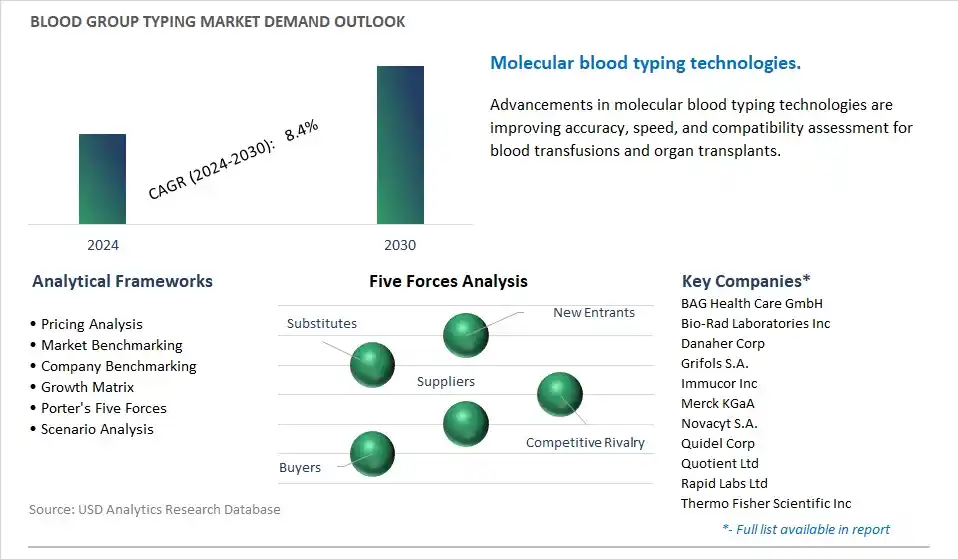
Blood Group Typing Market is estimated to increase at a Compounded Annual Growth Rate of 8.4% CAGR over the forecast period from 2024 to 2030
The Blood Group Typing Market study analyzes and forecasts the market size across 6 regions and 24 countries for diverse segments- By Products and Services (Consumables, Instruments, Services & Software), By Test (ABO Blood Tests & Rh Typing, Antibody Screening, HLA Typing, Cross-matching Tests, Antigen Typing), By Technique (Assay-based Techniques, PCR-based and Microarray Techniques, Massively Parallel Sequencing, Others), By End-User (Hospitals, Blood Banks, Clinical Laboratories, Others).
An Introduction to Blood Group Typing Market in 2024
Blood group typing is a crucial laboratory test used to determine an individual's blood group antigens and antibodies to ensure safe blood transfusions, organ transplants, and pregnancy management. In 2024, the field of blood group typing continues to advance with innovations in testing methodologies, automation, and molecular typing techniques aimed at improving accuracy, efficiency, and compatibility assessment. From traditional serological methods such as blood typing cards and tube agglutination tests to molecular techniques including polymerase chain reaction (PCR) and next-generation sequencing (NGS), blood group typing laboratories have access to a variety of tools to perform comprehensive blood group testing. Moreover, with the integration of automation platforms, computerized algorithms, and barcoding systems, blood banks and transfusion services can streamline workflows, reduce human errors, and ensure traceability and compliance with regulatory standards. By providing reliable and timely blood group typing results, laboratories play a critical role in preventing transfusion reactions, minimizing alloimmunization risks, and optimizing patient care in diverse clinical settings.
Market Trend: Adoption of Molecular Typing Techniques
A significant trend in the blood group typing market is the increasing adoption of molecular typing techniques for blood group determination. Traditional serological methods for blood group typing, while effective, can be time-consuming and labor-intensive. Molecular typing techniques, such as polymerase chain reaction (PCR), sequencing, and microarray-based assays, offer advantages such as higher throughput, greater accuracy, and the ability to detect rare blood group antigens. Additionally, molecular typing allows for the identification of blood group variants and provides valuable information for blood transfusion compatibility testing, organ transplantation, and paternity testing. The adoption of molecular typing techniques reflects a broader trend towards precision medicine and personalized healthcare, driving innovation and growth in the blood group typing market.
Market Driver: Rising Demand for Blood Transfusion and Organ Donation
The primary driver fueling the growth of the blood group typing market is the rising demand for blood transfusion and organ donation services worldwide. Blood group typing is essential for ensuring safe and compatible blood transfusions, preventing adverse reactions, and reducing the risk of transfusion-related complications. Additionally, accurate blood group typing is critical for matching donor organs with recipients in organ transplantation procedures, improving transplant outcomes and patient survival rates. With increasing incidence of chronic diseases, surgical procedures, and traumatic injuries, there is growing demand for blood products and organs for transplantation, driving the need for efficient and reliable blood group typing solutions. As healthcare systems strive to enhance patient care and improve healthcare outcomes, the demand for blood group typing technologies is expected to continue to grow, creating opportunities for market expansion and innovation in blood group typing assays and platforms.
Market Opportunity: Expansion into Point-of-Care Testing and Remote Settings
A potential opportunity for the blood group typing market lies in the expansion into point-of-care testing (POCT) and remote settings. While blood group typing traditionally occurs in centralized laboratories, there is increasing interest in bringing testing capabilities closer to the patient, particularly in emergency departments, ambulatory care settings, and remote or resource-limited regions. Portable and rapid blood group typing devices that can deliver accurate results at the point of care enable timely decision-making, reduce turnaround times, and improve patient outcomes. Furthermore, expanding access to blood group typing in remote settings, such as military bases, disaster relief operations, and rural healthcare facilities, enhances healthcare delivery and emergency preparedness efforts. By developing robust and user-friendly blood group typing solutions for POCT and remote settings, manufacturers can address unmet needs, expand market reach, and improve accessibility to critical healthcare services, ultimately contributing to better patient care and healthcare outcomes globally.
Blood Group Typing Market Share Analysis: Blood Group Typing Services is the fastest growing segment over the forecast period to 2030
The fastest-growing segment in the Blood Group Typing Market is Services & Software, driven by several factors contributing to the increasing demand for outsourcing blood group typing procedures. Firstly, the growing complexity of blood transfusion procedures and the rising prevalence of blood-related disorders necessitate accurate and efficient blood group typing services, leading healthcare facilities to rely on specialized service providers equipped with advanced technologies and expertise in blood typing techniques. Outsourcing these services enables hospitals, blood banks, and clinical laboratories to access state-of-the-art equipment and highly skilled professionals without significant upfront investments in infrastructure and training. Additionally, the integration of software solutions for data management, result interpretation, and quality assurance further enhances the efficiency and reliability of blood typing processes, driving the adoption of comprehensive service packages offered by specialized providers. Consequently, the Services & Software segment experiences rapid growth as healthcare institutions prioritize outsourcing blood group typing to ensure optimal patient care and operational efficiency.
Blood Group Typing Competitive Analysis
The market research study provides in-depth insights into leading companies including the SWOT analyses, product profile, financial details, and recent developments acrossBAG Health Care GmbH, Bio-Rad Laboratories Inc, Danaher Corp, Grifols S.A., Immucor Inc, Merck KGaA, Novacyt S.A., Quidel Corp, Quotient Ltd, Rapid Labs Ltd, Thermo Fisher Scientific Inc
Blood Group Typing Market Segmentation
By Products and Services
Consumables
-Antisera Reagents
-Anti-human Globulin Reagents
-Red Blood Cell Reagents
-Blood Bank Saline
Instruments
Services & Software
By Test
ABO Blood Tests & Rh Typing
Antibody Screening
HLA Typing
Cross-matching Tests
Antigen Typing
By Technique
Assay-based Techniques
PCR-based and Microarray Techniques
Massively Parallel Sequencing
Others
By End-User
Hospitals
Blood Banks
Clinical Laboratories
Others
Geographical Analysis
North America (United States, Canada, Mexico)
Europe (Germany, France, United Kingdom, Spain, Italy, Rest of Europe)
Asia Pacific (China, India, Japan, South Korea, Rest of Asia Pacific)
South America (Brazil, Argentina, Rest of South America)
Middle East and Africa (Saudi Arabia, UAE, Rest of Middle East, South Africa, Egypt, Rest of Africa)
Blood Group Typing Market Companies
BAG Health Care GmbH
Bio-Rad Laboratories Inc
Danaher Corp
Grifols S.A.
Immucor Inc
Merck KGaA
Novacyt S.A.
Quidel Corp
Quotient Ltd
Rapid Labs Ltd
Thermo Fisher Scientific Inc
Reasons to Buy the Blood Group Typing Market Study
• Deepen your industry insights and navigate uncertainties for strategy formulation, CAPEX, and Operational decisions
• Gain access to detailed insights on the Blood Group Typing Market, encompassing current market size, growth trends, and forecasts till 2030.
• Access detailed competitor analysis, enabling competitive advantage through a thorough understanding of market players, strategies, and potential differentiation opportunities
• Stay ahead of the curve with insights on technological advancements, innovations, and upcoming trends
• Identify lucrative investment avenues and expansion opportunities within the Blood Group Typing Market industry, guided by robust, data-backed analysis.
• Understand regional and global markets through country-wise analysis, regional market potential, regulatory nuances, and dynamics
• Execute strategies with confidence and speed through information, analytics, and insights on the industry value chain
• Corporate leaders, strategists, financial experts, shareholders, asset managers, and governmental representatives can make long-term planning scenarios and build an integrated and timely understanding of market dynamics
• Benefit from tailored solutions and expert consultation based on report insights, providing personalized strategies aligned with specific business needs.
TABLE OF CONTENTS
1 Introduction to 2024 Blood Group Typing Market
1.1 Market Overview
1.2 Quick Facts
1.3 Scope/Objective of the Study
1.4 Market Definition
1.5 Countries and Regions Covered
1.6 Units, Currency, and Conversions
1.7 Industry Value Chain
2 Research Methodology
2.1 Market Size Estimation
2.2 Sources and Research Methodology
2.3 Data Triangulation
2.4 Assumptions and Limitations
3 Executive Summary
3.1 Global Blood Group Typing Market Size Outlook, $ Million, 2021 to 2030
3.2 Blood Group Typing Market Outlook by Type, $ Million, 2021 to 2030
3.3 Blood Group Typing Market Outlook by Product, $ Million, 2021 to 2030
3.4 Blood Group Typing Market Outlook by Application, $ Million, 2021 to 2030
3.5 Blood Group Typing Market Outlook by Key Countries, $ Million, 2021 to 2030
4 Market Dynamics
4.1 Key Driving Forces of Blood Group Typing Industry
4.2 Key Market Trends in Blood Group Typing Industry
4.3 Potential Opportunities in Blood Group Typing Industry
4.4 Key Challenges in Blood Group Typing Industry
5 Market Factor Analysis
5.1 Value Chain Analysis
5.2 Competitive Landscape
5.2.1 Global Blood Group Typing Market Share by Company (%), 2023
5.2.2 Product Offerings by Company
5.3 Porter’s Five Forces Analysis
5.4 Pricing Analysis and Outlook
6 Growth Outlook Across Scenarios
6.1 Growth Analysis-Case Scenario Definitions
6.2 Low Growth Scenario Forecasts
6.3 Reference Growth Scenario Forecasts
6.4 High Growth Scenario Forecasts
7 Global Blood Group Typing Market Outlook by Segments
7.1 Blood Group Typing Market Outlook by Segments, $ Million, 2021- 2030
By Products and Services
Consumables
-Antisera Reagents
-Anti-human Globulin Reagents
-Red Blood Cell Reagents
-Blood Bank Saline
Instruments
Services & Software
By Test
ABO Blood Tests & Rh Typing
Antibody Screening
HLA Typing
Cross-matching Tests
Antigen Typing
By Technique
Assay-based Techniques
PCR-based and Microarray Techniques
Massively Parallel Sequencing
Others
By End-User
Hospitals
Blood Banks
Clinical Laboratories
Others
8 North America Blood Group Typing Market Analysis and Outlook To 2030
8.1 Introduction to North America Blood Group Typing Markets in 2024
8.2 North America Blood Group Typing Market Size Outlook by Country, 2021-2030
8.2.1 United States
8.2.2 Canada
8.2.3 Mexico
8.3 North America Blood Group Typing Market size Outlook by Segments, 2021-2030
By Products and Services
Consumables
-Antisera Reagents
-Anti-human Globulin Reagents
-Red Blood Cell Reagents
-Blood Bank Saline
Instruments
Services & Software
By Test
ABO Blood Tests & Rh Typing
Antibody Screening
HLA Typing
Cross-matching Tests
Antigen Typing
By Technique
Assay-based Techniques
PCR-based and Microarray Techniques
Massively Parallel Sequencing
Others
By End-User
Hospitals
Blood Banks
Clinical Laboratories
Others
9 Europe Blood Group Typing Market Analysis and Outlook To 2030
9.1 Introduction to Europe Blood Group Typing Markets in 2024
9.2 Europe Blood Group Typing Market Size Outlook by Country, 2021-2030
9.2.1 Germany
9.2.2 France
9.2.3 Spain
9.2.4 United Kingdom
9.2.4 Italy
9.2.5 Russia
9.2.6 Norway
9.2.7 Rest of Europe
9.3 Europe Blood Group Typing Market Size Outlook by Segments, 2021-2030
By Products and Services
Consumables
-Antisera Reagents
-Anti-human Globulin Reagents
-Red Blood Cell Reagents
-Blood Bank Saline
Instruments
Services & Software
By Test
ABO Blood Tests & Rh Typing
Antibody Screening
HLA Typing
Cross-matching Tests
Antigen Typing
By Technique
Assay-based Techniques
PCR-based and Microarray Techniques
Massively Parallel Sequencing
Others
By End-User
Hospitals
Blood Banks
Clinical Laboratories
Others
10 Asia Pacific Blood Group Typing Market Analysis and Outlook To 2030
10.1 Introduction to Asia Pacific Blood Group Typing Markets in 2024
10.2 Asia Pacific Blood Group Typing Market Size Outlook by Country, 2021-2030
10.2.1 China
10.2.2 India
10.2.3 Japan
10.2.4 South Korea
10.2.5 Indonesia
10.2.6 Malaysia
10.2.7 Australia
10.2.8 Rest of Asia Pacific
10.3 Asia Pacific Blood Group Typing Market size Outlook by Segments, 2021-2030
By Products and Services
Consumables
-Antisera Reagents
-Anti-human Globulin Reagents
-Red Blood Cell Reagents
-Blood Bank Saline
Instruments
Services & Software
By Test
ABO Blood Tests & Rh Typing
Antibody Screening
HLA Typing
Cross-matching Tests
Antigen Typing
By Technique
Assay-based Techniques
PCR-based and Microarray Techniques
Massively Parallel Sequencing
Others
By End-User
Hospitals
Blood Banks
Clinical Laboratories
Others
11 South America Blood Group Typing Market Analysis and Outlook To 2030
11.1 Introduction to South America Blood Group Typing Markets in 2024
11.2 South America Blood Group Typing Market Size Outlook by Country, 2021-2030
11.2.1 Brazil
11.2.2 Argentina
11.2.3 Rest of South America
11.3 South America Blood Group Typing Market size Outlook by Segments, 2021-2030
By Products and Services
Consumables
-Antisera Reagents
-Anti-human Globulin Reagents
-Red Blood Cell Reagents
-Blood Bank Saline
Instruments
Services & Software
By Test
ABO Blood Tests & Rh Typing
Antibody Screening
HLA Typing
Cross-matching Tests
Antigen Typing
By Technique
Assay-based Techniques
PCR-based and Microarray Techniques
Massively Parallel Sequencing
Others
By End-User
Hospitals
Blood Banks
Clinical Laboratories
Others
12 Middle East and Africa Blood Group Typing Market Analysis and Outlook To 2030
12.1 Introduction to Middle East and Africa Blood Group Typing Markets in 2024
12.2 Middle East and Africa Blood Group Typing Market Size Outlook by Country, 2021-2030
12.2.1 Saudi Arabia
12.2.2 UAE
12.2.3 Oman
12.2.4 Rest of Middle East
12.2.5 Egypt
12.2.6 Nigeria
12.2.7 South Africa
12.2.8 Rest of Africa
12.3 Middle East and Africa Blood Group Typing Market size Outlook by Segments, 2021-2030
By Products and Services
Consumables
-Antisera Reagents
-Anti-human Globulin Reagents
-Red Blood Cell Reagents
-Blood Bank Saline
Instruments
Services & Software
By Test
ABO Blood Tests & Rh Typing
Antibody Screening
HLA Typing
Cross-matching Tests
Antigen Typing
By Technique
Assay-based Techniques
PCR-based and Microarray Techniques
Massively Parallel Sequencing
Others
By End-User
Hospitals
Blood Banks
Clinical Laboratories
Others
13 Company Profiles
13.1 Company Snapshot
13.2 SWOT Profiles
13.3 Products and Services
13.4 Recent Developments
13.5 Financial Profile
List of Companies
BAG Health Care GmbH
Bio-Rad Laboratories Inc
Danaher Corp
Grifols S.A.
Immucor Inc
Merck KGaA
Novacyt S.A.
Quidel Corp
Quotient Ltd
Rapid Labs Ltd
Thermo Fisher Scientific Inc
14 Appendix
14.1 Customization Offerings
14.2 Subscription Services
14.3 Related Reports
14.4 Publisher Expertise
By Products and Services
Consumables
-Antisera Reagents
-Anti-human Globulin Reagents
-Red Blood Cell Reagents
-Blood Bank Saline
Instruments
Services & Software
By Test
ABO Blood Tests & Rh Typing
Antibody Screening
HLA Typing
Cross-matching Tests
Antigen Typing
By Technique
Assay-based Techniques
PCR-based and Microarray Techniques
Massively Parallel Sequencing
Others
By End-User
Hospitals
Blood Banks
Clinical Laboratories
Others
Countries Analyzed
North America (United States, Canada, Mexico)
Europe (Germany, France, United Kingdom, Spain, Italy, Rest of Europe)
Asia Pacific (China, India, Japan, South Korea, Rest of Asia Pacific)
South America (Brazil, Argentina, Rest of South America)
Middle East and Africa (Saudi Arabia, UAE, Rest of Middle East, South Africa, Egypt, Rest of Africa)
