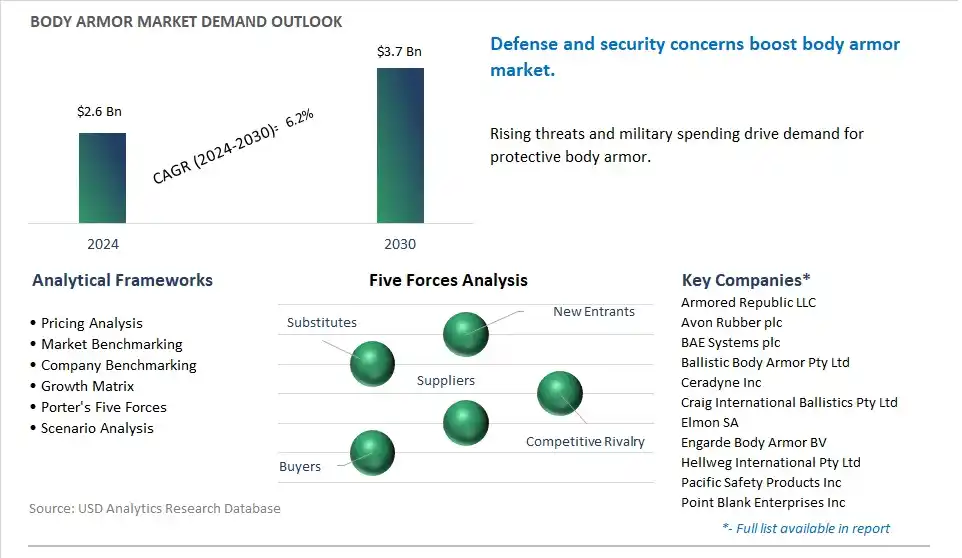
The global Body Armor Market is poised to register a 6.2% CAGR from $2.6 Billion in 2024 to $3.7 Billion in 2030.
The global Body Armor Market Study analyzes and forecasts the market size across 6 regions and 24 countries for diverse segments -By Type (Vest, Helmet, Other), By Style (Covert, Overt), By Level (Level II, Level IIA, Level III, Level IIIA, Level IV), By End-User (Defense, Law Enforcement & Security Personnel, Civilians).
An Introduction to Global Body Armor Market in 2024
The body armor market is experiencing notable shifts driven by evolving security threats, technological advancements, and changing military and law enforcement requirements. Key trends shaping the industry's future include the development of lightweight and flexible armor materials without compromising protection levels. Advanced materials such as aramid fibers, ceramics, and ultra-high molecular weight polyethylene (UHMWPE) are increasingly being utilized to create body armor with improved ballistic resistance and comfort for the wearer. Moreover, the integration of smart technologies, such as sensors and communication systems, into body armor enhances situational awareness and connectivity for personnel in the field. As defense and law enforcement agencies seek to adapt to emerging threats while optimizing mobility and agility, the demand for innovative body armor solutions is expected to continue growing.
Body Armor Market Competitive Landscape
The market report analyses the leading companies in the industry including Armored Republic LLC, Avon Rubber plc, BAE Systems plc, Ballistic Body Armor Pty Ltd, Ceradyne Inc, Craig International Ballistics Pty Ltd, Elmon SA, Engarde Body Armor BV, Hellweg International Pty Ltd, Pacific Safety Products Inc, Point Blank Enterprises Inc, Safariland LLC, Sarkar Defence Solutions Pvt. Ltd.
Body Armor Market Dynamics
Body Armor Market Trend: Technological Advancements in Body Armor Materials
A prominent trend in the body armor market is the continual technological advancements in body armor materials. With ongoing research and development efforts, there is a growing focus on enhancing the performance, comfort, and versatility of body armor to meet evolving threats and operational requirements. Advanced materials such as ultra-high molecular weight polyethylene (UHMWPE), ceramic composites, and aramid fibers are being utilized to develop lighter, stronger, and more flexible body armor solutions. Additionally, advancements in manufacturing techniques such as 3D printing and nanotechnology are enabling the production of customized and multi-functional body armor designs. As military, law enforcement, and security agencies seek to equip personnel with the most effective protection against ballistic threats, the demand for technologically advanced body armor continues to increase, driving market growth and innovation in body armor materials and designs.
Body Armor Market Driver: Rising Security Concerns and Threats
A primary driver fueling the body armor market is the rising security concerns and threats faced by military, law enforcement, and security personnel globally. With increasing incidences of armed conflicts, terrorism, and violent crime, there is a growing need to equip frontline personnel with effective protection against ballistic threats such as bullets, shrapnel, and explosives. Body armor plays a critical role in safeguarding personnel and saving lives in high-risk environments by providing protection against a range of ballistic and blunt force trauma injuries. Moreover, the proliferation of small arms and improvised explosive devices (IEDs) in conflict zones and urban areas further underscores the importance of body armor as an essential piece of personal protective equipment. As security threats continue to evolve and become more sophisticated, the demand for advanced body armor solutions is expected to rise, driving market demand and investment in protective equipment.
Body Armor Market Opportunity: Expansion into Civilian and Commercial Markets
An opportunity within the body armor market lies in the expansion into civilian and commercial markets to diversify product offerings and capture new customer segments. While body armor has traditionally been associated with military and law enforcement applications, there is increasing demand for personal protection solutions in civilian sectors such as private security, emergency response, and sports and recreational activities. Additionally, industries such as oil and gas, transportation, and construction may require body armor for personnel working in high-risk environments or hostile territories. By developing specialized body armor products tailored to the needs of civilian and commercial users, companies can tap into new market opportunities, expand their customer base, and increase revenue streams. Moreover, there is potential to leverage advancements in wearable technology, smart fabrics, and ergonomics to develop innovative body armor solutions that offer enhanced comfort, mobility, and functionality for civilian and commercial applications. By embracing diversification strategies, companies can position themselves for growth and differentiation in the dynamic body armor market.
Body Armor Market Share Analysis: Vest Segment generated the highest revenue in the industry
The Vest segment is the largest segment in the Body Armor Market. Body armor vests are widely used by military personnel, law enforcement officers, security professionals, and civilians for personal protection against ballistic threats. Vests provide coverage to vital organs, including the chest, abdomen, and back, offering effective protection against bullets, shrapnel, and other ballistic projectiles. They are essential components of individual protective equipment (IPE) kits and tactical gear used in combat, law enforcement, and security operations. In addition, body armor vests come in various configurations, including concealable vests for covert operations and tactical vests with modular attachments for carrying equipment and accessories. Additionally, advancements in materials science, manufacturing processes, and design technologies have led to the development of lightweight, flexible, and ergonomic vests that offer enhanced comfort, mobility, and ballistic performance. Further, the global demand for body armor vests is driven by factors such as increasing security threats, rising crime rates, and government initiatives to modernize defense and law enforcement capabilities. Over the forecast period, the Vest segment's combination of widespread applications, critical role in personal protection, and technological advancements positions it as the largest segment in the Body Armor Market.
Body Armor Market Share Analysis: Covert Segment is poised to register the fastest growth rate (CAGR) over the forecast period to 2030
The Covert segment is the fastest-growing segment in the Body Armor Market. Covert body armor refers to concealable vests designed to be worn discreetly under clothing, offering protection without drawing attention to the wearer's security measures. This segment is experiencing rapid growth due to diverse key factors. The increased concerns about personal safety and security have led to rising demand for body armor among civilians, including professionals in high-risk occupations, such as executives, diplomats, journalists, and private individuals. Covert body armor provides individuals with the means to protect themselves discreetly in various everyday situations without attracting unwanted attention. Additionally, advancements in material technology and manufacturing processes have resulted in the development of lightweight and flexible covert vests that offer enhanced comfort and wearability without compromising on protection levels. In addition, the growing availability of customizable options and tailored solutions in the covert body armor market allows individuals to choose vests that meet their specific protection needs and aesthetic preferences. Further, rising instances of violent crime, terrorism, and active shooter incidents worldwide have contributed to increased awareness and adoption of personal protective equipment, including covert body armor, among civilians and professionals alike. Over the forecast period, the Covert segment's combination of discreet protection, technological advancements, and growing demand for personal safety solutions positions it as the fastest-growing segment in the Body Armor Market.
Body Armor Market Share Analysis: Level IIIA Segment is poised to register the fastest growth rate (CAGR) over the forecast period to 2030
The Level IIIA segment is the fastest-growing segment in the Body Armor Market. Level IIIA body armor provides protection against a wide range of handgun threats, including most common handgun calibers up to .44 Magnum. This segment is experiencing rapid growth due to diverse key factors. The there is a growing demand for lightweight and flexible body armor solutions that offer enhanced protection against handgun threats while allowing wearers to maintain mobility and comfort. Level IIIA vests meet this demand by providing high levels of ballistic protection without sacrificing maneuverability or agility, making them suitable for a wide range of applications, including law enforcement, security, and civilian self-defense. Additionally, advancements in materials science and ballistic technology have led to the development of ultra-lightweight and thin Level IIIA vests that offer superior ballistic performance compared to traditional armor solutions. These advancements have made Level IIIA body armor more accessible and appealing to a broader range of users, including professionals in high-risk occupations and individuals seeking personal protection. Further, the increasing prevalence of handgun violence and active shooter incidents has heightened awareness of the need for effective personal protective equipment, driving the demand for Level IIIA body armor among law enforcement agencies, security firms, and private individuals. Over the forecast period, the Level IIIA segment's combination of lightweight protection, technological advancements, and growing demand for handgun-resistant armor positions it as the fastest-growing segment in the Body Armor Market.
Body Armor Market Report Segmentation
By Type
Vest
Helmet
Other
By Style
Covert
Overt
By Level
Level II
Level IIA
Level III
Level IIIA
Level IV
By End-User
Defense
Law Enforcement & Security Personnel
Civilians
Regions Included
North America (US, Canada, Mexico)
Europe (Germany, UK, France, Spain, Italy, Russia, Rest of Europe)
Asia Pacific (China, India, Japan, South Korea, Australia, South East Asia, Rest of Asia)
South America (Brazil, Argentina, Rest of South America)
Middle East and Africa (Saudi Arabia, UAE, Rest of Middle East, South Africa, Egypt, Rest of Africa)
Body Armor Companies Profiled in the Market Study
Armored Republic LLC
Avon Rubber plc
BAE Systems plc
Ballistic Body Armor Pty Ltd
Ceradyne Inc
Craig International Ballistics Pty Ltd
Elmon SA
Engarde Body Armor BV
Hellweg International Pty Ltd
Pacific Safety Products Inc
Point Blank Enterprises Inc
Safariland LLC
Sarkar Defence Solutions Pvt. Ltd
*- List Not Exhaustive
TABLE OF CONTENTS
1 Introduction to 2024 Body Armor Market
1.1 Market Overview
1.2 Quick Facts
1.3 Scope/Objective of the Study
1.4 Market Definition
1.5 Countries and Regions Covered
1.6 Units, Currency, and Conversions
1.7 Industry Value Chain
2 Research Methodology
2.1 Market Size Estimation
2.2 Sources and Research Methodology
2.3 Data Triangulation
2.4 Assumptions and Limitations
3 Executive Summary
3.1 Global Body Armor Market Size Outlook, $ Million, 2021 to 2030
3.2 Body Armor Market Outlook by Type, $ Million, 2021 to 2030
3.3 Body Armor Market Outlook by Product, $ Million, 2021 to 2030
3.4 Body Armor Market Outlook by Application, $ Million, 2021 to 2030
3.5 Body Armor Market Outlook by Key Countries, $ Million, 2021 to 2030
4 Market Dynamics
4.1 Key Driving Forces of Body Armor Industry
4.2 Key Market Trends in Body Armor Industry
4.3 Potential Opportunities in Body Armor Industry
4.4 Key Challenges in Body Armor Industry
5 Market Factor Analysis
5.1 Value Chain Analysis
5.2 Competitive Landscape
5.2.1 Global Body Armor Market Share by Company (%), 2023
5.2.2 Product Offerings by Company
5.3 Porter’s Five Forces Analysis
5.4 Pricing Analysis and Outlook
6 Growth Outlook Across Scenarios
6.1 Growth Analysis-Case Scenario Definitions
6.2 Low Growth Scenario Forecasts
6.3 Reference Growth Scenario Forecasts
6.4 High Growth Scenario Forecasts
7 Global Body Armor Market Outlook by Segments
7.1 Body Armor Market Outlook by Segments, $ Million, 2021- 2030
By Type
Vest
Helmet
Other
By Style
Covert
Overt
By Level
Level II
Level IIA
Level III
Level IIIA
Level IV
By End-User
Defense
Law Enforcement & Security Personnel
Civilians
8 North America Body Armor Market Analysis and Outlook To 2030
8.1 Introduction to North America Body Armor Markets in 2024
8.2 North America Body Armor Market Size Outlook by Country, 2021-2030
8.2.1 United States
8.2.2 Canada
8.2.3 Mexico
8.3 North America Body Armor Market size Outlook by Segments, 2021-2030
By Type
Vest
Helmet
Other
By Style
Covert
Overt
By Level
Level II
Level IIA
Level III
Level IIIA
Level IV
By End-User
Defense
Law Enforcement & Security Personnel
Civilians
9 Europe Body Armor Market Analysis and Outlook To 2030
9.1 Introduction to Europe Body Armor Markets in 2024
9.2 Europe Body Armor Market Size Outlook by Country, 2021-2030
9.2.1 Germany
9.2.2 France
9.2.3 Spain
9.2.4 United Kingdom
9.2.4 Italy
9.2.5 Russia
9.2.6 Norway
9.2.7 Rest of Europe
9.3 Europe Body Armor Market Size Outlook by Segments, 2021-2030
By Type
Vest
Helmet
Other
By Style
Covert
Overt
By Level
Level II
Level IIA
Level III
Level IIIA
Level IV
By End-User
Defense
Law Enforcement & Security Personnel
Civilians
10 Asia Pacific Body Armor Market Analysis and Outlook To 2030
10.1 Introduction to Asia Pacific Body Armor Markets in 2024
10.2 Asia Pacific Body Armor Market Size Outlook by Country, 2021-2030
10.2.1 China
10.2.2 India
10.2.3 Japan
10.2.4 South Korea
10.2.5 Indonesia
10.2.6 Malaysia
10.2.7 Australia
10.2.8 Rest of Asia Pacific
10.3 Asia Pacific Body Armor Market size Outlook by Segments, 2021-2030
By Type
Vest
Helmet
Other
By Style
Covert
Overt
By Level
Level II
Level IIA
Level III
Level IIIA
Level IV
By End-User
Defense
Law Enforcement & Security Personnel
Civilians
11 South America Body Armor Market Analysis and Outlook To 2030
11.1 Introduction to South America Body Armor Markets in 2024
11.2 South America Body Armor Market Size Outlook by Country, 2021-2030
11.2.1 Brazil
11.2.2 Argentina
11.2.3 Rest of South America
11.3 South America Body Armor Market size Outlook by Segments, 2021-2030
By Type
Vest
Helmet
Other
By Style
Covert
Overt
By Level
Level II
Level IIA
Level III
Level IIIA
Level IV
By End-User
Defense
Law Enforcement & Security Personnel
Civilians
12 Middle East and Africa Body Armor Market Analysis and Outlook To 2030
12.1 Introduction to Middle East and Africa Body Armor Markets in 2024
12.2 Middle East and Africa Body Armor Market Size Outlook by Country, 2021-2030
12.2.1 Saudi Arabia
12.2.2 UAE
12.2.3 Oman
12.2.4 Rest of Middle East
12.2.5 Egypt
12.2.6 Nigeria
12.2.7 South Africa
12.2.8 Rest of Africa
12.3 Middle East and Africa Body Armor Market size Outlook by Segments, 2021-2030
By Type
Vest
Helmet
Other
By Style
Covert
Overt
By Level
Level II
Level IIA
Level III
Level IIIA
Level IV
By End-User
Defense
Law Enforcement & Security Personnel
Civilians
13 Company Profiles
13.1 Company Snapshot
13.2 SWOT Profiles
13.3 Products and Services
13.4 Recent Developments
13.5 Financial Profile
Armored Republic LLC
Avon Rubber plc
BAE Systems plc
Ballistic Body Armor Pty Ltd
Ceradyne Inc
Craig International Ballistics Pty Ltd
Elmon SA
Engarde Body Armor BV
Hellweg International Pty Ltd
Pacific Safety Products Inc
Point Blank Enterprises Inc
Safariland LLC
Sarkar Defence Solutions Pvt. Ltd
14 Appendix
14.1 Customization Offerings
14.2 Subscription Services
14.3 Related Reports
14.4 Publisher Expertise
By Type
Vest
Helmet
Other
By Style
Covert
Overt
By Level
Level II
Level IIA
Level III
Level IIIA
Level IV
By End-User
Defense
Law Enforcement & Security Personnel
Civilians
Countries Analyzed
North America (US, Canada, Mexico)
Europe (Germany, UK, France, Spain, Italy, Russia, Rest of Europe)
Asia Pacific (China, India, Japan, South Korea, Australia, South East Asia, Rest of Asia)
South America (Brazil, Argentina, Rest of South America)
Middle East and Africa (Saudi Arabia, UAE, Rest of Middle East, South Africa, Egypt, Rest of Africa)
