
The Bone Conduction Hearing Aids Market study analyzes and forecasts the market size across 6 regions and 24 countries for diverse segments- By Type (Bone Anchored Hearing Aids, Traditional Bone Conduction Hearing Aids), By Product (Systems, Accessories, Sound Processors, Patient Type, Children/Pediatrics, Adults).
In 2024, the market for bone conduction hearing aids addresses the therapeutic needs of individuals with conductive hearing loss, single-sided deafness, and mixed hearing loss, offering innovative auditory prostheses that bypass the outer and middle ear structures to deliver sound vibrations directly to the cochlea via bone conduction pathways. Bone conduction hearing aids consist of an external sound processor worn behind the ear or on the head, which transmits sound waves through bone conduction transducers to stimulate the cochlear nerve, bypassing the impaired auditory pathway and restoring hearing sensation. With a focus on speech intelligibility, comfort, and cosmetic appeal, bone conduction hearing aids offer personalized fitting options, adaptive signal processing algorithms, and wireless connectivity features to meet individual patient preferences and lifestyle needs. Moreover, with advancements in digital signal processing, implantable bone conduction systems, and surgical techniques, the bone conduction hearing aids market continues to expand, offering innovative solutions for improving hearing outcomes and quality of life in patients with hearing impairment worldwide.
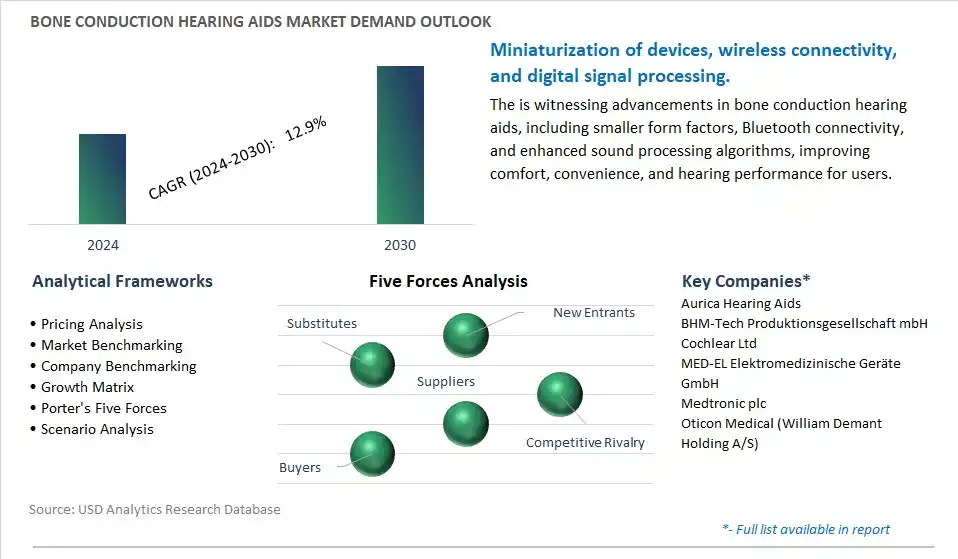
A notable trend in the Bone Conduction Hearing Aids market is the integration of wireless connectivity and smart features. Modern bone conduction hearing aids are increasingly incorporating Bluetooth technology, allowing users to stream audio directly from their smartphones, TVs, and other compatible devices. Additionally, these devices may offer features such as smartphone apps for personalized adjustments, adaptive noise cancellation, and remote control functionality. This trend reflects the growing consumer demand for convenient, connected solutions that enhance the overall hearing experience while providing greater flexibility and control over device settings.
An important driver fueling the Bone Conduction Hearing Aids market is the growing awareness and acceptance of bone conduction technology as a viable hearing solution. Traditional hearing aids may not be suitable for individuals with certain types of hearing loss or conditions such as chronic ear infections or congenital malformations of the ear canal. Bone conduction hearing aids offer an alternative by bypassing the outer and middle ear and transmitting sound vibrations directly to the inner ear through bone conduction. As awareness of this technology spreads and its benefits become more widely recognized among healthcare professionals and consumers alike, there is a growing demand for bone-conduction hearing aids as a preferred choice for hearing rehabilitation.
A significant opportunity within the Bone Conduction Hearing Aids market lies in expanding into the pediatric and geriatric markets. While bone conduction hearing aids have historically been used primarily by adults with specific hearing conditions, there is a growing recognition of their potential benefits for pediatric populations, including children with conductive hearing loss, chronic ear infections, or certain developmental disorders. Similarly, as the global population ages, there is an increasing prevalence of age-related hearing loss among older adults, many of whom may benefit from the unique advantages offered by bone conduction technology. By developing specialized devices tailored to the needs of pediatric and geriatric users and addressing considerations such as durability, comfort, and ease of use, manufacturers can tap into these underserved segments and unlock new avenues for market growth and innovation.
Among the various types of bone conduction hearing aids, bone anchored hearing aids (BAHA) are experiencing significant growth in the market. BAHA devices utilize bone conduction technology to bypass the outer and middle ear, transmitting sound vibrations directly to the inner ear through the skull bone. This makes them particularly effective for individuals with conductive or mixed hearing loss, as well as those with single-sided deafness. The growing awareness about the benefits of BAHA devices, such as improved speech clarity, sound localization, and comfort, is driving their adoption among both pediatric and adult populations. Moreover, advancements in BAHA technology, including digital signal processing and wireless connectivity features, are further enhancing their efficacy and user experience. Additionally, the expanding geriatric population, coupled with the increasing prevalence of hearing disorders worldwide, is fueling the demand for BAHA devices as a viable solution for individuals with hearing impairment. As a result, the bone anchored hearing aids segment is poised for bone conduction hearing aids market, presenting lucrative opportunities for manufacturers, healthcare providers, and other stakeholders involved in hearing healthcare.
The market research study provides in-depth insights into leading companies including the SWOT analyses, product profile, financial details, and recent developments acrossAurica Hearing Aids, BHM-Tech Produktionsgesellschaft mbH, Cochlear Ltd, MED-EL Elektromedizinische Geräte GmbH, Medtronic plc, Oticon Medical (William Demant Holding A/S)
By Type
Bone Anchored Hearing Aids
Traditional Bone Conduction Hearing Aids
By Product
Systems
Accessories
Sound Processors
Patient Type
Children/Pediatrics
Adults
Geographical Analysis
North America (United States, Canada, Mexico)
Europe (Germany, France, United Kingdom, Spain, Italy, Rest of Europe)
Asia Pacific (China, India, Japan, South Korea, Rest of Asia Pacific)
South America (Brazil, Argentina, Rest of South America)
Middle East and Africa (Saudi Arabia, UAE, Rest of Middle East, South Africa, Egypt, Rest of Africa)
Aurica Hearing Aids
BHM-Tech Produktionsgesellschaft mbH
Cochlear Ltd
MED-EL Elektromedizinische Geräte GmbH
Medtronic plc
Oticon Medical (William Demant Holding A/S)
• Deepen your industry insights and navigate uncertainties for strategy formulation, CAPEX, and Operational decisions
• Gain access to detailed insights on the Bone Conduction Hearing Aids Market, encompassing current market size, growth trends, and forecasts till 2030.
• Access detailed competitor analysis, enabling competitive advantage through a thorough understanding of market players, strategies, and potential differentiation opportunities
• Stay ahead of the curve with insights on technological advancements, innovations, and upcoming trends
• Identify lucrative investment avenues and expansion opportunities within the Bone Conduction Hearing Aids Market industry, guided by robust, data-backed analysis.
• Understand regional and global markets through country-wise analysis, regional market potential, regulatory nuances, and dynamics
• Execute strategies with confidence and speed through information, analytics, and insights on the industry value chain
• Corporate leaders, strategists, financial experts, shareholders, asset managers, and governmental representatives can make long-term planning scenarios and build an integrated and timely understanding of market dynamics
• Benefit from tailored solutions and expert consultation based on report insights, providing personalized strategies aligned with specific business needs.
TABLE OF CONTENTS
1 Introduction to 2024 Bone Conduction Hearing Aids Market
1.1 Market Overview
1.2 Quick Facts
1.3 Scope/Objective of the Study
1.4 Market Definition
1.5 Countries and Regions Covered
1.6 Units, Currency, and Conversions
1.7 Industry Value Chain
2 Research Methodology
2.1 Market Size Estimation
2.2 Sources and Research Methodology
2.3 Data Triangulation
2.4 Assumptions and Limitations
3 Executive Summary
3.1 Global Bone Conduction Hearing Aids Market Size Outlook, $ Million, 2021 to 2030
3.2 Bone Conduction Hearing Aids Market Outlook by Type, $ Million, 2021 to 2030
3.3 Bone Conduction Hearing Aids Market Outlook by Product, $ Million, 2021 to 2030
3.4 Bone Conduction Hearing Aids Market Outlook by Application, $ Million, 2021 to 2030
3.5 Bone Conduction Hearing Aids Market Outlook by Key Countries, $ Million, 2021 to 2030
4 Market Dynamics
4.1 Key Driving Forces of Bone Conduction Hearing Aids Industry
4.2 Key Market Trends in Bone Conduction Hearing Aids Industry
4.3 Potential Opportunities in Bone Conduction Hearing Aids Industry
4.4 Key Challenges in Bone Conduction Hearing Aids Industry
5 Market Factor Analysis
5.1 Value Chain Analysis
5.2 Competitive Landscape
5.2.1 Global Bone Conduction Hearing Aids Market Share by Company (%), 2023
5.2.2 Product Offerings by Company
5.3 Porter’s Five Forces Analysis
5.4 Pricing Analysis and Outlook
6 Growth Outlook Across Scenarios
6.1 Growth Analysis-Case Scenario Definitions
6.2 Low Growth Scenario Forecasts
6.3 Reference Growth Scenario Forecasts
6.4 High Growth Scenario Forecasts
7 Global Bone Conduction Hearing Aids Market Outlook by Segments
7.1 Bone Conduction Hearing Aids Market Outlook by Segments, $ Million, 2021- 2030
By Type
Bone Anchored Hearing Aids
Traditional Bone Conduction Hearing Aids
By Product
Systems
Accessories
Sound Processors
Patient Type
Children/Pediatrics
Adults
8 North America Bone Conduction Hearing Aids Market Analysis and Outlook To 2030
8.1 Introduction to North America Bone Conduction Hearing Aids Markets in 2024
8.2 North America Bone Conduction Hearing Aids Market Size Outlook by Country, 2021-2030
8.2.1 United States
8.2.2 Canada
8.2.3 Mexico
8.3 North America Bone Conduction Hearing Aids Market size Outlook by Segments, 2021-2030
By Type
Bone Anchored Hearing Aids
Traditional Bone Conduction Hearing Aids
By Product
Systems
Accessories
Sound Processors
Patient Type
Children/Pediatrics
Adults
9 Europe Bone Conduction Hearing Aids Market Analysis and Outlook To 2030
9.1 Introduction to Europe Bone Conduction Hearing Aids Markets in 2024
9.2 Europe Bone Conduction Hearing Aids Market Size Outlook by Country, 2021-2030
9.2.1 Germany
9.2.2 France
9.2.3 Spain
9.2.4 United Kingdom
9.2.4 Italy
9.2.5 Russia
9.2.6 Norway
9.2.7 Rest of Europe
9.3 Europe Bone Conduction Hearing Aids Market Size Outlook by Segments, 2021-2030
By Type
Bone Anchored Hearing Aids
Traditional Bone Conduction Hearing Aids
By Product
Systems
Accessories
Sound Processors
Patient Type
Children/Pediatrics
Adults
10 Asia Pacific Bone Conduction Hearing Aids Market Analysis and Outlook To 2030
10.1 Introduction to Asia Pacific Bone Conduction Hearing Aids Markets in 2024
10.2 Asia Pacific Bone Conduction Hearing Aids Market Size Outlook by Country, 2021-2030
10.2.1 China
10.2.2 India
10.2.3 Japan
10.2.4 South Korea
10.2.5 Indonesia
10.2.6 Malaysia
10.2.7 Australia
10.2.8 Rest of Asia Pacific
10.3 Asia Pacific Bone Conduction Hearing Aids Market size Outlook by Segments, 2021-2030
By Type
Bone Anchored Hearing Aids
Traditional Bone Conduction Hearing Aids
By Product
Systems
Accessories
Sound Processors
Patient Type
Children/Pediatrics
Adults
11 South America Bone Conduction Hearing Aids Market Analysis and Outlook To 2030
11.1 Introduction to South America Bone Conduction Hearing Aids Markets in 2024
11.2 South America Bone Conduction Hearing Aids Market Size Outlook by Country, 2021-2030
11.2.1 Brazil
11.2.2 Argentina
11.2.3 Rest of South America
11.3 South America Bone Conduction Hearing Aids Market size Outlook by Segments, 2021-2030
By Type
Bone Anchored Hearing Aids
Traditional Bone Conduction Hearing Aids
By Product
Systems
Accessories
Sound Processors
Patient Type
Children/Pediatrics
Adults
12 Middle East and Africa Bone Conduction Hearing Aids Market Analysis and Outlook To 2030
12.1 Introduction to Middle East and Africa Bone Conduction Hearing Aids Markets in 2024
12.2 Middle East and Africa Bone Conduction Hearing Aids Market Size Outlook by Country, 2021-2030
12.2.1 Saudi Arabia
12.2.2 UAE
12.2.3 Oman
12.2.4 Rest of Middle East
12.2.5 Egypt
12.2.6 Nigeria
12.2.7 South Africa
12.2.8 Rest of Africa
12.3 Middle East and Africa Bone Conduction Hearing Aids Market size Outlook by Segments, 2021-2030
By Type
Bone Anchored Hearing Aids
Traditional Bone Conduction Hearing Aids
By Product
Systems
Accessories
Sound Processors
Patient Type
Children/Pediatrics
Adults
13 Company Profiles
13.1 Company Snapshot
13.2 SWOT Profiles
13.3 Products and Services
13.4 Recent Developments
13.5 Financial Profile
List of Companies
Aurica Hearing Aids
BHM-Tech Produktionsgesellschaft mbH
Cochlear Ltd
MED-EL Elektromedizinische Geräte GmbH
Medtronic plc
Oticon Medical (William Demant Holding A/S)
14 Appendix
14.1 Customization Offerings
14.2 Subscription Services
14.3 Related Reports
14.4 Publisher Expertise
By Type
Bone Anchored Hearing Aids
Traditional Bone Conduction Hearing Aids
By Product
Systems
Accessories
Sound Processors
Patient Type
Children/Pediatrics
Adults
Countries Analyzed
North America (United States, Canada, Mexico)
Europe (Germany, France, United Kingdom, Spain, Italy, Rest of Europe)
Asia Pacific (China, India, Japan, South Korea, Rest of Asia Pacific)
South America (Brazil, Argentina, Rest of South America)
Middle East and Africa (Saudi Arabia, UAE, Rest of Middle East, South Africa, Egypt, Rest of Africa)
The global Bone Conduction Hearing Aids Market is one of the lucrative growth markets, poised to register a 12.9% growth (CAGR) between 2024 and 2030.
Emerging Markets across Asia Pacific, Europe, and Americas present robust growth prospects.
Aurica Hearing Aids, BHM-Tech Produktionsgesellschaft mbH, Cochlear Ltd, MED-EL Elektromedizinische Geräte GmbH, Medtronic plc, Oticon Medical (William Demant Holding A/S)
Base Year- 2023; Estimated Year- 2024; Historic Period- 2018-2023; Forecast period- 2024 to 2030; Currency: USD; Volume