The global Building Acoustic Insulation Market is poised to register a 4.4% CAGR from $4.7 Billion in 2024 to $6.1 Billion in 2030.
The global Building Acoustic Insulation Market Study analyzes and forecasts the market size across 6 regions and 24 countries for diverse segments -By Product (Glass Wool, Rock Wool, Foamed Plastic, Others), By Application (Residential, Non-Residential).
An Introduction to Global Building Acoustic Insulation Market in 2024
The market for building acoustic insulation is enhancing comfort and noise control in buildings by providing solutions that effectively reduce sound transmission and improve acoustical performance. Key trends shaping the future of this industry include advancements in insulation materials, such as mineral wool, fiberglass, and acoustic foam, which offer superior sound absorption properties and meet stringent building code requirements for noise control. Additionally, developments in insulation installation techniques, including resilient channels, staggered stud walls, and soundproofing membranes, enhance the effectiveness of acoustic insulation systems in mitigating airborne and impact noise transmission between spaces. Moreover, the integration of acoustic design principles, such as room layout optimization and strategic placement of sound-absorbing materials, enhances the overall acoustic comfort and functionality of buildings for occupants. As architects, developers, and building owners prioritize occupant well-being, productivity, and satisfaction, the demand for building acoustic insulation solutions is expected to grow, driving further innovation and market expansion in this essential segment of the construction industry.
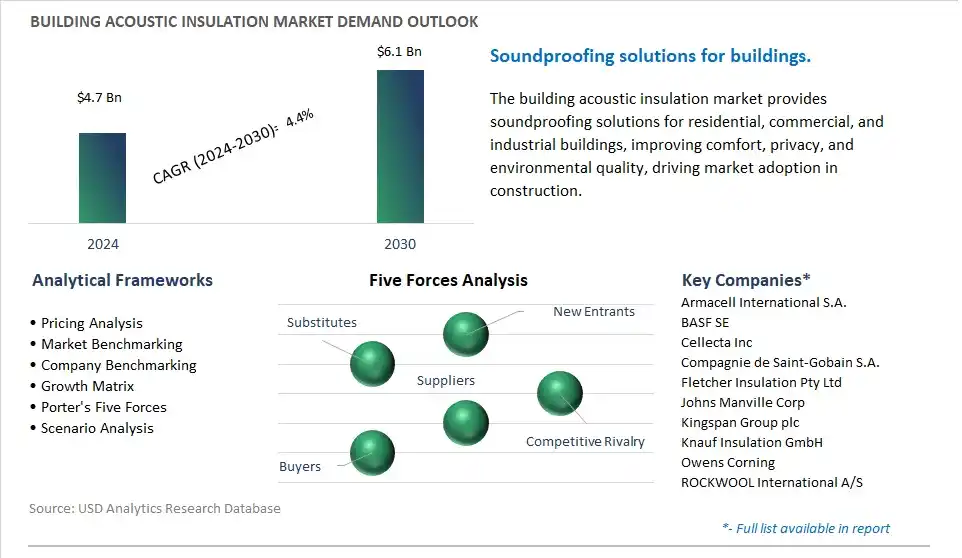
Building Acoustic Insulation Market Competitive Landscape
The market report analyses the leading companies in the industry including Armacell International S.A., BASF SE, Cellecta Inc, Compagnie de Saint-Gobain S.A., Fletcher Insulation Pty Ltd, Johns Manville Corp, Kingspan Group plc, Knauf Insulation GmbH, Owens Corning, ROCKWOOL International A/S.
Building Acoustic Insulation Market Dynamics
Building Acoustic Insulation Market Trend: Increasing Focus on Noise Control in Buildings
A prominent trend in the market for building acoustic insulation is the increasing focus on noise control in buildings. As urbanization intensifies and populations grow denser, the need to mitigate noise pollution within buildings becomes more pressing. Building occupants seek environments that offer tranquility and comfort, free from disruptive noises from traffic, machinery, or neighboring activities. Acoustic insulation materials play a crucial role in dampening sound transmission, improving indoor acoustics, and enhancing occupant well-being. Architects, developers, and building owners are prioritizing acoustic comfort in their designs, leading to a growing demand for high-performance acoustic insulation solutions. As awareness of the importance of noise control in buildings continues to rise, the demand for building acoustic insulation is expected to increase, driving market growth and innovation in soundproofing technologies.
Building Acoustic Insulation Market Driver: Stringent Building Codes and Regulations
A key driver behind the demand for building acoustic insulation is the implementation of stringent building codes and regulations. Governments and regulatory bodies worldwide are enacting regulations aimed at improving indoor environmental quality, including noise control standards for buildings. These regulations mandate minimum requirements for sound insulation in walls, floors, ceilings, and partitions to ensure a comfortable and healthy indoor environment for occupants. Compliance with building codes and standards drives the adoption of acoustic insulation materials in new construction and renovation projects across residential, commercial, institutional, and industrial sectors. As building regulations become more stringent and as developers strive to meet or exceed acoustic performance requirements, the demand for building acoustic insulation is expected to grow, stimulating market expansion and investment in insulation technologies.
Building Acoustic Insulation Market Opportunity: Development of Multifunctional Insulation Solutions
An emerging opportunity in the market for building acoustic insulation lies in the development of multifunctional insulation solutions. Opportunities exist to innovate and integrate acoustic insulation materials with other building performance features, such as thermal insulation, fire resistance, moisture control, and air quality management. By developing multifunctional insulation solutions, manufacturers can offer products that address multiple building performance needs simultaneously, providing added value to customers and simplifying construction processes. Additionally, there is a growing demand for sustainable and environmentally friendly insulation materials that offer acoustic performance while minimizing environmental impact. By investing in research and development of multifunctional and sustainable insulation solutions, manufacturers can capitalize on new opportunities, differentiate their products in the market, and meet the evolving needs of the construction industry for high-performance building materials. Embracing innovation in multifunctional insulation solutions can drive market growth and competitiveness in the building acoustic insulation industry, contributing to healthier, more comfortable, and quieter indoor environments.
Building Acoustic Insulation Market Ecosystem
The building acoustic insulation market encompasses diverse key stages, beginning with raw material supply, where companies including Rockwool, Saint-Gobain, Owens Corning, BASF, and others provide fibrous materials including mineral wool, glass wool, natural fibers, synthetic fibers, membranes, and mass-loaded vinyl (MLV). These materials are then processed by established insulation manufacturers including Knauf Insulation and Johns Manville, which convert them into various acoustic insulation products using techniques including baling, felting, bonding, lamination, and specialized production for membranes and MLV.
Distribution and sales networks, involving building material distributors and insulation manufacturers, facilitate the delivery of acoustic insulation to construction projects, while installation by specialized contractors and construction companies ensures proper implementation for noise reduction. Additionally, maintenance services, provided by building inspectors, acoustic consultants, and insulation contractors, offer optional upkeep for sustained effectiveness.
Companies including Rockwool International, Saint-Gobain, Knauf Insulation, Owens Corning, Johns Manville, CertainTeed, Kingspan, and LIXIL play critical roles in supplying raw materials, manufacturing acoustic insulation products, conducting quality control, distributing to various channels, and providing installation and maintenance services.
Building Acoustic Insulation Market Share Analysis: Foamed Plastic held the dominant revenue share in 2024
In the Building Acoustic Insulation Market, the largest segment is foamed plastic insulation, and this dominance can be attributed to diverse key factors. Foamed plastic insulation materials, such as expanded polystyrene (EPS), extruded polystyrene (XPS), and polyurethane (PU), offer excellent acoustic insulation properties along with thermal insulation benefits, making them preferred choices for soundproofing applications in buildings. Foamed plastic insulation is lightweight, easy to install, and can be molded into various shapes to fit different construction needs, contributing to its versatility and popularity among builders and contractors. In addition, foamed plastic insulation materials are durable, moisture-resistant, and resistant to mold and mildew growth, ensuring long-term performance and reliability in building applications. Additionally, advancements in foamed plastic insulation technology have led to the development of eco-friendly and sustainable options, addressing concerns about environmental impact and promoting their widespread adoption in the construction industry. Further, the growing demand for energy-efficient buildings and the need to comply with stringent acoustic regulations drive the demand for foamed plastic insulation, further solidifying its position as the largest segment in the Building Acoustic Insulation Market. Overall, foamed plastic insulation is the largest segment due to its excellent acoustic performance, versatility, durability, and compatibility with modern building practices and regulations.
Building Acoustic Insulation Market Share Analysis: Non-Residential is the fastest growing market segment over the forecast period to 2030
In the Building Acoustic Insulation Market, the fastest-growing segment is non-residential applications, driven by diverse significant factors. Non-residential buildings, such as commercial complexes, educational institutions, healthcare facilities, and industrial plants, require effective acoustic insulation to ensure a conducive and comfortable environment for occupants and to meet regulatory standards. The increasing focus on occupant comfort, productivity, and wellness in workplaces, educational institutions, and healthcare facilities drives the demand for high-performance acoustic insulation solutions. Additionally, stringent building codes and regulations mandate the use of acoustic insulation materials in non-residential buildings to mitigate noise transmission and ensure compliance with noise pollution standards. In addition, the growing trend toward sustainable and energy-efficient buildings in the non-residential sector presents opportunities for acoustic insulation manufacturers to provide innovative and eco-friendly solutions that address both acoustic and thermal insulation requirements. Further, the rise of mixed-use developments, such as commercial-residential complexes and multipurpose facilities, further fuels the demand for acoustic insulation in non-residential buildings, contributing to the segment's rapid growth in the Building Acoustic Insulation Market. Overall, the non-residential segment is experiencing fast growth due to the increasing demand for acoustic comfort, regulatory requirements, sustainability initiatives, and the evolving nature of modern building projects.
Building Acoustic Insulation Market Report Scope-
By Product
Glass Wool
Rock Wool
Foamed Plastic
Others
By Application
Residential
Non-Residential
Building Acoustic Insulation Market Companies Profiled
Armacell International S.A.
BASF SE
Cellecta Inc
Compagnie de Saint-Gobain S.A.
Fletcher Insulation Pty Ltd
Johns Manville Corp
Kingspan Group plc
Knauf Insulation GmbH
Owens Corning
ROCKWOOL International A/S
*- List Not Exhaustive
TABLE OF CONTENTS
1 Introduction to 2024 Building Acoustic Insulation Market
1.1 Market Overview
1.2 Quick Facts
1.3 Scope/Objective of the Study
1.4 Market Definition
1.5 Countries and Regions Covered
1.6 Units, Currency, and Conversions
1.7 Industry Value Chain
2 Research Methodology
2.1 Market Size Estimation
2.2 Sources and Research Methodology
2.3 Data Triangulation
2.4 Assumptions and Limitations
3 Executive Summary
3.1 Global Building Acoustic Insulation Market Size Outlook, $ Million, 2021 to 2030
3.2 Building Acoustic Insulation Market Outlook by Type, $ Million, 2021 to 2030
3.3 Building Acoustic Insulation Market Outlook by Product, $ Million, 2021 to 2030
3.4 Building Acoustic Insulation Market Outlook by Application, $ Million, 2021 to 2030
3.5 Building Acoustic Insulation Market Outlook by Key Countries, $ Million, 2021 to 2030
4 Market Dynamics
4.1 Key Driving Forces of Building Acoustic Insulation Industry
4.2 Key Market Trends in Building Acoustic Insulation Industry
4.3 Potential Opportunities in Building Acoustic Insulation Industry
4.4 Key Challenges in Building Acoustic Insulation Industry
5 Market Factor Analysis
5.1 Value Chain Analysis
5.2 Competitive Landscape
5.2.1 Global Building Acoustic Insulation Market Share by Company (%), 2023
5.2.2 Product Offerings by Company
5.3 Porter’s Five Forces Analysis
5.4 Pricing Analysis and Outlook
6 Growth Outlook Across Scenarios
6.1 Growth Analysis-Case Scenario Definitions
6.2 Low Growth Scenario Forecasts
6.3 Reference Growth Scenario Forecasts
6.4 High Growth Scenario Forecasts
7 Global Building Acoustic Insulation Market Outlook by Segments
7.1 Building Acoustic Insulation Market Outlook by Segments, $ Million, 2021- 2030
By Product
Glass Wool
Rock Wool
Foamed Plastic
Others
By Application
Residential
Non-Residential
8 North America Building Acoustic Insulation Market Analysis and Outlook To 2030
8.1 Introduction to North America Building Acoustic Insulation Markets in 2024
8.2 North America Building Acoustic Insulation Market Size Outlook by Country, 2021-2030
8.2.1 United States
8.2.2 Canada
8.2.3 Mexico
8.3 North America Building Acoustic Insulation Market size Outlook by Segments, 2021-2030
By Product
Glass Wool
Rock Wool
Foamed Plastic
Others
By Application
Residential
Non-Residential
9 Europe Building Acoustic Insulation Market Analysis and Outlook To 2030
9.1 Introduction to Europe Building Acoustic Insulation Markets in 2024
9.2 Europe Building Acoustic Insulation Market Size Outlook by Country, 2021-2030
9.2.1 Germany
9.2.2 France
9.2.3 Spain
9.2.4 United Kingdom
9.2.4 Italy
9.2.5 Russia
9.2.6 Norway
9.2.7 Rest of Europe
9.3 Europe Building Acoustic Insulation Market Size Outlook by Segments, 2021-2030
By Product
Glass Wool
Rock Wool
Foamed Plastic
Others
By Application
Residential
Non-Residential
10 Asia Pacific Building Acoustic Insulation Market Analysis and Outlook To 2030
10.1 Introduction to Asia Pacific Building Acoustic Insulation Markets in 2024
10.2 Asia Pacific Building Acoustic Insulation Market Size Outlook by Country, 2021-2030
10.2.1 China
10.2.2 India
10.2.3 Japan
10.2.4 South Korea
10.2.5 Indonesia
10.2.6 Malaysia
10.2.7 Australia
10.2.8 Rest of Asia Pacific
10.3 Asia Pacific Building Acoustic Insulation Market size Outlook by Segments, 2021-2030
By Product
Glass Wool
Rock Wool
Foamed Plastic
Others
By Application
Residential
Non-Residential
11 South America Building Acoustic Insulation Market Analysis and Outlook To 2030
11.1 Introduction to South America Building Acoustic Insulation Markets in 2024
11.2 South America Building Acoustic Insulation Market Size Outlook by Country, 2021-2030
11.2.1 Brazil
11.2.2 Argentina
11.2.3 Rest of South America
11.3 South America Building Acoustic Insulation Market size Outlook by Segments, 2021-2030
By Product
Glass Wool
Rock Wool
Foamed Plastic
Others
By Application
Residential
Non-Residential
12 Middle East and Africa Building Acoustic Insulation Market Analysis and Outlook To 2030
12.1 Introduction to Middle East and Africa Building Acoustic Insulation Markets in 2024
12.2 Middle East and Africa Building Acoustic Insulation Market Size Outlook by Country, 2021-2030
12.2.1 Saudi Arabia
12.2.2 UAE
12.2.3 Oman
12.2.4 Rest of Middle East
12.2.5 Egypt
12.2.6 Nigeria
12.2.7 South Africa
12.2.8 Rest of Africa
12.3 Middle East and Africa Building Acoustic Insulation Market size Outlook by Segments, 2021-2030
By Product
Glass Wool
Rock Wool
Foamed Plastic
Others
By Application
Residential
Non-Residential
13 Company Profiles
13.1 Company Snapshot
13.2 SWOT Profiles
13.3 Products and Services
13.4 Recent Developments
13.5 Financial Profile
Armacell International S.A.
BASF SE
Cellecta Inc
Compagnie de Saint-Gobain S.A.
Fletcher Insulation Pty Ltd
Johns Manville Corp
Kingspan Group plc
Knauf Insulation GmbH
Owens Corning
ROCKWOOL International A/S
14 Appendix
14.1 Customization Offerings
14.2 Subscription Services
14.3 Related Reports
14.4 Publisher Expertise
By Product
Glass Wool
Rock Wool
Foamed Plastic
Others
By Application
Residential
Non-Residential
Countries Analyzed
North America (US, Canada, Mexico)
Europe (Germany, UK, France, Spain, Italy, Russia, Rest of Europe)
Asia Pacific (China, India, Japan, South Korea, Australia, South East Asia, Rest of Asia)
South America (Brazil, Argentina, Rest of South America)
Middle East and Africa (Saudi Arabia, UAE, Rest of Middle East, South Africa, Egypt, Rest of Africa)
