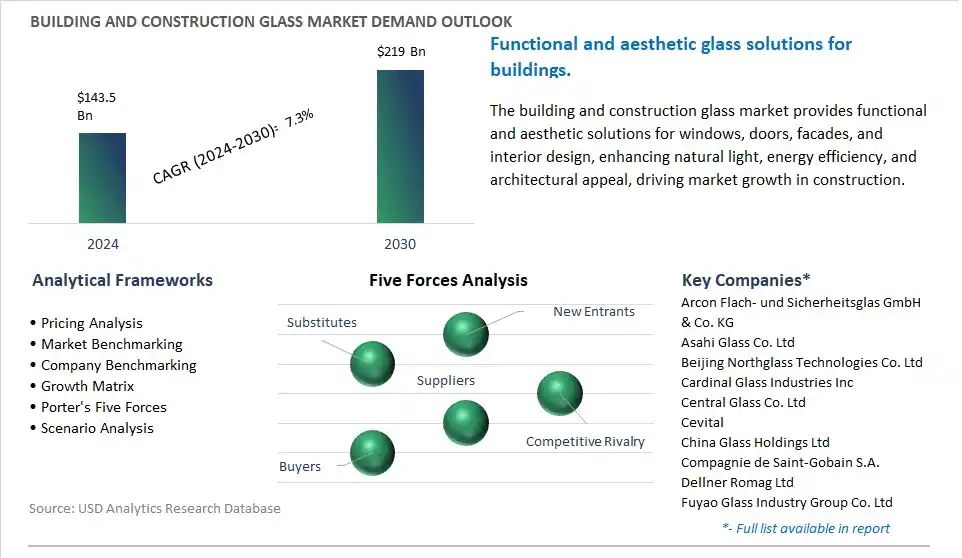
The global Building and Construction Glass Market is poised to register a 7.3% CAGR from $143.5 Billion in 2024 to $219 Billion in 2030.
The global Building and Construction Glass Market Study analyzes and forecasts the market size across 6 regions and 24 countries for diverse segments -By Type (Low-E Glass, Special Glass, Flat Glass, Laminated Glass, Toughened Glass, Others), By Manufacturing Process (Float Glass Process, Rolled/Sheet Process, Chemical Composition, Soda-Lime, Potash-Lime, Potash-Lead), By Application (Residential, Non-Residential).
An Introduction to Global Building and Construction Glass Market in 2024
The market for building and construction glass is advancing safety, energy efficiency, and design in modern buildings by offering innovative glass solutions that meet evolving architectural and performance requirements. Key trends shaping the future of this industry include advancements in glass technology, such as low-emissivity coatings, insulated glazing units, and laminated glass systems, which improve thermal insulation, solar control, and sound attenuation properties in buildings. Additionally, developments in glass manufacturing processes, including float glass production, glass tempering, and digital printing, enable the customization of glass products with various colors, patterns, and surface finishes to enhance aesthetic appeal and design versatility. Moreover, the integration of smart glass technologies, such as electrochromic glass, dynamic glazing, and integrated sensors, enhances occupant comfort, daylighting, and energy efficiency in buildings. As architects, developers, and building owners seek to create sustainable, comfortable, and visually appealing spaces, the demand for innovative building and construction glass solutions is expected to grow, driving further research, development, and market adoption in this dynamic segment of the construction materials industry.
Building and Construction Glass Market Competitive Landscape
The market report analyses the leading companies in the industry including Arcon Flach- und Sicherheitsglas GmbH & Co. KG, Asahi Glass Co. Ltd, Beijing Northglass Technologies Co. Ltd, Cardinal Glass Industries Inc, Central Glass Co. Ltd, Cevital, China Glass Holdings Ltd, Compagnie de Saint-Gobain S.A., Dellner Romag Ltd, Fuyao Glass Industry Group Co. Ltd, Guangzhou Topo Glass Co. Ltd, Guardian Industries, Nippon Sheet Glass Co. Ltd, Qingdao Tsing Glass Co. Ltd, SCHOTT AG, ÅžiÅŸecam Group, Taiwan Glass Ind. Corp, Xinyi Glass Holdings Ltd.
Building and Construction Glass Market Dynamics
Building and Construction Glass Market Trend: Increasing Demand for Energy-Efficient and Sustainable Buildings
A prominent trend in the market for building and construction glass is the increasing demand for energy-efficient and sustainable buildings. With growing concerns about climate change and energy consumption, there is a heightened focus on designing and constructing buildings that minimize environmental impact and maximize energy efficiency. Building and construction glass plays a crucial role in sustainable building design, offering solutions such as low-emissivity (low-E) coatings, insulated glass units (IGUs), and dynamic glass technologies that enhance thermal performance, daylighting, and occupant comfort while reducing heating, cooling, and lighting costs. As green building practices become more prevalent and as energy efficiency standards tighten, the demand for energy-efficient and sustainable glass solutions is expected to rise, driving market growth and innovation in glass manufacturing technologies.
Building and Construction Glass Market Driver: Urbanization and Infrastructure Development
A key driver behind the demand for building and construction glass is urbanization and infrastructure development. As populations grow, urban areas expand, and economic development accelerates, there is a rising demand for residential, commercial, institutional, and infrastructure projects worldwide. Building and construction glass is essential for creating modern and aesthetically appealing structures, including skyscrapers, office buildings, residential towers, retail centers, and transportation hubs. Glass facades, windows, doors, and partitions enhance building aesthetics, provide natural light, and create open and inviting spaces. As urbanization trends continue and as cities invest in infrastructure projects such as transportation systems, airports, and stadiums, the demand for building and construction glass is expected to remain strong, driving market expansion and investment in glass manufacturing capacity.
Building and Construction Glass Market Opportunity: Innovation in Smart Glass Technologies
An emerging opportunity in the market for building and construction glass lies in innovation in smart glass technologies. Opportunities exist to develop glass products with integrated smart features that enhance functionality, comfort, and sustainability in buildings. Smart glass technologies, such as electrochromic, thermochromic, and photochromic glass, offer dynamic control over light transmission, glare reduction, and solar heat gain, enabling occupants to optimize indoor environments according to their preferences and changing external conditions. Additionally, there is a growing demand for glass products that incorporate IoT (Internet of Things) sensors and connectivity, allowing for remote monitoring, automation, and energy management. By investing in research and development of smart glass technologies, manufacturers can differentiate their products in the market, cater to the evolving needs of architects and building owners, and capture new opportunities in sectors such as commercial real estate, hospitality, and smart cities. Embracing innovation in smart glass technologies can drive market growth and competitiveness in the building and construction glass industry, contributing to more sustainable and intelligent built environments.
Building and Construction Glass Market Ecosystem
The building and construction glass market involves diverse critical stages, with raw material supply from companies including sand mining firms, soda ash producers including Solvay and Tata Chemicals, limestone quarries, and specialty chemical suppliers. These materials undergo glass manufacturing processes, including the float glass method for flat glass production by established manufacturers including Asahi Glass Company and Saint-Gobain, and specialty glass production by companies including Schott Group. Maintenance services, provided by window cleaning companies and glazing contractors, involve periodic cleaning, inspection, and minor repairs.
Leading companies including Asahi Glass Company, Saint-Gobain, NSG Group, Schott Group, and Guardian Industries play pivotal roles in supplying raw materials, manufacturing various types of glass, coating for enhanced performance, distributing through diverse channels, providing installation services, and ensuring maintenance when necessary. Their collective efforts contribute to shaping modern architecture by offering transparency, aesthetics, and energy-efficient solutions to meet the evolving demands of the building and construction industry worldwide.
Building and Construction Glass Market Share Analysis: Flat Glass held the dominant revenue share in 2024
In the Building and Construction Glass Market, the largest segment is flat glass, and its dominance can be attributed to diverse key factors. Flat glass is widely used in various construction applications due to its versatility, affordability, and ease of manufacturing. It serves as the primary material for windows, doors, partitions, and facades in residential, commercial, and industrial buildings. The flat glass segment benefits from the increasing demand for natural light, energy efficiency, and aesthetic appeal in modern building design. Additionally, advancements in manufacturing processes have enabled the production of flat glass in large sizes and various thicknesses, catering to diverse architectural requirements. In addition, the flat glass segment offers a wide range of options, including clear, tinted, coated, and patterned glass, allowing architects and designers to create customized solutions for different projects. Further, the growing emphasis on green building practices and sustainability drives the demand for energy-efficient flat glass products, such as low-E glass and insulated glazing units, further solidifying the segment's position as the largest in the Building and Construction Glass Market. Overall, flat glass is the largest segment due to its versatility, affordability, and compatibility with modern architectural trends and sustainability goals.
Building and Construction Glass Market Share Analysis: Float Glass Process is the fastest growing market segment over the forecast period to 2030
In the Building and Construction Glass Market, the fastest-growing segment is the float glass process, driven by diverse significant factors. The float glass process offers numerous advantages over traditional manufacturing methods, including superior quality, consistency, and efficiency. This process involves pouring molten glass onto a bed of molten tin, resulting in a smooth and uniform surface that requires minimal additional processing. The float glass method enables the production of large sheets of glass with precise thickness and flatness, making it ideal for architectural applications such as windows, facades, and glass partitions. Additionally, the float glass process allows for the production of specialty glass products with enhanced properties, including low-E coatings, solar control coatings, and self-cleaning capabilities, to meet the increasing demand for energy-efficient and sustainable building materials. In addition, advancements in float glass technology, such as online coating and tempering processes, further enhance the performance and versatility of glass products, driving their adoption in the construction industry. Further, the growing trend toward urbanization, infrastructure development, and green building initiatives fuels the demand for high-quality float glass products, contributing to the rapid growth of this segment in the Building and Construction Glass Market. Overall, the float glass process is the fastest-growing segment due to its superior quality, efficiency, and ability to meet the evolving needs of the construction industry.
Building and Construction Glass Market Share Analysis: Non-Residential is the fastest growing market segment over the forecast period to 2030
In the Building and Construction Glass Market, the fastest-growing segment is non-residential applications, driven by diverse significant factors. Non-residential construction projects, including commercial buildings, offices, hotels, educational institutions, and healthcare facilities, are experiencing rapid growth due to urbanization, population expansion, and economic development. These projects require extensive use of glass for various applications such as facades, curtain walls, windows, and interior partitions to create modern and aesthetically appealing spaces. Additionally, the growing emphasis on energy efficiency, sustainability, and occupant comfort in non-residential buildings drives the demand for advanced glass solutions with features such as low-E coatings, solar control properties, and acoustic insulation. In addition, the rise of smart buildings and green building initiatives further fuels the adoption of innovative glass technologies that enhance building performance and reduce environmental impact. Further, the increasing investment in infrastructure projects, including transportation hubs, sports stadiums, and public amenities, presents opportunities for glass manufacturers to provide specialized solutions tailored to the unique requirements of non-residential applications, contributing to the segment's rapid growth in the Building and Construction Glass Market. Overall, the non-residential segment is experiencing fast growth due to the increasing demand for modern, sustainable, and technologically advanced glass solutions in commercial and institutional construction projects.
Building and Construction Glass Market Report Scope-
By Type
Low-E Glass
-Hard Coat Low-E-Glass
-Soft Coat Low-E-Glass
-Solar Coat Low-E-Glass
Special Glass
Flat Glass
Laminated Glass
Toughened Glass
Others
By Manufacturing Process
Float Glass Process
Rolled/Sheet Process
Chemical Composition
Soda-Lime
Potash-Lime
Potash-Lead
By Application
Residential
Non-Residential
Building and Construction Glass Market Companies Profiled
Arcon Flach- und Sicherheitsglas GmbH & Co. KG
Asahi Glass Co. Ltd
Beijing Northglass Technologies Co. Ltd
Cardinal Glass Industries Inc
Central Glass Co. Ltd
Cevital
China Glass Holdings Ltd
Compagnie de Saint-Gobain S.A.
Dellner Romag Ltd
Fuyao Glass Industry Group Co. Ltd
Guangzhou Topo Glass Co. Ltd
Guardian Industries
Nippon Sheet Glass Co. Ltd
Qingdao Tsing Glass Co. Ltd
SCHOTT AG
ÅžiÅŸecam Group
Taiwan Glass Ind. Corp
Xinyi Glass Holdings Ltd
*- List Not Exhaustive
TABLE OF CONTENTS
1 Introduction to 2024 Building and Construction Glass Market
1.1 Market Overview
1.2 Quick Facts
1.3 Scope/Objective of the Study
1.4 Market Definition
1.5 Countries and Regions Covered
1.6 Units, Currency, and Conversions
1.7 Industry Value Chain
2 Research Methodology
2.1 Market Size Estimation
2.2 Sources and Research Methodology
2.3 Data Triangulation
2.4 Assumptions and Limitations
3 Executive Summary
3.1 Global Building and Construction Glass Market Size Outlook, $ Million, 2021 to 2030
3.2 Building and Construction Glass Market Outlook by Type, $ Million, 2021 to 2030
3.3 Building and Construction Glass Market Outlook by Product, $ Million, 2021 to 2030
3.4 Building and Construction Glass Market Outlook by Application, $ Million, 2021 to 2030
3.5 Building and Construction Glass Market Outlook by Key Countries, $ Million, 2021 to 2030
4 Market Dynamics
4.1 Key Driving Forces of Building and Construction Glass Industry
4.2 Key Market Trends in Building and Construction Glass Industry
4.3 Potential Opportunities in Building and Construction Glass Industry
4.4 Key Challenges in Building and Construction Glass Industry
5 Market Factor Analysis
5.1 Value Chain Analysis
5.2 Competitive Landscape
5.2.1 Global Building and Construction Glass Market Share by Company (%), 2023
5.2.2 Product Offerings by Company
5.3 Porter’s Five Forces Analysis
5.4 Pricing Analysis and Outlook
6 Growth Outlook Across Scenarios
6.1 Growth Analysis-Case Scenario Definitions
6.2 Low Growth Scenario Forecasts
6.3 Reference Growth Scenario Forecasts
6.4 High Growth Scenario Forecasts
7 Global Building and Construction Glass Market Outlook by Segments
7.1 Building and Construction Glass Market Outlook by Segments, $ Million, 2021- 2030
By Type
Low-E Glass
-Hard Coat Low-E-Glass
-Soft Coat Low-E-Glass
-Solar Coat Low-E-Glass
Special Glass
Flat Glass
Laminated Glass
Toughened Glass
Others
By Manufacturing Process
Float Glass Process
Rolled/Sheet Process
Chemical Composition
Soda-Lime
Potash-Lime
Potash-Lead
By Application
Residential
Non-Residential
8 North America Building and Construction Glass Market Analysis and Outlook To 2030
8.1 Introduction to North America Building and Construction Glass Markets in 2024
8.2 North America Building and Construction Glass Market Size Outlook by Country, 2021-2030
8.2.1 United States
8.2.2 Canada
8.2.3 Mexico
8.3 North America Building and Construction Glass Market size Outlook by Segments, 2021-2030
By Type
Low-E Glass
-Hard Coat Low-E-Glass
-Soft Coat Low-E-Glass
-Solar Coat Low-E-Glass
Special Glass
Flat Glass
Laminated Glass
Toughened Glass
Others
By Manufacturing Process
Float Glass Process
Rolled/Sheet Process
Chemical Composition
Soda-Lime
Potash-Lime
Potash-Lead
By Application
Residential
Non-Residential
9 Europe Building and Construction Glass Market Analysis and Outlook To 2030
9.1 Introduction to Europe Building and Construction Glass Markets in 2024
9.2 Europe Building and Construction Glass Market Size Outlook by Country, 2021-2030
9.2.1 Germany
9.2.2 France
9.2.3 Spain
9.2.4 United Kingdom
9.2.4 Italy
9.2.5 Russia
9.2.6 Norway
9.2.7 Rest of Europe
9.3 Europe Building and Construction Glass Market Size Outlook by Segments, 2021-2030
By Type
Low-E Glass
-Hard Coat Low-E-Glass
-Soft Coat Low-E-Glass
-Solar Coat Low-E-Glass
Special Glass
Flat Glass
Laminated Glass
Toughened Glass
Others
By Manufacturing Process
Float Glass Process
Rolled/Sheet Process
Chemical Composition
Soda-Lime
Potash-Lime
Potash-Lead
By Application
Residential
Non-Residential
10 Asia Pacific Building and Construction Glass Market Analysis and Outlook To 2030
10.1 Introduction to Asia Pacific Building and Construction Glass Markets in 2024
10.2 Asia Pacific Building and Construction Glass Market Size Outlook by Country, 2021-2030
10.2.1 China
10.2.2 India
10.2.3 Japan
10.2.4 South Korea
10.2.5 Indonesia
10.2.6 Malaysia
10.2.7 Australia
10.2.8 Rest of Asia Pacific
10.3 Asia Pacific Building and Construction Glass Market size Outlook by Segments, 2021-2030
By Type
Low-E Glass
-Hard Coat Low-E-Glass
-Soft Coat Low-E-Glass
-Solar Coat Low-E-Glass
Special Glass
Flat Glass
Laminated Glass
Toughened Glass
Others
By Manufacturing Process
Float Glass Process
Rolled/Sheet Process
Chemical Composition
Soda-Lime
Potash-Lime
Potash-Lead
By Application
Residential
Non-Residential
11 South America Building and Construction Glass Market Analysis and Outlook To 2030
11.1 Introduction to South America Building and Construction Glass Markets in 2024
11.2 South America Building and Construction Glass Market Size Outlook by Country, 2021-2030
11.2.1 Brazil
11.2.2 Argentina
11.2.3 Rest of South America
11.3 South America Building and Construction Glass Market size Outlook by Segments, 2021-2030
By Type
Low-E Glass
-Hard Coat Low-E-Glass
-Soft Coat Low-E-Glass
-Solar Coat Low-E-Glass
Special Glass
Flat Glass
Laminated Glass
Toughened Glass
Others
By Manufacturing Process
Float Glass Process
Rolled/Sheet Process
Chemical Composition
Soda-Lime
Potash-Lime
Potash-Lead
By Application
Residential
Non-Residential
12 Middle East and Africa Building and Construction Glass Market Analysis and Outlook To 2030
12.1 Introduction to Middle East and Africa Building and Construction Glass Markets in 2024
12.2 Middle East and Africa Building and Construction Glass Market Size Outlook by Country, 2021-2030
12.2.1 Saudi Arabia
12.2.2 UAE
12.2.3 Oman
12.2.4 Rest of Middle East
12.2.5 Egypt
12.2.6 Nigeria
12.2.7 South Africa
12.2.8 Rest of Africa
12.3 Middle East and Africa Building and Construction Glass Market size Outlook by Segments, 2021-2030
By Type
Low-E Glass
-Hard Coat Low-E-Glass
-Soft Coat Low-E-Glass
-Solar Coat Low-E-Glass
Special Glass
Flat Glass
Laminated Glass
Toughened Glass
Others
By Manufacturing Process
Float Glass Process
Rolled/Sheet Process
Chemical Composition
Soda-Lime
Potash-Lime
Potash-Lead
By Application
Residential
Non-Residential
13 Company Profiles
13.1 Company Snapshot
13.2 SWOT Profiles
13.3 Products and Services
13.4 Recent Developments
13.5 Financial Profile
Arcon Flach- und Sicherheitsglas GmbH & Co. KG
Asahi Glass Co. Ltd
Beijing Northglass Technologies Co. Ltd
Cardinal Glass Industries Inc
Central Glass Co. Ltd
Cevital
China Glass Holdings Ltd
Compagnie de Saint-Gobain S.A.
Dellner Romag Ltd
Fuyao Glass Industry Group Co. Ltd
Guangzhou Topo Glass Co. Ltd
Guardian Industries
Nippon Sheet Glass Co. Ltd
Qingdao Tsing Glass Co. Ltd
SCHOTT AG
ÅžiÅŸecam Group
Taiwan Glass Ind. Corp
Xinyi Glass Holdings Ltd
14 Appendix
14.1 Customization Offerings
14.2 Subscription Services
14.3 Related Reports
14.4 Publisher Expertise
