Cancer Monoclonal Antibodies Market is estimated to increase at a growth rate of 19.5% CAGR over the forecast period from 2024 to 2030.
The Cancer Monoclonal Antibodies Market study analyzes and forecasts the market size across 6 regions and 24 countries for diverse segments including By Type (Humanized, Human, Chimeric, Murine), By Application (Blood Cancer, Breast Cancer, Lung Cancer, Melanoma, Colorectal Cancer, Liver Cancer, Others), By End-User (Hospitals, Research Institutes, Research Laboratories).
An Introduction to Cancer Monoclonal Antibodies Market in 2024
The Cancer Monoclonal Antibodies market in 2024 experiences robust growth driven by the expanding use of targeted immunotherapies in cancer treatment. Monoclonal antibodies, engineered to recognize and bind to specific antigens expressed on cancer cells, offer precise and potent anti-cancer effects while sparing normal tissues. Market dynamics are influenced by factors such as increasing adoption of immunotherapy across cancer types, advancements in antibody engineering and drug delivery technologies, and regulatory approvals for novel monoclonal antibody therapies. Collaboration between oncologists, immunologists, biopharmaceutical companies, and regulatory agencies drives innovation and market expansion in cancer monoclonal antibodies, leading to improved treatment outcomes and survival rates for cancer patients.
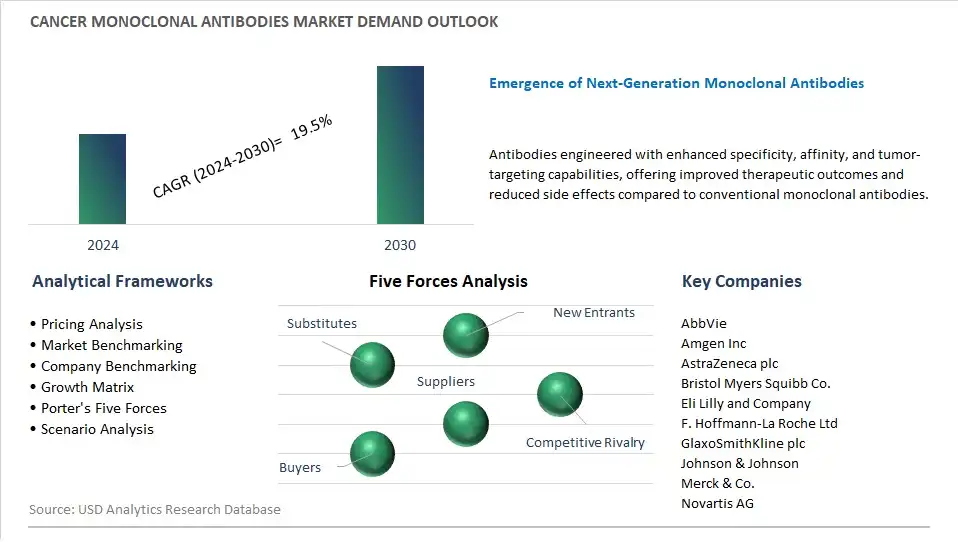
Cancer Monoclonal Antibodies Market Trend: Emergence of Next-Generation Monoclonal Antibodies
A prominent trend in the Cancer Monoclonal Antibodies market is the emergence of next-generation monoclonal antibodies. These antibodies are engineered with enhanced specificity, affinity, and tumor-targeting capabilities, offering improved therapeutic outcomes and reduced side effects compared to conventional monoclonal antibodies. Advanced technologies such as antibody-drug conjugates (ADCs), bispecific antibodies, and immune checkpoint inhibitors are driving innovation in the field, allowing for more precise targeting of cancer cells and modulation of immune responses. As researchers continue to optimize antibody design and develop novel therapeutic platforms, next-generation monoclonal antibodies are poised to revolutionize cancer treatment strategies.
Cancer Monoclonal Antibodies Market Driver: Increasing Incidence of Cancer and Rising Demand for Targeted Therapies
The primary driver for the Cancer Monoclonal Antibodies market is the increasing incidence of cancer and the rising demand for targeted therapies. Cancer remains a significant global health burden, with millions of new cases diagnosed each year, driving the need for effective and personalized treatment options. Monoclonal antibodies offer targeted and tailored approaches to cancer therapy by selectively binding to specific antigens expressed on cancer cells, thereby inhibiting tumor growth and promoting immune-mediated destruction. With growing awareness of the limitations of traditional chemotherapy and the desire for therapies with fewer side effects, there is escalating demand for monoclonal antibody-based treatments that can deliver superior efficacy and improved patient outcomes.
Cancer Monoclonal Antibodies Market Opportunity: Expansion into Combination Therapies and Immunotherapy Combinations
An opportunity in the Cancer Monoclonal Antibodies market lies in the expansion into combination therapies and immunotherapy combinations. Monoclonal antibodies have demonstrated significant clinical benefit as standalone treatments across various cancer types. However, their potential can be further optimized through strategic combinations with other therapeutic modalities, such as chemotherapy, radiation therapy, targeted therapies, and immunotherapies. Combination regimens can synergistically enhance anti-tumor immune responses, overcome treatment resistance, and improve overall response rates and survival outcomes for cancer patients. Additionally, there is increasing interest in combining monoclonal antibodies with immune checkpoint inhibitors, adoptive cell therapies, and cancer vaccines to unleash the full power of the immune system against cancer. By exploring innovative combination approaches, stakeholders in the Cancer Monoclonal Antibodies market can unlock new opportunities for addressing unmet medical needs and expanding their market presence.
Cancer Monoclonal Antibodies Market Segmentation
By Type
Humanized
Human
Chimeric
Murine
By Application
Blood Cancer
Breast Cancer
Lung Cancer
Melanoma
Colorectal Cancer
Liver Cancer
Others
By End-user
Hospitals
Research Institutes
Research Laboratories
Others
Geographical Analysis
North America (United States, Canada, Mexico)
Europe (Germany, France, United Kingdom, Spain, Italy, Rest of Europe)
Asia Pacific (China, India, Japan, South Korea, Rest of Asia Pacific)
South America (Brazil, Argentina, Rest of South America)
Middle East and Africa (Saudi Arabia, UAE, Rest of Middle East, South Africa, Egypt, Rest of Africa)
Cancer Monoclonal Antibodies Market Companies
AbbVie
Amgen Inc
AstraZeneca plc
Bristol Myers Squibb Co.
Eli Lilly and Company
F. Hoffmann-La Roche Ltd
GlaxoSmithKline plc
Johnson & Johnson
Merck & Co.
Novartis AG
Reasons to Buy the Cancer Monoclonal Antibodies Market Study
• Deepen your industry insights and navigate uncertainties for strategy formulation, CAPEX, and Operational decisions
• Gain access to detailed insights on the Cancer Monoclonal Antibodies Market, encompassing current market size, growth trends, and forecasts till 2030.
• Access detailed competitor analysis, enabling competitive advantage through a thorough understanding of market players, strategies, and potential differentiation opportunities
• Stay ahead of the curve with insights on technological advancements, innovations, and upcoming trends
• Identify lucrative investment avenues and expansion opportunities within the Cancer Monoclonal Antibodies Market industry, guided by robust, data-backed analysis.
• Understand regional and global markets through country-wise analysis, regional market potential, regulatory nuances, and dynamics
• Execute strategies with confidence and speed through information, analytics, and insights on the industry value chain
• Corporate leaders, strategists, financial experts, shareholders, asset managers, and governmental representatives can make long-term planning scenarios and build an integrated and timely understanding of market dynamics
• Benefit from tailored solutions and expert consultation based on report insights, providing personalized strategies aligned with specific business needs.
TABLE OF CONTENTS
1 Introduction to 2024 Cancer Monoclonal Antibodies Market
1.1 Market Overview
1.2 Quick Facts
1.3 Scope/Objective of the Study
1.4 Market Definition
1.5 Countries and Regions Analyzed
1.6 Units, Currency, and Conversions
1.7 Industry Value Chain
2 Research Methodology
2.1 Market Size Estimation
2.2 Sources and Research Methodology
2.3 Data Triangulation
2.4 Assumptions and Limitations
3 Executive Summary
3.1 Global Cancer Monoclonal Antibodies Market Size Outlook, $ Million, 2021 to 2030
3.2 Cancer Monoclonal Antibodies Market Outlook by Type, $ Million, 2021 to 2030
3.3 Cancer Monoclonal Antibodies Market Outlook by Product, $ Million, 2021 to 2030
3.4 Cancer Monoclonal Antibodies Market Outlook by Application, $ Million, 2021 to 2030
3.5 Cancer Monoclonal Antibodies Market Outlook by Key Countries, $ Million, 2021 to 2030
4 Market Dynamics
4.1 Key Driving Forces of Cancer Monoclonal Antibodies Market Industry
4.2 Key Market Trends in Cancer Monoclonal Antibodies Market Industry
4.3 Potential Opportunities in Cancer Monoclonal Antibodies Market Industry
4.4 Key Challenges in Cancer Monoclonal Antibodies Market Industry
5 Market Factor Analysis
5.1 Competitive Landscape
5.1.1 Global Cancer Monoclonal Antibodies Market Share by Company (%), 2023
5.1.2 Product Offerings by Company
5.2 Porter’s Five Forces Analysis
6 Growth Outlook Across Scenarios
6.1 Growth Analysis-Case Scenario Definitions
6.2 Low Growth Scenario Forecasts
6.3 Reference Growth Scenario Forecasts
6.4 High Growth Scenario Forecasts
7 Global Cancer Monoclonal Antibodies Market Outlook By Segments
7.1 Cancer Monoclonal Antibodies Market Outlook by Segments
By Type
Humanized
Human
Chimeric
Murine
By Application
Blood Cancer
Breast Cancer
Lung Cancer
Melanoma
Colorectal Cancer
Liver Cancer
Others
By End-user
Hospitals
Research Institutes
Research Laboratories
Others
8 North America Cancer Monoclonal Antibodies Market Analysis And Outlook To 2030
8.1 Introduction to North America Cancer Monoclonal Antibodies Markets in 2024
8.2 North America Cancer Monoclonal Antibodies Market Size Outlook by Country, 2021-2030
8.2.1 United States
8.2.2 Canada
8.2.3 Mexico
8.3 North America Cancer Monoclonal Antibodies Market size Outlook by Segments, 2021-2030
By Type
Humanized
Human
Chimeric
Murine
By Application
Blood Cancer
Breast Cancer
Lung Cancer
Melanoma
Colorectal Cancer
Liver Cancer
Others
By End-user
Hospitals
Research Institutes
Research Laboratories
Others
9 Europe Cancer Monoclonal Antibodies Market Analysis And Outlook To 2030
9.1 Introduction to Europe Cancer Monoclonal Antibodies Markets in 2024
9.2 Europe Cancer Monoclonal Antibodies Market Size Outlook by Country, 2021-2030
9.2.1 Germany
9.2.2 France
9.2.3 Spain
9.2.4 United Kingdom
9.2.4 Italy
9.2.5 Russia
9.2.6 Norway
9.2.7 Rest of Europe
9.3 Europe Cancer Monoclonal Antibodies Market Size Outlook By Segments, 2021-2030
By Type
Humanized
Human
Chimeric
Murine
By Application
Blood Cancer
Breast Cancer
Lung Cancer
Melanoma
Colorectal Cancer
Liver Cancer
Others
By End-user
Hospitals
Research Institutes
Research Laboratories
Others
10 Asia Pacific Cancer Monoclonal Antibodies Market Analysis And Outlook To 2030
10.1 Introduction to Asia Pacific Cancer Monoclonal Antibodies Markets in 2024
10.2 Asia Pacific Cancer Monoclonal Antibodies Market Size Outlook by Country, 2021-2030
10.2.1 China
10.2.2 India
10.2.3 Japan
10.2.4 South Korea
10.2.5 Indonesia
10.2.6 Malaysia
10.2.7 Australia
10.2.8 Rest of Asia Pacific
10.3 Asia Pacific Cancer Monoclonal Antibodies Market size Outlook by Segments, 2021-2030
By Type
Humanized
Human
Chimeric
Murine
By Application
Blood Cancer
Breast Cancer
Lung Cancer
Melanoma
Colorectal Cancer
Liver Cancer
Others
By End-user
Hospitals
Research Institutes
Research Laboratories
Others
11 South America Cancer Monoclonal Antibodies Market Analysis And Outlook To 2030
11.1 Introduction to South America Cancer Monoclonal Antibodies Markets in 2024
11.2 South America Cancer Monoclonal Antibodies Market Size Outlook by Country, 2021-2030
11.2.1 Brazil
11.2.2 Argentina
11.2.3 Rest of South America
11.3 South America Cancer Monoclonal Antibodies Market size Outlook by Segments, 2021-2030
By Type
Humanized
Human
Chimeric
Murine
By Application
Blood Cancer
Breast Cancer
Lung Cancer
Melanoma
Colorectal Cancer
Liver Cancer
Others
By End-user
Hospitals
Research Institutes
Research Laboratories
Others
12 Middle East And Africa Cancer Monoclonal Antibodies Market Analysis And Outlook To 2030
12.1 Introduction to Middle East and Africa Cancer Monoclonal Antibodies Markets in 2024
12.2 Middle East and Africa Cancer Monoclonal Antibodies Market Size Outlook by Country, 2021-2030
12.2.1 Saudi Arabia
12.2.2 UAE
12.2.3 Oman
12.2.4 Rest of Middle East
12.2.5 Egypt
12.2.6 Nigeria
12.2.7 South Africa
12.2.8 Rest of Africa
12.3 Middle East and Africa Cancer Monoclonal Antibodies Market size Outlook by Segments, 2021-2030
By Type
Humanized
Human
Chimeric
Murine
By Application
Blood Cancer
Breast Cancer
Lung Cancer
Melanoma
Colorectal Cancer
Liver Cancer
Others
By End-user
Hospitals
Research Institutes
Research Laboratories
Others
13 Company Profiles
13.1 Company Snapshot
13.2 SWOT Profiles
13.3 Products and Services
13.4 Recent Developments
13.5 Financial Profile
List of Companies
AbbVie
Amgen Inc
AstraZeneca plc
Bristol Myers Squibb Co.
Eli Lilly and Company
F. Hoffmann-La Roche Ltd
GlaxoSmithKline plc
Johnson & Johnson
Merck & Co.
Novartis AG
14 Appendix
14.1 Customization Offerings
14.2 Subscription Services
14.3 Related Reports
14.4 Publisher Expertise
By Type
Humanized
Human
Chimeric
Murine
By Application
Blood Cancer
Breast Cancer
Lung Cancer
Melanoma
Colorectal Cancer
Liver Cancer
Others
By End-user
Hospitals
Research Institutes
Research Laboratories
Others
