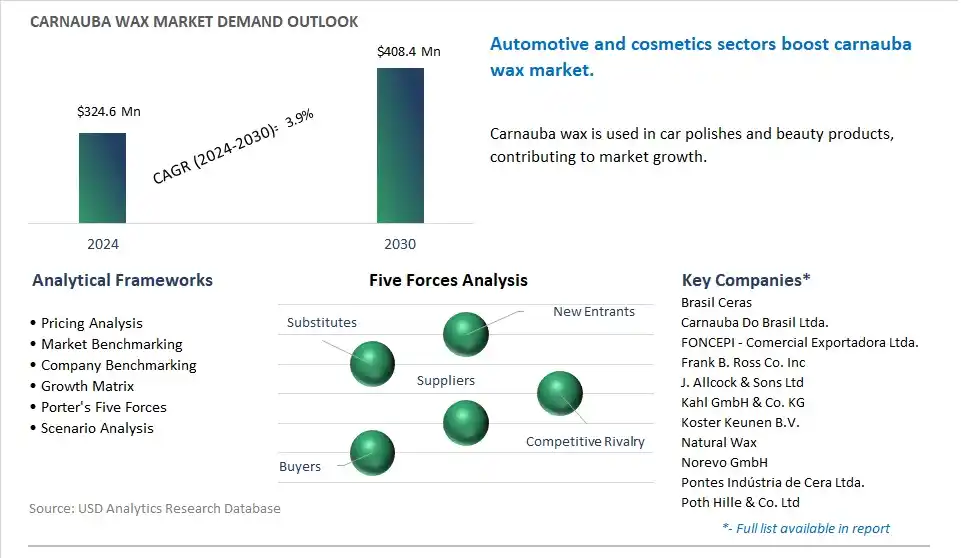
The global Carnauba Wax Market is poised to register a 3.9% CAGR from $324.6 Million in 2024 to $408.4 Million in 2030.
The global Carnauba Wax Market Study analyzes and forecasts the market size across 6 regions and 24 countries for diverse segments -By Product (Type 1, Type 3, Type 4), By Application (Cosmetics, Food, Automotive, Pharmaceutical, Others).
An Introduction to Global Carnauba Wax Market in 2024
The carnauba wax market is experiencing significant growth driven by its versatile applications in industries such as cosmetics, food, pharmaceuticals, and automotive. Key trends shaping the future of the industry include the increasing demand for natural and sustainable ingredients in consumer products, driven by consumer awareness of environmental sustainability and health-consciousness. As consumers seek eco-friendly alternatives to synthetic additives and petroleum-based ingredients, there's a growing need for carnauba wax as a natural wax derived from the leaves of the carnauba palm tree, particularly in cosmetics and personal care products such as lip balms, lipsticks, and hair waxes. Moreover, the expanding applications of carnauba wax in food and confectionery products such as chocolate coatings, chewing gum, and fruit coatings as a glazing agent and surface finisher are fueling demand in the food industry. Additionally, the rising adoption of carnauba wax in pharmaceutical formulations such as tablets, capsules, and ointments as a coating and binder is driving market expansion in the pharmaceutical sector. Furthermore, advancements in carnauba wax refining and processing technologies, as well as sustainable harvesting and cultivation practices, are ensuring product quality, purity, and sustainability while meeting ethical and environmental standards.
Carnauba Wax Market Competitive Landscape
The market report analyses the leading companies in the industry including Brasil Ceras, Carnauba Do Brasil Ltda., FONCEPI - Comercial Exportadora Ltda., Frank B. Ross Co. Inc, J. Allcock & Sons Ltd, Kahl GmbH & Co. KG, Koster Keunen B.V., Natural Wax, Norevo GmbH, Pontes Indústria de Cera Ltda., Poth Hille & Co. Ltd, Strahl & Pitsch Inc, ter Hell & Co. GmbH, The International Group Inc, Tropical Ceras Do Brasil Ltda..
Carnauba Wax Market Dynamics
Carnauba Wax Market Trend: Growing Demand for Natural and Sustainable Ingredients
A prominent trend in the carnauba wax market is the growing demand for natural and sustainable ingredients. Carnauba wax, derived from the leaves of the carnauba palm tree, is a natural wax widely used in various industries such as food, cosmetics, pharmaceuticals, and automotive. With increasing consumer awareness about environmental issues and preference for eco-friendly products, there is a rising demand for natural alternatives to synthetic additives and chemicals. Carnauba wax is prized for its natural origin, biodegradability, and versatility, making it a preferred choice for manufacturers seeking sustainable ingredients for their formulations. As industries strive to meet consumer demands for clean-label and environmentally friendly products, there is a trend towards the use of carnauba wax as a natural and renewable ingredient, driving its demand across diverse applications.
Carnauba Wax Market Driver: Expansion in Cosmetics and Personal Care Industry
A primary driver fueling the carnauba wax market is the expansion in the cosmetics and personal care industry, where carnauba wax is widely used in formulations for skincare, haircare, and color cosmetics. Carnauba wax offers unique properties such as emolliency, gloss, and film-forming capabilities, making it a valuable ingredient in cosmetic products such as lipsticks, lip balms, mascaras, creams, and hair styling products. With the growth of the global beauty and personal care market, driven by changing consumer lifestyles, beauty trends, and emerging markets, there is an increasing demand for high-performance and natural ingredients in cosmetic formulations. Carnauba wax, known for its natural shine and texture-enhancing properties, is favored by formulators seeking to create luxurious and sustainable beauty products. As the demand for natural and plant-based cosmetics continues to rise, the demand for carnauba wax as a key ingredient in cosmetic formulations is expected to grow, providing opportunities for suppliers and manufacturers in the carnauba wax market.
Carnauba Wax Market Opportunity: Diversification into Food and Pharmaceutical Applications
An opportunity within the carnauba wax market lies in diversification into food and pharmaceutical applications beyond traditional uses in cosmetics and personal care products. While the cosmetics industry represents a significant market segment for carnauba wax, there is potential to explore new applications in sectors such as food, pharmaceuticals, and nutraceuticals. Carnauba wax is recognized as safe for use in food and pharmaceutical applications by regulatory agencies such as the U.S. Food and Drug Administration (FDA) and the European Food Safety Authority (EFSA). It is commonly used as a glazing agent, coating agent, and surface finish in food products such as confectionery, chewing gum, and pharmaceutical tablets. Additionally, carnauba wax is utilized as a release agent and binder in pharmaceutical formulations. By expanding product offerings and targeting niche markets in the food and pharmaceutical sectors, carnauba wax manufacturers can diversify their customer base, penetrate new applications, and capitalize on the growing demand for natural and sustainable ingredients in these regulated industries.
Carnauba Wax Market Share Analysis: Type 1 segment generated the highest revenue in the industry
The Type 1 segment is the largest in the Carnauba Wax Market. Type 1 carnauba wax, also known as prime yellow wax, is the highest grade of carnauba wax available, distinguished by its superior quality and purity. This grade of carnauba wax undergoes a meticulous refining process to remove impurities and achieve a high level of clarity and consistency. Type 1 carnauba wax is valued for its glossy finish, hardness, and durability, making it suitable for various applications across industries such as cosmetics, pharmaceuticals, food, and automotive. Due to its premium quality and versatility, Type 1 carnauba wax commands higher prices compared to other grades, driving its dominance in the market. Additionally, Type 1 carnauba wax is preferred by manufacturers seeking the highest quality ingredients for their products, further contributing to its prominence in the Carnauba Wax Market.
Carnauba Wax Market Share Analysis: Cosmetics Segment is poised to register the fastest growth rate (CAGR) over the forecast period to 2030
The Cosmetics segment is the fastest-growing category in the Carnauba Wax Market. Diverse factors contribute to the rapid growth of carnauba wax in cosmetics applications. The there is an increasing demand for natural and sustainable ingredients in cosmetic formulations, driven by consumer preferences for clean beauty products. Carnauba wax, derived from the leaves of the Brazilian palm tree Copernicia prunifera, is a natural and eco-friendly alternative to synthetic waxes and petroleum-derived ingredients commonly used in cosmetics. Additionally, carnauba wax offers unique properties such as glossy shine, emollient texture, and film-forming capabilities, making it ideal for use in various cosmetic products such as lipsticks, mascaras, foundations, and creams. In addition, carnauba wax is compatible with a wide range of cosmetic formulations and provides excellent stability and adherence to the skin, enhancing the performance and aesthetic appeal of cosmetic products. Further, as cosmetic brands prioritize transparency and sustainability in their product offerings, the demand for carnauba wax as a natural and renewable ingredient in cosmetics is expected to increase, driving its growth in the Cosmetics segment of the Carnauba Wax Market.
Carnauba Wax Market Report Segmentation
By Product
Type 1
Type 3
Type 4
By Application
Cosmetics
Food
Automotive
Pharmaceutical
Others
Regions Included
North America (US, Canada, Mexico)
Europe (Germany, UK, France, Spain, Italy, Russia, Rest of Europe)
Asia Pacific (China, India, Japan, South Korea, Australia, South East Asia, Rest of Asia)
South America (Brazil, Argentina, Rest of South America)
Middle East and Africa (Saudi Arabia, UAE, Rest of Middle East, South Africa, Egypt, Rest of Africa)
Carnauba Wax Companies Profiled in the Market Study
Brasil Ceras
Carnauba Do Brasil Ltda.
FONCEPI - Comercial Exportadora Ltda.
Frank B. Ross Co. Inc
J. Allcock & Sons Ltd
Kahl GmbH & Co. KG
Koster Keunen B.V.
Natural Wax
Norevo GmbH
Pontes Indústria de Cera Ltda.
Poth Hille & Co. Ltd
Strahl & Pitsch Inc
ter Hell & Co. GmbH
The International Group Inc
Tropical Ceras Do Brasil Ltda.
*- List Not Exhaustive
TABLE OF CONTENTS
1 Introduction to 2024 Carnauba Wax Market
1.1 Market Overview
1.2 Quick Facts
1.3 Scope/Objective of the Study
1.4 Market Definition
1.5 Countries and Regions Covered
1.6 Units, Currency, and Conversions
1.7 Industry Value Chain
2 Research Methodology
2.1 Market Size Estimation
2.2 Sources and Research Methodology
2.3 Data Triangulation
2.4 Assumptions and Limitations
3 Executive Summary
3.1 Global Carnauba Wax Market Size Outlook, $ Million, 2021 to 2030
3.2 Carnauba Wax Market Outlook by Type, $ Million, 2021 to 2030
3.3 Carnauba Wax Market Outlook by Product, $ Million, 2021 to 2030
3.4 Carnauba Wax Market Outlook by Application, $ Million, 2021 to 2030
3.5 Carnauba Wax Market Outlook by Key Countries, $ Million, 2021 to 2030
4 Market Dynamics
4.1 Key Driving Forces of Carnauba Wax Industry
4.2 Key Market Trends in Carnauba Wax Industry
4.3 Potential Opportunities in Carnauba Wax Industry
4.4 Key Challenges in Carnauba Wax Industry
5 Market Factor Analysis
5.1 Value Chain Analysis
5.2 Competitive Landscape
5.2.1 Global Carnauba Wax Market Share by Company (%), 2023
5.2.2 Product Offerings by Company
5.3 Porter’s Five Forces Analysis
5.4 Pricing Analysis and Outlook
6 Growth Outlook Across Scenarios
6.1 Growth Analysis-Case Scenario Definitions
6.2 Low Growth Scenario Forecasts
6.3 Reference Growth Scenario Forecasts
6.4 High Growth Scenario Forecasts
7 Global Carnauba Wax Market Outlook by Segments
7.1 Carnauba Wax Market Outlook by Segments, $ Million, 2021- 2030
By Product
Type 1
Type 3
Type 4
By Application
Cosmetics
Food
Automotive
Pharmaceutical
Others
8 North America Carnauba Wax Market Analysis and Outlook To 2030
8.1 Introduction to North America Carnauba Wax Markets in 2024
8.2 North America Carnauba Wax Market Size Outlook by Country, 2021-2030
8.2.1 United States
8.2.2 Canada
8.2.3 Mexico
8.3 North America Carnauba Wax Market size Outlook by Segments, 2021-2030
By Product
Type 1
Type 3
Type 4
By Application
Cosmetics
Food
Automotive
Pharmaceutical
Others
9 Europe Carnauba Wax Market Analysis and Outlook To 2030
9.1 Introduction to Europe Carnauba Wax Markets in 2024
9.2 Europe Carnauba Wax Market Size Outlook by Country, 2021-2030
9.2.1 Germany
9.2.2 France
9.2.3 Spain
9.2.4 United Kingdom
9.2.4 Italy
9.2.5 Russia
9.2.6 Norway
9.2.7 Rest of Europe
9.3 Europe Carnauba Wax Market Size Outlook by Segments, 2021-2030
By Product
Type 1
Type 3
Type 4
By Application
Cosmetics
Food
Automotive
Pharmaceutical
Others
10 Asia Pacific Carnauba Wax Market Analysis and Outlook To 2030
10.1 Introduction to Asia Pacific Carnauba Wax Markets in 2024
10.2 Asia Pacific Carnauba Wax Market Size Outlook by Country, 2021-2030
10.2.1 China
10.2.2 India
10.2.3 Japan
10.2.4 South Korea
10.2.5 Indonesia
10.2.6 Malaysia
10.2.7 Australia
10.2.8 Rest of Asia Pacific
10.3 Asia Pacific Carnauba Wax Market size Outlook by Segments, 2021-2030
By Product
Type 1
Type 3
Type 4
By Application
Cosmetics
Food
Automotive
Pharmaceutical
Others
11 South America Carnauba Wax Market Analysis and Outlook To 2030
11.1 Introduction to South America Carnauba Wax Markets in 2024
11.2 South America Carnauba Wax Market Size Outlook by Country, 2021-2030
11.2.1 Brazil
11.2.2 Argentina
11.2.3 Rest of South America
11.3 South America Carnauba Wax Market size Outlook by Segments, 2021-2030
By Product
Type 1
Type 3
Type 4
By Application
Cosmetics
Food
Automotive
Pharmaceutical
Others
12 Middle East and Africa Carnauba Wax Market Analysis and Outlook To 2030
12.1 Introduction to Middle East and Africa Carnauba Wax Markets in 2024
12.2 Middle East and Africa Carnauba Wax Market Size Outlook by Country, 2021-2030
12.2.1 Saudi Arabia
12.2.2 UAE
12.2.3 Oman
12.2.4 Rest of Middle East
12.2.5 Egypt
12.2.6 Nigeria
12.2.7 South Africa
12.2.8 Rest of Africa
12.3 Middle East and Africa Carnauba Wax Market size Outlook by Segments, 2021-2030
By Product
Type 1
Type 3
Type 4
By Application
Cosmetics
Food
Automotive
Pharmaceutical
Others
13 Company Profiles
13.1 Company Snapshot
13.2 SWOT Profiles
13.3 Products and Services
13.4 Recent Developments
13.5 Financial Profile
Brasil Ceras
Carnauba Do Brasil Ltda.
FONCEPI - Comercial Exportadora Ltda.
Frank B. Ross Co. Inc
J. Allcock & Sons Ltd
Kahl GmbH & Co. KG
Koster Keunen B.V.
Natural Wax
Norevo GmbH
Pontes Indústria de Cera Ltda.
Poth Hille & Co. Ltd
Strahl & Pitsch Inc
ter Hell & Co. GmbH
The International Group Inc
Tropical Ceras Do Brasil Ltda.
14 Appendix
14.1 Customization Offerings
14.2 Subscription Services
14.3 Related Reports
14.4 Publisher Expertise
By Product
Type 1
Type 3
Type 4
By Application
Cosmetics
Food
Automotive
Pharmaceutical
Others
Countries Analyzed
North America (US, Canada, Mexico)
Europe (Germany, UK, France, Spain, Italy, Russia, Rest of Europe)
Asia Pacific (China, India, Japan, South Korea, Australia, South East Asia, Rest of Asia)
South America (Brazil, Argentina, Rest of South America)
Middle East and Africa (Saudi Arabia, UAE, Rest of Middle East, South Africa, Egypt, Rest of Africa)
