
The global Cattle Feed Market Study analyzes and forecasts the market size across 6 regions and 24 countries for diverse segments -By Animal (Dairy Cattle, Beef Cattle, Others), By Ingredient (Cereals, Cakes and Mixes, Food Wastages, Feed Additives, Others).
The market for cattle feed is meeting the growing demand for nutritious and sustainable livestock nutrition, with key trends focused on optimizing feed formulations, enhancing feed efficiency, and reducing environmental impact. With rising global demand for meat and dairy products, livestock producers are seeking cost-effective and environmentally responsible feed solutions to maximize animal health and productivity. Key trends include advancements in feed ingredients and additives, such as protein supplements, vitamins, minerals, and enzymes, to meet the nutritional requirements of cattle at different life stages and production systems. Additionally, there is a growing emphasis on feed efficiency and sustainability, with strategies such as precision feeding, feed additives to reduce methane emissions, and utilization of co-products from food and biofuel industries. Moreover, the adoption of digital technologies and data analytics enables precision management of feed resources and monitoring of animal performance, optimizing production efficiency and resource utilization. As the livestock industry faces challenges related to resource constraints and environmental sustainability, the demand for innovative and sustainable cattle feed solutions is expected to grow, driving further research, development, and market adoption in this critical sector of animal nutrition.
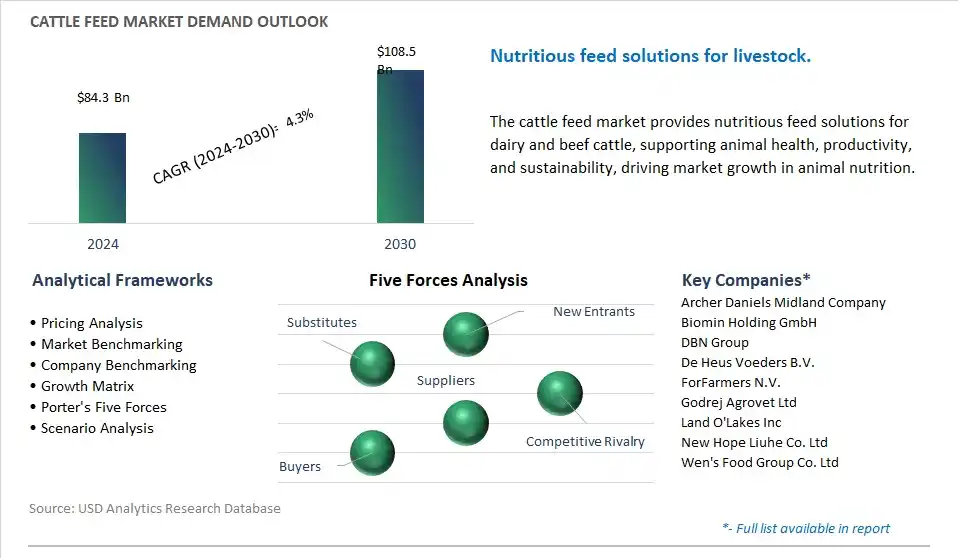
The market report analyses the leading companies in the industry including Archer Daniels Midland Company, Biomin Holding GmbH, DBN Group, De Heus Voeders B.V., ForFarmers N.V., Godrej Agrovet Ltd, Land O'Lakes Inc, New Hope Liuhe Co. Ltd, Wen's Food Group Co. Ltd.
A prominent trend in the market for cattle feed is the increasing demand for nutrient-rich and customized feed solutions. With the growing focus on optimizing animal health, performance, and productivity, there is a rising preference among livestock producers for feed formulations that are tailored to the specific nutritional needs of their cattle. As consumers demand high-quality dairy and meat products, there is pressure on producers to ensure that their cattle receive balanced diets that promote growth, milk production, and overall well-being. The trend is driving the adoption of specialized feed ingredients, additives, and supplements that enhance the nutritional profile of cattle feed, meeting the evolving needs of the livestock industry and driving investments in research and development to develop innovative feed solutions.
A significant driver fueling the demand for cattle feed is the growth of the livestock industry and intensification of production practices. With increasing global population and rising affluence, there is growing demand for meat, dairy, and other animal products, driving expansion and consolidation within the livestock sector. As producers seek to maximize efficiency and profitability, there is a need for feed solutions that optimize feed conversion, reduce feed costs, and improve animal performance. This driver is further supported by technological advancements in animal nutrition, genetics, and management practices, enabling producers to achieve higher levels of productivity and profitability through optimized feeding strategies, herd management, and health monitoring, driving the demand for high-quality cattle feed products and driving investments in infrastructure and supply chain capabilities.
An opportunity within the market for cattle feed lies in the development of sustainable and alternative feed ingredients. With growing concerns about the environmental impact of livestock production, there is increasing interest in sustainable feed solutions that reduce reliance on conventional feed ingredients such as grains and soybeans, which are associated with land use change, deforestation, and greenhouse gas emissions. There is opportunity to explore alternative feed sources such as insect meal, algae, and food waste, which offer potential advantages such as lower environmental footprint, improved nutrient utilization, and reduced competition with human food sources. By capitalizing on this opportunity and investing in research and development of sustainable feed ingredients, feed manufacturers can meet the growing demand for environmentally responsible feed solutions, differentiate their products in the marketplace, and contribute to the sustainability of the livestock industry.
The largest segment in the Cattle Feed market is Dairy Cattle. Dairy cattle feed constitutes a substantial portion of the overall market due to the extensive dairy industry worldwide. Dairy cattle require specialized feed formulations to support milk production and overall health, driving the demand for various types of cattle feed such as forage, concentrates, and supplements. This segment's prominence is further amplified by the growing consumption of dairy products globally and the need to optimize milk yield and quality, making it the largest segment within the cattle feed market.
The fastest-growing segment in the Cattle Feed market is Feed Additives. With advancements in animal nutrition and a growing focus on improving cattle health and productivity, the demand for feed additives such as vitamins, minerals, amino acids, and enzymes has surged. These additives play a crucial role in enhancing feed efficiency, immune function, and overall animal performance, leading to increased adoption among cattle farmers. Additionally, regulatory changes promoting the use of safe and effective feed additives further contribute to the rapid growth of this segment within the cattle feed market.
By Animal
Dairy Cattle
Beef Cattle
Others
By Ingredient
Cereals
Cakes and Mixes
Food Wastages
Feed Additives
Others
Regions Included
North America (US, Canada, Mexico)
Europe (Germany, UK, France, Spain, Italy, Russia, Rest of Europe)
Asia Pacific (China, India, Japan, South Korea, Australia, South East Asia, Rest of Asia)
South America (Brazil, Argentina, Rest of South America)
Middle East and Africa (Saudi Arabia, UAE, Rest of Middle East, South Africa, Egypt, Rest of Africa)
Archer Daniels Midland Company
Biomin Holding GmbH
DBN Group
De Heus Voeders B.V.
ForFarmers N.V.
Godrej Agrovet Ltd
Land O'Lakes Inc
New Hope Liuhe Co. Ltd
Wen's Food Group Co. Ltd
*- List Not Exhaustive
TABLE OF CONTENTS
1 Introduction to 2024 Cattle Feed Market
1.1 Market Overview
1.2 Quick Facts
1.3 Scope/Objective of the Study
1.4 Market Definition
1.5 Countries and Regions Covered
1.6 Units, Currency, and Conversions
1.7 Industry Value Chain
2 Research Methodology
2.1 Market Size Estimation
2.2 Sources and Research Methodology
2.3 Data Triangulation
2.4 Assumptions and Limitations
3 Executive Summary
3.1 Global Cattle Feed Market Size Outlook, $ Million, 2021 to 2030
3.2 Cattle Feed Market Outlook by Type, $ Million, 2021 to 2030
3.3 Cattle Feed Market Outlook by Product, $ Million, 2021 to 2030
3.4 Cattle Feed Market Outlook by Application, $ Million, 2021 to 2030
3.5 Cattle Feed Market Outlook by Key Countries, $ Million, 2021 to 2030
4 Market Dynamics
4.1 Key Driving Forces of Cattle Feed Industry
4.2 Key Market Trends in Cattle Feed Industry
4.3 Potential Opportunities in Cattle Feed Industry
4.4 Key Challenges in Cattle Feed Industry
5 Market Factor Analysis
5.1 Value Chain Analysis
5.2 Competitive Landscape
5.2.1 Global Cattle Feed Market Share by Company (%), 2023
5.2.2 Product Offerings by Company
5.3 Porter’s Five Forces Analysis
5.4 Pricing Analysis and Outlook
6 Growth Outlook Across Scenarios
6.1 Growth Analysis-Case Scenario Definitions
6.2 Low Growth Scenario Forecasts
6.3 Reference Growth Scenario Forecasts
6.4 High Growth Scenario Forecasts
7 Global Cattle Feed Market Outlook by Segments
7.1 Cattle Feed Market Outlook by Segments, $ Million, 2021- 2030
By Animal
Dairy Cattle
Beef Cattle
Others
By Ingredient
Cereals
Cakes and Mixes
Food Wastages
Feed Additives
Others
8 North America Cattle Feed Market Analysis and Outlook To 2030
8.1 Introduction to North America Cattle Feed Markets in 2024
8.2 North America Cattle Feed Market Size Outlook by Country, 2021-2030
8.2.1 United States
8.2.2 Canada
8.2.3 Mexico
8.3 North America Cattle Feed Market size Outlook by Segments, 2021-2030
By Animal
Dairy Cattle
Beef Cattle
Others
By Ingredient
Cereals
Cakes and Mixes
Food Wastages
Feed Additives
Others
9 Europe Cattle Feed Market Analysis and Outlook To 2030
9.1 Introduction to Europe Cattle Feed Markets in 2024
9.2 Europe Cattle Feed Market Size Outlook by Country, 2021-2030
9.2.1 Germany
9.2.2 France
9.2.3 Spain
9.2.4 United Kingdom
9.2.4 Italy
9.2.5 Russia
9.2.6 Norway
9.2.7 Rest of Europe
9.3 Europe Cattle Feed Market Size Outlook by Segments, 2021-2030
By Animal
Dairy Cattle
Beef Cattle
Others
By Ingredient
Cereals
Cakes and Mixes
Food Wastages
Feed Additives
Others
10 Asia Pacific Cattle Feed Market Analysis and Outlook To 2030
10.1 Introduction to Asia Pacific Cattle Feed Markets in 2024
10.2 Asia Pacific Cattle Feed Market Size Outlook by Country, 2021-2030
10.2.1 China
10.2.2 India
10.2.3 Japan
10.2.4 South Korea
10.2.5 Indonesia
10.2.6 Malaysia
10.2.7 Australia
10.2.8 Rest of Asia Pacific
10.3 Asia Pacific Cattle Feed Market size Outlook by Segments, 2021-2030
By Animal
Dairy Cattle
Beef Cattle
Others
By Ingredient
Cereals
Cakes and Mixes
Food Wastages
Feed Additives
Others
11 South America Cattle Feed Market Analysis and Outlook To 2030
11.1 Introduction to South America Cattle Feed Markets in 2024
11.2 South America Cattle Feed Market Size Outlook by Country, 2021-2030
11.2.1 Brazil
11.2.2 Argentina
11.2.3 Rest of South America
11.3 South America Cattle Feed Market size Outlook by Segments, 2021-2030
By Animal
Dairy Cattle
Beef Cattle
Others
By Ingredient
Cereals
Cakes and Mixes
Food Wastages
Feed Additives
Others
12 Middle East and Africa Cattle Feed Market Analysis and Outlook To 2030
12.1 Introduction to Middle East and Africa Cattle Feed Markets in 2024
12.2 Middle East and Africa Cattle Feed Market Size Outlook by Country, 2021-2030
12.2.1 Saudi Arabia
12.2.2 UAE
12.2.3 Oman
12.2.4 Rest of Middle East
12.2.5 Egypt
12.2.6 Nigeria
12.2.7 South Africa
12.2.8 Rest of Africa
12.3 Middle East and Africa Cattle Feed Market size Outlook by Segments, 2021-2030
By Animal
Dairy Cattle
Beef Cattle
Others
By Ingredient
Cereals
Cakes and Mixes
Food Wastages
Feed Additives
Others
13 Company Profiles
13.1 Company Snapshot
13.2 SWOT Profiles
13.3 Products and Services
13.4 Recent Developments
13.5 Financial Profile
Archer Daniels Midland Company
Biomin Holding GmbH
DBN Group
De Heus Voeders B.V.
ForFarmers N.V.
Godrej Agrovet Ltd
Land O'Lakes Inc
New Hope Liuhe Co. Ltd
Wen's Food Group Co. Ltd
14 Appendix
14.1 Customization Offerings
14.2 Subscription Services
14.3 Related Reports
14.4 Publisher Expertise
By Animal
Dairy Cattle
Beef Cattle
Others
By Ingredient
Cereals
Cakes and Mixes
Food Wastages
Feed Additives
Others
Countries Analyzed
North America (US, Canada, Mexico)
Europe (Germany, UK, France, Spain, Italy, Russia, Rest of Europe)
Asia Pacific (China, India, Japan, South Korea, Australia, South East Asia, Rest of Asia)
South America (Brazil, Argentina, Rest of South America)
Middle East and Africa (Saudi Arabia, UAE, Rest of Middle East, South Africa, Egypt, Rest of Africa)
Global Cattle Feed is forecast to reach $108.5 Billion in 2030 from $84.3 Billion in 2024, registering a CAGR of 4.3%
Emerging Markets across Asia Pacific, Europe, and Americas present robust growth prospects.
Archer Daniels Midland Company, Biomin Holding GmbH, DBN Group, De Heus Voeders B.V., ForFarmers N.V., Godrej Agrovet Ltd, Land O'Lakes Inc, New Hope Liuhe Co. Ltd, Wen's Food Group Co. Ltd
Base Year- 2023; Estimated Year- 2024; Historic Period- 2018-2023; Forecast period- 2024 to 2030; Currency: Revenue (USD); Volume