
The global Cell Imagers Market Study analyzes and forecasts the market size across 6 regions and 24 countries for diverse segments including By Product (Equipment, Consumables, Software), By Application (Cell Biology, Developmental Biology, Stem Cell & Drug Discovery, Others), By Technology (Time-Lapse Microscopy, Fluorescence Recovery after Photobleaching (FRAP), Fluorescence Resonance Energy Transfer (FRET), High Content Screening (HCS), Others).
The Cell Imagers Market focuses on advanced imaging systems and platforms designed for cellular analysis, visualization, and imaging in biological research, drug discovery, and clinical diagnostics. These imaging systems utilize fluorescence, confocal microscopy, live-cell imaging, and high-resolution imaging techniques to study cellular structures, dynamics, and interactions. In 2024, this market highlights innovations in imaging technologies, software integration, multiplex imaging capabilities, and high-content analysis tools, empowering researchers and clinicians with precise cellular imaging and data analysis capabilities.
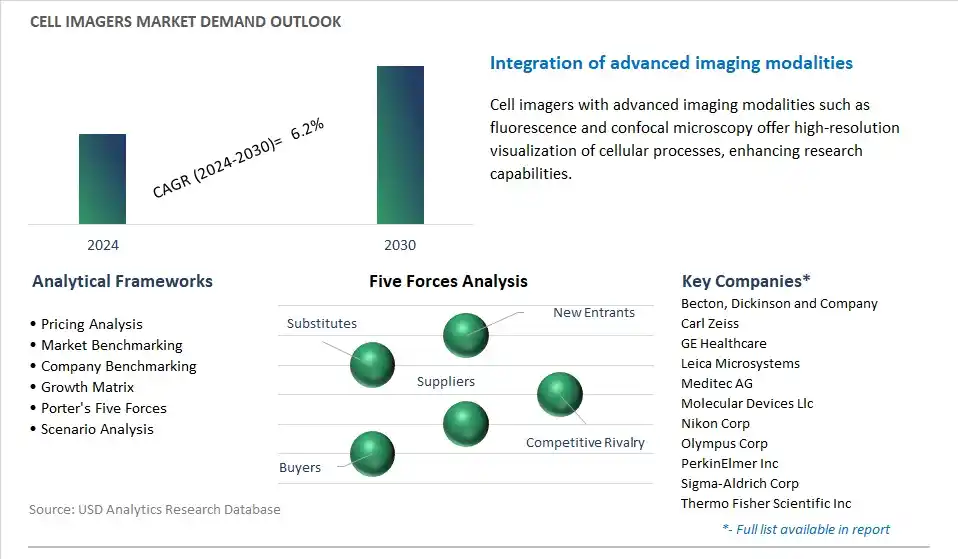
The global Cell Imagers Industry is highly competitive with a large number of companies focusing on niche market segments. Amidst intense competitive conditions, Cell Imagers Companies are investing in new product launches and strengthening distribution channels. Key companies operating in the Cell Imagers Industry include- Becton, Dickinson and Company, Carl Zeiss, GE Healthcare, Leica Microsystems, Meditec AG, Molecular Devices Llc, Nikon Corp, Olympus Corp, PerkinElmer Inc, Sigma-Aldrich Corp, Thermo Fisher Scientific Inc.
A prominent trend in the Cell Imagers market is the integration of artificial intelligence (AI) and machine learning (ML) technologies into imaging systems. Advancements in AI and ML algorithms have enabled automated image analysis, allowing for more efficient and accurate interpretation of cellular images. These technologies can automatically identify and quantify cellular features, such as cell morphology, subcellular structures, and biomarkers, reducing the time and labor required for manual analysis. Furthermore, AI-powered image analysis can uncover subtle cellular phenotypes and correlations that may be overlooked by traditional methods, leading to deeper insights into cellular biology and disease mechanisms. As a result, there is a growing demand for cell imagers equipped with AI and ML capabilities, driving market growth in this direction.
The primary driver for the Cell Imagers market is the rising demand for high-throughput screening (HTS) and drug discovery applications. As pharmaceutical and biotechnology companies strive to accelerate the drug development process and improve the efficiency of compound screening, there is a growing need for advanced imaging systems capable of capturing and analyzing large volumes of cellular images rapidly. Cell imagers equipped with features such as automated image acquisition, multi-channel fluorescence imaging, and live-cell imaging enable researchers to perform high-content screening assays, assess compound effects on cellular phenotypes, and identify potential drug candidates more effectively. With the increasing emphasis on personalized medicine and target-based drug discovery approaches, the demand for cell imagers tailored for HTS and drug discovery applications is expected to continue growing, supporting market expansion.
An opportunity for market growth in the Cell Imagers segment lies in the development of portable and point-of-care imaging systems. While traditional cell imagers are typically benchtop instruments found in research laboratories and academic institutions, there is a growing demand for compact, user-friendly imaging solutions that can be deployed in clinical settings, point-of-care facilities, and resource-limited environments. Portable cell imagers offer the potential to bring advanced imaging capabilities closer to the patient, enabling real-time monitoring of cellular responses, disease progression, and treatment efficacy at the bedside. Additionally, point-of-care imaging systems can facilitate rapid diagnostic assessments, personalized treatment decisions, and remote patient monitoring, leading to improved healthcare outcomes and reduced healthcare costs. Investing in the development of portable and point-of-care cell imagers presents an opportunity to address unmet clinical needs, expand market reach, and drive innovation in the Cell Imagers market.
Among the various segments of cell imagers, High Content Screening (HCS) technology stands out as the fastest-growing category. HCS technology enables automated, high-throughput imaging and analysis of cells and tissues, allowing researchers to extract rich quantitative data from complex biological samples. This technology is particularly valuable in cell biology, developmental biology, stem cell research, and drug discovery applications, where the analysis of large datasets and the extraction of meaningful biological information are crucial. HCS systems integrate advanced imaging capabilities with sophisticated software algorithms for image processing and analysis, enabling researchers to study cellular morphology, function, and behavior in a highly quantitative manner. The growing demand for HCS technology is driven by the increasing complexity of biological research, the need for more efficient and cost-effective drug discovery processes, and the rising interest in personalized medicine. Additionally, advancements in microscopy techniques, imaging modalities, and data analysis algorithms are further fueling the adoption of HCS technology in various research fields.
By Product
Equipment
Consumables
Software
By Application
Cell Biology
Developmental Biology
Stem Cell & Drug Discovery
Others
By Technology
Time-Lapse Microscopy
Fluorescence Recovery after Photobleaching (FRAP)
Fluorescence Resonance Energy Transfer (FRET)
High Content Screening (HCS)
Others
Geographical Analysis
North America (United States, Canada, Mexico)
Europe (Germany, France, United Kingdom, Spain, Italy, Rest of Europe)
Asia Pacific (China, India, Japan, South Korea, Rest of Asia Pacific)
South America (Brazil, Argentina, Rest of South America)
Middle East and Africa (Saudi Arabia, UAE, Rest of Middle East, South Africa, Egypt, Rest of Africa)
Becton, Dickinson and Company
Carl Zeiss
GE Healthcare
Leica Microsystems
Meditec AG
Molecular Devices Llc
Nikon Corp
Olympus Corp
PerkinElmer Inc
Sigma-Aldrich Corp
Thermo Fisher Scientific Inc
* List not Exhaustive
• Deepen your industry insights and navigate uncertainties for strategy formulation, CAPEX, and Operational decisions
• Gain access to detailed insights on the Cell Imagers Market, encompassing current market size, growth trends, and forecasts till 2030.
• Access detailed competitor analysis, enabling competitive advantage through a thorough understanding of market players, strategies, and potential differentiation opportunities
• Stay ahead of the curve with insights on technological advancements, innovations, and upcoming trends
• Identify lucrative investment avenues and expansion opportunities within the Cell Imagers Industry, guided by robust, data-backed analysis.
• Understand regional and global markets through country-wise analysis, regional market potential, regulatory nuances, and dynamics
• Execute strategies with confidence and speed through information, analytics, and insights on the industry value chain
• Corporate leaders, strategists, financial experts, shareholders, asset managers, and governmental representatives can make long-term planning scenarios and build an integrated and timely understanding of market dynamics
• Benefit from tailored solutions and expert consultation based on report insights, providing personalized strategies aligned with specific business needs.
TABLE OF CONTENTS
1 Introduction to 2024 Cell Imagers Market
1.1 Market Overview
1.2 Quick Facts
1.3 Scope/Objective of the Study
1.4 Market Definition
1.5 Countries and Regions Analyzed
1.6 Units, Currency, and Conversions
1.7 Industry Value Chain
2 Research Methodology
2.1 Market Size Estimation
2.2 Sources and Research Methodology
2.3 Data Triangulation
2.4 Assumptions and Limitations
3 Executive Summary
3.1 Global Cell Imagers Market Size Outlook, $ Million, 2021 to 2030
3.2 Cell Imagers Market Outlook by Type, $ Million, 2021 to 2030
3.3 Cell Imagers Market Outlook by Product, $ Million, 2021 to 2030
3.4 Cell Imagers Market Outlook by Application, $ Million, 2021 to 2030
3.5 Cell Imagers Market Outlook by Key Countries, $ Million, 2021 to 2030
4 Market Dynamics
4.1 Key Driving Forces of Cell Imagers Industry
4.2 Key Market Trends in Cell Imagers Industry
4.3 Potential Opportunities in Cell Imagers Industry
4.4 Key Challenges in Cell Imagers Industry
5 Market Factor Analysis
5.1 Value Chain Analysis
5.2 Competitive Landscape
5.2.1 Global Cell Imagers Market Share by Company (%), 2023
5.2.2 Product Offerings by Company
5.3 Porter’s Five Forces Analysis
5.4 Pricing Analysis and Outlook
6 Growth Outlook Across Scenarios
6.1 Growth Analysis-Case Scenario Definitions
6.2 Low Growth Scenario Forecasts
6.3 Reference Growth Scenario Forecasts
6.4 High Growth Scenario Forecasts
7 Global Cell Imagers Market Outlook by Segments
7.1 Cell Imagers Market Outlook by Segments, $ Million, 2021- 2030
By Product
Equipment
Consumables
Software
By Application
Cell Biology
Developmental Biology
Stem Cell & Drug Discovery
Others
By Technology
Time-Lapse Microscopy
Fluorescence Recovery after Photobleaching (FRAP)
Fluorescence Resonance Energy Transfer (FRET)
High Content Screening (HCS)
Others
8 North America Cell Imagers Market Analysis and Outlook To 2030
8.1 Introduction to North America Cell Imagers Markets in 2024
8.2 North America Cell Imagers Market Size Outlook by Country, 2021-2030
8.2.1 United States
8.2.2 Canada
8.2.3 Mexico
8.3 North America Cell Imagers Market size Outlook by Segments, 2021-2030
By Product
Equipment
Consumables
Software
By Application
Cell Biology
Developmental Biology
Stem Cell & Drug Discovery
Others
By Technology
Time-Lapse Microscopy
Fluorescence Recovery after Photobleaching (FRAP)
Fluorescence Resonance Energy Transfer (FRET)
High Content Screening (HCS)
Others
9 Europe Cell Imagers Market Analysis and Outlook To 2030
9.1 Introduction to Europe Cell Imagers Markets in 2024
9.2 Europe Cell Imagers Market Size Outlook by Country, 2021-2030
9.2.1 Germany
9.2.2 France
9.2.3 Spain
9.2.4 United Kingdom
9.2.4 Italy
9.2.5 Russia
9.2.6 Norway
9.2.7 Rest of Europe
9.3 Europe Cell Imagers Market Size Outlook by Segments, 2021-2030
By Product
Equipment
Consumables
Software
By Application
Cell Biology
Developmental Biology
Stem Cell & Drug Discovery
Others
By Technology
Time-Lapse Microscopy
Fluorescence Recovery after Photobleaching (FRAP)
Fluorescence Resonance Energy Transfer (FRET)
High Content Screening (HCS)
Others
10 Asia Pacific Cell Imagers Market Analysis and Outlook To 2030
10.1 Introduction to Asia Pacific Cell Imagers Markets in 2024
10.2 Asia Pacific Cell Imagers Market Size Outlook by Country, 2021-2030
10.2.1 China
10.2.2 India
10.2.3 Japan
10.2.4 South Korea
10.2.5 Indonesia
10.2.6 Malaysia
10.2.7 Australia
10.2.8 Rest of Asia Pacific
10.3 Asia Pacific Cell Imagers Market size Outlook by Segments, 2021-2030
By Product
Equipment
Consumables
Software
By Application
Cell Biology
Developmental Biology
Stem Cell & Drug Discovery
Others
By Technology
Time-Lapse Microscopy
Fluorescence Recovery after Photobleaching (FRAP)
Fluorescence Resonance Energy Transfer (FRET)
High Content Screening (HCS)
Others
11 South America Cell Imagers Market Analysis and Outlook To 2030
11.1 Introduction to South America Cell Imagers Markets in 2024
11.2 South America Cell Imagers Market Size Outlook by Country, 2021-2030
11.2.1 Brazil
11.2.2 Argentina
11.2.3 Rest of South America
11.3 South America Cell Imagers Market size Outlook by Segments, 2021-2030
By Product
Equipment
Consumables
Software
By Application
Cell Biology
Developmental Biology
Stem Cell & Drug Discovery
Others
By Technology
Time-Lapse Microscopy
Fluorescence Recovery after Photobleaching (FRAP)
Fluorescence Resonance Energy Transfer (FRET)
High Content Screening (HCS)
Others
12 Middle East and Africa Cell Imagers Market Analysis and Outlook To 2030
12.1 Introduction to Middle East and Africa Cell Imagers Markets in 2024
12.2 Middle East and Africa Cell Imagers Market Size Outlook by Country, 2021-2030
12.2.1 Saudi Arabia
12.2.2 UAE
12.2.3 Oman
12.2.4 Rest of Middle East
12.2.5 Egypt
12.2.6 Nigeria
12.2.7 South Africa
12.2.8 Rest of Africa
12.3 Middle East and Africa Cell Imagers Market size Outlook by Segments, 2021-2030
By Product
Equipment
Consumables
Software
By Application
Cell Biology
Developmental Biology
Stem Cell & Drug Discovery
Others
By Technology
Time-Lapse Microscopy
Fluorescence Recovery after Photobleaching (FRAP)
Fluorescence Resonance Energy Transfer (FRET)
High Content Screening (HCS)
Others
13 Company Profiles
13.1 Company Snapshot
13.2 SWOT Profiles
13.3 Products and Services
13.4 Recent Developments
13.5 Financial Profile
List of Companies
Becton, Dickinson and Company
Carl Zeiss
GE Healthcare
Leica Microsystems
Meditec AG
Molecular Devices Llc
Nikon Corp
Olympus Corp
PerkinElmer Inc
Sigma-Aldrich Corp
Thermo Fisher Scientific Inc
14 Appendix
14.1 Customization Offerings
14.2 Subscription Services
14.3 Related Reports
14.4 Publisher Expertise
By Product
Equipment
Consumables
Software
By Application
Cell Biology
Developmental Biology
Stem Cell & Drug Discovery
Others
By Technology
Time-Lapse Microscopy
Fluorescence Recovery after Photobleaching (FRAP)
Fluorescence Resonance Energy Transfer (FRET)
High Content Screening (HCS)
Others
The global Cell Imagers Market is one of the lucrative growth markets, poised to register a 6.2% growth (CAGR) between 2024 and 2030.
Emerging Markets across Asia Pacific, Europe, and Americas present robust growth prospects.
Becton, Dickinson and Company, Carl Zeiss, GE Healthcare, Leica Microsystems, Meditec AG, Molecular Devices Llc, Nikon Corp, Olympus Corp, PerkinElmer Inc, Sigma-Aldrich Corp, Thermo Fisher Scientific Inc
Base Year- 2023; Estimated Year- 2024; Historic Period- 2018-2023; Forecast period- 2024 to 2030; Currency: USD; Volume