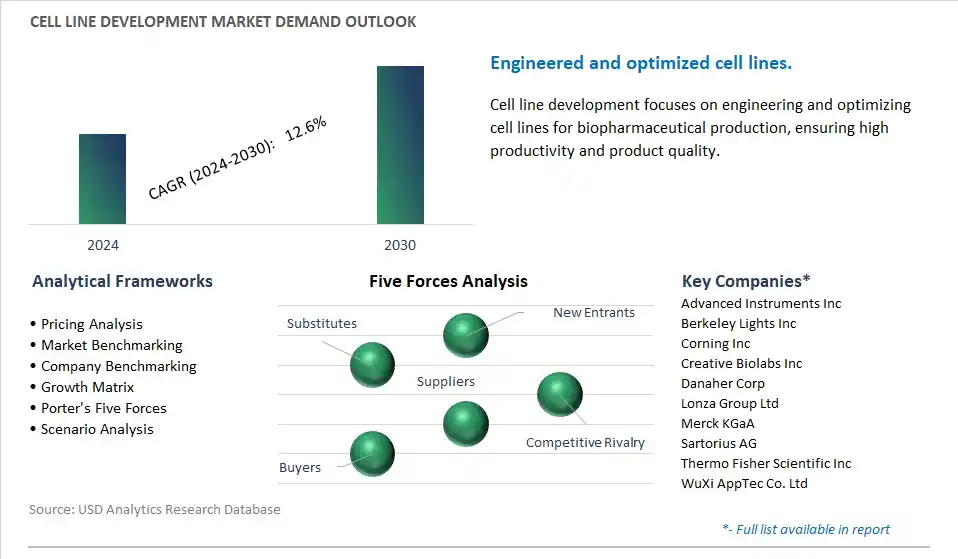
Cell Line Development Market is estimated to increase at a Compounded Annual Growth Rate of 12.6% CAGR over the forecast period from 2024 to 2030
The Cell Line Development Market study analyzes and forecasts the market size across 6 regions and 24 countries for diverse segments- By Products and Services (Reagents and media, Equipment, Accessories and consumables, Services), By Source (Mammalian cell line, Non-mammalian cell line), By Cell Line (Recombinant cell lines, Hybridomas, Continuous cell lines, Primary cell lines), By Application (Bioproduction, Drug discovery, Toxicity testing, Tissue engineering, Others).
An Introduction to Cell Line Development Market in 2024
Cell line development is a process used to establish immortalized cell lines derived from primary cells or tissues for long-term culture and propagation in vitro. In 2024, cell line development techniques include immortalization through genetic modification or spontaneous transformation, followed by clonal selection and expansion to generate stable, homogenous cell populations. Immortalized cell lines are widely used in biomedical research, drug discovery, and biomanufacturing for studying cellular physiology, screening drug candidates, and producing biologics such as monoclonal antibodies and recombinant proteins. Cell line development involves optimizing culture conditions, selecting growth media, and screening for desirable characteristics such as growth rate, morphology, and expression of target proteins. With advancements in gene editing technologies such as CRISPR-Cas9, cell line development has become more efficient and precise, enabling the generation of engineered cell lines with specific genetic modifications or reporter genes. Cell line development plays a critical role in advancing scientific knowledge, accelerating drug discovery, and facilitating the production of biopharmaceuticals for clinical use. As the demand for cell-based therapies and biologics continues to grow, cell line development remains a key enabling technology for translating research findings into medical applications that benefit patients worldwide.
Market Trend: Adoption of High-Throughput Screening Technologies
A significant trend in the cell line development market is the widespread adoption of high-throughput screening technologies. Traditional methods for generating stable cell lines often involve labor-intensive processes, including transfection, selection, and clonal expansion, which can be time-consuming and resource-intensive. In response to the need for faster and more efficient cell line development, there's a growing interest in high-throughput screening approaches. These technologies enable researchers to screen large numbers of cells or clones rapidly, identify high-producing or desirable cell lines, and optimize culture conditions for protein expression or therapeutic efficacy. The adoption of high-throughput screening technologies represents a shift towards more streamlined and cost-effective approaches in cell line development, particularly in the biopharmaceutical and biotechnology industries.
Market Driver: Expansion of Biologics and Cell-Based Therapies
A key driver fueling the cell line development market is the expansion of biologics and cell-based therapies. Biologics, including monoclonal antibodies, recombinant proteins, and cell-based therapies, represent a growing segment of the pharmaceutical industry, driven by advancements in biotechnology and personalized medicine approaches. The successful development and commercialization of biologics depend on the generation of stable and high-producing cell lines for protein expression or therapeutic cell production. Additionally, the emergence of cell-based therapies for treating various diseases, including cancer, autoimmune disorders, and genetic disorders, further increases the demand for engineered cell lines tailored for specific therapeutic applications. As the demand for biologics and cell-based therapies continues to rise, the need for efficient and scalable cell line development technologies becomes increasingly critical, driving market growth.
Market Opportunity: Integration of CRISPR-Cas9 Genome Editing Technologies
An opportunity within the cell line development market lies in the integration of CRISPR-Cas9 genome editing technologies. CRISPR-Cas9 offers precise and efficient tools for editing the genome of mammalian cells, enabling targeted modifications such as gene knockouts, knock-ins, or gene corrections. By harnessing CRISPR-Cas9 technology, researchers can streamline the process of cell line engineering, accelerate the generation of genetically modified cell lines, and improve the predictability and reliability of cell-based assays or therapeutic production systems. Additionally, CRISPR-Cas9 enables the generation of complex cellular models for disease research, drug discovery, and precision medicine applications. Companies investing in the integration of CRISPR-Cas9 genome editing technologies into their cell line development workflows stand to offer innovative solutions to the biopharmaceutical industry and capitalize on the growing demand for engineered cell lines with precise genetic modifications.
Cell Line Development Market Share Analysis: Reagents and Media is the fastest growing segment over the forecast period to 2030
Within the cell line development market, the segment experiencing the fastest growth is reagents and media. This growth is primarily driven by several key factors. Firstly, reagents and media are essential components for cell culture and propagation, playing a critical role in the establishment and maintenance of cell lines. As the demand for cell-based therapies, bioproduction, and drug discovery continues to rise, there is a corresponding increase in the need for specialized reagents and media formulations optimized for different cell types and applications. Moreover, advancements in cell culture technology have led to the development of serum-free, chemically-defined, and animal component-free media formulations, addressing concerns regarding reproducibility, scalability, and product safety. Additionally, the emergence of novel cell culture techniques, such as suspension culture and microcarrier-based systems, further amplifies the demand for specialized media and supplements tailored for these applications. Furthermore, the availability of customizable media formulations and media optimization services enables researchers and biopharmaceutical companies to fine-tune culture conditions and enhance cell line productivity and performance. With ongoing innovations and expanding applications in bioproduction, drug discovery, and tissue engineering, reagents and media are expected to maintain their rapid growth trajectory in the cell line development market.
Cell Line Development Competitive Analysis
The market research study provides in-depth insights into leading companies including the SWOT analyses, product profile, financial details, and recent developments acrossAdvanced Instruments Inc, Berkeley Lights Inc, Corning Inc, Creative Biolabs Inc, Danaher Corp, Lonza Group Ltd, Merck KGaA, Sartorius AG, Thermo Fisher Scientific Inc, WuXi AppTec Co. Ltd
Cell Line Development Market Segmentation
By Products and Services
Reagents and media
Equipment
Accessories and consumables
Services
By Source
Mammalian cell line
Non-mammalian cell line
By Cell Line
Recombinant cell lines
Hybridomas
Continuous cell lines
Primary cell lines
By Application
Bioproduction
Drug discovery
Toxicity testing
Tissue engineering
Others
Geographical Analysis
North America (United States, Canada, Mexico)
Europe (Germany, France, United Kingdom, Spain, Italy, Rest of Europe)
Asia Pacific (China, India, Japan, South Korea, Rest of Asia Pacific)
South America (Brazil, Argentina, Rest of South America)
Middle East and Africa (Saudi Arabia, UAE, Rest of Middle East, South Africa, Egypt, Rest of Africa)
Cell Line Development Market Companies
Advanced Instruments Inc
Berkeley Lights Inc
Corning Inc
Creative Biolabs Inc
Danaher Corp
Lonza Group Ltd
Merck KGaA
Sartorius AG
Thermo Fisher Scientific Inc
WuXi AppTec Co. Ltd
Reasons to Buy the Cell Line Development Market Study
• Deepen your industry insights and navigate uncertainties for strategy formulation, CAPEX, and Operational decisions
• Gain access to detailed insights on the Cell Line Development Market, encompassing current market size, growth trends, and forecasts till 2030.
• Access detailed competitor analysis, enabling competitive advantage through a thorough understanding of market players, strategies, and potential differentiation opportunities
• Stay ahead of the curve with insights on technological advancements, innovations, and upcoming trends
• Identify lucrative investment avenues and expansion opportunities within the Cell Line Development Market industry, guided by robust, data-backed analysis.
• Understand regional and global markets through country-wise analysis, regional market potential, regulatory nuances, and dynamics
• Execute strategies with confidence and speed through information, analytics, and insights on the industry value chain
• Corporate leaders, strategists, financial experts, shareholders, asset managers, and governmental representatives can make long-term planning scenarios and build an integrated and timely understanding of market dynamics
• Benefit from tailored solutions and expert consultation based on report insights, providing personalized strategies aligned with specific business needs.
TABLE OF CONTENTS
1 Introduction to 2024 Cell Line Development Market
1.1 Market Overview
1.2 Quick Facts
1.3 Scope/Objective of the Study
1.4 Market Definition
1.5 Countries and Regions Covered
1.6 Units, Currency, and Conversions
1.7 Industry Value Chain
2 Research Methodology
2.1 Market Size Estimation
2.2 Sources and Research Methodology
2.3 Data Triangulation
2.4 Assumptions and Limitations
3 Executive Summary
3.1 Global Cell Line Development Market Size Outlook, $ Million, 2021 to 2030
3.2 Cell Line Development Market Outlook by Type, $ Million, 2021 to 2030
3.3 Cell Line Development Market Outlook by Product, $ Million, 2021 to 2030
3.4 Cell Line Development Market Outlook by Application, $ Million, 2021 to 2030
3.5 Cell Line Development Market Outlook by Key Countries, $ Million, 2021 to 2030
4 Market Dynamics
4.1 Key Driving Forces of Cell Line Development Industry
4.2 Key Market Trends in Cell Line Development Industry
4.3 Potential Opportunities in Cell Line Development Industry
4.4 Key Challenges in Cell Line Development Industry
5 Market Factor Analysis
5.1 Value Chain Analysis
5.2 Competitive Landscape
5.2.1 Global Cell Line Development Market Share by Company (%), 2023
5.2.2 Product Offerings by Company
5.3 Porter’s Five Forces Analysis
5.4 Pricing Analysis and Outlook
6 Growth Outlook Across Scenarios
6.1 Growth Analysis-Case Scenario Definitions
6.2 Low Growth Scenario Forecasts
6.3 Reference Growth Scenario Forecasts
6.4 High Growth Scenario Forecasts
7 Global Cell Line Development Market Outlook by Segments
7.1 Cell Line Development Market Outlook by Segments, $ Million, 2021- 2030
By Products and Services
Reagents and media
Equipment
Accessories and consumables
Services
By Source
Mammalian cell line
Non-mammalian cell line
By Cell Line
Recombinant cell lines
Hybridomas
Continuous cell lines
Primary cell lines
By Application
Bioproduction
Drug discovery
Toxicity testing
Tissue engineering
Others
8 North America Cell Line Development Market Analysis and Outlook To 2030
8.1 Introduction to North America Cell Line Development Markets in 2024
8.2 North America Cell Line Development Market Size Outlook by Country, 2021-2030
8.2.1 United States
8.2.2 Canada
8.2.3 Mexico
8.3 North America Cell Line Development Market size Outlook by Segments, 2021-2030
By Products and Services
Reagents and media
Equipment
Accessories and consumables
Services
By Source
Mammalian cell line
Non-mammalian cell line
By Cell Line
Recombinant cell lines
Hybridomas
Continuous cell lines
Primary cell lines
By Application
Bioproduction
Drug discovery
Toxicity testing
Tissue engineering
Others
9 Europe Cell Line Development Market Analysis and Outlook To 2030
9.1 Introduction to Europe Cell Line Development Markets in 2024
9.2 Europe Cell Line Development Market Size Outlook by Country, 2021-2030
9.2.1 Germany
9.2.2 France
9.2.3 Spain
9.2.4 United Kingdom
9.2.4 Italy
9.2.5 Russia
9.2.6 Norway
9.2.7 Rest of Europe
9.3 Europe Cell Line Development Market Size Outlook by Segments, 2021-2030
By Products and Services
Reagents and media
Equipment
Accessories and consumables
Services
By Source
Mammalian cell line
Non-mammalian cell line
By Cell Line
Recombinant cell lines
Hybridomas
Continuous cell lines
Primary cell lines
By Application
Bioproduction
Drug discovery
Toxicity testing
Tissue engineering
Others
10 Asia Pacific Cell Line Development Market Analysis and Outlook To 2030
10.1 Introduction to Asia Pacific Cell Line Development Markets in 2024
10.2 Asia Pacific Cell Line Development Market Size Outlook by Country, 2021-2030
10.2.1 China
10.2.2 India
10.2.3 Japan
10.2.4 South Korea
10.2.5 Indonesia
10.2.6 Malaysia
10.2.7 Australia
10.2.8 Rest of Asia Pacific
10.3 Asia Pacific Cell Line Development Market size Outlook by Segments, 2021-2030
By Products and Services
Reagents and media
Equipment
Accessories and consumables
Services
By Source
Mammalian cell line
Non-mammalian cell line
By Cell Line
Recombinant cell lines
Hybridomas
Continuous cell lines
Primary cell lines
By Application
Bioproduction
Drug discovery
Toxicity testing
Tissue engineering
Others
11 South America Cell Line Development Market Analysis and Outlook To 2030
11.1 Introduction to South America Cell Line Development Markets in 2024
11.2 South America Cell Line Development Market Size Outlook by Country, 2021-2030
11.2.1 Brazil
11.2.2 Argentina
11.2.3 Rest of South America
11.3 South America Cell Line Development Market size Outlook by Segments, 2021-2030
By Products and Services
Reagents and media
Equipment
Accessories and consumables
Services
By Source
Mammalian cell line
Non-mammalian cell line
By Cell Line
Recombinant cell lines
Hybridomas
Continuous cell lines
Primary cell lines
By Application
Bioproduction
Drug discovery
Toxicity testing
Tissue engineering
Others
12 Middle East and Africa Cell Line Development Market Analysis and Outlook To 2030
12.1 Introduction to Middle East and Africa Cell Line Development Markets in 2024
12.2 Middle East and Africa Cell Line Development Market Size Outlook by Country, 2021-2030
12.2.1 Saudi Arabia
12.2.2 UAE
12.2.3 Oman
12.2.4 Rest of Middle East
12.2.5 Egypt
12.2.6 Nigeria
12.2.7 South Africa
12.2.8 Rest of Africa
12.3 Middle East and Africa Cell Line Development Market size Outlook by Segments, 2021-2030
By Products and Services
Reagents and media
Equipment
Accessories and consumables
Services
By Source
Mammalian cell line
Non-mammalian cell line
By Cell Line
Recombinant cell lines
Hybridomas
Continuous cell lines
Primary cell lines
By Application
Bioproduction
Drug discovery
Toxicity testing
Tissue engineering
Others
13 Company Profiles
13.1 Company Snapshot
13.2 SWOT Profiles
13.3 Products and Services
13.4 Recent Developments
13.5 Financial Profile
List of Companies
Advanced Instruments Inc
Berkeley Lights Inc
Corning Inc
Creative Biolabs Inc
Danaher Corp
Lonza Group Ltd
Merck KGaA
Sartorius AG
Thermo Fisher Scientific Inc
WuXi AppTec Co. Ltd
14 Appendix
14.1 Customization Offerings
14.2 Subscription Services
14.3 Related Reports
14.4 Publisher Expertise
By Products and Services
Reagents and media
Equipment
Accessories and consumables
Services
By Source
Mammalian cell line
Non-mammalian cell line
By Cell Line
Recombinant cell lines
Hybridomas
Continuous cell lines
Primary cell lines
By Application
Bioproduction
Drug discovery
Toxicity testing
Tissue engineering
Others
Countries Analyzed
North America (United States, Canada, Mexico)
Europe (Germany, France, United Kingdom, Spain, Italy, Rest of Europe)
Asia Pacific (China, India, Japan, South Korea, Rest of Asia Pacific)
South America (Brazil, Argentina, Rest of South America)
Middle East and Africa (Saudi Arabia, UAE, Rest of Middle East, South Africa, Egypt, Rest of Africa)
