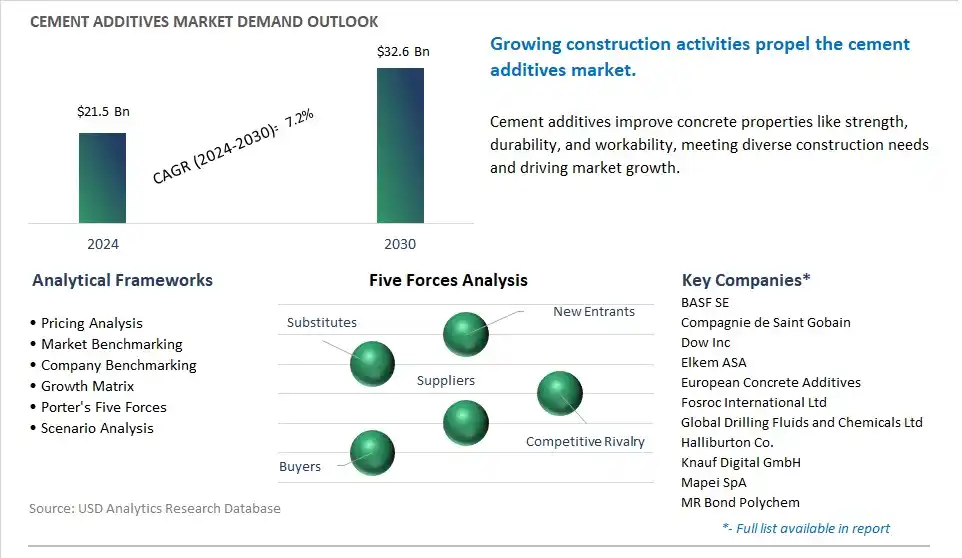
The global Cement Additives Market is poised to register a 7.2% CAGR from $21.5 Billion in 2024 to $32.6 Billion in 2030.
The global Cement Additives Market Study analyzes and forecasts the market size across 6 regions and 24 countries for diverse segments -By Type (Chemicals, Minerals, Fiber), By End-User (Residential, Non-residential).
An Introduction to Global Cement Additives Market in 2024
The market for cement additives is witnessing steady growth, driven by the increasing demand for high-performance concrete in infrastructure development, construction projects, and urbanization trends. Key trends shaping the future of the industry include advancements in cement chemistry, admixture technology, and sustainable construction practices, enabling the development of additives that enhance the workability, durability, and performance of cementitious materials while reducing environmental impact and construction costs. Additionally, there is a growing emphasis on specialty additives such as superplasticizers, accelerators, retarders, and air-entraining agents, which improve concrete properties such as strength, flowability, and setting time, enabling the use of concrete in challenging construction applications and harsh environments. Moreover, advancements in green building standards, LEED certification, and carbon footprint reduction are driving innovation in eco-friendly cement additives, promoting the adoption of alternative binders, recycled aggregates, and supplementary cementitious materials that enhance sustainability and reduce greenhouse gas emissions in construction projects. Furthermore, collaborations between cement manufacturers, concrete producers, and research institutions are shaping the development of innovative additive solutions that address evolving construction needs, regulatory requirements, and market demands for high-performance, sustainable building materials. Overall, the future of cement additives lies in continuous research and development efforts to optimize material properties, improve construction efficiency, and promote environmental stewardship in the global construction industry.
Cement Additives Market Competitive Landscape
The market report analyses the leading companies in the industry including BASF SE, Compagnie de Saint Gobain, Dow Inc, Elkem ASA, European Concrete Additives, Fosroc International Ltd, Global Drilling Fluids and Chemicals Ltd, Halliburton Co., Knauf Digital GmbH, Mapei SpA, MR Bond Polychem, Nan Pao Resins Chemical Co. Ltd, OMNOVA Solutions Inc, Oscrete UK Ltd.
Cement Additives Market Dynamics
Cement Additives Market Trend: Increasing Demand for High-Performance Concrete Solutions
In the Cement Additives market, a prominent trend is the increasing demand for high-performance concrete solutions. Cement additives are chemicals or materials added to cement during the manufacturing process to improve its properties and performance. This trend is driven by the growing need for durable, sustainable, and cost-effective construction materials in various infrastructure and building projects worldwide. As construction projects become more complex and demanding, there's a rising market demand for cement additives that can enhance concrete strength, durability, workability, and sustainability. Manufacturers are innovating and developing new additives to meet the evolving requirements of the construction industry, leading to a growing market for high-performance cement additives.
Cement Additives Market Driver: Growth in Construction and Infrastructure Development
A significant driver in the Cement Additives market is the growth in construction and infrastructure development. With increasing urbanization, population growth, and economic development, there's a growing demand for residential, commercial, and public infrastructure projects such as roads, bridges, buildings, and airports. This driver is fueled by factors such as urban migration, government investments in infrastructure projects, and the need to upgrade and modernize existing infrastructure. Cement additives play a crucial role in optimizing concrete performance and meeting the requirements of diverse construction projects, driving their adoption in the construction industry. As construction activity continues to expand globally, there's a rising market demand for cement additives as essential components of high-quality concrete formulations.
Cement Additives Market Opportunity: Innovation in Sustainable and Environmentally Friendly Additives
A promising opportunity within the Cement Additives market lies in innovation in sustainable and environmentally friendly additives. With increasing focus on sustainability and environmental stewardship in the construction industry, there's growing interest in developing additives that reduce carbon footprint, minimize waste, and enhance the eco-friendliness of concrete formulations. Opportunities exist in researching and commercializing additives derived from renewable or recycled materials, such as fly ash, slag, silica fume, and bio-based polymers. By offering sustainable cement additives that meet performance requirements while addressing environmental concerns, manufacturers can capitalize on this opportunity to differentiate themselves in the market, meet customer demands for green construction solutions, and contribute to the transition towards a more sustainable built environment.
Cement Additives Market Share Analysis: Chemicals type generated the highest revenue in 2024
The largest segment in the Cement Additives Market is the Chemicals type segment. This dominance is. chemicals play a crucial role in improving the performance, durability, and workability of cement and concrete formulations. Cement additives in the form of chemicals include a wide range of substances such as accelerators, retarders, plasticizers, dispersants, air-entraining agents, and waterproofing agents, among others. These chemicals are specifically designed to enhance various properties of cement and concrete, including setting time, strength development, workability, durability, and resistance to adverse environmental conditions. Additionally, chemical additives enable concrete producers and construction professionals to achieve specific performance requirements and tailor-made solutions for different applications and project specifications. Further, advancements in chemical technology and formulations have led to the development of innovative additives with superior performance characteristics, compatibility, and environmental sustainability, further driving their adoption in the cement and concrete industry. Furthermore, the increasing demand for high-performance, sustainable, and cost-effective construction materials in infrastructure development, residential construction, and commercial projects worldwide supports the dominance of the Chemicals type segment in the Cement Additives Market. Therefore, the Chemicals type segment continues to lead the market due to its extensive application, versatility, and importance in enhancing the properties and performance of cement and concrete formulations.
Cement Additives Market Share Analysis: Non-residential segment is poised to register the fastest growth rate (CAGR) over the forecast period to 2030
The fastest-growing segment in the Cement Additives Market is the Non-residential end-user segment. non-residential construction includes a wide range of infrastructure projects such as commercial buildings, industrial facilities, transportation infrastructure, and public works projects. These projects often require specialized cement formulations tailored to meet specific performance requirements, environmental conditions, and project timelines. Cement additives play a crucial role in enhancing the properties and performance of concrete used in non-residential construction applications. Additionally, the growing trend towards urbanization, industrialization, and infrastructure development in emerging economies drives the demand for cement additives in non-residential construction projects. Further, advancements in additive technology and formulations have led to the development of innovative solutions that address the unique challenges and requirements of non-residential construction, such as high strength, durability, sustainability, and reduced environmental impact. Furthermore, government initiatives, public-private partnerships, and investment in infrastructure projects further stimulate the demand for cement additives in non-residential construction applications. Therefore, the Non-residential end-user segment presents significant growth opportunities in the Cement Additives Market, driven by the increasing demand for high-performance construction materials in infrastructure development and commercial projects globally.
Cement Additives Market Report Segmentation
By Type
Chemicals
Minerals
Fiber
By End-User
Residential
Non-residential
Regions Included
North America (US, Canada, Mexico)
Europe (Germany, UK, France, Spain, Italy, Russia, Rest of Europe)
Asia Pacific (China, India, Japan, South Korea, Australia, South East Asia, Rest of Asia)
South America (Brazil, Argentina, Rest of South America)
Middle East and Africa (Saudi Arabia, UAE, Rest of Middle East, South Africa, Egypt, Rest of Africa)
Cement Additives Companies Profiled in the Market Study
BASF SE
Compagnie de Saint Gobain
Dow Inc
Elkem ASA
European Concrete Additives
Fosroc International Ltd
Global Drilling Fluids and Chemicals Ltd
Halliburton Co.
Knauf Digital GmbH
Mapei SpA
MR Bond Polychem
Nan Pao Resins Chemical Co. Ltd
OMNOVA Solutions Inc
Oscrete UK Ltd
*- List Not Exhaustive
TABLE OF CONTENTS
1 Introduction to 2024 Cement Additives Market
1.1 Market Overview
1.2 Quick Facts
1.3 Scope/Objective of the Study
1.4 Market Definition
1.5 Countries and Regions Covered
1.6 Units, Currency, and Conversions
1.7 Industry Value Chain
2 Research Methodology
2.1 Market Size Estimation
2.2 Sources and Research Methodology
2.3 Data Triangulation
2.4 Assumptions and Limitations
3 Executive Summary
3.1 Global Cement Additives Market Size Outlook, $ Million, 2021 to 2030
3.2 Cement Additives Market Outlook by Type, $ Million, 2021 to 2030
3.3 Cement Additives Market Outlook by Product, $ Million, 2021 to 2030
3.4 Cement Additives Market Outlook by Application, $ Million, 2021 to 2030
3.5 Cement Additives Market Outlook by Key Countries, $ Million, 2021 to 2030
4 Market Dynamics
4.1 Key Driving Forces of Cement Additives Industry
4.2 Key Market Trends in Cement Additives Industry
4.3 Potential Opportunities in Cement Additives Industry
4.4 Key Challenges in Cement Additives Industry
5 Market Factor Analysis
5.1 Value Chain Analysis
5.2 Competitive Landscape
5.2.1 Global Cement Additives Market Share by Company (%), 2023
5.2.2 Product Offerings by Company
5.3 Porter’s Five Forces Analysis
5.4 Pricing Analysis and Outlook
6 Growth Outlook Across Scenarios
6.1 Growth Analysis-Case Scenario Definitions
6.2 Low Growth Scenario Forecasts
6.3 Reference Growth Scenario Forecasts
6.4 High Growth Scenario Forecasts
7 Global Cement Additives Market Outlook by Segments
7.1 Cement Additives Market Outlook by Segments, $ Million, 2021- 2030
By Type
Chemicals
Minerals
Fiber
By End-User
Residential
Non-residential
8 North America Cement Additives Market Analysis and Outlook To 2030
8.1 Introduction to North America Cement Additives Markets in 2024
8.2 North America Cement Additives Market Size Outlook by Country, 2021-2030
8.2.1 United States
8.2.2 Canada
8.2.3 Mexico
8.3 North America Cement Additives Market size Outlook by Segments, 2021-2030
By Type
Chemicals
Minerals
Fiber
By End-User
Residential
Non-residential
9 Europe Cement Additives Market Analysis and Outlook To 2030
9.1 Introduction to Europe Cement Additives Markets in 2024
9.2 Europe Cement Additives Market Size Outlook by Country, 2021-2030
9.2.1 Germany
9.2.2 France
9.2.3 Spain
9.2.4 United Kingdom
9.2.4 Italy
9.2.5 Russia
9.2.6 Norway
9.2.7 Rest of Europe
9.3 Europe Cement Additives Market Size Outlook by Segments, 2021-2030
By Type
Chemicals
Minerals
Fiber
By End-User
Residential
Non-residential
10 Asia Pacific Cement Additives Market Analysis and Outlook To 2030
10.1 Introduction to Asia Pacific Cement Additives Markets in 2024
10.2 Asia Pacific Cement Additives Market Size Outlook by Country, 2021-2030
10.2.1 China
10.2.2 India
10.2.3 Japan
10.2.4 South Korea
10.2.5 Indonesia
10.2.6 Malaysia
10.2.7 Australia
10.2.8 Rest of Asia Pacific
10.3 Asia Pacific Cement Additives Market size Outlook by Segments, 2021-2030
By Type
Chemicals
Minerals
Fiber
By End-User
Residential
Non-residential
11 South America Cement Additives Market Analysis and Outlook To 2030
11.1 Introduction to South America Cement Additives Markets in 2024
11.2 South America Cement Additives Market Size Outlook by Country, 2021-2030
11.2.1 Brazil
11.2.2 Argentina
11.2.3 Rest of South America
11.3 South America Cement Additives Market size Outlook by Segments, 2021-2030
By Type
Chemicals
Minerals
Fiber
By End-User
Residential
Non-residential
12 Middle East and Africa Cement Additives Market Analysis and Outlook To 2030
12.1 Introduction to Middle East and Africa Cement Additives Markets in 2024
12.2 Middle East and Africa Cement Additives Market Size Outlook by Country, 2021-2030
12.2.1 Saudi Arabia
12.2.2 UAE
12.2.3 Oman
12.2.4 Rest of Middle East
12.2.5 Egypt
12.2.6 Nigeria
12.2.7 South Africa
12.2.8 Rest of Africa
12.3 Middle East and Africa Cement Additives Market size Outlook by Segments, 2021-2030
By Type
Chemicals
Minerals
Fiber
By End-User
Residential
Non-residential
13 Company Profiles
13.1 Company Snapshot
13.2 SWOT Profiles
13.3 Products and Services
13.4 Recent Developments
13.5 Financial Profile
BASF SE
Compagnie de Saint Gobain
Dow Inc
Elkem ASA
European Concrete Additives
Fosroc International Ltd
Global Drilling Fluids and Chemicals Ltd
Halliburton Co.
Knauf Digital GmbH
Mapei SpA
MR Bond Polychem
Nan Pao Resins Chemical Co. Ltd
OMNOVA Solutions Inc
Oscrete UK Ltd
14 Appendix
14.1 Customization Offerings
14.2 Subscription Services
14.3 Related Reports
14.4 Publisher Expertise
By Type
Chemicals
Minerals
Fiber
By End-User
Residential
Non-residential
Countries Analyzed
North America (US, Canada, Mexico)
Europe (Germany, UK, France, Spain, Italy, Russia, Rest of Europe)
Asia Pacific (China, India, Japan, South Korea, Australia, South East Asia, Rest of Asia)
South America (Brazil, Argentina, Rest of South America)
Middle East and Africa (Saudi Arabia, UAE, Rest of Middle East, South Africa, Egypt, Rest of Africa)
