
The global Central Venous Access Devices Market Study analyzes and forecasts the market size across 6 regions and 24 countries for diverse segments including By Product (Peripheral, PIV Catheters, Midline Catheters, Others), By Application (Drug Administration, Fluid and Nutrition Administration, Blood Transfusion, Diagnostics & Testing).
The Central Venous Access Devices Market encompasses a range of medical devices and catheters used for long-term venous access, medication administration, chemotherapy, blood sampling, and parenteral nutrition in healthcare settings. These devices include central venous catheters (CVCs), peripherally inserted central catheters (PICCs), implantable ports, and tunneled catheters, providing secure and reliable access to central veins. In 2024, this market emphasizes infection prevention strategies, catheter materials, implantable device designs, and patient-centric care models, ensuring safe and effective vascular access for patients requiring complex medical treatments.
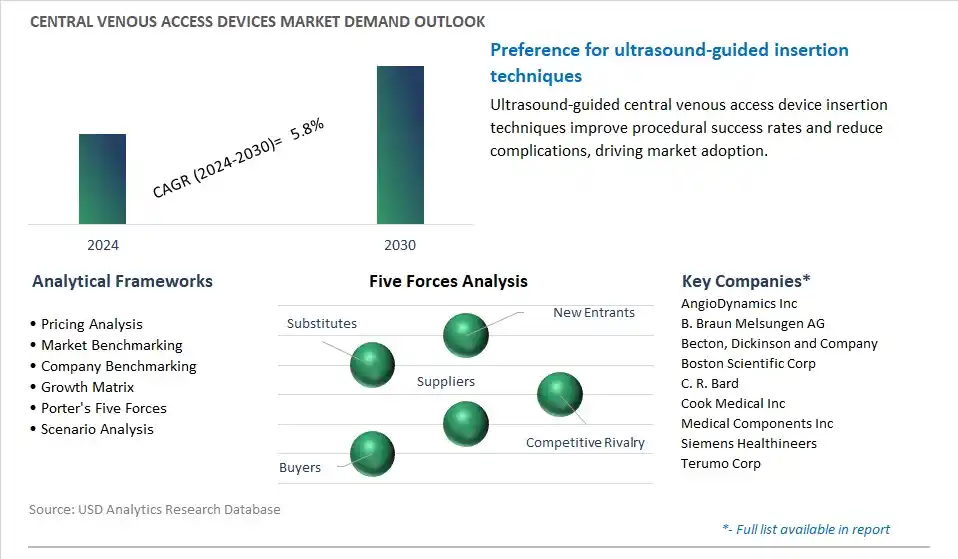
The global Central Venous Access Devices Industry is highly competitive with a large number of companies focusing on niche market segments. Amidst intense competitive conditions, Central Venous Access Devices Companies are investing in new product launches and strengthening distribution channels. Key companies operating in the Central Venous Access Devices Industry include- AngioDynamics Inc, B. Braun Melsungen AG, Becton, Dickinson and Company, Boston Scientific Corp, C. R. Bard, Cook Medical Inc, Medical Components Inc, Siemens Healthineers, Terumo Corp.
A prominent trend in the Central Venous Access Devices market is the growing preference for minimally invasive procedures for venous access. Minimally invasive techniques, such as ultrasound-guided insertion and peripherally inserted central catheters (PICCs), are gaining popularity due to their lower risk of complications, shorter recovery times, and improved patient comfort compared to traditional central venous catheterization methods. Healthcare providers are increasingly adopting these techniques to reduce the incidence of catheter-related bloodstream infections (CRBSIs), thrombotic complications, and procedural discomfort, driving the demand for innovative central venous access devices designed for minimally invasive insertion and long-term use.
The primary driver for the Central Venous Access Devices market is the rising incidence of chronic diseases such as cancer, kidney failure, and infectious diseases that require long-term intravenous therapies and frequent venous access. Patients undergoing chemotherapy, dialysis, parenteral nutrition, or long-term antibiotic therapy often require reliable and durable central venous access for administration of medications, fluids, and blood products. Additionally, the aging population and increasing prevalence of chronic conditions contribute to the growing demand for central venous access devices to facilitate safe and efficient delivery of essential treatments. As a result, healthcare facilities, including hospitals, ambulatory surgery centers, and long-term care facilities, are investing in advanced central venous access devices to meet the complex venous access needs of patients, thus fueling market growth.
An opportunity for market expansion in the Central Venous Access Devices segment lies in the development of central venous catheters with antimicrobial and antithrombotic coatings to reduce the risk of infection and thrombosis associated with catheter use. Catheter-related bloodstream infections (CRBSIs) and catheter-related thrombosis (CRT) are significant complications that can lead to morbidity, mortality, and increased healthcare costs. By incorporating antimicrobial agents, such as silver nanoparticles or chlorhexidine, into catheter materials or applying antimicrobial coatings, manufacturers can help prevent bacterial colonization and biofilm formation on catheter surfaces, thereby reducing the incidence of CRBSIs. Similarly, the integration of antithrombotic coatings, such as heparin or nitric oxide-releasing compounds, can inhibit thrombus formation and catheter-related thrombosis, enhancing catheter patency and reducing the need for catheter replacement. Investing in the development of central venous access devices with advanced coatings offers an opportunity to address key challenges associated with catheter-related complications, improve patient outcomes, and differentiate products in the competitive market landscape.
Within the realm of central venous access devices, midline catheters are experiencing significant growth. Midline catheters are longer than peripheral intravenous (PIV) catheters but shorter than traditional central venous catheters, making them suitable for patients who require vascular access for longer durations but do not necessarily need central venous access. They are typically inserted into peripheral veins and advanced into the upper arm, providing a secure and stable route for medication administration and blood draws. Midline catheters offer several advantages, including reduced risk of complications associated with central venous catheters, such as infection and thrombosis, and decreased need for frequent catheter replacement. As healthcare providers seek to minimize invasive procedures and optimize patient comfort while ensuring effective vascular access, the demand for midline catheters is growing steadily. Additionally, advancements in catheter design and materials, along with improved insertion techniques, contribute to the increasing adoption of midline catheters in various clinical settings, including hospitals, long-term care facilities, and home healthcare. As healthcare systems prioritize patient safety and cost-effectiveness, midline catheters are poised to maintain their growth trajectory as a preferred option for peripheral vascular access.
By Product
Peripheral
PIV Catheters
Midline Catheters
Others
By Application
Drug Administration
Fluid and Nutrition Administration
Blood Transfusion
Diagnostics & Testing
Geographical Analysis
North America (United States, Canada, Mexico)
Europe (Germany, France, United Kingdom, Spain, Italy, Rest of Europe)
Asia Pacific (China, India, Japan, South Korea, Rest of Asia Pacific)
South America (Brazil, Argentina, Rest of South America)
Middle East and Africa (Saudi Arabia, UAE, Rest of Middle East, South Africa, Egypt, Rest of Africa)
AngioDynamics Inc
B. Braun Melsungen AG
Becton, Dickinson and Company
Boston Scientific Corp
C. R. Bard
Cook Medical Inc
Medical Components Inc
Siemens Healthineers
Terumo Corp
* List not Exhaustive
• Deepen your industry insights and navigate uncertainties for strategy formulation, CAPEX, and Operational decisions
• Gain access to detailed insights on the Central Venous Access Devices Market, encompassing current market size, growth trends, and forecasts till 2030.
• Access detailed competitor analysis, enabling competitive advantage through a thorough understanding of market players, strategies, and potential differentiation opportunities
• Stay ahead of the curve with insights on technological advancements, innovations, and upcoming trends
• Identify lucrative investment avenues and expansion opportunities within the Central Venous Access Devices Industry, guided by robust, data-backed analysis.
• Understand regional and global markets through country-wise analysis, regional market potential, regulatory nuances, and dynamics
• Execute strategies with confidence and speed through information, analytics, and insights on the industry value chain
• Corporate leaders, strategists, financial experts, shareholders, asset managers, and governmental representatives can make long-term planning scenarios and build an integrated and timely understanding of market dynamics
• Benefit from tailored solutions and expert consultation based on report insights, providing personalized strategies aligned with specific business needs.
TABLE OF CONTENTS
1 Introduction to 2024 Central Venous Access Devices Market
1.1 Market Overview
1.2 Quick Facts
1.3 Scope/Objective of the Study
1.4 Market Definition
1.5 Countries and Regions Analyzed
1.6 Units, Currency, and Conversions
1.7 Industry Value Chain
2 Research Methodology
2.1 Market Size Estimation
2.2 Sources and Research Methodology
2.3 Data Triangulation
2.4 Assumptions and Limitations
3 Executive Summary
3.1 Global Central Venous Access Devices Market Size Outlook, $ Million, 2021 to 2030
3.2 Central Venous Access Devices Market Outlook by Type, $ Million, 2021 to 2030
3.3 Central Venous Access Devices Market Outlook by Product, $ Million, 2021 to 2030
3.4 Central Venous Access Devices Market Outlook by Application, $ Million, 2021 to 2030
3.5 Central Venous Access Devices Market Outlook by Key Countries, $ Million, 2021 to 2030
4 Market Dynamics
4.1 Key Driving Forces of Central Venous Access Devices Industry
4.2 Key Market Trends in Central Venous Access Devices Industry
4.3 Potential Opportunities in Central Venous Access Devices Industry
4.4 Key Challenges in Central Venous Access Devices Industry
5 Market Factor Analysis
5.1 Value Chain Analysis
5.2 Competitive Landscape
5.2.1 Global Central Venous Access Devices Market Share by Company (%), 2023
5.2.2 Product Offerings by Company
5.3 Porter’s Five Forces Analysis
5.4 Pricing Analysis and Outlook
6 Growth Outlook Across Scenarios
6.1 Growth Analysis-Case Scenario Definitions
6.2 Low Growth Scenario Forecasts
6.3 Reference Growth Scenario Forecasts
6.4 High Growth Scenario Forecasts
7 Global Central Venous Access Devices Market Outlook by Segments
7.1 Central Venous Access Devices Market Outlook by Segments, $ Million, 2021- 2030
By Product
Peripheral
PIV Catheters
Midline Catheters
Others
By Application
Drug Administration
Fluid and Nutrition Administration
Blood Transfusion
Diagnostics & Testing
8 North America Central Venous Access Devices Market Analysis and Outlook To 2030
8.1 Introduction to North America Central Venous Access Devices Markets in 2024
8.2 North America Central Venous Access Devices Market Size Outlook by Country, 2021-2030
8.2.1 United States
8.2.2 Canada
8.2.3 Mexico
8.3 North America Central Venous Access Devices Market size Outlook by Segments, 2021-2030
By Product
Peripheral
PIV Catheters
Midline Catheters
Others
By Application
Drug Administration
Fluid and Nutrition Administration
Blood Transfusion
Diagnostics & Testing
9 Europe Central Venous Access Devices Market Analysis and Outlook To 2030
9.1 Introduction to Europe Central Venous Access Devices Markets in 2024
9.2 Europe Central Venous Access Devices Market Size Outlook by Country, 2021-2030
9.2.1 Germany
9.2.2 France
9.2.3 Spain
9.2.4 United Kingdom
9.2.4 Italy
9.2.5 Russia
9.2.6 Norway
9.2.7 Rest of Europe
9.3 Europe Central Venous Access Devices Market Size Outlook by Segments, 2021-2030
By Product
Peripheral
PIV Catheters
Midline Catheters
Others
By Application
Drug Administration
Fluid and Nutrition Administration
Blood Transfusion
Diagnostics & Testing
10 Asia Pacific Central Venous Access Devices Market Analysis and Outlook To 2030
10.1 Introduction to Asia Pacific Central Venous Access Devices Markets in 2024
10.2 Asia Pacific Central Venous Access Devices Market Size Outlook by Country, 2021-2030
10.2.1 China
10.2.2 India
10.2.3 Japan
10.2.4 South Korea
10.2.5 Indonesia
10.2.6 Malaysia
10.2.7 Australia
10.2.8 Rest of Asia Pacific
10.3 Asia Pacific Central Venous Access Devices Market size Outlook by Segments, 2021-2030
By Product
Peripheral
PIV Catheters
Midline Catheters
Others
By Application
Drug Administration
Fluid and Nutrition Administration
Blood Transfusion
Diagnostics & Testing
11 South America Central Venous Access Devices Market Analysis and Outlook To 2030
11.1 Introduction to South America Central Venous Access Devices Markets in 2024
11.2 South America Central Venous Access Devices Market Size Outlook by Country, 2021-2030
11.2.1 Brazil
11.2.2 Argentina
11.2.3 Rest of South America
11.3 South America Central Venous Access Devices Market size Outlook by Segments, 2021-2030
By Product
Peripheral
PIV Catheters
Midline Catheters
Others
By Application
Drug Administration
Fluid and Nutrition Administration
Blood Transfusion
Diagnostics & Testing
12 Middle East and Africa Central Venous Access Devices Market Analysis and Outlook To 2030
12.1 Introduction to Middle East and Africa Central Venous Access Devices Markets in 2024
12.2 Middle East and Africa Central Venous Access Devices Market Size Outlook by Country, 2021-2030
12.2.1 Saudi Arabia
12.2.2 UAE
12.2.3 Oman
12.2.4 Rest of Middle East
12.2.5 Egypt
12.2.6 Nigeria
12.2.7 South Africa
12.2.8 Rest of Africa
12.3 Middle East and Africa Central Venous Access Devices Market size Outlook by Segments, 2021-2030
By Product
Peripheral
PIV Catheters
Midline Catheters
Others
By Application
Drug Administration
Fluid and Nutrition Administration
Blood Transfusion
Diagnostics & Testing
13 Company Profiles
13.1 Company Snapshot
13.2 SWOT Profiles
13.3 Products and Services
13.4 Recent Developments
13.5 Financial Profile
List of Companies
AngioDynamics Inc
B. Braun Melsungen AG
Becton, Dickinson and Company
Boston Scientific Corp
C. R. Bard
Cook Medical Inc
Medical Components Inc
Siemens Healthineers
Terumo Corp
14 Appendix
14.1 Customization Offerings
14.2 Subscription Services
14.3 Related Reports
14.4 Publisher Expertise
By Product
Peripheral
PIV Catheters
Midline Catheters
Others
By Application
Drug Administration
Fluid and Nutrition Administration
Blood Transfusion
Diagnostics & Testing
The global Central Venous Access Devices Market is one of the lucrative growth markets, poised to register a 5.8% growth (CAGR) between 2024 and 2030.
Emerging Markets across Asia Pacific, Europe, and Americas present robust growth prospects.
AngioDynamics Inc, B. Braun Melsungen AG, Becton, Dickinson and Company, Boston Scientific Corp, C. R. Bard, Cook Medical Inc, Medical Components Inc, Siemens Healthineers, Terumo Corp
Base Year- 2023; Estimated Year- 2024; Historic Period- 2018-2023; Forecast period- 2024 to 2030; Currency: USD; Volume