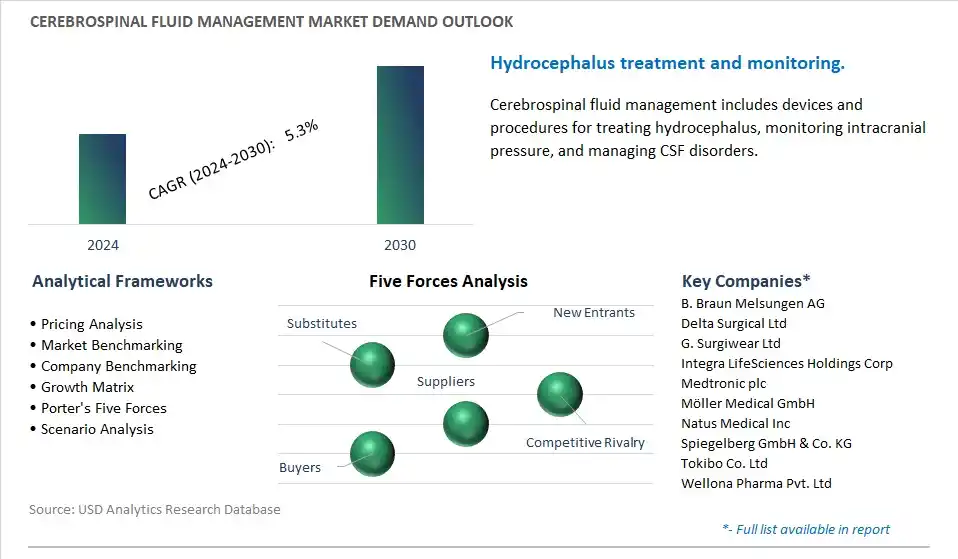
Cerebro spinal Fluid Management Market is estimated to increase at a Compounded Annual Growth Rate of 5.3% CAGR over the forecast period from 2024 to 2030
The Cerebro spinal Fluid Management Market study analyzes and forecasts the market size across 6 regions and 24 countries for diverse segments- By Type (CSF shunts, External drainage system), By Age Group (Pediatric, Adult).
An Introduction to Cerebro spinal Fluid Management Market in 2024
Cerebrospinal fluid (CSF) management involves the monitoring, analysis, and therapeutic interventions related to the production, circulation, and absorption of CSF within the central nervous system. In 2024, CSF management encompasses diagnostic procedures such as lumbar puncture (spinal tap) for CSF analysis, intracranial pressure (ICP) monitoring for assessing brain health, and therapeutic interventions such as CSF drainage or shunting for managing conditions like hydrocephalus or intracranial hypertension. These procedures are performed by neurologists, neurosurgeons, and other healthcare professionals in hospital settings, neurocritical care units, and neurosurgery centers. CSF management plays a crucial role in diagnosing neurological disorders, monitoring disease progression, and managing intracranial pressure to prevent complications such as brain herniation or cerebral edema. With advancements in imaging technology, minimally invasive techniques, and shunt design, CSF management procedures offer improved safety, accuracy, and patient outcomes. As our understanding of CSF dynamics and neurologic conditions continues to advance, CSF management remains a cornerstone of neurological care, providing essential diagnostic and therapeutic interventions for patients with a wide range of neurologic disorders and traumatic brain injuries.
Market Trend: Shift Towards Minimally Invasive Procedures
A significant trend in the cerebrospinal fluid management market is the shift towards minimally invasive procedures. Traditionally, cerebrospinal fluid (CSF) management procedures involved invasive surgeries such as shunt placements or lumbar punctures, which carry risks of complications and require longer recovery times. However, advancements in medical technology have led to the development of minimally invasive techniques for CSF management, such as endoscopic third ventriculostomy (ETV) and minimally invasive lumbar puncture procedures. These techniques offer reduced tissue trauma, shorter hospital stays, and faster recovery times, driving the adoption of minimally invasive CSF management procedures and shaping the market landscape.
Market Driver: Increasing Incidence of Neurological Disorders and Hydrocephalus
A key driver fueling the cerebrospinal fluid management market is the increasing incidence of neurological disorders and hydrocephalus. Neurological disorders such as hydrocephalus, intracranial hemorrhage, and meningitis can disrupt CSF circulation and absorption, leading to abnormal accumulation of fluid within the brain or spinal cord. Hydrocephalus, in particular, affects individuals of all ages, from newborns to the elderly, and requires interventions for CSF drainage and management to alleviate symptoms and prevent complications. With the rising prevalence of neurological disorders globally, there's a growing demand for effective CSF management strategies, driving market growth and innovation in treatment modalities.
Market Opportunity: Development of Implantable CSF Shunt Devices with Advanced Monitoring Capabilities
An opportunity within the cerebrospinal fluid management market lies in the development of implantable CSF shunt devices with advanced monitoring capabilities. CSF shunts are commonly used to divert excess fluid from the brain to other parts of the body, relieving intracranial pressure and managing hydrocephalus. However, complications such as shunt malfunction, overdrainage, or underdrainage can occur, requiring additional surgical interventions and posing risks to patients. Developing implantable CSF shunt devices equipped with advanced monitoring sensors, such as pressure sensors or flow meters, enables real-time monitoring of CSF dynamics and shunt performance. This technology allows for early detection of shunt malfunctions, optimization of shunt settings, and personalized management of CSF flow, improving patient outcomes and reducing the need for repeat surgeries. Companies investing in the development of implantable CSF shunt devices with advanced monitoring capabilities stand to address unmet needs in CSF management and enhance the standard of care for patients with hydrocephalus and other neurological conditions.
Cerebrospinal Fluid Management Market Share Analysis: Cerebrospinal Fluid (CSF) Shunts is the fastest growing segment over the forecast period to 2030
Among the segments listed, the CSF shunts segment within the Cerebrospinal Fluid Management market is experiencing the fastest growth. This growth is primarily driven by several factors. Firstly, CSF shunts are surgical devices used to manage conditions such as hydrocephalus, a condition characterized by the accumulation of excess cerebrospinal fluid in the brain's ventricles. Hydrocephalus can occur in both pediatric and adult populations and requires surgical intervention to divert the excess fluid and alleviate intracranial pressure. As the prevalence of conditions requiring CSF shunt placement, such as congenital hydrocephalus, normal pressure hydrocephalus (NPH), and intracranial hemorrhage, continues to rise globally, there is a corresponding increase in the demand for CSF shunt devices. Moreover, advancements in shunt technology, including the development of programmable and adjustable valves, have improved the safety, efficacy, and longevity of CSF shunt systems, reducing the risk of complications such as overdrainage and underdrainage. Additionally, with the aging population and the increasing incidence of neurological disorders such as Alzheimer's disease and Parkinson's disease, there is a growing prevalence of NPH and other conditions requiring CSF diversion procedures in the adult population. Furthermore, the expanding application of CSF shunts in pediatric neurosurgery, where they are used to treat conditions such as myelomeningocele and congenital hydrocephalus, contributes to their growing demand across pediatric age groups. With ongoing advancements in neurosurgical techniques and shunt technology, CSF shunts are expected to maintain their rapid growth trajectory in the Cerebrospinal Fluid Management market.
Cerebro spinal Fluid Management Competitive Analysis
The market research study provides in-depth insights into leading companies including the SWOT analyses, product profile, financial details, and recent developments acrossB. Braun Melsungen AG, Delta Surgical Ltd, G. Surgiwear Ltd, Integra LifeSciences Holdings Corp, Medtronic plc, Möller Medical GmbH, Natus Medical Inc, Spiegelberg GmbH & Co. KG, Tokibo Co. Ltd, Wellona Pharma Pvt. Ltd
Cerebro spinal Fluid Management Market Segmentation
By Type
CSF shunts
External drainage system
By Age Group
Pediatric
Adult
Geographical Analysis
North America (United States, Canada, Mexico)
Europe (Germany, France, United Kingdom, Spain, Italy, Rest of Europe)
Asia Pacific (China, India, Japan, South Korea, Rest of Asia Pacific)
South America (Brazil, Argentina, Rest of South America)
Middle East and Africa (Saudi Arabia, UAE, Rest of Middle East, South Africa, Egypt, Rest of Africa)
Cerebro spinal Fluid Management Market Companies
B. Braun Melsungen AG
Delta Surgical Ltd
G. Surgiwear Ltd
Integra LifeSciences Holdings Corp
Medtronic plc
Möller Medical GmbH
Natus Medical Inc
Spiegelberg GmbH & Co. KG
Tokibo Co. Ltd
Wellona Pharma Pvt. Ltd
Reasons to Buy the Cerebro spinal Fluid Management Market Study
• Deepen your industry insights and navigate uncertainties for strategy formulation, CAPEX, and Operational decisions
• Gain access to detailed insights on the Cerebro spinal Fluid Management Market, encompassing current market size, growth trends, and forecasts till 2030.
• Access detailed competitor analysis, enabling competitive advantage through a thorough understanding of market players, strategies, and potential differentiation opportunities
• Stay ahead of the curve with insights on technological advancements, innovations, and upcoming trends
• Identify lucrative investment avenues and expansion opportunities within the Cerebro spinal Fluid Management Market industry, guided by robust, data-backed analysis.
• Understand regional and global markets through country-wise analysis, regional market potential, regulatory nuances, and dynamics
• Execute strategies with confidence and speed through information, analytics, and insights on the industry value chain
• Corporate leaders, strategists, financial experts, shareholders, asset managers, and governmental representatives can make long-term planning scenarios and build an integrated and timely understanding of market dynamics
• Benefit from tailored solutions and expert consultation based on report insights, providing personalized strategies aligned with specific business needs.
TABLE OF CONTENTS
1 Introduction to 2024 Cerebro spinal Fluid Management Market
1.1 Market Overview
1.2 Quick Facts
1.3 Scope/Objective of the Study
1.4 Market Definition
1.5 Countries and Regions Covered
1.6 Units, Currency, and Conversions
1.7 Industry Value Chain
2 Research Methodology
2.1 Market Size Estimation
2.2 Sources and Research Methodology
2.3 Data Triangulation
2.4 Assumptions and Limitations
3 Executive Summary
3.1 Global Cerebro spinal Fluid Management Market Size Outlook, $ Million, 2021 to 2030
3.2 Cerebro spinal Fluid Management Market Outlook by Type, $ Million, 2021 to 2030
3.3 Cerebro spinal Fluid Management Market Outlook by Product, $ Million, 2021 to 2030
3.4 Cerebro spinal Fluid Management Market Outlook by Application, $ Million, 2021 to 2030
3.5 Cerebro spinal Fluid Management Market Outlook by Key Countries, $ Million, 2021 to 2030
4 Market Dynamics
4.1 Key Driving Forces of Cerebro spinal Fluid Management Industry
4.2 Key Market Trends in Cerebro spinal Fluid Management Industry
4.3 Potential Opportunities in Cerebro spinal Fluid Management Industry
4.4 Key Challenges in Cerebro spinal Fluid Management Industry
5 Market Factor Analysis
5.1 Value Chain Analysis
5.2 Competitive Landscape
5.2.1 Global Cerebro spinal Fluid Management Market Share by Company (%), 2023
5.2.2 Product Offerings by Company
5.3 Porter’s Five Forces Analysis
5.4 Pricing Analysis and Outlook
6 Growth Outlook Across Scenarios
6.1 Growth Analysis-Case Scenario Definitions
6.2 Low Growth Scenario Forecasts
6.3 Reference Growth Scenario Forecasts
6.4 High Growth Scenario Forecasts
7 Global Cerebro spinal Fluid Management Market Outlook by Segments
7.1 Cerebro spinal Fluid Management Market Outlook by Segments, $ Million, 2021- 2030
By Type
CSF shunts
External drainage system
By Age Group
Pediatric
Adult
8 North America Cerebro spinal Fluid Management Market Analysis and Outlook To 2030
8.1 Introduction to North America Cerebro spinal Fluid Management Markets in 2024
8.2 North America Cerebro spinal Fluid Management Market Size Outlook by Country, 2021-2030
8.2.1 United States
8.2.2 Canada
8.2.3 Mexico
8.3 North America Cerebro spinal Fluid Management Market size Outlook by Segments, 2021-2030
By Type
CSF shunts
External drainage system
By Age Group
Pediatric
Adult
9 Europe Cerebro spinal Fluid Management Market Analysis and Outlook To 2030
9.1 Introduction to Europe Cerebro spinal Fluid Management Markets in 2024
9.2 Europe Cerebro spinal Fluid Management Market Size Outlook by Country, 2021-2030
9.2.1 Germany
9.2.2 France
9.2.3 Spain
9.2.4 United Kingdom
9.2.4 Italy
9.2.5 Russia
9.2.6 Norway
9.2.7 Rest of Europe
9.3 Europe Cerebro spinal Fluid Management Market Size Outlook by Segments, 2021-2030
By Type
CSF shunts
External drainage system
By Age Group
Pediatric
Adult
10 Asia Pacific Cerebro spinal Fluid Management Market Analysis and Outlook To 2030
10.1 Introduction to Asia Pacific Cerebro spinal Fluid Management Markets in 2024
10.2 Asia Pacific Cerebro spinal Fluid Management Market Size Outlook by Country, 2021-2030
10.2.1 China
10.2.2 India
10.2.3 Japan
10.2.4 South Korea
10.2.5 Indonesia
10.2.6 Malaysia
10.2.7 Australia
10.2.8 Rest of Asia Pacific
10.3 Asia Pacific Cerebro spinal Fluid Management Market size Outlook by Segments, 2021-2030
By Type
CSF shunts
External drainage system
By Age Group
Pediatric
Adult
11 South America Cerebro spinal Fluid Management Market Analysis and Outlook To 2030
11.1 Introduction to South America Cerebro spinal Fluid Management Markets in 2024
11.2 South America Cerebro spinal Fluid Management Market Size Outlook by Country, 2021-2030
11.2.1 Brazil
11.2.2 Argentina
11.2.3 Rest of South America
11.3 South America Cerebro spinal Fluid Management Market size Outlook by Segments, 2021-2030
By Type
CSF shunts
External drainage system
By Age Group
Pediatric
Adult
12 Middle East and Africa Cerebro spinal Fluid Management Market Analysis and Outlook To 2030
12.1 Introduction to Middle East and Africa Cerebro spinal Fluid Management Markets in 2024
12.2 Middle East and Africa Cerebro spinal Fluid Management Market Size Outlook by Country, 2021-2030
12.2.1 Saudi Arabia
12.2.2 UAE
12.2.3 Oman
12.2.4 Rest of Middle East
12.2.5 Egypt
12.2.6 Nigeria
12.2.7 South Africa
12.2.8 Rest of Africa
12.3 Middle East and Africa Cerebro spinal Fluid Management Market size Outlook by Segments, 2021-2030
By Type
CSF shunts
External drainage system
By Age Group
Pediatric
Adult
13 Company Profiles
13.1 Company Snapshot
13.2 SWOT Profiles
13.3 Products and Services
13.4 Recent Developments
13.5 Financial Profile
List of Companies
B. Braun Melsungen AG
Delta Surgical Ltd
G. Surgiwear Ltd
Integra LifeSciences Holdings Corp
Medtronic plc
Möller Medical GmbH
Natus Medical Inc
Spiegelberg GmbH & Co. KG
Tokibo Co. Ltd
Wellona Pharma Pvt. Ltd
14 Appendix
14.1 Customization Offerings
14.2 Subscription Services
14.3 Related Reports
14.4 Publisher Expertise
By Type
CSF shunts
External drainage system
By Age Group
Pediatric
Adult
Countries Analyzed
North America (United States, Canada, Mexico)
Europe (Germany, France, United Kingdom, Spain, Italy, Rest of Europe)
Asia Pacific (China, India, Japan, South Korea, Rest of Asia Pacific)
South America (Brazil, Argentina, Rest of South America)
Middle East and Africa (Saudi Arabia, UAE, Rest of Middle East, South Africa, Egypt, Rest of Africa)
