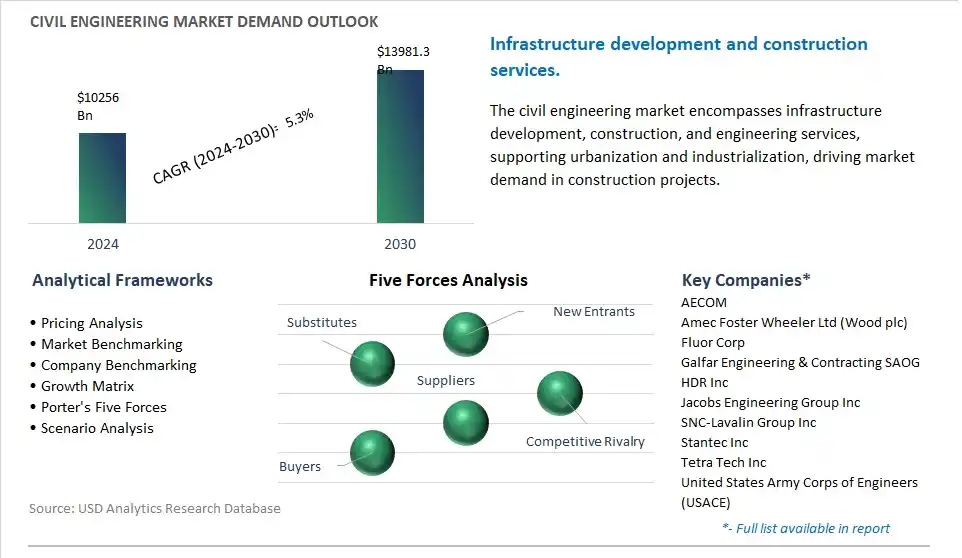
The global Civil Engineering Market is poised to register a 5.3% CAGR from $10256 Billion in 2024 to $13981.3 Billion in 2030.
The global Civil Engineering Market Study analyzes and forecasts the market size across 6 regions and 24 countries for diverse segments -By Services (Planning & Design, Construction, Maintenance, Others), By Application (Real Estate, Infrastructure, Industrial), By End-User (Government, Private, Others).
An Introduction to Global Civil Engineering Market in 2024
The field of civil engineering is undergoing a transformation driven by digitalization and sustainability, with key trends shaping the future of infrastructure development. Civil engineers are increasingly leveraging digital technologies such as Building Information Modeling (BIM), Geographic Information Systems (GIS), and remote sensing to optimize project design, construction, and management processes. Additionally, there is a growing emphasis on sustainability and resilience in infrastructure projects, with the integration of green building practices, renewable energy systems, and climate-responsive design principles. Key trends include the use of advanced materials such as recycled aggregates, high-performance concrete, and carbon-neutral construction methods to reduce environmental impact and enhance infrastructure durability. Moreover, the adoption of smart infrastructure solutions, including sensors, IoT devices, and real-time monitoring systems, enables proactive maintenance and efficient resource management, leading to safer and more resilient urban environments. As cities grapple with population growth, climate change, and aging infrastructure, civil engineering plays a crucial role in driving innovation and creating sustainable solutions for the built environment.
Civil Engineering Market Competitive Landscape
The market report analyses the leading companies in the industry including AECOM, Amec Foster Wheeler Ltd (Wood plc), Fluor Corp, Galfar Engineering & Contracting SAOG, HDR Inc, Jacobs Engineering Group Inc, SNC-Lavalin Group Inc, Stantec Inc, Tetra Tech Inc, United States Army Corps of Engineers (USACE).
Civil Engineering Market Dynamics
Civil Engineering Market Trend: Adoption of Sustainable and Resilient Infrastructure Practices
A prominent trend in the civil engineering market is the widespread adoption of sustainable and resilient infrastructure practices. With increasing concerns about climate change, population growth, and urbanization, there is a growing emphasis on developing infrastructure that is not only functional but also environmentally sustainable and resilient to natural disasters. Civil engineers are incorporating green building techniques, renewable energy systems, and resilient design principles into their projects to minimize environmental impact, conserve resources, and enhance infrastructure durability. This is driven by government regulations, green building certifications, and public awareness of the need for sustainable development, driving the demand for civil engineering services that prioritize environmental stewardship and long-term resilience.
Civil Engineering Market Driver: Infrastructure Investment and Urbanization
A significant driver fueling the demand for civil engineering services is infrastructure investment and urbanization. With rapid urbanization and population growth in emerging economies, there is a pressing need to develop and upgrade infrastructure such as roads, bridges, railways, airports, water supply systems, and sewage treatment facilities to support economic growth and improve quality of life. Governments and private sector entities are investing heavily in infrastructure projects to address transportation congestion, water scarcity, energy demands, and environmental challenges. This driver is further supported by initiatives such as public-private partnerships, stimulus packages, and urban development plans, driving the demand for civil engineering expertise to plan, design, and implement infrastructure projects that meet the needs of growing urban populations.
Civil Engineering Market Opportunity: Integration of Smart Technologies and Digital Solutions
An opportunity within the civil engineering market lies in the integration of smart technologies and digital solutions. With advancements in digitalization, data analytics, and Internet of Things (IoT) technologies, there is potential to improve the efficiency, safety, and sustainability of infrastructure projects through the use of smart sensors, digital twins, and predictive analytics. Civil engineers can leverage these technologies to optimize project planning, monitor construction progress, manage asset performance, and enhance maintenance practices. Additionally, there is opportunity to utilize Building Information Modeling (BIM) and Geographic Information Systems (GIS) to streamline design processes, minimize errors, and improve collaboration among project stakeholders. By capitalizing on this opportunity and embracing digital transformation, civil engineering firms can stay competitive, deliver innovative solutions, and meet the evolving needs of clients in the digital age.
Civil Engineering Market Share Analysis: construction services held the highest revenue share in 2024
In civil engineering, the largest segment is construction services, encompassing the actual building and development of infrastructure projects such as roads, bridges, buildings, and utilities. This segment involves a range of activities from site preparation and foundation work to structural erection and finishing touches. Planning and design services also play a crucial role, but construction services represent the largest share in terms of project scale and resource allocation. Maintenance services follow, ensuring the longevity and functionality of constructed infrastructure, while other services include specialized consulting, research, or regulatory compliance support.
Civil Engineering Market Share Analysis: infrastructure segment is poised to register the fastest growth rate (CAGR) over the forecast period to 2030
The infrastructure sector has been identified as the fastest-growing segment in civil engineering. This growth is driven by increasing investments in transportation networks, energy systems, water supply and sanitation facilities, and other critical infrastructure projects worldwide. Rapid urbanization, population growth, and the need for sustainable development further fuel the demand for infrastructure, making it a key area of focus for civil engineering advancements and innovations.
Civil Engineering Market Share Analysis: government held the highest revenue share in 2024
The government sector emerges as the largest end-user of civil engineering services. This is primarily due to government involvement in large-scale infrastructure projects such as roads, bridges, dams, airports, and public utilities. Government agencies at various levels, including local, state, and national governments, play a crucial role in funding, planning, and executing these infrastructure developments, making them a significant contributor to the civil engineering sector.
Civil Engineering Market Report Segmentation
By Services
Planning & Design
Construction
Maintenance
Others
By Application
Real Estate
Infrastructure
Industrial
By End-User
Government
Private
Others
Regions Included
North America (US, Canada, Mexico)
Europe (Germany, UK, France, Spain, Italy, Russia, Rest of Europe)
Asia Pacific (China, India, Japan, South Korea, Australia, South East Asia, Rest of Asia)
South America (Brazil, Argentina, Rest of South America)
Middle East and Africa (Saudi Arabia, UAE, Rest of Middle East, South Africa, Egypt, Rest of Africa)
Civil Engineering Companies Profiled in the Market Study
AECOM
Amec Foster Wheeler Ltd (Wood plc)
Fluor Corp
Galfar Engineering & Contracting SAOG
HDR Inc
Jacobs Engineering Group Inc
SNC-Lavalin Group Inc
Stantec Inc
Tetra Tech Inc
United States Army Corps of Engineers (USACE)
*- List Not Exhaustive
TABLE OF CONTENTS
1 Introduction to 2024 Civil Engineering Market
1.1 Market Overview
1.2 Quick Facts
1.3 Scope/Objective of the Study
1.4 Market Definition
1.5 Countries and Regions Covered
1.6 Units, Currency, and Conversions
1.7 Industry Value Chain
2 Research Methodology
2.1 Market Size Estimation
2.2 Sources and Research Methodology
2.3 Data Triangulation
2.4 Assumptions and Limitations
3 Executive Summary
3.1 Global Civil Engineering Market Size Outlook, $ Million, 2021 to 2030
3.2 Civil Engineering Market Outlook by Type, $ Million, 2021 to 2030
3.3 Civil Engineering Market Outlook by Product, $ Million, 2021 to 2030
3.4 Civil Engineering Market Outlook by Application, $ Million, 2021 to 2030
3.5 Civil Engineering Market Outlook by Key Countries, $ Million, 2021 to 2030
4 Market Dynamics
4.1 Key Driving Forces of Civil Engineering Industry
4.2 Key Market Trends in Civil Engineering Industry
4.3 Potential Opportunities in Civil Engineering Industry
4.4 Key Challenges in Civil Engineering Industry
5 Market Factor Analysis
5.1 Value Chain Analysis
5.2 Competitive Landscape
5.2.1 Global Civil Engineering Market Share by Company (%), 2023
5.2.2 Product Offerings by Company
5.3 Porter’s Five Forces Analysis
5.4 Pricing Analysis and Outlook
6 Growth Outlook Across Scenarios
6.1 Growth Analysis-Case Scenario Definitions
6.2 Low Growth Scenario Forecasts
6.3 Reference Growth Scenario Forecasts
6.4 High Growth Scenario Forecasts
7 Global Civil Engineering Market Outlook by Segments
7.1 Civil Engineering Market Outlook by Segments, $ Million, 2021- 2030
By Services
Planning & Design
Construction
Maintenance
Others
By Application
Real Estate
Infrastructure
Industrial
By End-User
Government
Private
Others
8 North America Civil Engineering Market Analysis and Outlook To 2030
8.1 Introduction to North America Civil Engineering Markets in 2024
8.2 North America Civil Engineering Market Size Outlook by Country, 2021-2030
8.2.1 United States
8.2.2 Canada
8.2.3 Mexico
8.3 North America Civil Engineering Market size Outlook by Segments, 2021-2030
By Services
Planning & Design
Construction
Maintenance
Others
By Application
Real Estate
Infrastructure
Industrial
By End-User
Government
Private
Others
9 Europe Civil Engineering Market Analysis and Outlook To 2030
9.1 Introduction to Europe Civil Engineering Markets in 2024
9.2 Europe Civil Engineering Market Size Outlook by Country, 2021-2030
9.2.1 Germany
9.2.2 France
9.2.3 Spain
9.2.4 United Kingdom
9.2.4 Italy
9.2.5 Russia
9.2.6 Norway
9.2.7 Rest of Europe
9.3 Europe Civil Engineering Market Size Outlook by Segments, 2021-2030
By Services
Planning & Design
Construction
Maintenance
Others
By Application
Real Estate
Infrastructure
Industrial
By End-User
Government
Private
Others
10 Asia Pacific Civil Engineering Market Analysis and Outlook To 2030
10.1 Introduction to Asia Pacific Civil Engineering Markets in 2024
10.2 Asia Pacific Civil Engineering Market Size Outlook by Country, 2021-2030
10.2.1 China
10.2.2 India
10.2.3 Japan
10.2.4 South Korea
10.2.5 Indonesia
10.2.6 Malaysia
10.2.7 Australia
10.2.8 Rest of Asia Pacific
10.3 Asia Pacific Civil Engineering Market size Outlook by Segments, 2021-2030
By Services
Planning & Design
Construction
Maintenance
Others
By Application
Real Estate
Infrastructure
Industrial
By End-User
Government
Private
Others
11 South America Civil Engineering Market Analysis and Outlook To 2030
11.1 Introduction to South America Civil Engineering Markets in 2024
11.2 South America Civil Engineering Market Size Outlook by Country, 2021-2030
11.2.1 Brazil
11.2.2 Argentina
11.2.3 Rest of South America
11.3 South America Civil Engineering Market size Outlook by Segments, 2021-2030
By Services
Planning & Design
Construction
Maintenance
Others
By Application
Real Estate
Infrastructure
Industrial
By End-User
Government
Private
Others
12 Middle East and Africa Civil Engineering Market Analysis and Outlook To 2030
12.1 Introduction to Middle East and Africa Civil Engineering Markets in 2024
12.2 Middle East and Africa Civil Engineering Market Size Outlook by Country, 2021-2030
12.2.1 Saudi Arabia
12.2.2 UAE
12.2.3 Oman
12.2.4 Rest of Middle East
12.2.5 Egypt
12.2.6 Nigeria
12.2.7 South Africa
12.2.8 Rest of Africa
12.3 Middle East and Africa Civil Engineering Market size Outlook by Segments, 2021-2030
By Services
Planning & Design
Construction
Maintenance
Others
By Application
Real Estate
Infrastructure
Industrial
By End-User
Government
Private
Others
13 Company Profiles
13.1 Company Snapshot
13.2 SWOT Profiles
13.3 Products and Services
13.4 Recent Developments
13.5 Financial Profile
AECOM
Amec Foster Wheeler Ltd (Wood plc)
Fluor Corp
Galfar Engineering & Contracting SAOG
HDR Inc
Jacobs Engineering Group Inc
SNC-Lavalin Group Inc
Stantec Inc
Tetra Tech Inc
United States Army Corps of Engineers (USACE)
14 Appendix
14.1 Customization Offerings
14.2 Subscription Services
14.3 Related Reports
14.4 Publisher Expertise
By Services
Planning & Design
Construction
Maintenance
Others
By Application
Real Estate
Infrastructure
Industrial
By End-User
Government
Private
Others
Countries Analyzed
North America (US, Canada, Mexico)
Europe (Germany, UK, France, Spain, Italy, Russia, Rest of Europe)
Asia Pacific (China, India, Japan, South Korea, Australia, South East Asia, Rest of Asia)
South America (Brazil, Argentina, Rest of South America)
Middle East and Africa (Saudi Arabia, UAE, Rest of Middle East, South Africa, Egypt, Rest of Africa)
