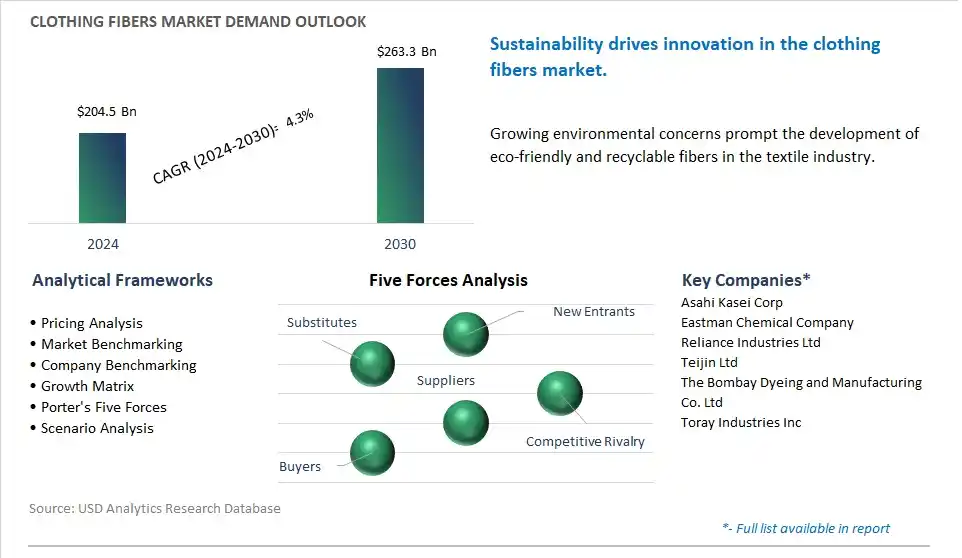
The global Clothing Fibers Market is poised to register a 4.3% CAGR from $204.5 Billion in 2024 to $263.3 Billion in 2030.
The global Clothing Fibers Market Study analyzes and forecasts the market size across 6 regions and 24 countries for diverse segments -By Product (Cotton, Synthetic, Animal Based, Others), By End-User (Women's Wear, Men's Wear, Kid's Wear).
An Introduction to Global Clothing Fibers Market in 2024
The clothing fibers market is witnessing significant growth driven by changing consumer preferences, technological innovations, and sustainability initiatives. Key trends shaping the future of the industry include the increasing demand for eco-friendly and performance-driven fibers that offer comfort, durability, and style in apparel and fashion products. As consumers become more conscious of environmental and social impacts, there's a growing need for clothing fibers made from renewable resources, recycled materials, and biodegradable polymers. Moreover, advancements in fiber spinning techniques, textile processing, and finishing technologies are expanding design possibilities and enhancing fabric performance in terms of moisture management, thermal regulation, and stretchability. Additionally, the rising adoption of specialty fibers such as microfibers, lyocell, and bamboo viscose for activewear, athleisure, and sustainable fashion lines is driving market expansion in the apparel industry. Furthermore, the integration of circular economy principles, closed-loop manufacturing, and supply chain transparency is reshaping the clothing fibers industry, promoting resource efficiency, waste reduction, and ethical sourcing practices throughout the value chain.
Clothing Fibers Market Competitive Landscape
The market report analyses the leading companies in the industry including Asahi Kasei Corp, Eastman Chemical Company, Reliance Industries Ltd, Teijin Ltd, The Bombay Dyeing and Manufacturing Co. Ltd, Toray Industries Inc.
Clothing Fibers Market Dynamics
Clothing Fibers Market Trend: Shift Towards Sustainable and Eco-Friendly Fibers
One prominent trend in the clothing fibers market is the increasing consumer demand for sustainable and eco-friendly fibers. With growing awareness of environmental issues and concerns about the fashion industry's impact on the planet, there is a notable shift towards more sustainable and ethically sourced clothing materials. Fibers derived from renewable sources such as bamboo, hemp, organic cotton, and recycled materials are gaining popularity as consumers seek to minimize their carbon footprint and support environmentally responsible fashion brands. This trend is further fueled by regulatory initiatives promoting sustainability, as well as campaigns raising awareness about the social and environmental implications of fast fashion. As a result, clothing manufacturers are exploring alternative fiber options and adopting sustainable practices throughout the supply chain to meet evolving consumer preferences and market demands.
Clothing Fibers Market Driver: Technological Innovations in Fiber Production and Processing
A primary driver shaping the clothing fibers market is technological innovation in fiber production and processing techniques. Advances in materials science, biotechnology, and textile engineering have led to the development of new fibers with enhanced properties such as strength, elasticity, moisture-wicking, and biodegradability. Innovations in spinning, weaving, and finishing processes have also improved the efficiency and sustainability of fiber manufacturing, reducing energy consumption, water usage, and chemical inputs. Additionally, advancements in digital textile printing and dyeing technologies offer opportunities for customization and waste reduction, enabling manufacturers to create unique, high-quality fabrics while minimizing environmental impact. The relentless pursuit of technological advancements drives product innovation, enhances supply chain efficiency, and expands the range of fiber options available to clothing designers and consumers, driving market growth and competitiveness.
Clothing Fibers Market Opportunity: Embracing Circular Economy Principles
An opportunity within the clothing fibers market lies in embracing circular economy principles to promote resource efficiency and waste reduction. By adopting closed-loop systems for fiber production, recycling, and reuse, clothing manufacturers can minimize the environmental footprint of their operations and contribute to a more sustainable fashion industry. Opportunities exist for the development of innovative recycling technologies that can efficiently recover fibers from post-consumer textiles and manufacturing waste, allowing them to be reintegrated into the production process. Additionally, initiatives promoting garment rental, resale, and repair services encourage extended product lifecycles and reduce textile waste sent to landfills. By embracing the principles of circularity, clothing fiber producers can align themselves with consumer preferences for sustainable fashion choices, differentiate their brands in the market, and create value throughout the entire product lifecycle.
Clothing Fibers Market Share Analysis: Cotton segment generated the highest revenue in the industry
Among the delineated segments based on product, Cotton is the largest segment in the Clothing Fibers Market, driven by diverse pivotal factors. The dominance of Cotton in the market is driven by cotton is one of the oldest and most widely used natural fibers in the textile industry, with a long history of cultivation and utilization in clothing production. Its popularity stems from its desirable characteristics, including softness, breathability, absorbency, and comfort, making it an ideal choice for various types of apparel, from everyday wear to high-end fashion. Additionally, cotton's versatility allows it to be used in a wide range of clothing items, including shirts, pants, dresses, and underwear, as well as in home textiles such as bed linens, towels, and curtains. In addition, cotton's natural properties make it suitable for a diverse range of climates and seasons, contributing to its widespread adoption across different regions and consumer demographics. Further, the global availability of cotton, combined with advancements in farming techniques, processing technologies, and textile manufacturing processes, ensures a reliable and sustainable supply chain for cotton-based clothing fibers. As consumers continue to prioritize comfort, sustainability, and natural materials in their clothing choices, the Cotton segment maintains its lead in the Clothing Fibers Market, reflecting its enduring popularity and widespread acceptance in the global fashion industry.
Clothing Fibers Market Share Analysis: Kid's Wear Segment is poised to register the fastest growth rate (CAGR) over the forecast period to 2030
Among the delineated segments based on end-user, Kid's Wear is the fastest-growing segment in the Clothing Fibers Market, driven by diverse compelling factors. The rapid growth of the Kid's Wear segment can be attributed to diverse key trends and developments in the fashion industry. The there is a growing emphasis on children's fashion and apparel, driven by changing consumer preferences, increasing disposable income, and evolving lifestyle trends. Parents are increasingly investing in high-quality clothing for their children, seeking garments that offer comfort, durability, and style. Additionally, the rise of social media and digital influencers has led to greater awareness and demand for fashionable children's clothing, driving market growth. In addition, advancements in textile technologies and manufacturing processes have led to the development of innovative and sustainable fibers and fabrics suitable for children's wear, meeting the demand for eco-friendly and safe clothing options. Further, the expansion of online retail channels and e-commerce platforms has made it easier for parents to access a wide range of children's clothing brands and styles, further fueling market growth. As parents prioritize the comfort, safety, and style of their children's clothing, the Kid's Wear segment experiences rapid growth in the Clothing Fibers Market, reflecting its significant contribution to Over the forecast period market expansion and consumer demand.
Clothing Fibers Market Report Segmentation
By Product
Cotton
Synthetic
Animal Based
Others
By End-User
Women's Wear
Men's Wear
Kid's Wear
Regions Included
North America (US, Canada, Mexico)
Europe (Germany, UK, France, Spain, Italy, Russia, Rest of Europe)
Asia Pacific (China, India, Japan, South Korea, Australia, South East Asia, Rest of Asia)
South America (Brazil, Argentina, Rest of South America)
Middle East and Africa (Saudi Arabia, UAE, Rest of Middle East, South Africa, Egypt, Rest of Africa)
Clothing Fibers Companies Profiled in the Market Study
Asahi Kasei Corp
Eastman Chemical Company
Reliance Industries Ltd
Teijin Ltd
The Bombay Dyeing and Manufacturing Co. Ltd
Toray Industries Inc
*- List Not Exhaustive
TABLE OF CONTENTS
1 Introduction to 2024 Clothing Fibers Market
1.1 Market Overview
1.2 Quick Facts
1.3 Scope/Objective of the Study
1.4 Market Definition
1.5 Countries and Regions Covered
1.6 Units, Currency, and Conversions
1.7 Industry Value Chain
2 Research Methodology
2.1 Market Size Estimation
2.2 Sources and Research Methodology
2.3 Data Triangulation
2.4 Assumptions and Limitations
3 Executive Summary
3.1 Global Clothing Fibers Market Size Outlook, $ Million, 2021 to 2030
3.2 Clothing Fibers Market Outlook by Type, $ Million, 2021 to 2030
3.3 Clothing Fibers Market Outlook by Product, $ Million, 2021 to 2030
3.4 Clothing Fibers Market Outlook by Application, $ Million, 2021 to 2030
3.5 Clothing Fibers Market Outlook by Key Countries, $ Million, 2021 to 2030
4 Market Dynamics
4.1 Key Driving Forces of Clothing Fibers Industry
4.2 Key Market Trends in Clothing Fibers Industry
4.3 Potential Opportunities in Clothing Fibers Industry
4.4 Key Challenges in Clothing Fibers Industry
5 Market Factor Analysis
5.1 Value Chain Analysis
5.2 Competitive Landscape
5.2.1 Global Clothing Fibers Market Share by Company (%), 2023
5.2.2 Product Offerings by Company
5.3 Porter’s Five Forces Analysis
5.4 Pricing Analysis and Outlook
6 Growth Outlook Across Scenarios
6.1 Growth Analysis-Case Scenario Definitions
6.2 Low Growth Scenario Forecasts
6.3 Reference Growth Scenario Forecasts
6.4 High Growth Scenario Forecasts
7 Global Clothing Fibers Market Outlook by Segments
7.1 Clothing Fibers Market Outlook by Segments, $ Million, 2021- 2030
By Product
Cotton
Synthetic
Animal Based
Others
By End-User
Women's Wear
Men's Wear
Kid's Wear
8 North America Clothing Fibers Market Analysis and Outlook To 2030
8.1 Introduction to North America Clothing Fibers Markets in 2024
8.2 North America Clothing Fibers Market Size Outlook by Country, 2021-2030
8.2.1 United States
8.2.2 Canada
8.2.3 Mexico
8.3 North America Clothing Fibers Market size Outlook by Segments, 2021-2030
By Product
Cotton
Synthetic
Animal Based
Others
By End-User
Women's Wear
Men's Wear
Kid's Wear
9 Europe Clothing Fibers Market Analysis and Outlook To 2030
9.1 Introduction to Europe Clothing Fibers Markets in 2024
9.2 Europe Clothing Fibers Market Size Outlook by Country, 2021-2030
9.2.1 Germany
9.2.2 France
9.2.3 Spain
9.2.4 United Kingdom
9.2.4 Italy
9.2.5 Russia
9.2.6 Norway
9.2.7 Rest of Europe
9.3 Europe Clothing Fibers Market Size Outlook by Segments, 2021-2030
By Product
Cotton
Synthetic
Animal Based
Others
By End-User
Women's Wear
Men's Wear
Kid's Wear
10 Asia Pacific Clothing Fibers Market Analysis and Outlook To 2030
10.1 Introduction to Asia Pacific Clothing Fibers Markets in 2024
10.2 Asia Pacific Clothing Fibers Market Size Outlook by Country, 2021-2030
10.2.1 China
10.2.2 India
10.2.3 Japan
10.2.4 South Korea
10.2.5 Indonesia
10.2.6 Malaysia
10.2.7 Australia
10.2.8 Rest of Asia Pacific
10.3 Asia Pacific Clothing Fibers Market size Outlook by Segments, 2021-2030
By Product
Cotton
Synthetic
Animal Based
Others
By End-User
Women's Wear
Men's Wear
Kid's Wear
11 South America Clothing Fibers Market Analysis and Outlook To 2030
11.1 Introduction to South America Clothing Fibers Markets in 2024
11.2 South America Clothing Fibers Market Size Outlook by Country, 2021-2030
11.2.1 Brazil
11.2.2 Argentina
11.2.3 Rest of South America
11.3 South America Clothing Fibers Market size Outlook by Segments, 2021-2030
By Product
Cotton
Synthetic
Animal Based
Others
By End-User
Women's Wear
Men's Wear
Kid's Wear
12 Middle East and Africa Clothing Fibers Market Analysis and Outlook To 2030
12.1 Introduction to Middle East and Africa Clothing Fibers Markets in 2024
12.2 Middle East and Africa Clothing Fibers Market Size Outlook by Country, 2021-2030
12.2.1 Saudi Arabia
12.2.2 UAE
12.2.3 Oman
12.2.4 Rest of Middle East
12.2.5 Egypt
12.2.6 Nigeria
12.2.7 South Africa
12.2.8 Rest of Africa
12.3 Middle East and Africa Clothing Fibers Market size Outlook by Segments, 2021-2030
By Product
Cotton
Synthetic
Animal Based
Others
By End-User
Women's Wear
Men's Wear
Kid's Wear
13 Company Profiles
13.1 Company Snapshot
13.2 SWOT Profiles
13.3 Products and Services
13.4 Recent Developments
13.5 Financial Profile
Asahi Kasei Corp
Eastman Chemical Company
Reliance Industries Ltd
Teijin Ltd
The Bombay Dyeing and Manufacturing Co. Ltd
Toray Industries Inc
14 Appendix
14.1 Customization Offerings
14.2 Subscription Services
14.3 Related Reports
14.4 Publisher Expertise
By Product
Cotton
Synthetic
Animal Based
Others
By End-User
Women's Wear
Men's Wear
Kid's Wear
Countries Analyzed
North America (US, Canada, Mexico)
Europe (Germany, UK, France, Spain, Italy, Russia, Rest of Europe)
Asia Pacific (China, India, Japan, South Korea, Australia, South East Asia, Rest of Asia)
South America (Brazil, Argentina, Rest of South America)
Middle East and Africa (Saudi Arabia, UAE, Rest of Middle East, South Africa, Egypt, Rest of Africa)
