Cocoa Butter Equivalents Market is estimated to increase at a growth rate of 7.1% CAGR over the forecast period from 2024 to 2030.
The Cocoa Butter Equivalents Market Study forecasts the market size across 6 regions and 24 countries for diverse segments including-Type (Shea Butter, Palm and Palm Kernel Oil, Sal Fat, Kokum Butter, Mango Butter), Application (Confectionery, Food and Beverages, Cosmetics, Others), Distribution Channel (Online, Offline).
An Introduction to Cocoa Butter Equivalents Market, 2024
Cocoa Butter Equivalents: The market for cocoa butter equivalents is driven by the formulation of fats with properties resembling cocoa butter for use in chocolate and confectionery. Key drivers include the production of fats like shea, palm, or coconut oil that mimic cocoa butter's texture, melting point, and stability. The appeal lies in cocoa butter equivalents' compatibility in chocolate processing and their role as functional substitutes, catering to manufacturers seeking cost-effective and sustainable alternatives.
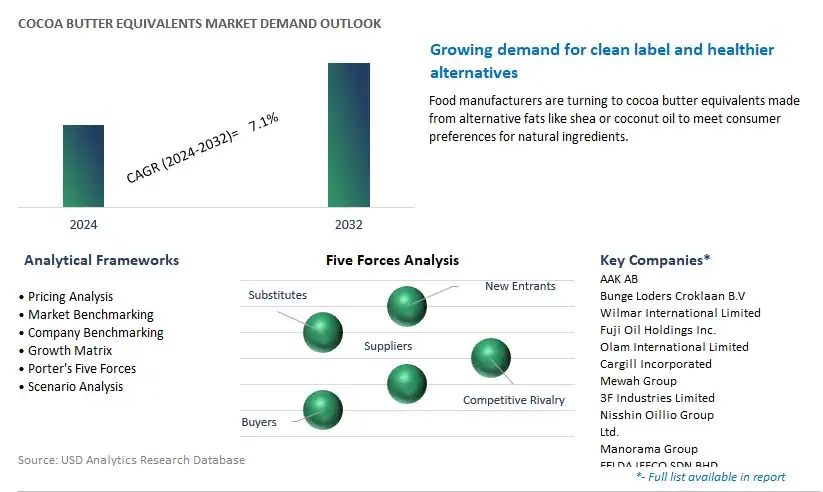
Cocoa Butter Equivalents Market Trend: Increasing Demand for Versatile and Stable Fat Alternatives
A prominent market trend in the Cocoa Butter Equivalents segment is the increasing demand for versatile and stable fat alternatives in the food industry. With the dynamic landscape of food formulations and the need for stable fats in various applications, there is a growing interest in cocoa butter equivalents that offer similar functional properties. This trend reflects the industry's pursuit of alternatives that can match cocoa butter's stability, texture, and versatility while providing a cost-effective solution. Manufacturers can capitalize on this trend by developing cocoa butter equivalents that meet the requirements of diverse applications, including confectionery, bakery, and cosmetic products.
Cocoa Butter Equivalents Market Driver: Cost Efficiency and Stability in Confectionery and Baking Industries
The primary market driver for Cocoa Butter Equivalents is the need for cost efficiency and stability in the confectionery and baking industries. Cocoa butter equivalents, offering stability in various temperature conditions and a cost-effective alternative to cocoa butter, are essential for the production of chocolate confections and baked goods. This driver is fueled by the economic considerations of manufacturers aiming to maintain product quality while managing production costs. Manufacturers can leverage this driver by providing high-quality cocoa butter equivalents that contribute to the stability, texture, and overall sensory attributes of chocolate and baked products.
Cocoa Butter Equivalents Market Opportunity: Formulation for Health-Conscious and Specialty Diets
A potential opportunity within the Cocoa Butter Equivalents market lies in formulating products tailored to health-conscious and specialty diets. Manufacturers can explore the development of cocoa butter equivalents that cater to specific dietary preferences, such as plant-based, vegan, or allergen-free formulations. This opportunity aligns with the growing consumer demand for alternatives that address health and lifestyle choices. By innovating in this space, companies can tap into niche markets, offering cocoa butter equivalents that not only mimic the functional properties of traditional cocoa butter but also align with the preferences of consumers seeking specialized dietary options in their confectionery and baking products.
Cocoa Butter Equivalents Market Segmentation
Type
Shea Butter
Palm and Palm Kernel Oil
Sal Fat
Kokum Butter
Mango Butter
Application
Confectionery
Food and Beverages
Cosmetics
Others
Distribution Channel
Online
Offline
Geographical Segmentation
• North America (US, Canada, Mexico)
• Europe (Germany, UK, France, Spain, Italy, Russia, Rest of Europe)
• Asia Pacific (China, India, Japan, South Korea, South East Asia, Rest of Asia Pacific)
• South America (Brazil, Argentina, Rest of South America)
• Middle East and Africa (Saudi Arabia, UAE, Rest of Middle East, Egypt, South Africa, Nigeria, Rest of Africa)
Cocoa Butter Equivalents Companies Profiled in the Study-
AAK AB
Bunge Loders Croklaan B.V
Wilmar International Limited
Fuji Oil Holdings Inc.
Olam International Limited
Cargill, Incorporated
Mewah Group
3F Industries Limited
Nisshin Oillio Group, Ltd.
Manorama Group
FELDA IFFCO SDN BHD
Musim Mas Holdings Pte. Ltd.
Intercontinental Specialty Fats Sdn. Bhd.
Reasons to Buy the Cocoa Butter Equivalents Market Study
• Deepen your industry insights and navigate uncertainties for strategy formulation, CAPEX, and Operational decisions
• Gain access to detailed insights on the Cocoa Butter Equivalents Market, encompassing current market size, growth trends, and forecasts till 2030.
• Access detailed competitor analysis, enabling competitive advantage through a thorough understanding of market players, strategies, and potential differentiation opportunities
• Stay ahead of the curve with insights on technological advancements, innovations, and upcoming trends
• Identify lucrative investment avenues and expansion opportunities within the Cocoa Butter Equivalents Market industry, guided by robust, data-backed analysis.
• Understand regional and global markets through country-wise analysis, regional market potential, regulatory nuances, and dynamics
• Execute strategies with confidence and speed through information, analytics, and insights on the industry value chain
• Corporate leaders, strategists, financial experts, shareholders, asset managers, and governmental representatives can make long-term planning scenarios and build an integrated and timely understanding of market dynamics
• Benefit from tailored solutions and expert consultation based on report insights, providing personalized strategies aligned with specific business needs.
TABLE OF CONTENTS
1 Introduction To 2024 Cocoa Butter Equivalents Markets
1.1 Market Overview
1.2 Quick Facts
1.3 Scope/Objective of the Study
1.4 Market Definition
1.5 Countries and Regions Included
1.6 Units, Currency, and Conversions
1.7 Industry Value Chain
2 Research Methodology
2.1 Market Size Estimation
2.2 Sources and Research Methodology
2.3 Data Triangulation
2.4 Assumptions and Limitations
3 Executive Summary
3.1 Global Cocoa Butter Equivalents Market Size Outlook, $ Million, 2021 to 2030
3.2 Cocoa Butter Equivalents Market Outlook by Type, $ Million, 2021 to 2030
3.3 Cocoa Butter Equivalents Market Outlook by Product, $ Million, 2021 to 2030
3.4 Cocoa Butter Equivalents Market Outlook by Application, $ Million, 2021 to 2030
3.5 Cocoa Butter Equivalents Market Outlook by Key Countries, $ Million, 2021 to 2030
4 Market Dynamics
4.1 Key Driving Forces of Cocoa Butter Equivalents Industry
4.2 Key Market Trends in Cocoa Butter Equivalents Industry
4.3 Potential Opportunities in Cocoa Butter Equivalents Industry
4.4 Key Challenges in Cocoa Butter Equivalents Industry
5 Market Factor Analysis
5.1 Competitive Landscape
5.1.1 Global Cocoa Butter Equivalents Market Share by Company
5.1.2 Product Offerings by Company
5.2 Porter’s Five Forces Analysis
6 Growth Outlook Across Scenarios
6.1 Growth Analysis-Case Scenario Definitions
6.2 Low Growth Scenario Forecasts
6.3 Reference Growth Scenario Forecasts
6.4 High Growth Scenario Forecasts
7 Global Cocoa Butter Equivalents Market Outlook by Segments
7.1 Cocoa Butter Equivalents Market Outlook by Segments
Type
Shea Butter
Palm and Palm Kernel Oil
Sal Fat
Kokum Butter
Mango Butter
Application
Confectionery
Food and Beverages
Cosmetics
Others
Distribution Channel
Online
Offline
8 North America Cocoa Butter Equivalents Market Analysis and Outlook To 2030
8.1 Introduction to North America Cocoa Butter Equivalents Markets in 2024
8.2 North America Cocoa Butter Equivalents Market Size Outlook by Country, 2021-2030
8.2.1 United States
8.2.2 Canada
8.2.3 Mexico
8.3 North America Cocoa Butter Equivalents Market size Outlook by Segments, 2021-2030
Type
Shea Butter
Palm and Palm Kernel Oil
Sal Fat
Kokum Butter
Mango Butter
Application
Confectionery
Food and Beverages
Cosmetics
Others
Distribution Channel
Online
Offline
9 Europe Cocoa Butter Equivalents Market Analysis and Outlook To 2030
9.1 Introduction to Europe Cocoa Butter Equivalents Markets in 2024
9.2 Europe Cocoa Butter Equivalents Market Size Outlook by Country, 2021-2030
9.2.1 Germany
9.2.2 France
9.2.3 Spain
9.2.4 United Kingdom
9.2.4 Italy
9.2.5 Russia
9.2.6 Norway
9.2.7 Rest of Europe
9.3 Europe Cocoa Butter Equivalents Market size Outlook by Segments, 2021-2030
Type
Shea Butter
Palm and Palm Kernel Oil
Sal Fat
Kokum Butter
Mango Butter
Application
Confectionery
Food and Beverages
Cosmetics
Others
Distribution Channel
Online
Offline
10 Asia Pacific Cocoa Butter Equivalents Market Analysis and Outlook To 2030
10.1 Introduction to Asia Pacific Cocoa Butter Equivalents Markets in 2024
10.2 Asia Pacific Cocoa Butter Equivalents Market Size Outlook by Country, 2021-2030
10.2.1 China
10.2.2 India
10.2.3 Japan
10.2.4 South Korea
10.2.5 Indonesia
10.2.6 Malaysia
10.2.7 Australia
10.2.8 Rest of Asia Pacific
10.3 Asia Pacific Cocoa Butter Equivalents Market size Outlook by Segments, 2021-2030
Type
Shea Butter
Palm and Palm Kernel Oil
Sal Fat
Kokum Butter
Mango Butter
Application
Confectionery
Food and Beverages
Cosmetics
Others
Distribution Channel
Online
Offline
11 South America Cocoa Butter Equivalents Market Analysis and Outlook To 2030
11.1 Introduction to South America Cocoa Butter Equivalents Markets in 2024
11.2 South America Cocoa Butter Equivalents Market Size Outlook by Country, 2021-2030
11.2.1 Brazil
11.2.2 Argentina
11.2.3 Rest of South America
11.3 South America Cocoa Butter Equivalents Market size Outlook by Segments, 2021-2030
Type
Shea Butter
Palm and Palm Kernel Oil
Sal Fat
Kokum Butter
Mango Butter
Application
Confectionery
Food and Beverages
Cosmetics
Others
Distribution Channel
Online
Offline
12 Middle East and Africa Cocoa Butter Equivalents Market Analysis and Outlook To 2030
12.1 Introduction to Middle East and Africa Cocoa Butter Equivalents Markets in 2024
12.2 Middle East and Africa Cocoa Butter Equivalents Market Size Outlook by Country, 2021-2030
12.2.1 Saudi Arabia
12.2.2 UAE
12.2.3 Oman
12.2.4 Rest of Middle East
12.2.5 Egypt
12.2.6 Nigeria
12.2.7 South Africa
12.2.8 Rest of Africa
12.3 Middle East and Africa Cocoa Butter Equivalents Market size Outlook by Segments, 2021-2030
Type
Shea Butter
Palm and Palm Kernel Oil
Sal Fat
Kokum Butter
Mango Butter
Application
Confectionery
Food and Beverages
Cosmetics
Others
Distribution Channel
Online
Offline
List of Companies
AAK AB
Bunge Loders Croklaan B.V
Wilmar International Limited
Fuji Oil Holdings Inc.
Olam International Limited
Cargill, Incorporated
Mewah Group
3F Industries Limited
Nisshin Oillio Group, Ltd.
Manorama Group
FELDA IFFCO SDN BHD
Musim Mas Holdings Pte. Ltd.
Intercontinental Specialty Fats Sdn. Bhd.
13 Company Profiles
13.1 Company Snapshot
13.2 SWOT Profiles
13.3 Products and Services
13.4 Recent Developments
13.5 Financial Profile
14 Appendix
14.1 Customization Offerings
14.2 Subscription Services
14.3 Related Reports
14.4 Publisher Expertise
Type/brShea Butter /brPalm and Palm Kernel Oil /brSal Fat /brKokum Butter /brMango Butter /br/brApplication/brConfectionery /brFood and Beverages/brCosmetics /brOthers /br/brDistribution Channel/brOnline /brOffline
