The global Coconut Sugar Market is poised to register a 6.1% CAGR from $2.1 Billion in 2024 to $3 Billion in 2030.
The global Coconut Sugar Market Study analyzes and forecasts the market size across 6 regions and 24 countries for diverse segments -By Application (Food and Beverage, Cosmetics, Personal Care), By Sales Channel (Hypermarkets, Specialty Stores, E-Commerce, Business To Business), By Form (Organic, Conventional), By End-User (Commercial, Residential).
An Introduction to Global Coconut Sugar Market in 2024
The coconut sugar market is experiencing notable growth driven by its popularity as a natural sweetener and its perceived health benefits. Key trends shaping the future of the industry include the increasing demand for coconut sugar as a healthier alternative to refined sugar, driven by growing consumer awareness of the adverse effects of excessive sugar consumption on health. As consumers seek natural and minimally processed sweeteners, there's a growing interest in coconut sugar due to its lower glycemic index, higher nutrient content, and sustainable production practices. Moreover, advancements in coconut sugar processing techniques, such as vacuum evaporation and low-temperature drying, are preserving the natural flavor, color, and nutritional profile of coconut sap, driving market expansion. Additionally, the rising adoption of coconut sugar in food and beverage products such as baked goods, confectionery, and beverages as a flavor enhancer and natural sweetening agent is fueling demand in the food industry. Furthermore, the development of organic and Fair Trade-certified coconut sugar products is meeting consumer preferences for ethical sourcing, environmental sustainability, and social responsibility, ensuring transparency and trust in the coconut sugar supply chain.
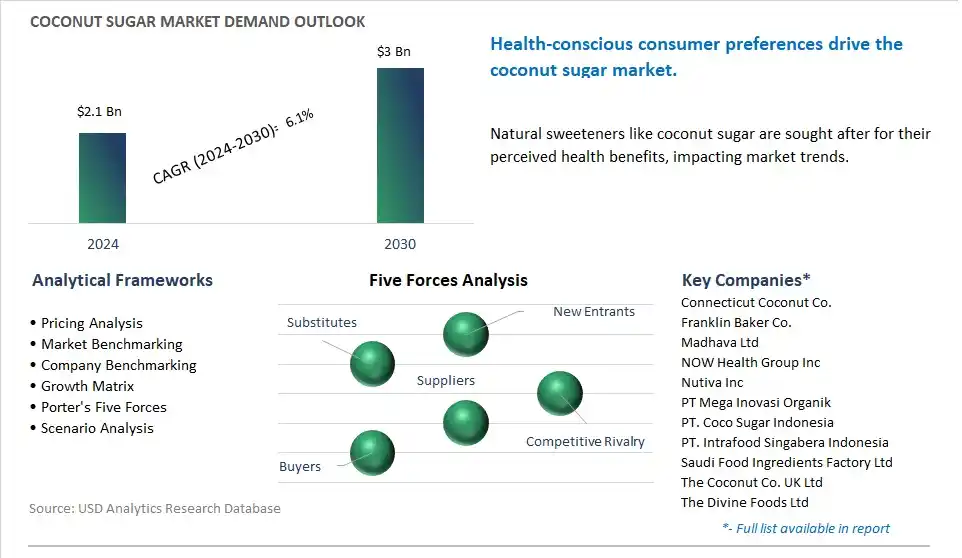
Coconut Sugar Market Competitive Landscape
The market report analyses the leading companies in the industry including Connecticut Coconut Co., Franklin Baker Co., Madhava Ltd, NOW Health Group Inc, Nutiva Inc, PT Mega Inovasi Organik, PT. Coco Sugar Indonesia, PT. Intrafood Singabera Indonesia, Saudi Food Ingredients Factory Ltd, The Coconut Co. UK Ltd, The Divine Foods Ltd, The Groovy Food Co. Ltd, Tradin Organic Agriculture B.V., Tree Grab Ltd, Treelife Ltd, Wholsum Foods Pvt. Ltd, Yana Industries LLP.
Coconut Sugar Market Dynamics
Coconut Sugar Market Trend: Growing Demand for Natural and Healthy Sweeteners
One prominent trend in the coconut sugar market is the growing demand for natural and healthy sweeteners among health-conscious consumers. Coconut sugar, derived from the sap of coconut palm trees, is gaining popularity as an alternative to refined sugars and artificial sweeteners due to its perceived health benefits and low glycemic index. With increasing awareness of the adverse health effects associated with excessive sugar consumption, there is a shift towards natural sweeteners that offer a more sustainable and nutritious option. Coconut sugar is valued for its rich flavor, vitamins, minerals, and antioxidants, making it a preferred choice for individuals seeking to reduce their sugar intake without sacrificing taste or nutritional quality. This trend is reinforced by consumer preferences for clean-label products, sustainable sourcing practices, and transparency in food production, driving demand for coconut sugar as a healthier and more natural sweetening solution.
Coconut Sugar Market Driver: Rising Prevalence of Diabetes and Obesity
A primary driver shaping the coconut sugar market is the rising prevalence of diabetes and obesity worldwide. As lifestyles become increasingly sedentary and diets high in processed foods and added sugars, there is a growing incidence of chronic health conditions such as type 2 diabetes and obesity. Health authorities and medical professionals emphasize the importance of reducing sugar consumption to prevent and manage these lifestyle-related diseases, driving consumer demand for healthier alternatives such as coconut sugar. With its lower glycemic index compared to refined sugars, coconut sugar offers a slower release of glucose into the bloodstream, helping to stabilize blood sugar levels and reduce the risk of insulin resistance and metabolic disorders. The increasing awareness of the health risks associated with high sugar intake drives consumer interest in natural sweeteners like coconut sugar as part of a balanced and healthier diet, fueling market growth and innovation in the sweetener industry.
Coconut Sugar Market Opportunity: Expansion into Functional Food and Beverage Applications
An opportunity within the coconut sugar market lies in expanding its applications beyond traditional sweetening functions and venturing into functional food and beverage categories. As consumers seek foods and beverages that offer additional health benefits beyond basic nutrition, there is growing demand for functional ingredients that promote wellness and enhance overall health. Coconut sugar's natural sweetness and nutritional profile make it well-suited for incorporation into functional products such as energy bars, granola mixes, flavored beverages, and dairy alternatives. By formulating innovative products that combine coconut sugar with other functional ingredients such as probiotics, antioxidants, and plant-based proteins, manufacturers can create value-added offerings that appeal to health-conscious consumers seeking convenient and nutritious options. Furthermore, by targeting niche markets such as sports nutrition, gut health, and clean-label snacks, coconut sugar suppliers can diversify their product portfolio, differentiate their brand, and capitalize on emerging trends in the health and wellness sector, driving revenue growth and market expansion.
Coconut Sugar Market Share Analysis: Food and Beverage segment generated the highest revenue in the industry
Among the delineated segments based on application, the Food and Beverage sector is the largest segment in the Coconut Sugar Market, driven by diverse pivotal factors. The dominance of Food and Beverage in the market is driven by coconut sugar is primarily used as a natural sweetener in food and beverage products due to its distinct flavor profile, nutritional benefits, and perceived health advantages over traditional sweeteners such as refined sugar. Coconut sugar offers a rich, caramel-like taste with subtle hints of coconut flavor, making it popular in a wide range of culinary applications, including baking, confectionery, desserts, and beverages. Additionally, coconut sugar is prized for its low glycemic index (GI) and higher mineral content, including potassium, magnesium, and zinc, which appeal to health-conscious consumers seeking alternatives to refined sugars. In addition, the growing consumer demand for natural, organic, and minimally processed ingredients in food and beverage products drives the adoption of coconut sugar by food manufacturers, retailers, and restaurants worldwide. Further, the versatility and compatibility of coconut sugar with various food formulations, dietary preferences, and global cuisines contribute to its widespread use and market dominance in the food and beverage sector. As consumers continue to prioritize healthier eating habits, clean-label products, and sustainable sourcing, the Food and Beverage segment maintains its lead in the Coconut Sugar Market, reflecting its significant contribution to the global sweeteners industry and consumer preferences for natural, plant-based ingredients.
Coconut Sugar Market Share Analysis: E-Commerce Segment is poised to register the fastest growth rate (CAGR) over the forecast period to 2030
Among the delineated segments based on sales channel, the E-Commerce sector is the fastest-growing segment in the Coconut Sugar Market, driven by diverse compelling factors. The rapid growth of the E-Commerce segment can be attributed to diverse key trends and developments in consumer behavior, technology, and retailing. The the increasing prevalence of online shopping platforms, mobile commerce, and digital marketing channels has transformed the way consumers purchase food and beverage products, including coconut sugar. E-Commerce platforms offer convenience, accessibility, and a wide selection of products, enabling consumers to browse, compare, and purchase coconut sugar from the comfort of their homes or mobile devices. Additionally, the COVID-19 pandemic has accelerated the shift towards online shopping as consumers prioritize safety, social distancing, and contactless delivery options, further boosting the demand for coconut sugar through E-Commerce channels. In addition, the growing popularity of health and wellness products, including natural sweeteners like coconut sugar, drives consumers to seek out specialty and niche products online, where they can find a broader assortment and better availability compared to brick-and-mortar stores. Further, E-Commerce platforms provide opportunities for coconut sugar brands and manufacturers to reach a wider audience, expand their market reach, and engage with consumers through targeted marketing campaigns, product promotions, and customer reviews. As online shopping continues to gain traction globally and consumer preferences shift towards digital channels, the E-Commerce segment experiences rapid growth in the Coconut Sugar Market, reflecting its convenience, accessibility, and responsiveness to evolving consumer needs and shopping behaviors.
Coconut Sugar Market Share Analysis: Organic Segment is poised to register the fastest growth rate (CAGR) over the forecast period to 2030
Among the delineated segments based on form, the Organic sector is the fastest-growing segment in the Coconut Sugar Market, driven by diverse compelling factors. The rapid growth of the Organic segment can be attributed to diverse key trends and consumer preferences surrounding health, sustainability, and ethical sourcing. The there is a growing awareness and demand for organic food products among health-conscious consumers who prioritize natural ingredients, sustainable farming practices, and environmental stewardship. Organic coconut sugar is produced without the use of synthetic pesticides, fertilizers, or genetically modified organisms (GMOs), aligning with consumers' preferences for clean-label, minimally processed foods. Additionally, organic certification ensures that coconut sugar is sourced from farms that adhere to strict organic standards, including soil health, biodiversity conservation, and fair labor practices, enhancing its appeal to ethically minded consumers. In addition, organic coconut sugar is perceived to have higher nutritional value and superior flavor compared to conventional varieties, as it retains more of the natural nutrients and flavor compounds present in coconuts. Further, the growing availability and accessibility of organic coconut sugar through retail channels, specialty stores, and E-Commerce platforms cater to the increasing demand for organic food options and lifestyle choices. As consumers continue to seek healthier, more sustainable alternatives to conventional sweeteners, the Organic segment experiences rapid growth in the Coconut Sugar Market, reflecting its alignment with consumer values, preferences, and market trends towards organic and natural food products.
Coconut Sugar Market Report Segmentation
By Application
Food and Beverage
Cosmetics
Personal Care
By Sales Channel
Hypermarkets
Specialty Stores
E-Commerce
Business To Business
By Form
Organic
Conventional
By End-User
Commercial
Residential
Regions Included
North America (US, Canada, Mexico)
Europe (Germany, UK, France, Spain, Italy, Russia, Rest of Europe)
Asia Pacific (China, India, Japan, South Korea, Australia, South East Asia, Rest of Asia)
South America (Brazil, Argentina, Rest of South America)
Middle East and Africa (Saudi Arabia, UAE, Rest of Middle East, South Africa, Egypt, Rest of Africa)
Coconut Sugar Companies Profiled in the Market Study
Connecticut Coconut Co.
Franklin Baker Co.
Madhava Ltd
NOW Health Group Inc
Nutiva Inc
PT Mega Inovasi Organik
PT. Coco Sugar Indonesia
PT. Intrafood Singabera Indonesia
Saudi Food Ingredients Factory Ltd
The Coconut Co. UK Ltd
The Divine Foods Ltd
The Groovy Food Co. Ltd
Tradin Organic Agriculture B.V.
Tree Grab Ltd
Treelife Ltd
Wholsum Foods Pvt. Ltd
Yana Industries LLP
*- List Not Exhaustive
TABLE OF CONTENTS
1 Introduction to 2024 Coconut Sugar Market
1.1 Market Overview
1.2 Quick Facts
1.3 Scope/Objective of the Study
1.4 Market Definition
1.5 Countries and Regions Covered
1.6 Units, Currency, and Conversions
1.7 Industry Value Chain
2 Research Methodology
2.1 Market Size Estimation
2.2 Sources and Research Methodology
2.3 Data Triangulation
2.4 Assumptions and Limitations
3 Executive Summary
3.1 Global Coconut Sugar Market Size Outlook, $ Million, 2021 to 2030
3.2 Coconut Sugar Market Outlook by Type, $ Million, 2021 to 2030
3.3 Coconut Sugar Market Outlook by Product, $ Million, 2021 to 2030
3.4 Coconut Sugar Market Outlook by Application, $ Million, 2021 to 2030
3.5 Coconut Sugar Market Outlook by Key Countries, $ Million, 2021 to 2030
4 Market Dynamics
4.1 Key Driving Forces of Coconut Sugar Industry
4.2 Key Market Trends in Coconut Sugar Industry
4.3 Potential Opportunities in Coconut Sugar Industry
4.4 Key Challenges in Coconut Sugar Industry
5 Market Factor Analysis
5.1 Value Chain Analysis
5.2 Competitive Landscape
5.2.1 Global Coconut Sugar Market Share by Company (%), 2023
5.2.2 Product Offerings by Company
5.3 Porter’s Five Forces Analysis
5.4 Pricing Analysis and Outlook
6 Growth Outlook Across Scenarios
6.1 Growth Analysis-Case Scenario Definitions
6.2 Low Growth Scenario Forecasts
6.3 Reference Growth Scenario Forecasts
6.4 High Growth Scenario Forecasts
7 Global Coconut Sugar Market Outlook by Segments
7.1 Coconut Sugar Market Outlook by Segments, $ Million, 2021- 2030
By Application
Food and Beverage
Cosmetics
Personal Care
By Sales Channel
Hypermarkets
Specialty Stores
E-Commerce
Business To Business
By Form
Organic
Conventional
By End-User
Commercial
Residential
8 North America Coconut Sugar Market Analysis and Outlook To 2030
8.1 Introduction to North America Coconut Sugar Markets in 2024
8.2 North America Coconut Sugar Market Size Outlook by Country, 2021-2030
8.2.1 United States
8.2.2 Canada
8.2.3 Mexico
8.3 North America Coconut Sugar Market size Outlook by Segments, 2021-2030
By Application
Food and Beverage
Cosmetics
Personal Care
By Sales Channel
Hypermarkets
Specialty Stores
E-Commerce
Business To Business
By Form
Organic
Conventional
By End-User
Commercial
Residential
9 Europe Coconut Sugar Market Analysis and Outlook To 2030
9.1 Introduction to Europe Coconut Sugar Markets in 2024
9.2 Europe Coconut Sugar Market Size Outlook by Country, 2021-2030
9.2.1 Germany
9.2.2 France
9.2.3 Spain
9.2.4 United Kingdom
9.2.4 Italy
9.2.5 Russia
9.2.6 Norway
9.2.7 Rest of Europe
9.3 Europe Coconut Sugar Market Size Outlook by Segments, 2021-2030
By Application
Food and Beverage
Cosmetics
Personal Care
By Sales Channel
Hypermarkets
Specialty Stores
E-Commerce
Business To Business
By Form
Organic
Conventional
By End-User
Commercial
Residential
10 Asia Pacific Coconut Sugar Market Analysis and Outlook To 2030
10.1 Introduction to Asia Pacific Coconut Sugar Markets in 2024
10.2 Asia Pacific Coconut Sugar Market Size Outlook by Country, 2021-2030
10.2.1 China
10.2.2 India
10.2.3 Japan
10.2.4 South Korea
10.2.5 Indonesia
10.2.6 Malaysia
10.2.7 Australia
10.2.8 Rest of Asia Pacific
10.3 Asia Pacific Coconut Sugar Market size Outlook by Segments, 2021-2030
By Application
Food and Beverage
Cosmetics
Personal Care
By Sales Channel
Hypermarkets
Specialty Stores
E-Commerce
Business To Business
By Form
Organic
Conventional
By End-User
Commercial
Residential
11 South America Coconut Sugar Market Analysis and Outlook To 2030
11.1 Introduction to South America Coconut Sugar Markets in 2024
11.2 South America Coconut Sugar Market Size Outlook by Country, 2021-2030
11.2.1 Brazil
11.2.2 Argentina
11.2.3 Rest of South America
11.3 South America Coconut Sugar Market size Outlook by Segments, 2021-2030
By Application
Food and Beverage
Cosmetics
Personal Care
By Sales Channel
Hypermarkets
Specialty Stores
E-Commerce
Business To Business
By Form
Organic
Conventional
By End-User
Commercial
Residential
12 Middle East and Africa Coconut Sugar Market Analysis and Outlook To 2030
12.1 Introduction to Middle East and Africa Coconut Sugar Markets in 2024
12.2 Middle East and Africa Coconut Sugar Market Size Outlook by Country, 2021-2030
12.2.1 Saudi Arabia
12.2.2 UAE
12.2.3 Oman
12.2.4 Rest of Middle East
12.2.5 Egypt
12.2.6 Nigeria
12.2.7 South Africa
12.2.8 Rest of Africa
12.3 Middle East and Africa Coconut Sugar Market size Outlook by Segments, 2021-2030
By Application
Food and Beverage
Cosmetics
Personal Care
By Sales Channel
Hypermarkets
Specialty Stores
E-Commerce
Business To Business
By Form
Organic
Conventional
By End-User
Commercial
Residential
13 Company Profiles
13.1 Company Snapshot
13.2 SWOT Profiles
13.3 Products and Services
13.4 Recent Developments
13.5 Financial Profile
Connecticut Coconut Co.
Franklin Baker Co.
Madhava Ltd
NOW Health Group Inc
Nutiva Inc
PT Mega Inovasi Organik
PT. Coco Sugar Indonesia
PT. Intrafood Singabera Indonesia
Saudi Food Ingredients Factory Ltd
The Coconut Co. UK Ltd
The Divine Foods Ltd
The Groovy Food Co. Ltd
Tradin Organic Agriculture B.V.
Tree Grab Ltd
Treelife Ltd
Wholsum Foods Pvt. Ltd
Yana Industries LLP
14 Appendix
14.1 Customization Offerings
14.2 Subscription Services
14.3 Related Reports
14.4 Publisher Expertise
By Application
Food and Beverage
Cosmetics
Personal Care
By Sales Channel
Hypermarkets
Specialty Stores
E-Commerce
Business To Business
By Form
Organic
Conventional
By End-User
Commercial
Residential
Countries Analyzed
North America (US, Canada, Mexico)
Europe (Germany, UK, France, Spain, Italy, Russia, Rest of Europe)
Asia Pacific (China, India, Japan, South Korea, Australia, South East Asia, Rest of Asia)
South America (Brazil, Argentina, Rest of South America)
Middle East and Africa (Saudi Arabia, UAE, Rest of Middle East, South Africa, Egypt, Rest of Africa)
