
The global Coffee Substitute Market Comprehensive Study analyzes and forecasts the market size across 6 regions and 24 countries for diverse segments -By Product (Herbal coffee substitutes, Grain-based coffee substitutes, Plant-based substitutes), By Packaging (Pouches, Cans), By Distribution Channel (Supermarkets/ Hypermarkets, Departmental Stores, Convenience Stores, Online Sales Channels)
In 2024, the coffee substitute market is experiencing steady growth driven by shifting consumer preferences towards healthier lifestyles, sustainability concerns, and the desire for diverse beverage options. Coffee substitutes are beverages made from various ingredients such as chicory, dandelion root, grains, nuts, and herbs, offering a caffeine-free alternative to traditional coffee with similar taste and aroma profiles. The market caters to health-conscious consumers seeking alternatives to coffee due to caffeine sensitivity, dietary restrictions, or personal preferences, while also appealing to environmentally conscious individuals looking to reduce their carbon footprint and support sustainable agriculture practices. With a growing emphasis on natural ingredients, organic certifications, and clean label formulations, manufacturers are innovating to develop coffee substitutes that deliver on taste, texture, and nutritional value, while also addressing consumer concerns regarding additives, preservatives, and artificial flavors. Moreover, the market benefits from the rising popularity of functional beverages, with coffee substitutes offering additional health benefits such as digestive support, antioxidant properties, and mood enhancement, further driving consumer adoption and market expansion.
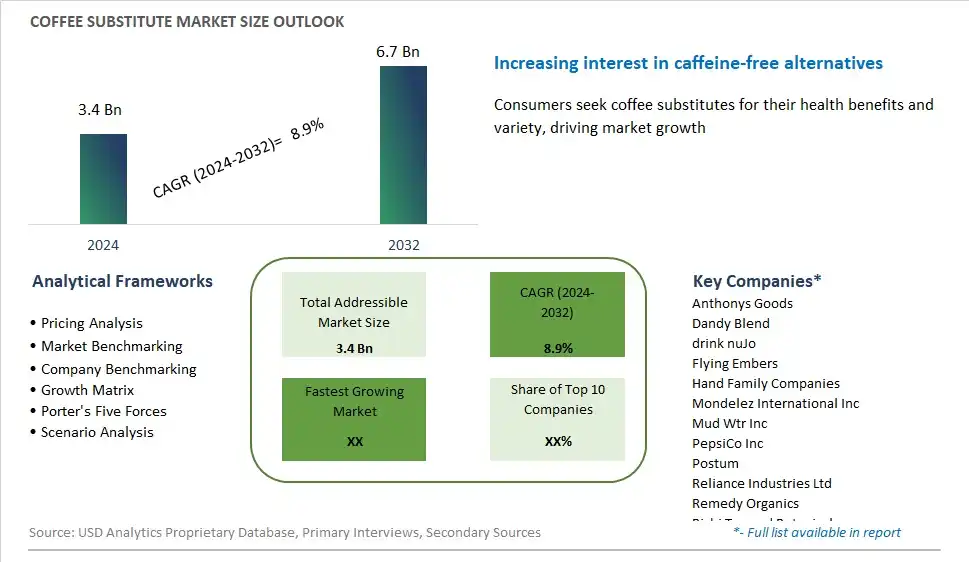
The market report analyses the leading companies in the industry including Anthonys Goods, Dandy Blend, drink nuJo, Flying Embers, Hand Family Companies, Mondelez International Inc, Mud Wtr Inc, PepsiCo Inc, Postum, Reliance Industries Ltd, Remedy Organics, Rishi Tea and Botanicals, Slate Craft Goods LLC, So Good Brand Inc, Tattvas Herbs LLC, Teeccino Caffe Inc, The Coca Cola Co., The Hain Celestial Group Inc, World Finer Foods LLC , World Matcha Inc, and Others.
The most prominent market trend for Coffee Substitute is the rising demand for health-conscious alternatives to traditional coffee. With increasing awareness of the potential health effects of excessive caffeine consumption and the desire for functional beverages that offer wellness benefits, there's a growing interest in coffee substitutes made from natural ingredients such as chicory, dandelion root, barley, and herbal blends. This trend is driven by consumers seeking caffeine-free options that provide a similar taste experience to coffee while offering additional health benefits such as digestive support, antioxidant properties, and energy-boosting effects without the jittery side effects associated with caffeine.
A significant market driver for Coffee Substitute is the growing interest in sustainable and ethical consumption practices among consumers. As concerns over environmental sustainability, fair trade practices, and supply chain transparency continue to influence purchasing decisions, there's a shift towards alternative beverages that align with ethical and eco-friendly values. Coffee substitutes sourced from responsibly grown and harvested ingredients, as well as those certified organic, non-GMO, and fair trade, appeal to consumers seeking products that prioritize social and environmental responsibility. The driver is fueled by the demand for products that offer transparency, traceability, and positive social impact throughout the production process, from sourcing to distribution.
An opportunity in the Coffee Substitute market lies in innovation in flavor profiles and functional benefits to differentiate products and attract a broader consumer base. Companies can explore opportunities to develop unique and appealing flavor combinations, such as spiced blends, citrus-infused varieties, or specialty herbal formulations, to cater to diverse taste preferences and usage occasions. Moreover, incorporating functional ingredients known for their health-promoting properties, such as adaptogens, superfoods, and botanical extracts, can enhance the nutritional value and therapeutic benefits of coffee substitutes. By offering a range of innovative flavors and functional benefits, companies can capture the attention of health-conscious consumers looking for alternatives to traditional coffee that deliver both taste and wellness benefits, driving growth and market expansion in the coffee substitute segment.
Within the Coffee Substitute market segmentation, the Grain-based Coffee Substitutes category is the largest and most significant segment. This dominance is primarily fueled by the widespread availability and versatility of grain-based alternatives such as barley, rye, and chicory. Grain-based substitutes offer a similar flavor profile and aroma to traditional coffee, making them a popular choice among consumers seeking caffeine-free options or looking to reduce their coffee intake. Additionally, grain-based substitutes are often perceived as healthier alternatives due to their lower acidity and potential health benefits, including digestive health and blood sugar regulation. As consumer demand for diverse and sustainable beverage options continues to rise, the grain-based coffee substitutes segment maintains its stronghold in the Coffee Substitute market, offering a viable alternative to traditional coffee without compromising on taste or quality.
In the Coffee Substitute market segmentation, the Pouches segment is the fastest-growing sector, driven by shifting consumer preferences towards convenience, portability, and sustainability. Pouch packaging offers several advantages over traditional cans, including lighter weight, reduced material usage, and improved shelf-life preservation. Additionally, pouches are more versatile and adaptable to various consumption occasions, such as on-the-go consumption or single servings, catering to the modern lifestyle of busy consumers. Furthermore, the rising awareness of environmental sustainability has led to increased demand for eco-friendly packaging solutions, with pouches often being perceived as more environmentally friendly than cans due to their lower carbon footprint and recyclability. As a result, coffee substitute brands are increasingly opting for pouch packaging to meet consumer demands for convenience and sustainability, driving the rapid growth of this segment in the Coffee Substitute market.
Within the Coffee Substitute market segmentation, the Supermarkets/Hypermarkets distribution channel is the largest and most prominent sector. This dominance is primarily attributed to the extensive reach and convenience offered by supermarkets and hypermarkets, which attract a wide range of consumers seeking one-stop shopping experiences. These retail giants typically offer a diverse selection of coffee substitute products, catering to varying consumer preferences and dietary needs. Further, supermarkets and hypermarkets benefit from strategic placement and prominent shelf space, enhancing visibility and accessibility for consumers. Additionally, the ability to browse and compare products in-store, coupled with the availability of promotional offers and discounts, further drives consumer engagement and purchase decisions in this distribution channel. As a result, supermarkets and hypermarkets continue to maintain their stronghold in the Coffee Substitute market, serving as key drivers of growth and market penetration.
By Product
Herbal coffee substitutes
Grain-based coffee substitutes
Plant based substitutes
By Packaging
Pouches
Cans
By Distribution Channel
Supermarkets/ Hypermarkets
Departmental Stores
Convenience Stores
Online Sales Channels
Countries Analyzed
North America (US, Canada, Mexico)
Europe (Germany, UK, France, Spain, Italy, Russia, Rest of Europe)
Asia Pacific (China, India, Japan, South Korea, Australia, South East Asia, Rest of Asia)
South America (Brazil, Argentina, Rest of South America)
Middle East and Africa (Saudi Arabia, UAE, Rest of Middle East, South Africa, Egypt, Rest of Africa)
Anthonys Goods
Dandy Blend
drink nuJo
Flying Embers
Hand Family Companies
Mondelez International Inc
Mud Wtr Inc
PepsiCo Inc
Postum
Reliance Industries Ltd
Remedy Organics
Rishi Tea and Botanicals
Slate Craft Goods LLC
So Good Brand Inc
Tattvas Herbs LLC
Teeccino Caffe Inc
The Coca Cola Co.
The Hain Celestial Group Inc
World Finer Foods LLC
World Matcha Inc
*- List Not Exhaustive
Chapter 1. TABLE OF CONTENTS
Chapter 2. Introduction to Coffee Substitute Market
2.1. Market Overview
2.2. Key Statistics and Report Highlights
2.3. Scope of the Comprehensive Study
2.3.1. Market Definition
2.3.2 Countries and Regions Covered
2.3.3 Research Objective
2.3.4 Units, Currency, and Conversions
2.3.5 Industry Value Chain
2.4. Key Market Segments
2.5. Key Companies
2.6. Study Period
Chapter 3. Strategic Analysis Review
3.1. Coffee Substitute Pricing Analysis and Forecast
3.2. Porter’s Five Forces
3.3. Market Ecosystem
3.4. SWOT Analysis
3.5. Regulatory Scenario
3.3. Effects of Inflation, Russia-Ukraine War, moderating economic growth, and other macroeconomic factors
Chapter 4. Competitive Landscape
4.1. Market Share Analysis
4.1.1. Global Coffee Substitute Market Share by Company, 2023
4.1.2. Product Offerings of Leading Coffee Substitute Companies
4.2. Market Entropy
4.2.1. New Product Launches in the Industry
4.2.2. Mergers, Acquisitions, Joint ventures, and Partnerships
4.3. Key Strategies and Best Practices
Chapter 5. Global Market Projections: Best, Reference, and Low Case Scenarios
5.1. Growth Analysis- Case Scenario Definitions
5.2. Low Growth Case Scenario Forecasts
5.3. Reference Growth Case Scenario Forecasts
5.4. High Growth Case Scenario Forecasts
Chapter 6. Market Dynamics
6.1. Coffee Substitute Market Drivers
6.2. Coffee Substitute Market Challenges
6.6. Coffee Substitute Market Opportunities
6.4. Coffee Substitute Market Trends
Chapter 7. Global Coffee Substitute Market Outlook Trends
7.1. Global Coffee Substitute Revenue (USD Million) and CAGR (%) by Type (2021-2032)
7.2. Global Coffee Substitute Revenue (USD Million) and CAGR (%) by Application (2021-2032)
7.3. Global Coffee Substitute Revenue (USD Million) and CAGR (%) by Product (2021-2032)
By Product
Herbal coffee substitutes
Grain-based coffee substitutes
Plant based substitutes
By Packaging
Pouches
Cans
By Distribution Channel
Supermarkets/ Hypermarkets
Departmental Stores
Convenience Stores
Online Sales Channels
Chapter 8. Global Coffee Substitute Regional Analysis and Outlook
8.1. Global Coffee Substitute Revenue (USD Million) By Regions (2021- 2032)
8.2. North America Coffee Substitute Revenue (USD Million) by Country (2021-2032)
8.2.1. United States Coffee Substitute Regional Analysis and Outlook
8.2.2. Canada Coffee Substitute Regional Analysis and Outlook
8.2.3. Mexico Coffee Substitute Regional Analysis and Outlook
8.3. Europe Coffee Substitute Revenue (USD Million), by Country (2021-2032)
8.3.1. Germany Coffee Substitute Regional Analysis and Outlook
8.3.2. France Coffee Substitute Regional Analysis and Outlook
8.3.3. United Kingdom Coffee Substitute Regional Analysis and Outlook
8.3.4. Spain Coffee Substitute Regional Analysis and Outlook
8.3.5. Italy Coffee Substitute Regional Analysis and Outlook
8.3.6. Russia Coffee Substitute Regional Analysis and Outlook
8.3.7. Rest of Europe Coffee Substitute Regional Analysis and Outlook
8.4. Asia Pacific Coffee Substitute Revenue (USD Million) by Country (2021-2032)
8.4.1. China Coffee Substitute Regional Analysis and Outlook
8.4.2. Japan Coffee Substitute Regional Analysis and Outlook
8.4.3. India Coffee Substitute Regional Analysis and Outlook
8.4.4. South Korea Coffee Substitute Regional Analysis and Outlook
8.4.5. Australia Coffee Substitute Regional Analysis and Outlook
8.4.6. South East Asia Coffee Substitute Regional Analysis and Outlook
8.4.7. Rest of Asia Pacific Coffee Substitute Regional Analysis and Outlook
8.5. South America Coffee Substitute Revenue (USD Million), by Country (2021-2032)
8.5.1. Brazil Coffee Substitute Regional Analysis and Outlook
8.5.2. Argentina Coffee Substitute Regional Analysis and Outlook
8.5.3. Rest of South America Coffee Substitute Regional Analysis and Outlook
8.6. Middle East and Africa Coffee Substitute Revenue (USD Million) by Country (2021-2032)
8.6.1. Middle East Coffee Substitute Regional Analysis and Outlook
8.6.2. Africa Coffee Substitute Regional Analysis and Outlook
Chapter 9. North America Coffee Substitute Analysis and Outlook
9.1. North America Coffee Substitute Revenue (USD Million) by Segments (2021-2032)
9.1.1. North America Coffee Substitute Revenue (USD Million) by Type (2021-2032)
9.1.2. North America Coffee Substitute Revenue (USD Million) by Application (2021-2032)
9.1.3. North America Coffee Substitute Revenue (USD Million) by Product (2021-2032)
By Product
Herbal coffee substitutes
Grain-based coffee substitutes
Plant based substitutes
By Packaging
Pouches
Cans
By Distribution Channel
Supermarkets/ Hypermarkets
Departmental Stores
Convenience Stores
Online Sales Channels
Chapter 10. Europe Coffee Substitute Analysis and Outlook
10.1. Europe Coffee Substitute Revenue (USD Million), by Segments (USD Million) (2021-2032)
10.1.1. Europe Coffee Substitute Revenue (USD Million) by Type (2021-2032)
10.1.2. Europe Coffee Substitute Revenue (USD Million) by Application (2021-2032)
10.1.3. Europe Coffee Substitute Revenue (USD Million) by Product (2021-2032)
By Product
Herbal coffee substitutes
Grain-based coffee substitutes
Plant based substitutes
By Packaging
Pouches
Cans
By Distribution Channel
Supermarkets/ Hypermarkets
Departmental Stores
Convenience Stores
Online Sales Channels
Chapter 11. Asia Pacific Coffee Substitute Analysis and Outlook
11.1. Asia Pacific Coffee Substitute Revenue (USD Million), and Revenue (USD Million) by Segments (2021-2032)
11.1.1. Asia Pacific Coffee Substitute Revenue (USD Million) by Type (2021-2032)
11.1.2. Asia Pacific Coffee Substitute Revenue (USD Million) by Application (2021-2032)
11.1.3. Asia Pacific Coffee Substitute Revenue (USD Million) by Product (2021-2032)
By Product
Herbal coffee substitutes
Grain-based coffee substitutes
Plant based substitutes
By Packaging
Pouches
Cans
By Distribution Channel
Supermarkets/ Hypermarkets
Departmental Stores
Convenience Stores
Online Sales Channels
Chapter 12. South America Coffee Substitute Analysis and Outlook
12.1. South America Coffee Substitute Revenue (USD Million), by Segments (2021-2032)
12.1.1. South America Coffee Substitute Revenue (USD Million) by Type (2021-2032)
12.1.2. South America Coffee Substitute Revenue (USD Million) by Application (2021-2032)
12.1.3. South America Coffee Substitute Revenue (USD Million) by Product (2021-2032)
By Product
Herbal coffee substitutes
Grain-based coffee substitutes
Plant based substitutes
By Packaging
Pouches
Cans
By Distribution Channel
Supermarkets/ Hypermarkets
Departmental Stores
Convenience Stores
Online Sales Channels
Chapter 13. Middle East and Africa Coffee Substitute Analysis and Outlook
13.1. Middle East and Africa Coffee Substitute Revenue (USD Million), by Segments (2021-2032)
13.1.1. Middle East and Africa Coffee Substitute Revenue (USD Million) by Type (2021-2032)
13.1.2. Middle East and Africa Coffee Substitute Revenue (USD Million) by Application (2021-2032)
13.1.3. Middle East and Africa Coffee Substitute Revenue (USD Million) by Product (2021-2032)
By Product
Herbal coffee substitutes
Grain-based coffee substitutes
Plant based substitutes
By Packaging
Pouches
Cans
By Distribution Channel
Supermarkets/ Hypermarkets
Departmental Stores
Convenience Stores
Online Sales Channels
Chapter 14. Coffee Substitute Company Profiles
14.1 Business Overview
14.2 Product Profiles
14.3 SWOT Profiles
14.5 Recent Developments
14.6 Financial Profile
List of Companies
Anthonys Goods
Dandy Blend
drink nuJo
Flying Embers
Hand Family Companies
Mondelez International Inc
Mud Wtr Inc
PepsiCo Inc
Postum
Reliance Industries Ltd
Remedy Organics
Rishi Tea and Botanicals
Slate Craft Goods LLC
So Good Brand Inc
Tattvas Herbs LLC
Teeccino Caffe Inc
The Coca Cola Co.
The Hain Celestial Group Inc
World Finer Foods LLC
World Matcha Inc
15. Methodology and Data Sources
15.1 Customization Offerings
15.2 Subscription Services
15.3 Related Reports
15.4 Publisher Expertise
LIST OF TABLES
Table 1 Market Segmentation Analysis
Table 2 Global Coffee Substitute Market Share of Leading Companies, 2023
Table 3 Product Offerings of Leading Companies
Table 4 Low Growth Scenario Forecasts
Table 5 Reference Case Growth Scenario
Table 6 High Growth Case Scenario
Table 7 Global Coffee Substitute Revenue (USD Million) And CAGR (%) By Type (2021-2032)
Table 8 Global Coffee Substitute Revenue (USD Million) And CAGR (%) By Application (2021-2032)
Table 9 Global Coffee Substitute Revenue (USD Million) And CAGR (%) By Product (2021-2032)
Table 10 Global Coffee Substitute Market Revenue (USD Million) By Regions (2021-2032)
Table 11 Global Coffee Substitute Market Share (%) By Regions (2021-2032)
Table 12 North America Coffee Substitute Revenue (USD Million) By Country (2021-2032)
Table 13 Europe Coffee Substitute Revenue (USD Million) By Country (2021-2032)
Table 14 Asia Pacific Coffee Substitute Revenue (USD Million) By Country (2021-2032)
Table 15 South America Coffee Substitute Revenue (USD Million) By Country (2021-2032)
Table 16 Middle East and Africa Coffee Substitute Revenue (USD Million) By Region (2021-2032)
Table 17 North America Coffee Substitute Revenue (USD Million) By Type (2021-2032)
Table 18 North America Coffee Substitute Revenue (USD Million) By Application (2021-2032)
Table 19 North America Coffee Substitute Revenue (USD Million) By Product (2021-2032)
Table 20 Europe Coffee Substitute Revenue (USD Million) By Type (2021-2032)
Table 21 Europe Coffee Substitute Revenue (USD Million) By Application (2021-2032)
Table 22 Europe Coffee Substitute Revenue (USD Million) By Product (2021-2032)
Table 23 Asia Pacific Coffee Substitute Revenue (USD Million) By Type (2021-2032)
Table 24 Asia Pacific Coffee Substitute Revenue (USD Million) By Application (2021-2032)
Table 25 Asia Pacific Coffee Substitute Revenue (USD Million) By Product (2021-2032)
Table 26 South America Coffee Substitute Revenue (USD Million) By Type (2021-2032)
Table 27 South America Coffee Substitute Revenue (USD Million) By Application (2021-2032)
Table 28 South America Coffee Substitute Revenue (USD Million) By Product (2021-2032)
Table 29 Middle East and Africa Coffee Substitute Revenue (USD Million) By Type (2021-2032)
Table 30 Middle East and Africa Coffee Substitute Revenue (USD Million) By Application (2021-2032)
Table 31 Middle East and Africa Coffee Substitute Revenue (USD Million) By Product (2021-2032)
LIST OF FIGURES
Figure 1. Market Scope
Figure 2. Pricing Forecasts Per Unit, 2023- 2032
Figure 3. Porter’s Five Forces
Figure 4. Global Coffee Substitute Market Revenue (USD Million) By Regions (2021-2032)
Figure 5. Global Coffee Substitute Market Share (%) By Regions (2023)
Figure 6. North America Coffee Substitute Revenue (USD Million) By Country (2021-2032)
Figure 7. United States Coffee Substitute Revenue (USD Million) By Country (2021-2032)
Figure 8. Canada Coffee Substitute Revenue (USD Million) By Country (2021-2032)
Figure 9. Mexico Coffee Substitute Revenue (USD Million) By Country (2021-2032)
Figure 10. Europe Coffee Substitute Revenue (USD Million) By Country (2021-2032)
Figure 11. Germany Coffee Substitute Revenue (USD Million) By Country (2021-2032)
Figure 12. France Coffee Substitute Revenue (USD Million) By Country (2021-2032)
Figure 13. United Kingdom Coffee Substitute Revenue (USD Million) By Country (2021-2032)
Figure 14. Spain Coffee Substitute Revenue (USD Million) By Country (2021-2032)
Figure 15. Italy Coffee Substitute Revenue (USD Million) By Country (2021-2032)
Figure 16. Russia Coffee Substitute Revenue (USD Million) By Country (2021-2032)
Figure 17. Rest of Europe Coffee Substitute Revenue (USD Million) By Country (2021-2032)
Figure 11. Asia Pacific Coffee Substitute Revenue (USD Million) By Country (2021-2032)
Figure 12. China Coffee Substitute Revenue (USD Million) By Country (2021-2032)
Figure 13. Japan Coffee Substitute Revenue (USD Million) By Country (2021-2032)
Figure 14. India Coffee Substitute Revenue (USD Million) By Country (2021-2032)
Figure 15. South Korea Coffee Substitute Revenue (USD Million) By Country (2021-2032)
Figure 16. Australia Coffee Substitute Revenue (USD Million) By Country (2021-2032)
Figure 17. South East Asia Coffee Substitute Revenue (USD Million) By Country (2021-2032)
Figure 18. South America Coffee Substitute Revenue (USD Million) By Country (2021-2032)
Figure 19. Brazil Coffee Substitute Revenue (USD Million) By Country (2021-2032)
Figure 20. Argentina Coffee Substitute Revenue (USD Million) By Country (2021-2032)
Figure 21. Rest of Asia Pacific Coffee Substitute Revenue (USD Million) By Country (2021-2032)
Figure 22. Middle East and Africa Coffee Substitute Revenue (USD Million) By Region (2021-2032)
Figure 23. Saudi Arabia Coffee Substitute Revenue (USD Million) By Region (2021-2032)
Figure 24. The UAE Coffee Substitute Revenue (USD Million) By Region (2021-2032)
Figure 25. Rest of Middle East Coffee Substitute Revenue (USD Million) By Region (2021-2032)
Figure 26. South Africa Coffee Substitute Revenue (USD Million) By Region (2021-2032)
Figure 27. Africa Coffee Substitute Revenue (USD Million) By Region (2021-2032)
Figure 28. North America Coffee Substitute Revenue (USD Million) By Type (2021-2032)
Figure 29. North America Coffee Substitute Revenue (USD Million) By Application (2021-2032)
Figure 30. North America Coffee Substitute Revenue (USD Million) By Product (2021-2032)
Figure 31. Europe Coffee Substitute Revenue (USD Million) By Type (2021-2032)
Figure 32. Europe Coffee Substitute Revenue (USD Million) By Application (2021-2032)
Figure 33. Europe Coffee Substitute Revenue (USD Million) By Product (2021-2032)
Figure 34. Asia Pacific Coffee Substitute Revenue (USD Million) By Type (2021-2032)
Figure 35. Asia Pacific Coffee Substitute Revenue (USD Million) By Application (2021-2032)
Figure 36. Asia Pacific Coffee Substitute Revenue (USD Million) By Product (2021-2032)
Figure 37. South America Coffee Substitute Revenue (USD Million) By Type (2021-2032)
Figure 38. South America Coffee Substitute Revenue (USD Million) By Application (2021-2032)
Figure 39. South America Coffee Substitute Revenue (USD Million) By Product (2021-2032)
Figure 40. Middle East and Africa Coffee Substitute Revenue (USD Million) By Type (2021-2032)
Figure 41. Middle East and Africa Coffee Substitute Revenue (USD Million) By Application (2021-2032)
Figure 42. Middle East and Africa Coffee Substitute Revenue (USD Million) By Product (2021-2032)
By Product
Herbal coffee substitutes
Grain-based coffee substitutes
Plant based substitutes
By Packaging
Pouches
Cans
By Distribution Channel
Supermarkets/ Hypermarkets
Departmental Stores
Convenience Stores
Online Sales Channels
Countries Analyzed
North America (US, Canada, Mexico)
Europe (Germany, UK, France, Spain, Italy, Russia, Rest of Europe)
Asia Pacific (China, India, Japan, South Korea, Australia, South East Asia, Rest of Asia)
South America (Brazil, Argentina, Rest of South America)
Middle East and Africa (Saudi Arabia, UAE, Rest of Middle East, South Africa, Egypt, Rest of Africa)
Global Coffee Substitute Market Size is valued at $3.4 Billion in 2024 and is forecast to register a growth rate (CAGR) of 8.9% to reach $6.7 Billion by 2032.
Emerging Markets across Asia Pacific, Europe, and Americas present robust growth prospects.
Anthonys Goods, Dandy Blend, drink nuJo, Flying Embers, Hand Family Companies, Mondelez International Inc, Mud Wtr Inc, PepsiCo Inc, Postum, Reliance Industries Ltd, Remedy Organics, Rishi Tea and Botanicals, Slate Craft Goods LLC, So Good Brand Inc, Tattvas Herbs LLC, Teeccino Caffe Inc, The Coca Cola Co., The Hain Celestial Group Inc, World Finer Foods LLC , World Matcha Inc
Base Year- 2023; Estimated Year- 2024; Historic Period- 2018-2023; Forecast period- 2024 to 2032; Currency: Revenue (USD); Volume