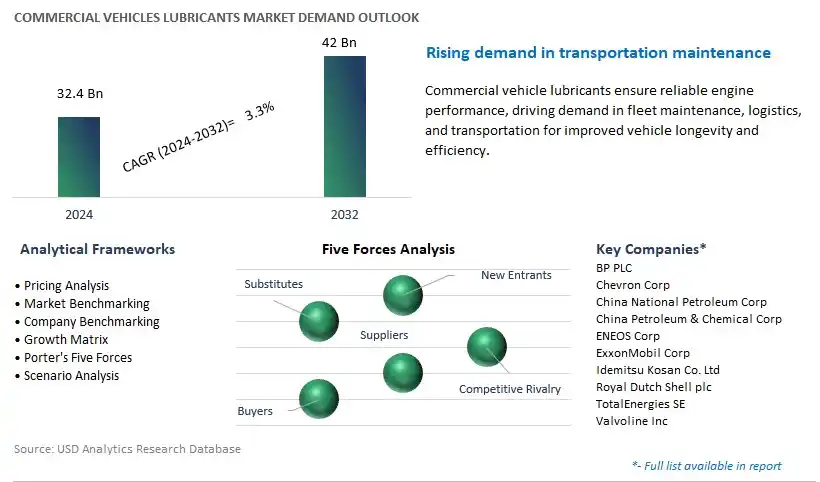
Global Commercial Vehicles Lubricants Market Size is valued at $32.4 Billion in 2024 and is forecast to register a growth rate (CAGR) of 3.3% to reach $42 Billion by 2032.
The global Commercial Vehicles Lubricants Market Study analyzes and forecasts the market size across 6 regions and 24 countries for diverse segments -By Product (Engine Oils, Greases, Hydraulic Fluids, Transmission & Gear Oils).
An Introduction to Commercial Vehicles Lubricants Market in 2024
Commercial vehicles lubricants are specialized oils and greases formulated to meet the lubrication needs of heavy-duty trucks, buses, construction equipment, and other commercial vehicles in 2024. These lubricants play a critical role in reducing friction, wear, and heat generation in various engine, transmission, and drivetrain components, thereby extending the service life of critical vehicle systems and maximizing operational efficiency. Commercial vehicles operate under demanding conditions, including high loads, frequent stops and starts, and extreme temperatures, requiring lubricants with superior performance characteristics such as high viscosity index, shear stability, and thermal resistance. Commercial vehicles lubricants are available in different viscosity grades and formulations to suit specific applications and operating conditions, including engine oils, transmission fluids, gear oils, and axle greases. They may also contain additives such as detergents, dispersants, anti-wear agents, and corrosion inhibitors to enhance performance and protect against contaminants and deposits. With advancements in lubricant technology and increasing focus on fuel efficiency and emissions reduction, commercial vehicles lubricants to evolve, offering improved performance, durability, and environmental compatibility to meet the evolving needs of fleet operators and vehicle manufacturers.
Commercial Vehicles Lubricants Market Competitive Landscape
The market report analyses the leading companies in the industry including BP PLC, Chevron Corp, China National Petroleum Corp, China Petroleum & Chemical Corp, ENEOS Corp, ExxonMobil Corp, Idemitsu Kosan Co. Ltd, Royal Dutch Shell plc, TotalEnergies SE, Valvoline Inc, and others.
Commercial Vehicles Lubricants Market Dynamics
Market Trend: Increasing Focus on Fuel Efficiency and Emissions Reduction
A prominent trend in the market for commercial vehicles lubricants is the increasing focus on fuel efficiency and emissions reduction driven by stringent environmental regulations and sustainability initiatives. With rising concerns about greenhouse gas emissions and air pollution, commercial vehicle operators are seeking lubricants that can help improve fuel economy and reduce harmful emissions. Lubricants play a crucial role in minimizing friction, optimizing engine performance, and extending equipment life, thereby contributing to overall vehicle efficiency and environmental sustainability. This trend is reshaping the lubricants market, with manufacturers developing advanced formulations and additives designed to enhance fuel efficiency, reduce emissions, and meet regulatory requirements, catering to the evolving needs of commercial vehicle fleets striving for greener and more sustainable operations.
Market Driver: Growth in Global Commercial Transportation and Logistics
The primary driver fueling the demand for commercial vehicles lubricants is the growth in global commercial transportation and logistics activities driven by economic expansion, urbanization, and increasing trade volumes. With the expansion of e-commerce, globalization of supply chains, and demand for just-in-time delivery services, commercial vehicles play a vital role in the movement of goods and materials across regions and continents. Lubricants are essential for maintaining the performance and reliability of commercial vehicle engines, transmissions, and drivetrains, ensuring smooth operation, reducing wear, and preventing breakdowns. As commercial fleets expand and modernize to meet growing transportation needs, the demand for high-quality lubricants tailored to the specific requirements of different vehicle types and operating conditions is expected to continue rising, driving market growth and investment in lubricant technologies that offer superior protection, performance, and durability.
Market Opportunity: Development of Hybrid and Electric Vehicle Lubricants
An emerging opportunity within the market for commercial vehicles lubricants lies in the development of lubricants tailored to hybrid and electric vehicle (EV) applications to support the transition towards cleaner and more sustainable transportation technologies. As the automotive industry shifts towards electrification to reduce dependence on fossil fuels and mitigate environmental impact, there is a growing need for lubricants that can meet the unique requirements of hybrid and EV drivetrains, including electric motors, battery packs, and power electronics. Lubricants for hybrid and electric vehicles must offer compatibility with electrical components, thermal conductivity for effective heat dissipation, and resistance to oxidation and corrosion in harsh operating environments. By investing in research and development of specialized lubricant formulations for hybrid and EV applications, lubricant manufacturers can capitalize on the expanding market for electrified commercial vehicles and position themselves as leaders in providing innovative solutions that support sustainable transportation and drive market differentiation and growth.
Commercial Vehicles Lubricants Market Share Analysis: Engine Oils Product segment generated the highest revenue in 2024
Within the Commercial Vehicles Lubricants market, the Engine Oils Product segment is the largest, primarily due to its essential role in maintaining the performance and longevity of commercial vehicle engines. Engine oils are critical lubricants that reduce friction, dissipate heat, and protect engine components from wear and corrosion, ensuring smooth operation and optimal efficiency of commercial vehicles such as trucks, buses, and heavy-duty equipment. Engine oils are used in various engine types, including diesel, gasoline, and natural gas engines, across a wide range of operating conditions, from short-haul urban deliveries to long-haul interstate transportation. Moreover, the extensive network of commercial vehicle fleets globally necessitates regular maintenance and oil changes, resulting in consistent demand for engine oils. Additionally, advancements in engine oil formulations, such as low-viscosity oils for improved fuel economy and extended-drain interval oils for reduced maintenance costs, further drive the adoption of engine oils in the commercial vehicle sector. As commercial vehicle operators prioritize engine performance, fuel efficiency, and equipment longevity, the Engine Oils Product segment maintains its dominance in the Commercial Vehicles Lubricants market, with sustained demand expected to continue driving its growth.
Commercial Vehicles Lubricants Market
By Product
Engine Oils
Greases
Hydraulic Fluids
Transmission & Gear OilsCountries Analyzed
North America (US, Canada, Mexico)
Europe (Germany, UK, France, Spain, Italy, Russia, Rest of Europe)
Asia Pacific (China, India, Japan, South Korea, Australia, South East Asia, Rest of Asia)
South America (Brazil, Argentina, Rest of South America)
Middle East and Africa (Saudi Arabia, UAE, Rest of Middle East, South Africa, Egypt, Rest of Africa)
Commercial Vehicles Lubricants Companies Profiled in the Study
BP PLC
Chevron Corp
China National Petroleum Corp
China Petroleum & Chemical Corp
ENEOS Corp
ExxonMobil Corp
Idemitsu Kosan Co. Ltd
Royal Dutch Shell plc
TotalEnergies SE
Valvoline Inc
*- List Not Exhaustive
TABLE OF CONTENTS
1 Introduction to 2024 Commercial Vehicles Lubricants Market
1.1 Market Overview
1.2 Quick Facts
1.3 Scope/Objective of the Study
1.4 Market Definition
1.5 Countries and Regions Covered
1.6 Units, Currency, and Conversions
1.7 Industry Value Chain
2 Research Methodology
2.1 Market Size Estimation
2.2 Sources and Research Methodology
2.3 Data Triangulation
2.4 Assumptions and Limitations
3 Executive Summary
3.1 Global Commercial Vehicles Lubricants Market Size Outlook, $ Million, 2021 to 2032
3.2 Commercial Vehicles Lubricants Market Outlook by Type, $ Million, 2021 to 2032
3.3 Commercial Vehicles Lubricants Market Outlook by Product, $ Million, 2021 to 2032
3.4 Commercial Vehicles Lubricants Market Outlook by Application, $ Million, 2021 to 2032
3.5 Commercial Vehicles Lubricants Market Outlook by Key Countries, $ Million, 2021 to 2032
4 Market Dynamics
4.1 Key Driving Forces of Commercial Vehicles Lubricants Industry
4.2 Key Market Trends in Commercial Vehicles Lubricants Industry
4.3 Potential Opportunities in Commercial Vehicles Lubricants Industry
4.4 Key Challenges in Commercial Vehicles Lubricants Industry
5 Market Factor Analysis
5.1 Value Chain Analysis
5.2 Competitive Landscape
5.2.1 Global Commercial Vehicles Lubricants Market Share by Company (%), 2023
5.2.2 Product Offerings by Company
5.3 Porter’s Five Forces Analysis
5.4 Pricing Analysis and Outlook
6 Growth Outlook Across Scenarios
6.1 Growth Analysis-Case Scenario Definitions
6.2 Low Growth Scenario Forecasts
6.3 Reference Growth Scenario Forecasts
6.4 High Growth Scenario Forecasts
7 Global Commercial Vehicles Lubricants Market Outlook by Segments
7.1 Commercial Vehicles Lubricants Market Outlook by Segments, $ Million, 2021- 2032
By Product
Engine Oils
Greases
Hydraulic Fluids
Transmission & Gear Oils
8 North America Commercial Vehicles Lubricants Market Analysis and Outlook To 2032
8.1 Introduction to North America Commercial Vehicles Lubricants Markets in 2024
8.2 North America Commercial Vehicles Lubricants Market Size Outlook by Country, 2021-2032
8.2.1 United States
8.2.2 Canada
8.2.3 Mexico
8.3 North America Commercial Vehicles Lubricants Market size Outlook by Segments, 2021-2032
By Product
Engine Oils
Greases
Hydraulic Fluids
Transmission & Gear Oils
9 Europe Commercial Vehicles Lubricants Market Analysis and Outlook To 2032
9.1 Introduction to Europe Commercial Vehicles Lubricants Markets in 2024
9.2 Europe Commercial Vehicles Lubricants Market Size Outlook by Country, 2021-2032
9.2.1 Germany
9.2.2 France
9.2.3 Spain
9.2.4 United Kingdom
9.2.4 Italy
9.2.5 Russia
9.2.6 Norway
9.2.7 Rest of Europe
9.3 Europe Commercial Vehicles Lubricants Market Size Outlook by Segments, 2021-2032
By Product
Engine Oils
Greases
Hydraulic Fluids
Transmission & Gear Oils
10 Asia Pacific Commercial Vehicles Lubricants Market Analysis and Outlook To 2032
10.1 Introduction to Asia Pacific Commercial Vehicles Lubricants Markets in 2024
10.2 Asia Pacific Commercial Vehicles Lubricants Market Size Outlook by Country, 2021-2032
10.2.1 China
10.2.2 India
10.2.3 Japan
10.2.4 South Korea
10.2.5 Indonesia
10.2.6 Malaysia
10.2.7 Australia
10.2.8 Rest of Asia Pacific
10.3 Asia Pacific Commercial Vehicles Lubricants Market size Outlook by Segments, 2021-2032
By Product
Engine Oils
Greases
Hydraulic Fluids
Transmission & Gear Oils
11 South America Commercial Vehicles Lubricants Market Analysis and Outlook To 2032
11.1 Introduction to South America Commercial Vehicles Lubricants Markets in 2024
11.2 South America Commercial Vehicles Lubricants Market Size Outlook by Country, 2021-2032
11.2.1 Brazil
11.2.2 Argentina
11.2.3 Rest of South America
11.3 South America Commercial Vehicles Lubricants Market size Outlook by Segments, 2021-2032
By Product
Engine Oils
Greases
Hydraulic Fluids
Transmission & Gear Oils
12 Middle East and Africa Commercial Vehicles Lubricants Market Analysis and Outlook To 2032
12.1 Introduction to Middle East and Africa Commercial Vehicles Lubricants Markets in 2024
12.2 Middle East and Africa Commercial Vehicles Lubricants Market Size Outlook by Country, 2021-2032
12.2.1 Saudi Arabia
12.2.2 UAE
12.2.3 Oman
12.2.4 Rest of Middle East
12.2.5 Egypt
12.2.6 Nigeria
12.2.7 South Africa
12.2.8 Rest of Africa
12.3 Middle East and Africa Commercial Vehicles Lubricants Market size Outlook by Segments, 2021-2032
By Product
Engine Oils
Greases
Hydraulic Fluids
Transmission & Gear Oils
13 Company Profiles
13.1 Company Snapshot
13.2 SWOT Profiles
13.3 Products and Services
13.4 Recent Developments
13.5 Financial Profile
BP PLC
Chevron Corp
China National Petroleum Corp
China Petroleum & Chemical Corp
ENEOS Corp
ExxonMobil Corp
Idemitsu Kosan Co. Ltd
Royal Dutch Shell plc
TotalEnergies SE
Valvoline Inc
14 Appendix
14.1 Customization Offerings
14.2 Subscription Services
14.3 Related Reports
14.4 Publisher Expertise
By Product
Engine Oils
Greases
Hydraulic Fluids
Transmission & Gear Oils
Countries Analyzed
North America (US, Canada, Mexico)
Europe (Germany, UK, France, Spain, Italy, Russia, Rest of Europe)
Asia Pacific (China, India, Japan, South Korea, Australia, South East Asia, Rest of Asia)
South America (Brazil, Argentina, Rest of South America)
Middle East and Africa (Saudi Arabia, UAE, Rest of Middle East, South Africa, Egypt, Rest of Africa)
