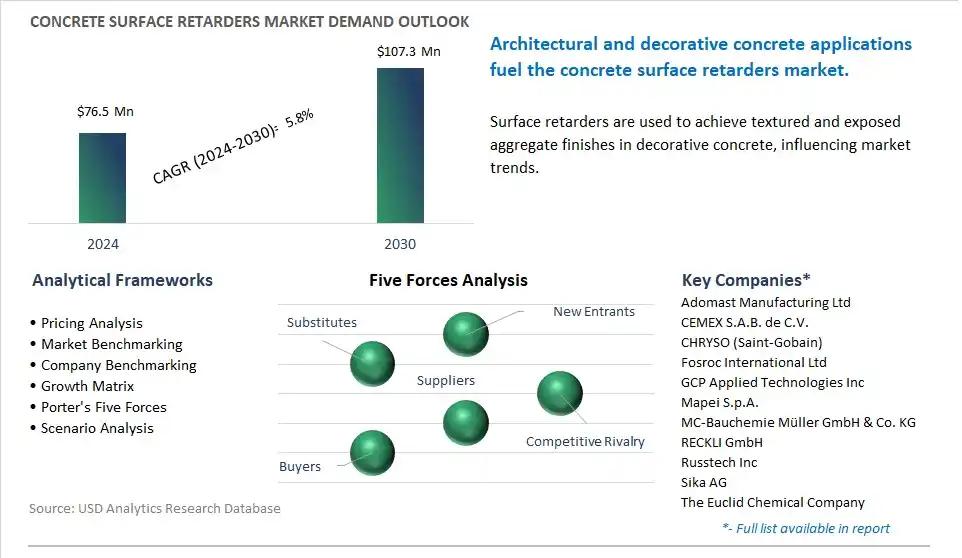
The global Concrete Surface Retarders Market is poised to register a 5.8% CAGR from $76.5 Million in 2024 to $107.3 Million in 2030.
The global Concrete Surface Retarders Market Study analyzes and forecasts the market size across 6 regions and 24 countries for diverse segments -By Raw Material (Organic, Inorganic), By Product (Water-Based, Solvent-Based), By Application (Residential, Commercial, Infrastructure, Others).
An Introduction to Global Concrete Surface Retarders Market in 2024
The concrete surface retarders market is witnessing significant growth driven by its applications in architectural concrete, decorative finishes, and exposed aggregate surfaces. Key trends shaping the future of the industry include the increasing demand for surface retarders that offer precise control over concrete curing, setting time, and surface texture, allowing for the creation of unique and customized concrete designs. As architects, designers, and contractors seek to achieve aesthetic appeal and design complexity in concrete structures, there's a growing need for surface retarders capable of exposing aggregates, creating etched patterns, and achieving uniform surface finishes. Moreover, advancements in surface retarder formulations, application methods, and environmental compatibility are improving product performance, safety, and sustainability, driving market expansion. Additionally, the rising adoption of surface retarders in stamped concrete, vertical concrete applications (such as walls and panels), and decorative paving for residential, commercial, and public spaces is fueling demand in the construction and landscaping sectors. Furthermore, the integration of digital design tools, 3D modeling software, and concrete printing technologies is enabling precise control and replication of intricate surface textures, patterns, and visual effects, driving innovation and market growth in the concrete surface retarders industry.
Concrete Surface Retarders Market Competitive Landscape
The market report analyses the leading companies in the industry including Adomast Manufacturing Ltd, CEMEX S.A.B. de C.V., CHRYSO (Saint-Gobain), Fosroc International Ltd, GCP Applied Technologies Inc, Mapei S.p.A., MC-Bauchemie Müller GmbH & Co. KG, RECKLI GmbH, Russtech Inc, Sika AG, The Euclid Chemical Company, W. R. Meadows Inc.
Concrete Surface Retarders Market Dynamics
Concrete Surface Retarders Market Trend: Growing Demand for Architectural Concrete Finishes
One prominent trend in the concrete surface retarders market is the growing demand for architectural concrete finishes in the construction industry. Concrete surface retarders are chemical formulations applied to freshly poured concrete surfaces to selectively delay the setting process, allowing for the creation of decorative and textured finishes such as exposed aggregate, stamped patterns, and etched designs. With increasing emphasis on aesthetics, creativity, and differentiation in architectural design, there is a rising interest in using concrete surface retarders to achieve unique and visually appealing concrete surfaces in residential, commercial, and public spaces. Architects, designers, and contractors are leveraging the versatility of surface retarders to enhance the appearance of concrete elements such as walls, floors, pavements, and facades, creating distinctive textures and patterns that complement modern architectural styles and interior designs. This trend is driven by the desire for personalized and visually striking building materials, driving the adoption of concrete surface retarders as a preferred method for achieving decorative concrete finishes in construction projects.
Concrete Surface Retarders Market Driver: Demand for Customization and Design Flexibility
A primary driver shaping the concrete surface retarders market is the demand for customization and design flexibility in architectural concrete applications. Concrete surface retarders offer architects, designers, and contractors the ability to create bespoke concrete finishes tailored to specific project requirements and aesthetic preferences. By selectively exposing aggregates, altering surface textures, and incorporating intricate patterns and designs, surface retarders enable the realization of diverse design visions and artistic expressions in concrete surfaces. This flexibility allows for the integration of decorative elements, branding motifs, and thematic motifs into architectural features, enhancing the visual appeal and identity of built environments. Additionally, surface retarders offer practical benefits such as uniformity of finish, ease of application, and compatibility with various concrete mixes and curing methods, making them a preferred choice for achieving consistent and high-quality decorative concrete surfaces. The demand for customized and visually striking architectural finishes drives the adoption of concrete surface retarders as a versatile and cost-effective solution for meeting design challenges and exceeding client expectations in construction projects.
Concrete Surface Retarders Market Opportunity: Expansion into Green Building and Sustainable Design
An opportunity within the concrete surface retarders market lies in expansion into green building and sustainable design applications. As sustainability becomes a key consideration in construction projects, there is a growing interest in environmentally friendly concrete finishing methods that minimize environmental impact and contribute to green building certifications such as LEED (Leadership in Energy and Environmental Design). Concrete surface retarders offer advantages such as water-based formulations, low VOC (volatile organic compound) content, and biodegradability, aligning with the principles of sustainable construction and responsible resource management. By promoting the use of surface retarders as a sustainable alternative to traditional surface treatments such as acid etching or abrasive blasting, manufacturers can capitalize on opportunities in green building projects, eco-conscious developments, and sustainable urban initiatives. Additionally, by investing in research and development to innovate eco-friendly formulations and partnering with sustainability-focused organizations and design firms, manufacturers can position themselves as leaders in the emerging market for sustainable architectural concrete finishes, driving market growth and differentiation in the industry.
Concrete Surface Retarders Market Share Analysis: Organic segment generated the highest revenue in the industry
The organic segment is the largest segment in the Concrete Surface Retarders Market due to diverse key factors. The organic surface retarders are derived from natural materials or organic compounds, making them environmentally friendly and sustainable options for concrete surface treatment. With growing concerns about environmental impact and regulatory requirements for sustainable construction practices, there is a significant preference for organic retarders over their inorganic counterparts. Additionally, organic surface retarders offer versatility and ease of application, allowing for precise control over concrete setting times and surface texture. This versatility makes them suitable for a wide range of applications, including decorative concrete, exposed aggregate finishes, and architectural concrete elements. In addition, organic surface retarders exhibit excellent performance in terms of uniformity of retardation, consistency of results, and compatibility with various types of cementitious materials. Further, the aesthetic appeal of concrete surfaces treated with organic retarders, such as enhanced color development and texture, contributes to their popularity in architectural and decorative concrete applications. Over the forecast period, the dominance of the organic segment in the concrete surface retarders market is driven by the growing demand for environmentally sustainable construction solutions, the versatility of organic retarders, and their superior performance characteristics in achieving desired concrete surface finishes.
Concrete Surface Retarders Market Share Analysis: Water-Based Segment is poised to register the fastest growth rate (CAGR) over the forecast period to 2030
The water-based segment is the fastest-growing segment in the Concrete Surface Retarders Market, driven by diverse compelling factors. The there is a growing emphasis on environmental sustainability and regulatory compliance in the construction industry, prompting a shift towards eco-friendly and low-VOC (volatile organic compound) solutions. Water-based surface retarders align with these sustainability goals as they contain fewer harmful chemicals and emit lower levels of volatile organic compounds compared to solvent-based alternatives. This environmental consciousness among builders, architects, and project owners fuels the adoption of water-based retarders, especially in environmentally sensitive areas or projects seeking green building certifications. Additionally, advancements in water-based formulation technology have led to improved performance characteristics, such as faster reaction times, consistent retardation effects, and enhanced surface finish quality. Further, the ease of application and cleanup associated with water-based retarders reduces labor costs and simplifies project logistics, contributing to their growing popularity among contractors and applicators. In addition, as water-based products become more widely available and cost-competitive, they are increasingly preferred over solvent-based options, further driving their market growth. Over the forecast period, the rapid expansion of the water-based segment in the concrete surface retarders market is propelled by its environmental sustainability, improved performance, ease of use, and growing acceptance within the construction industry.
Concrete Surface Retarders Market Share Analysis: Infrastructure Segment is poised to register the fastest growth rate (CAGR) over the forecast period to 2030
The infrastructure segment is the fastest-growing segment in the Concrete Surface Retarders Market due to diverse compelling reasons. The governments worldwide are heavily investing in infrastructure development to address aging infrastructure, accommodate urbanization, and stimulate economic growth. This surge in infrastructure projects includes the construction of roads, bridges, tunnels, airports, and other transportation facilities, all of which require extensive use of concrete. Concrete surface retarders play a crucial role in infrastructure projects by enabling precise control over concrete setting times and surface finishes, which is essential for achieving desired structural and aesthetic outcomes. In addition, the growing complexity and scale of infrastructure projects demand innovative construction solutions that enhance efficiency, durability, and sustainability. Concrete surface retarders contribute to these objectives by improving construction workflow, reducing labor costs, and minimizing material waste. Additionally, the durability and long-term performance of infrastructure assets are critical considerations, especially in harsh environments or high-traffic areas. Surface retarders help enhance the durability of concrete surfaces by minimizing surface defects, such as crazing and scaling, thereby extending the service life of infrastructure assets and reducing maintenance costs over time. Over the forecast period, the rapid growth of the infrastructure segment in the concrete surface retarders market is driven by the increasing investment in infrastructure projects, the need for innovative construction solutions, and the critical role of surface retarders in achieving durable and aesthetically pleasing concrete surfaces for infrastructure assets.
Concrete Surface Retarders Market Report Segmentation
By Raw Material
Organic
Inorganic
By Product
Water-Based
Solvent-Based
By Application
Residential
Commercial
Infrastructure
Others
Regions Included
North America (US, Canada, Mexico)
Europe (Germany, UK, France, Spain, Italy, Russia, Rest of Europe)
Asia Pacific (China, India, Japan, South Korea, Australia, South East Asia, Rest of Asia)
South America (Brazil, Argentina, Rest of South America)
Middle East and Africa (Saudi Arabia, UAE, Rest of Middle East, South Africa, Egypt, Rest of Africa)
Concrete Surface Retarders Companies Profiled in the Market Study
Adomast Manufacturing Ltd
CEMEX S.A.B. de C.V.
CHRYSO (Saint-Gobain)
Fosroc International Ltd
GCP Applied Technologies Inc
Mapei S.p.A.
MC-Bauchemie Müller GmbH & Co. KG
RECKLI GmbH
Russtech Inc
Sika AG
The Euclid Chemical Company
W. R. Meadows Inc
*- List Not Exhaustive
TABLE OF CONTENTS
1 Introduction to 2024 Concrete Surface Retarders Market
1.1 Market Overview
1.2 Quick Facts
1.3 Scope/Objective of the Study
1.4 Market Definition
1.5 Countries and Regions Covered
1.6 Units, Currency, and Conversions
1.7 Industry Value Chain
2 Research Methodology
2.1 Market Size Estimation
2.2 Sources and Research Methodology
2.3 Data Triangulation
2.4 Assumptions and Limitations
3 Executive Summary
3.1 Global Concrete Surface Retarders Market Size Outlook, $ Million, 2021 to 2030
3.2 Concrete Surface Retarders Market Outlook by Type, $ Million, 2021 to 2030
3.3 Concrete Surface Retarders Market Outlook by Product, $ Million, 2021 to 2030
3.4 Concrete Surface Retarders Market Outlook by Application, $ Million, 2021 to 2030
3.5 Concrete Surface Retarders Market Outlook by Key Countries, $ Million, 2021 to 2030
4 Market Dynamics
4.1 Key Driving Forces of Concrete Surface Retarders Industry
4.2 Key Market Trends in Concrete Surface Retarders Industry
4.3 Potential Opportunities in Concrete Surface Retarders Industry
4.4 Key Challenges in Concrete Surface Retarders Industry
5 Market Factor Analysis
5.1 Value Chain Analysis
5.2 Competitive Landscape
5.2.1 Global Concrete Surface Retarders Market Share by Company (%), 2023
5.2.2 Product Offerings by Company
5.3 Porter’s Five Forces Analysis
5.4 Pricing Analysis and Outlook
6 Growth Outlook Across Scenarios
6.1 Growth Analysis-Case Scenario Definitions
6.2 Low Growth Scenario Forecasts
6.3 Reference Growth Scenario Forecasts
6.4 High Growth Scenario Forecasts
7 Global Concrete Surface Retarders Market Outlook by Segments
7.1 Concrete Surface Retarders Market Outlook by Segments, $ Million, 2021- 2030
By Raw Material
Organic
Inorganic
By Product
Water-Based
Solvent-Based
By Application
Residential
Commercial
Infrastructure
Others
8 North America Concrete Surface Retarders Market Analysis and Outlook To 2030
8.1 Introduction to North America Concrete Surface Retarders Markets in 2024
8.2 North America Concrete Surface Retarders Market Size Outlook by Country, 2021-2030
8.2.1 United States
8.2.2 Canada
8.2.3 Mexico
8.3 North America Concrete Surface Retarders Market size Outlook by Segments, 2021-2030
By Raw Material
Organic
Inorganic
By Product
Water-Based
Solvent-Based
By Application
Residential
Commercial
Infrastructure
Others
9 Europe Concrete Surface Retarders Market Analysis and Outlook To 2030
9.1 Introduction to Europe Concrete Surface Retarders Markets in 2024
9.2 Europe Concrete Surface Retarders Market Size Outlook by Country, 2021-2030
9.2.1 Germany
9.2.2 France
9.2.3 Spain
9.2.4 United Kingdom
9.2.4 Italy
9.2.5 Russia
9.2.6 Norway
9.2.7 Rest of Europe
9.3 Europe Concrete Surface Retarders Market Size Outlook by Segments, 2021-2030
By Raw Material
Organic
Inorganic
By Product
Water-Based
Solvent-Based
By Application
Residential
Commercial
Infrastructure
Others
10 Asia Pacific Concrete Surface Retarders Market Analysis and Outlook To 2030
10.1 Introduction to Asia Pacific Concrete Surface Retarders Markets in 2024
10.2 Asia Pacific Concrete Surface Retarders Market Size Outlook by Country, 2021-2030
10.2.1 China
10.2.2 India
10.2.3 Japan
10.2.4 South Korea
10.2.5 Indonesia
10.2.6 Malaysia
10.2.7 Australia
10.2.8 Rest of Asia Pacific
10.3 Asia Pacific Concrete Surface Retarders Market size Outlook by Segments, 2021-2030
By Raw Material
Organic
Inorganic
By Product
Water-Based
Solvent-Based
By Application
Residential
Commercial
Infrastructure
Others
11 South America Concrete Surface Retarders Market Analysis and Outlook To 2030
11.1 Introduction to South America Concrete Surface Retarders Markets in 2024
11.2 South America Concrete Surface Retarders Market Size Outlook by Country, 2021-2030
11.2.1 Brazil
11.2.2 Argentina
11.2.3 Rest of South America
11.3 South America Concrete Surface Retarders Market size Outlook by Segments, 2021-2030
By Raw Material
Organic
Inorganic
By Product
Water-Based
Solvent-Based
By Application
Residential
Commercial
Infrastructure
Others
12 Middle East and Africa Concrete Surface Retarders Market Analysis and Outlook To 2030
12.1 Introduction to Middle East and Africa Concrete Surface Retarders Markets in 2024
12.2 Middle East and Africa Concrete Surface Retarders Market Size Outlook by Country, 2021-2030
12.2.1 Saudi Arabia
12.2.2 UAE
12.2.3 Oman
12.2.4 Rest of Middle East
12.2.5 Egypt
12.2.6 Nigeria
12.2.7 South Africa
12.2.8 Rest of Africa
12.3 Middle East and Africa Concrete Surface Retarders Market size Outlook by Segments, 2021-2030
By Raw Material
Organic
Inorganic
By Product
Water-Based
Solvent-Based
By Application
Residential
Commercial
Infrastructure
Others
13 Company Profiles
13.1 Company Snapshot
13.2 SWOT Profiles
13.3 Products and Services
13.4 Recent Developments
13.5 Financial Profile
Adomast Manufacturing Ltd
CEMEX S.A.B. de C.V.
CHRYSO (Saint-Gobain)
Fosroc International Ltd
GCP Applied Technologies Inc
Mapei S.p.A.
MC-Bauchemie Müller GmbH & Co. KG
RECKLI GmbH
Russtech Inc
Sika AG
The Euclid Chemical Company
W. R. Meadows Inc
14 Appendix
14.1 Customization Offerings
14.2 Subscription Services
14.3 Related Reports
14.4 Publisher Expertise
By Raw Material
Organic
Inorganic
By Product
Water-Based
Solvent-Based
By Application
Residential
Commercial
Infrastructure
Others
Countries Analyzed
North America (US, Canada, Mexico)
Europe (Germany, UK, France, Spain, Italy, Russia, Rest of Europe)
Asia Pacific (China, India, Japan, South Korea, Australia, South East Asia, Rest of Asia)
South America (Brazil, Argentina, Rest of South America)
Middle East and Africa (Saudi Arabia, UAE, Rest of Middle East, South Africa, Egypt, Rest of Africa)
