The global Construction Additives Market is poised to register a 7.2% CAGR from $23.1 Billion in 2024 to $35.1 Billion in 2030.
The global Construction Additives Market Study analyzes and forecasts the market size across 6 regions and 24 countries for diverse segments -By Type (Chemical, Mineral, Fiber), By End-User (Residential, Commercial, Infrastructure).
An Introduction to Global Construction Additives Market in 2024
The construction additives market is experiencing steady growth driven by its applications in concrete, cement, asphalt, and gypsum-based construction materials. Key trends shaping the future of the industry include the increasing demand for construction additives that improve the performance, durability, and sustainability of building materials while addressing specific challenges such as workability, strength enhancement, and crack resistance. As construction projects become more complex and demanding, there's a growing need for additives such as plasticizers, accelerators, retarders, and waterproofing agents that enhance the properties and workability of concrete and mortar mixes. Moreover, advancements in additive formulations, compatibility testing, and application methods are expanding the range of functionalities and performance benefits offered by construction additives, driving market expansion. Additionally, the rising adoption of sustainable additives such as fly ash, silica fume, and recycled materials in construction projects for reducing carbon footprint, conserving natural resources, and improving energy efficiency is fueling demand in the green building sector. Furthermore, the integration of digital modeling, simulation tools, and predictive analytics is optimizing additive selection, dosage optimization, and performance prediction in construction materials, driving innovation and market growth in the construction additives industry.
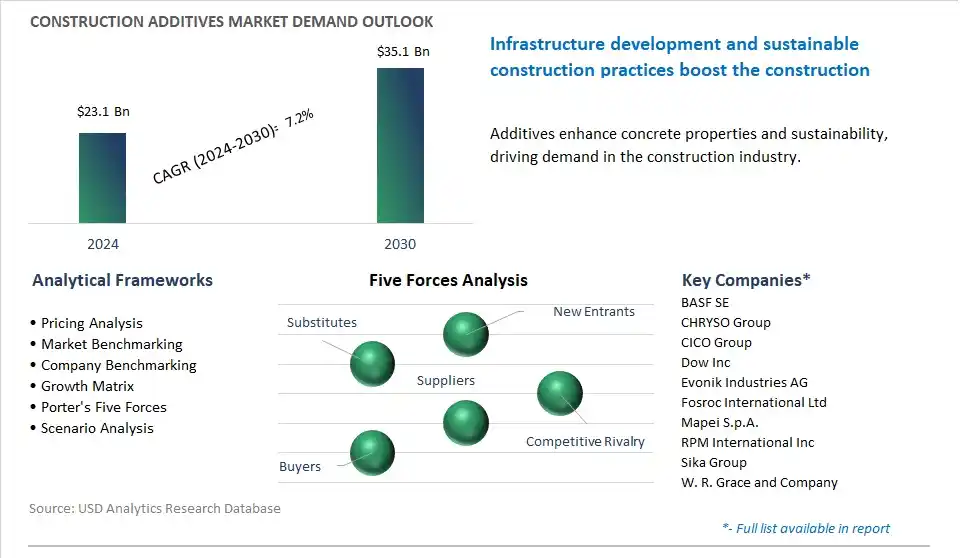
Construction Additives Market Competitive Landscape
The market report analyses the leading companies in the industry including BASF SE, CHRYSO Group, CICO Group, Dow Inc, Evonik Industries AG, Fosroc International Ltd, Mapei S.p.A., RPM International Inc, Sika Group, W. R. Grace and Company.
Construction Additives Market Dynamics
Construction Additives Market Trend: Growing Demand for High-Performance and Sustainable Construction Solutions
One prominent trend in the construction additives market is the growing demand for high-performance and sustainable construction solutions. As the construction industry evolves to meet the challenges of urbanization, population growth, and infrastructure development, there is increasing emphasis on enhancing the durability, efficiency, and sustainability of building materials and structures. Construction additives, including admixtures, accelerators, retarders, waterproofing agents, and air-entraining agents, play a crucial role in improving concrete properties, enhancing workability, and extending the service life of construction projects. With regulatory mandates, green building certifications, and consumer preferences driving the adoption of sustainable construction practices, there is a rising demand for additives that reduce environmental impact, conserve resources, and improve overall building performance. This trend is reinforced by the need for innovative solutions that address specific construction challenges such as durability, energy efficiency, and resilience to climate change, shaping the landscape of the construction additives market towards more sustainable and high-performance options.
Construction Additives Market Driver: Infrastructure Development and Urbanization
A primary driver shaping the construction additives market is infrastructure development and urbanization worldwide. With rapid urbanization and increasing investments in transportation, utilities, and public infrastructure, there is a significant demand for construction materials and technologies that can meet the evolving needs of urban environments. Construction additives are essential components in the construction of roads, bridges, tunnels, airports, and other critical infrastructure projects, providing solutions for improving concrete performance, enhancing durability, and reducing construction time and costs. Additionally, in urban areas facing challenges such as limited space, soil stabilization, and environmental constraints, construction additives offer solutions for mitigating risks and optimizing construction processes. The demand for construction additives is driven by the need for innovative solutions that address the complexities of urban development, improve infrastructure resilience, and contribute to sustainable urban growth, stimulating market growth and investment in additive technologies.
Construction Additives Market Opportunity: Expansion into Advanced Functional Additives
An opportunity within the construction additives market lies in the expansion into advanced functional additives that offer specialized properties and functionalities to address specific construction challenges. With advancements in materials science and chemical engineering, new generations of construction additives are being developed to enhance concrete performance, improve construction efficiency, and enable innovative building designs. Advanced functional additives such as self-healing agents, corrosion inhibitors, nanomaterials, and smart coatings provide solutions for improving concrete durability, reducing maintenance costs, and enhancing structural integrity. Additionally, functional additives that address emerging trends such as carbon neutrality, energy efficiency, and digitalization in construction present opportunities for additive manufacturers to innovate and differentiate their product offerings. By investing in research and development to develop novel additive formulations and collaborating with construction industry stakeholders to validate and commercialize these solutions, additive manufacturers can capitalize on opportunities in the growing market for advanced construction additives, drive innovation, and create value for customers in the evolving construction landscape.
Construction Additives Market Share Analysis: Chemical segment generated the highest revenue in the industry
The chemical segment is the largest segment in the Construction Additives Market due to diverse key factors. The chemical additives offer a wide range of functionalities and performance enhancements across various stages of the construction process, including concrete production, mortar formulation, and admixture applications. These additives include plasticizers, superplasticizers, accelerators, retarders, waterproofing agents, air-entraining agents, and corrosion inhibitors, among others. Their versatility allows construction professionals to tailor concrete and mortar mixes to meet specific project requirements, such as strength, workability, durability, and setting times. Additionally, chemical additives play a crucial role in improving the performance of concrete and mortar in adverse environmental conditions, such as extreme temperatures, high humidity, and exposure to aggressive chemicals. In addition, advancements in chemical additive technology have led to the development of specialized formulations that address evolving construction challenges, such as high-performance concrete for tall buildings, bridges, and infrastructure projects. Further, the growing demand for sustainable construction solutions has driven the adoption of chemical additives that enhance the eco-friendliness and energy efficiency of concrete and mortar mixes, such as low-CO2 emitting admixtures and recycled content additives. Over the forecast period, the dominance of the chemical segment in the Construction Additives Market is attributed to the broad range of functionalities, performance benefits, and innovative solutions offered by chemical additives in construction applications.
Construction Additives Market Share Analysis: Infrastructure Segment is poised to register the fastest growth rate (CAGR) over the forecast period to 2030
The infrastructure segment is the fastest-growing segment in the Construction Additives Market due to diverse compelling factors. The there is a global trend towards urbanization, population growth, and increasing investments in infrastructure development by governments and private entities. Infrastructure projects such as roads, bridges, tunnels, airports, railways, and water treatment facilities require robust and durable construction materials to withstand heavy loads, environmental factors, and long-term usage. Construction additives play a crucial role in enhancing the performance and longevity of concrete and mortar used in infrastructure projects by improving strength, durability, workability, and resistance to environmental hazards such as freeze-thaw cycles, chemical exposure, and abrasion. Additionally, the complexity and scale of modern infrastructure projects demand innovative construction solutions that optimize material usage, reduce construction time, and minimize maintenance costs over the asset's lifecycle. Construction additives enable the development of high-performance concrete and mortar mixes tailored to meet the specific requirements of infrastructure projects, such as high strength, rapid setting, and reduced permeability. In addition, the growing emphasis on sustainability and environmental responsibility in infrastructure development drives the adoption of construction additives that enhance the eco-friendliness and energy efficiency of construction materials, contributing to their rapid growth in the infrastructure segment. Over the forecast period, the infrastructure segment's rapid growth in the Construction Additives Market is driven by increasing investments in infrastructure projects, the demand for high-performance and sustainable construction solutions, and the critical role of additives in meeting the stringent performance requirements of modern infrastructure development.
Construction Additives Market Report Segmentation
By Type
Chemical
-Plasticizers
-Air-Entraining Agents
-Retarding Agents
-Waterproofing Agents
-Others
Mineral
Fiber
By End-User
Residential
Commercial
Infrastructure
Regions Included
North America (US, Canada, Mexico)
Europe (Germany, UK, France, Spain, Italy, Russia, Rest of Europe)
Asia Pacific (China, India, Japan, South Korea, Australia, South East Asia, Rest of Asia)
South America (Brazil, Argentina, Rest of South America)
Middle East and Africa (Saudi Arabia, UAE, Rest of Middle East, South Africa, Egypt, Rest of Africa)
Construction Additives Companies Profiled in the Market Study
BASF SE
CHRYSO Group
CICO Group
Dow Inc
Evonik Industries AG
Fosroc International Ltd
Mapei S.p.A.
RPM International Inc
Sika Group
W. R. Grace and Company
*- List Not Exhaustive
TABLE OF CONTENTS
1 Introduction to 2024 Construction Additives Market
1.1 Market Overview
1.2 Quick Facts
1.3 Scope/Objective of the Study
1.4 Market Definition
1.5 Countries and Regions Covered
1.6 Units, Currency, and Conversions
1.7 Industry Value Chain
2 Research Methodology
2.1 Market Size Estimation
2.2 Sources and Research Methodology
2.3 Data Triangulation
2.4 Assumptions and Limitations
3 Executive Summary
3.1 Global Construction Additives Market Size Outlook, $ Million, 2021 to 2030
3.2 Construction Additives Market Outlook by Type, $ Million, 2021 to 2030
3.3 Construction Additives Market Outlook by Product, $ Million, 2021 to 2030
3.4 Construction Additives Market Outlook by Application, $ Million, 2021 to 2030
3.5 Construction Additives Market Outlook by Key Countries, $ Million, 2021 to 2030
4 Market Dynamics
4.1 Key Driving Forces of Construction Additives Industry
4.2 Key Market Trends in Construction Additives Industry
4.3 Potential Opportunities in Construction Additives Industry
4.4 Key Challenges in Construction Additives Industry
5 Market Factor Analysis
5.1 Value Chain Analysis
5.2 Competitive Landscape
5.2.1 Global Construction Additives Market Share by Company (%), 2023
5.2.2 Product Offerings by Company
5.3 Porter’s Five Forces Analysis
5.4 Pricing Analysis and Outlook
6 Growth Outlook Across Scenarios
6.1 Growth Analysis-Case Scenario Definitions
6.2 Low Growth Scenario Forecasts
6.3 Reference Growth Scenario Forecasts
6.4 High Growth Scenario Forecasts
7 Global Construction Additives Market Outlook by Segments
7.1 Construction Additives Market Outlook by Segments, $ Million, 2021- 2030
By Type
Chemical
-Plasticizers
-Air-Entraining Agents
-Retarding Agents
-Waterproofing Agents
-Others
Mineral
Fiber
By End-User
Residential
Commercial
Infrastructure
8 North America Construction Additives Market Analysis and Outlook To 2030
8.1 Introduction to North America Construction Additives Markets in 2024
8.2 North America Construction Additives Market Size Outlook by Country, 2021-2030
8.2.1 United States
8.2.2 Canada
8.2.3 Mexico
8.3 North America Construction Additives Market size Outlook by Segments, 2021-2030
By Type
Chemical
-Plasticizers
-Air-Entraining Agents
-Retarding Agents
-Waterproofing Agents
-Others
Mineral
Fiber
By End-User
Residential
Commercial
Infrastructure
9 Europe Construction Additives Market Analysis and Outlook To 2030
9.1 Introduction to Europe Construction Additives Markets in 2024
9.2 Europe Construction Additives Market Size Outlook by Country, 2021-2030
9.2.1 Germany
9.2.2 France
9.2.3 Spain
9.2.4 United Kingdom
9.2.4 Italy
9.2.5 Russia
9.2.6 Norway
9.2.7 Rest of Europe
9.3 Europe Construction Additives Market Size Outlook by Segments, 2021-2030
By Type
Chemical
-Plasticizers
-Air-Entraining Agents
-Retarding Agents
-Waterproofing Agents
-Others
Mineral
Fiber
By End-User
Residential
Commercial
Infrastructure
10 Asia Pacific Construction Additives Market Analysis and Outlook To 2030
10.1 Introduction to Asia Pacific Construction Additives Markets in 2024
10.2 Asia Pacific Construction Additives Market Size Outlook by Country, 2021-2030
10.2.1 China
10.2.2 India
10.2.3 Japan
10.2.4 South Korea
10.2.5 Indonesia
10.2.6 Malaysia
10.2.7 Australia
10.2.8 Rest of Asia Pacific
10.3 Asia Pacific Construction Additives Market size Outlook by Segments, 2021-2030
By Type
Chemical
-Plasticizers
-Air-Entraining Agents
-Retarding Agents
-Waterproofing Agents
-Others
Mineral
Fiber
By End-User
Residential
Commercial
Infrastructure
11 South America Construction Additives Market Analysis and Outlook To 2030
11.1 Introduction to South America Construction Additives Markets in 2024
11.2 South America Construction Additives Market Size Outlook by Country, 2021-2030
11.2.1 Brazil
11.2.2 Argentina
11.2.3 Rest of South America
11.3 South America Construction Additives Market size Outlook by Segments, 2021-2030
By Type
Chemical
-Plasticizers
-Air-Entraining Agents
-Retarding Agents
-Waterproofing Agents
-Others
Mineral
Fiber
By End-User
Residential
Commercial
Infrastructure
12 Middle East and Africa Construction Additives Market Analysis and Outlook To 2030
12.1 Introduction to Middle East and Africa Construction Additives Markets in 2024
12.2 Middle East and Africa Construction Additives Market Size Outlook by Country, 2021-2030
12.2.1 Saudi Arabia
12.2.2 UAE
12.2.3 Oman
12.2.4 Rest of Middle East
12.2.5 Egypt
12.2.6 Nigeria
12.2.7 South Africa
12.2.8 Rest of Africa
12.3 Middle East and Africa Construction Additives Market size Outlook by Segments, 2021-2030
By Type
Chemical
-Plasticizers
-Air-Entraining Agents
-Retarding Agents
-Waterproofing Agents
-Others
Mineral
Fiber
By End-User
Residential
Commercial
Infrastructure
13 Company Profiles
13.1 Company Snapshot
13.2 SWOT Profiles
13.3 Products and Services
13.4 Recent Developments
13.5 Financial Profile
BASF SE
CHRYSO Group
CICO Group
Dow Inc
Evonik Industries AG
Fosroc International Ltd
Mapei S.p.A.
RPM International Inc
Sika Group
W. R. Grace and Company
14 Appendix
14.1 Customization Offerings
14.2 Subscription Services
14.3 Related Reports
14.4 Publisher Expertise
By Type
Chemical
-Plasticizers
-Air-Entraining Agents
-Retarding Agents
-Waterproofing Agents
-Others
Mineral
Fiber
By End-User
Residential
Commercial
Infrastructure
Countries Analyzed
North America (US, Canada, Mexico)
Europe (Germany, UK, France, Spain, Italy, Russia, Rest of Europe)
Asia Pacific (China, India, Japan, South Korea, Australia, South East Asia, Rest of Asia)
South America (Brazil, Argentina, Rest of South America)
Middle East and Africa (Saudi Arabia, UAE, Rest of Middle East, South Africa, Egypt, Rest of Africa)
