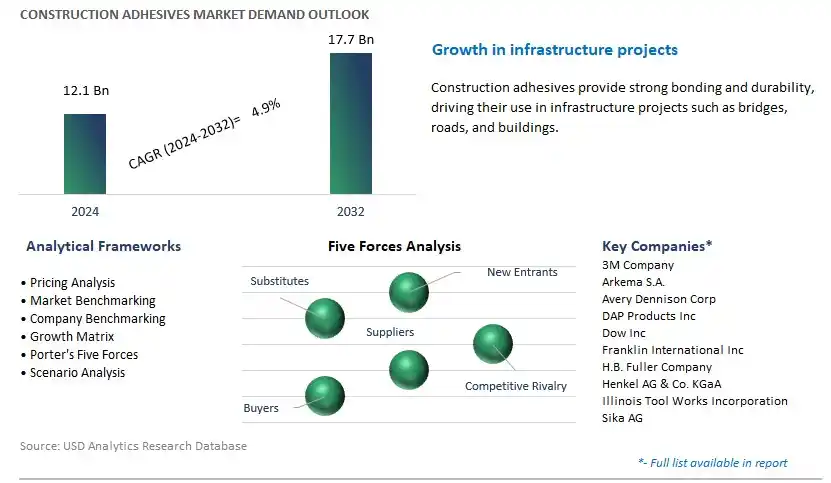
Global Construction Adhesives Market Size is valued at $12.1 Billion in 2024 and is forecast to register a growth rate (CAGR) of 4.9% to reach $17.7 Billion by 2032.
The global Construction Adhesives Market Study analyzes and forecasts the market size across 6 regions and 24 countries for diverse segments -By Resin (Acrylic, Polyurethanes, Polyvinyl Acetate, Epoxy, Others), By Technology (Water-based, Solvent-based, Reactive & Others), By Application (Residential, Commercial, Industrial).
An Introduction to Construction Adhesives Market in 2024
Construction adhesives are specialized adhesives formulated for bonding building materials such as wood, metal, concrete, drywall, and plastics in construction, remodeling, and renovation projects. The market for construction adhesives is driven by the need for strong, durable, and versatile bonding solutions that provide structural integrity, moisture resistance, and long-term performance in various applications. Construction adhesives come in various formulations such as polyurethane, epoxy, acrylic, and silicone, each offering specific properties and curing mechanisms suitable for different substrates and environmental conditions. These adhesives can be used for interior and exterior applications, including subfloor installation, drywall mounting, tile setting, and concrete repair. Further, advancements in adhesive chemistry, curing technologies, and application methods are driving innovation and market growth within the construction adhesives industry. As construction practices evolve to meet the demands for sustainable, efficient, and resilient building solutions, construction adhesives to play a crucial role in ensuring the strength, durability, and longevity of building structures and assemblies.
Construction Adhesives Market Competitive Landscape
The market report analyses the leading companies in the industry including 3M Company, Arkema S.A., Avery Dennison Corp, DAP Products Inc, Dow Inc, Franklin International Inc, H.B. Fuller Company, Henkel AG & Co. KGaA, Illinois Tool Works Incorporation, Sika AG, and others.
Construction Adhesives Market Dynamics
Market Trend: Increasing Demand for Sustainable and Green Building Materials
A significant trend in the construction adhesives market is the increasing demand for sustainable and green building materials. With growing concerns about environmental sustainability and indoor air quality, there is a rising preference for adhesives that meet green building standards and regulations. Manufacturers are responding to this trend by developing eco-friendly adhesives with low volatile organic compound (VOC) emissions, non-toxic formulations, and recyclable packaging. Additionally, there is a focus on adhesives that offer high performance, durability, and versatility while minimizing environmental impact, driving innovation in adhesive technologies and formulations to meet the evolving needs of architects, builders, and property owners in the construction industry.
Market Driver: Growth in Residential and Commercial Construction Activities
The market for construction adhesives is driven by the growth in residential and commercial construction activities worldwide. With increasing urbanization, population growth, and infrastructure development, there is a growing demand for adhesives for a wide range of construction applications such as flooring, tile installation, insulation, and structural bonding. Construction adhesives play a critical role in ensuring the integrity, safety, and longevity of construction projects by providing strong and durable bonds between various building materials such as concrete, wood, metal, and plastics. The expansion of residential housing markets, commercial real estate projects, and infrastructure investments drives the demand for construction adhesives as contractors and builders seek reliable and efficient bonding solutions to meet project timelines and quality standards.
Market Opportunity: Expansion into Prefabricated Construction and Modular Building Systems
An opportunity for market expansion in the construction adhesives industry lies in the expansion into prefabricated construction and modular building systems. While construction adhesives are widely used in traditional on-site construction applications, there is potential to explore new markets and applications where adhesives can offer value-added solutions. For example, there is an opportunity to penetrate the prefabricated construction market, where adhesives can be used to bond prefabricated building components such as wall panels, roof trusses, and floor systems, providing efficient assembly and superior structural performance. Additionally, there is potential to diversify into modular building systems, where adhesives can enable the assembly of modular units into customizable structures for residential, commercial, and industrial applications. By identifying emerging market opportunities and investing in product development and market expansion strategies, manufacturers of construction adhesives can unlock new revenue streams and gain a competitive edge in the rapidly evolving construction materials market.
Construction Adhesives Market Share Analysis: Acrylic generated the highest revenue in 2024
In the construction adhesives market, the acrylic resin segment is the largest segment, commanding a significant share of the market. In particular, acrylic adhesives offer a versatile solution for a wide range of construction applications due to their excellent adhesion properties, fast curing times, and resistance to weathering and moisture. Acrylic adhesives bond well to a variety of substrates, including metals, plastics, wood, and concrete, making them suitable for diverse construction projects such as bonding panels, tiles, insulation materials, and architectural elements. Additionally, acrylic adhesives are known for their ease of application, low odor, and environmental friendliness, contributing to their widespread adoption in both residential and commercial construction projects. Moreover, ongoing innovations in acrylic adhesive formulations, such as the development of low-VOC (volatile organic compound) and solvent-free options, further drive their popularity in the construction industry. As construction practices continue to evolve towards more efficient and sustainable solutions, the acrylic resin segment is expected to maintain its leading position in the construction adhesives market.
Construction Adhesives Market Share Analysis: Water-based is poised to register the fastest CAGR over the forecast period
In the construction adhesives market, the water-based technology segment is the fastest-growing segment. In particular, increasing regulatory scrutiny and consumer demand for environmentally friendly construction materials have fuelled the adoption of water-based adhesives. These adhesives have lower levels of volatile organic compounds (VOCs) compared to solvent-based counterparts, making them more environmentally sustainable and safer for use in indoor environments. Additionally, water-based adhesives offer excellent adhesion properties and versatility, making them suitable for a wide range of construction applications such as bonding wood, drywall, flooring, and tiles. Moreover, the ease of application and clean-up associated with water-based adhesives contribute to their growing popularity among contractors and DIY enthusiasts. Furthermore, advancements in water-based adhesive formulations have led to improved performance characteristics, including faster curing times, higher bond strengths, and enhanced resistance to water and weathering. As sustainability concerns and stringent regulations drive the shift towards greener construction practices, the water-based technology segment is poised for robust growth in the construction adhesives market.
Construction Adhesives Market Share Analysis: Residential generated the highest revenue in 2024
In the construction adhesives market, the residential segment stands out as the largest segment, commanding a significant share of the market. In particular, residential construction encompasses a broad spectrum of projects including single-family homes, apartments, condominiums, and housing developments, resulting in a high demand for construction adhesives across various applications. Adhesives are extensively used in residential construction for bonding materials such as drywall, flooring, tiles, insulation, trim, and moldings. Additionally, the growing global population, urbanization trends, and increasing disposable incomes drive the demand for new residential construction and renovation projects, further boosting the consumption of construction adhesives in this segment. Moreover, the shift towards sustainable and energy-efficient housing solutions, as well as the growing popularity of DIY home improvement projects, contribute to the strong demand for construction adhesives in the residential sector. As residential construction activities continue to flourish worldwide, the residential segment is expected to maintain its leading position in the construction adhesives market.
Construction Adhesives Market
By Resin
Acrylic
Polyurethanes
Polyvinyl Acetate
Epoxy
Others
By Technology
Water-based
Solvent-based
Reactive & Others
By Application
Residential
Commercial
IndustrialCountries Analyzed
North America (US, Canada, Mexico)
Europe (Germany, UK, France, Spain, Italy, Russia, Rest of Europe)
Asia Pacific (China, India, Japan, South Korea, Australia, South East Asia, Rest of Asia)
South America (Brazil, Argentina, Rest of South America)
Middle East and Africa (Saudi Arabia, UAE, Rest of Middle East, South Africa, Egypt, Rest of Africa)
Construction Adhesives Companies Profiled in the Study
3M Company
Arkema S.A.
Avery Dennison Corp
DAP Products Inc
Dow Inc
Franklin International Inc
H.B. Fuller Company
Henkel AG & Co. KGaA
Illinois Tool Works Incorporation
Sika AG
*- List Not Exhaustive
TABLE OF CONTENTS
1 Introduction to 2024 Construction Adhesives Market
1.1 Market Overview
1.2 Quick Facts
1.3 Scope/Objective of the Study
1.4 Market Definition
1.5 Countries and Regions Covered
1.6 Units, Currency, and Conversions
1.7 Industry Value Chain
2 Research Methodology
2.1 Market Size Estimation
2.2 Sources and Research Methodology
2.3 Data Triangulation
2.4 Assumptions and Limitations
3 Executive Summary
3.1 Global Construction Adhesives Market Size Outlook, $ Million, 2021 to 2032
3.2 Construction Adhesives Market Outlook by Type, $ Million, 2021 to 2032
3.3 Construction Adhesives Market Outlook by Product, $ Million, 2021 to 2032
3.4 Construction Adhesives Market Outlook by Application, $ Million, 2021 to 2032
3.5 Construction Adhesives Market Outlook by Key Countries, $ Million, 2021 to 2032
4 Market Dynamics
4.1 Key Driving Forces of Construction Adhesives Industry
4.2 Key Market Trends in Construction Adhesives Industry
4.3 Potential Opportunities in Construction Adhesives Industry
4.4 Key Challenges in Construction Adhesives Industry
5 Market Factor Analysis
5.1 Value Chain Analysis
5.2 Competitive Landscape
5.2.1 Global Construction Adhesives Market Share by Company (%), 2023
5.2.2 Product Offerings by Company
5.3 Porter’s Five Forces Analysis
5.4 Pricing Analysis and Outlook
6 Growth Outlook Across Scenarios
6.1 Growth Analysis-Case Scenario Definitions
6.2 Low Growth Scenario Forecasts
6.3 Reference Growth Scenario Forecasts
6.4 High Growth Scenario Forecasts
7 Global Construction Adhesives Market Outlook by Segments
7.1 Construction Adhesives Market Outlook by Segments, $ Million, 2021- 2032
By Resin
Acrylic
Polyurethanes
Polyvinyl Acetate
Epoxy
Others
By Technology
Water-based
Solvent-based
Reactive & Others
By Application
Residential
Commercial
Industrial
8 North America Construction Adhesives Market Analysis and Outlook To 2032
8.1 Introduction to North America Construction Adhesives Markets in 2024
8.2 North America Construction Adhesives Market Size Outlook by Country, 2021-2032
8.2.1 United States
8.2.2 Canada
8.2.3 Mexico
8.3 North America Construction Adhesives Market size Outlook by Segments, 2021-2032
By Resin
Acrylic
Polyurethanes
Polyvinyl Acetate
Epoxy
Others
By Technology
Water-based
Solvent-based
Reactive & Others
By Application
Residential
Commercial
Industrial
9 Europe Construction Adhesives Market Analysis and Outlook To 2032
9.1 Introduction to Europe Construction Adhesives Markets in 2024
9.2 Europe Construction Adhesives Market Size Outlook by Country, 2021-2032
9.2.1 Germany
9.2.2 France
9.2.3 Spain
9.2.4 United Kingdom
9.2.4 Italy
9.2.5 Russia
9.2.6 Norway
9.2.7 Rest of Europe
9.3 Europe Construction Adhesives Market Size Outlook by Segments, 2021-2032
By Resin
Acrylic
Polyurethanes
Polyvinyl Acetate
Epoxy
Others
By Technology
Water-based
Solvent-based
Reactive & Others
By Application
Residential
Commercial
Industrial
10 Asia Pacific Construction Adhesives Market Analysis and Outlook To 2032
10.1 Introduction to Asia Pacific Construction Adhesives Markets in 2024
10.2 Asia Pacific Construction Adhesives Market Size Outlook by Country, 2021-2032
10.2.1 China
10.2.2 India
10.2.3 Japan
10.2.4 South Korea
10.2.5 Indonesia
10.2.6 Malaysia
10.2.7 Australia
10.2.8 Rest of Asia Pacific
10.3 Asia Pacific Construction Adhesives Market size Outlook by Segments, 2021-2032
By Resin
Acrylic
Polyurethanes
Polyvinyl Acetate
Epoxy
Others
By Technology
Water-based
Solvent-based
Reactive & Others
By Application
Residential
Commercial
Industrial
11 South America Construction Adhesives Market Analysis and Outlook To 2032
11.1 Introduction to South America Construction Adhesives Markets in 2024
11.2 South America Construction Adhesives Market Size Outlook by Country, 2021-2032
11.2.1 Brazil
11.2.2 Argentina
11.2.3 Rest of South America
11.3 South America Construction Adhesives Market size Outlook by Segments, 2021-2032
By Resin
Acrylic
Polyurethanes
Polyvinyl Acetate
Epoxy
Others
By Technology
Water-based
Solvent-based
Reactive & Others
By Application
Residential
Commercial
Industrial
12 Middle East and Africa Construction Adhesives Market Analysis and Outlook To 2032
12.1 Introduction to Middle East and Africa Construction Adhesives Markets in 2024
12.2 Middle East and Africa Construction Adhesives Market Size Outlook by Country, 2021-2032
12.2.1 Saudi Arabia
12.2.2 UAE
12.2.3 Oman
12.2.4 Rest of Middle East
12.2.5 Egypt
12.2.6 Nigeria
12.2.7 South Africa
12.2.8 Rest of Africa
12.3 Middle East and Africa Construction Adhesives Market size Outlook by Segments, 2021-2032
By Resin
Acrylic
Polyurethanes
Polyvinyl Acetate
Epoxy
Others
By Technology
Water-based
Solvent-based
Reactive & Others
By Application
Residential
Commercial
Industrial
13 Company Profiles
13.1 Company Snapshot
13.2 SWOT Profiles
13.3 Products and Services
13.4 Recent Developments
13.5 Financial Profile
3M Company
Arkema S.A.
Avery Dennison Corp
DAP Products Inc
Dow Inc
Franklin International Inc
H.B. Fuller Company
Henkel AG & Co. KGaA
Illinois Tool Works Incorporation
Sika AG
14 Appendix
14.1 Customization Offerings
14.2 Subscription Services
14.3 Related Reports
14.4 Publisher Expertise
By Resin
Acrylic
Polyurethanes
Polyvinyl Acetate
Epoxy
Others
By Technology
Water-based
Solvent-based
Reactive & Others
By Application
Residential
Commercial
Industrial
Countries Analyzed
North America (US, Canada, Mexico)
Europe (Germany, UK, France, Spain, Italy, Russia, Rest of Europe)
Asia Pacific (China, India, Japan, South Korea, Australia, South East Asia, Rest of Asia)
South America (Brazil, Argentina, Rest of South America)
Middle East and Africa (Saudi Arabia, UAE, Rest of Middle East, South Africa, Egypt, Rest of Africa)
