Contraceptive Devices Market is estimated to increase at a Compounded Annual Growth Rate of 5.9% CAGR over the forecast period from 2024 to 2030
The Contraceptive Devices Market study analyzes and forecasts the market size across 6 regions and 24 countries for diverse segments- By Type (Condoms, Diaphragms, Cervical Caps, Sponges, Vaginal Rings, Intra Uterine Device (IUD), Others), By Gender (Male, Female).
An Introduction to Contraceptive Devices Market in 2024
In 2024, the market for contraceptive devices caters to the diverse contraceptive needs of women and couples worldwide, offering a range of highly effective, reversible birth control options for pregnancy prevention and family planning. Contraceptive devices include intrauterine devices (IUDs), contraceptive implants, contraceptive patches, vaginal rings, and barrier methods such as diaphragms and cervical caps, each offering unique advantages in terms of efficacy, convenience, and reversibility. Contraceptive devices provide long-term or short-term contraception, allowing individuals to choose the method that best suits their lifestyle, reproductive goals, and health considerations. With a focus on user satisfaction, contraceptive effectiveness, and safety, contraceptive devices undergo rigorous testing, regulatory approval, and quality assurance processes to ensure reliability and minimal adverse effects. Moreover, with advancements in contraceptive technology, biocompatible materials, and insertion techniques, the contraceptive devices market continues to evolve, offering innovative options for empowering women and couples to make informed choices about their reproductive health and contraceptive preferences.
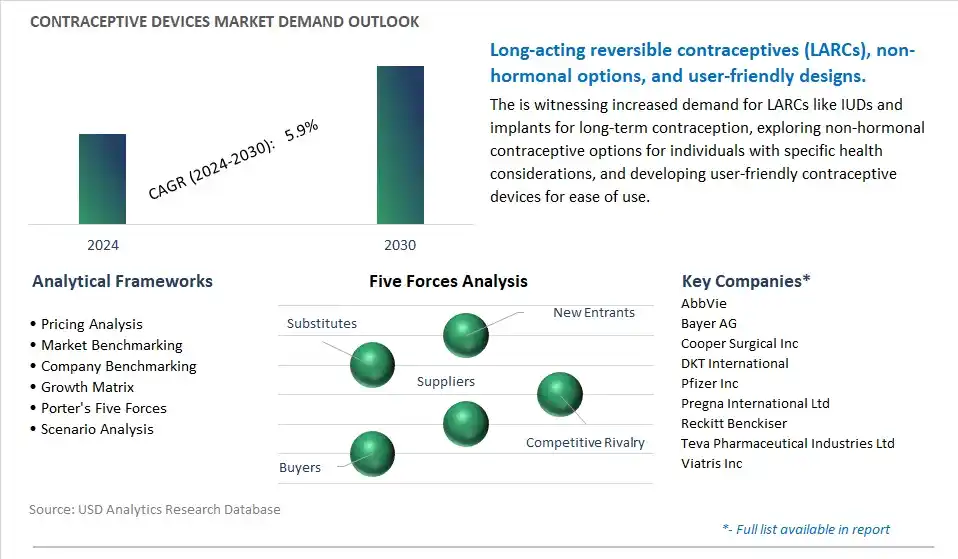
Market Trend: Increasing Adoption of Long-Acting Reversible Contraceptives (LARCs)
A significant trend in the Contraceptive Devices market is the increasing adoption of long-acting reversible contraceptives (LARCs). LARCs, such as intrauterine devices (IUDs) and contraceptive implants, offer highly effective, reversible, and convenient contraception options for women. These devices provide long-term protection against unintended pregnancies, with durations ranging from several years to over a decade, depending on the specific product. As awareness about the benefits of LARCs, including high efficacy rates, user satisfaction, and reduced reliance on daily adherence, grows among healthcare providers and women, there's a shift towards LARC methods as preferred contraceptive options. Additionally, initiatives promoting access to LARCs through public health programs, insurance coverage, and provider education contribute to the increasing adoption of these devices, driving market growth and expansion in the Contraceptive Devices market.
Market Driver: Demand for Effective and Convenient Birth Control Methods
An important driver fueling the Contraceptive Devices market is the ongoing demand for effective and convenient birth control methods. With the global population continuing to grow and women seeking greater control over their reproductive health and family planning decisions, there's a persistent need for contraceptive solutions that offer high efficacy, safety, and ease of use. Contraceptive devices, including IUDs, contraceptive implants, vaginal rings, and contraceptive patches, provide women with a range of options to choose from based on their lifestyle preferences, medical history, and contraceptive needs. The availability of diverse contraceptive devices that offer different mechanisms of action, durations of use, and levels of user control allows women to select the method that best aligns with their individual preferences and reproductive goals. As women prioritize contraception that fits seamlessly into their lives and offers reliable protection against unintended pregnancies, the demand for contraceptive devices continues to drive market growth and innovation in the Contraceptive Devices market.
Market Opportunity: Expansion of Access and Education in Underserved Populations
A significant opportunity within the Contraceptive Devices market lies in the expansion of access and education in underserved populations. Despite advances in contraceptive technology and availability, disparities in access to contraception persist, particularly among marginalized communities, low-income populations, and regions with limited healthcare resources. By focusing on initiatives to increase access to contraceptive devices and comprehensive family planning services in underserved areas, stakeholders in the Contraceptive Devices market can address unmet needs and improve reproductive health outcomes for vulnerable populations. This opportunity involves collaborating with healthcare providers, community organizations, and policymakers to implement outreach programs, remove financial barriers to contraceptive access, and provide culturally sensitive education about contraceptive options and family planning. Additionally, investing in research and development efforts to develop affordable, user-friendly contraceptive devices tailored to the needs of underserved populations can help bridge gaps in contraceptive access and contribute to global efforts to promote reproductive health equity. By expanding access and education initiatives, stakeholders in the Contraceptive Devices market can seize the opportunity to make meaningful contributions to advancing reproductive rights and improving health outcomes for women worldwide.
Contraceptive Devices Market Share Analysis: Intrauterine Devices (IUDs)
Among the various types of contraceptive devices, intrauterine devices (IUDs) are experiencing the fastest growth. IUDs are small, T-shaped devices inserted into the uterus to prevent pregnancy by interfering with the fertilization process or inhibiting implantation of the fertilized egg. The rapid growth of IUDs in the contraceptive devices market can be attributed to several factors. Firstly, IUDs offer long-acting reversible contraception (LARC), providing effective birth control for several years without requiring daily attention or user compliance. This convenience and efficacy make IUDs attractive options for individuals seeking reliable contraception with minimal effort. Secondly, advancements in IUD technology, including the development of hormonal IUDs containing progestin, have expanded the range of options available to users, offering additional benefits such as lighter periods, reduced menstrual cramps, and improved menstrual regularity. The availability of non-hormonal copper IUDs provides an alternative for individuals who prefer non-hormonal contraception. Additionally, the increasing acceptance and recommendation of IUDs by healthcare providers, public health organizations, and reproductive health advocates contribute to market growth. IUDs are considered one of the most effective forms of contraception and are endorsed as first-line options for women of reproductive age by professional medical associations and family planning guidelines. Furthermore, the growing emphasis on family planning, reproductive autonomy, and access to contraception drives demand for IUDs as part of comprehensive reproductive health services and family planning programs worldwide. As a result, IUDs emerge as the contraceptive devices market, offering significant opportunities for manufacturers, healthcare providers, and public health organizations aiming to expand access to safe and effective contraception for individuals of all genders.
Contraceptive Devices Competitive Analysis
The market research study provides in-depth insights into leading companies including the SWOT analyses, product profile, financial details, and recent developments acrossAbbVie, Bayer AG, Cooper Surgical Inc, DKT International, Pfizer Inc, Pregna International Ltd, Reckitt Benckiser, Teva Pharmaceutical Industries Ltd, Viatris Inc
Contraceptive Devices Market Segmentation
By Type
Condoms
Diaphragms
Cervical Caps
Sponges
Vaginal Rings
Intra Uterine Device (IUD)
Others
By Gender
Male
Female
Geographical Analysis
North America (United States, Canada, Mexico)
Europe (Germany, France, United Kingdom, Spain, Italy, Rest of Europe)
Asia Pacific (China, India, Japan, South Korea, Rest of Asia Pacific)
South America (Brazil, Argentina, Rest of South America)
Middle East and Africa (Saudi Arabia, UAE, Rest of Middle East, South Africa, Egypt, Rest of Africa)
Contraceptive Devices Market Companies
AbbVie
Bayer AG
Cooper Surgical Inc
DKT International
Pfizer Inc
Pregna International Ltd
Reckitt Benckiser
Teva Pharmaceutical Industries Ltd
Viatris Inc
Reasons to Buy the Contraceptive Devices Market Study
• Deepen your industry insights and navigate uncertainties for strategy formulation, CAPEX, and Operational decisions
• Gain access to detailed insights on the Contraceptive Devices Market, encompassing current market size, growth trends, and forecasts till 2030.
• Access detailed competitor analysis, enabling competitive advantage through a thorough understanding of market players, strategies, and potential differentiation opportunities
• Stay ahead of the curve with insights on technological advancements, innovations, and upcoming trends
• Identify lucrative investment avenues and expansion opportunities within the Contraceptive Devices Market industry, guided by robust, data-backed analysis.
• Understand regional and global markets through country-wise analysis, regional market potential, regulatory nuances, and dynamics
• Execute strategies with confidence and speed through information, analytics, and insights on the industry value chain
• Corporate leaders, strategists, financial experts, shareholders, asset managers, and governmental representatives can make long-term planning scenarios and build an integrated and timely understanding of market dynamics
• Benefit from tailored solutions and expert consultation based on report insights, providing personalized strategies aligned with specific business needs.
TABLE OF CONTENTS
1 Introduction to 2024 Contraceptive Devices Market
1.1 Market Overview
1.2 Quick Facts
1.3 Scope/Objective of the Study
1.4 Market Definition
1.5 Countries and Regions Covered
1.6 Units, Currency, and Conversions
1.7 Industry Value Chain
2 Research Methodology
2.1 Market Size Estimation
2.2 Sources and Research Methodology
2.3 Data Triangulation
2.4 Assumptions and Limitations
3 Executive Summary
3.1 Global Contraceptive Devices Market Size Outlook, $ Million, 2021 to 2030
3.2 Contraceptive Devices Market Outlook by Type, $ Million, 2021 to 2030
3.3 Contraceptive Devices Market Outlook by Product, $ Million, 2021 to 2030
3.4 Contraceptive Devices Market Outlook by Application, $ Million, 2021 to 2030
3.5 Contraceptive Devices Market Outlook by Key Countries, $ Million, 2021 to 2030
4 Market Dynamics
4.1 Key Driving Forces of Contraceptive Devices Industry
4.2 Key Market Trends in Contraceptive Devices Industry
4.3 Potential Opportunities in Contraceptive Devices Industry
4.4 Key Challenges in Contraceptive Devices Industry
5 Market Factor Analysis
5.1 Value Chain Analysis
5.2 Competitive Landscape
5.2.1 Global Contraceptive Devices Market Share by Company (%), 2023
5.2.2 Product Offerings by Company
5.3 Porter’s Five Forces Analysis
5.4 Pricing Analysis and Outlook
6 Growth Outlook Across Scenarios
6.1 Growth Analysis-Case Scenario Definitions
6.2 Low Growth Scenario Forecasts
6.3 Reference Growth Scenario Forecasts
6.4 High Growth Scenario Forecasts
7 Global Contraceptive Devices Market Outlook by Segments
7.1 Contraceptive Devices Market Outlook by Segments, $ Million, 2021- 2030
By Type
Condoms
Diaphragms
Cervical Caps
Sponges
Vaginal Rings
Intra Uterine Device (IUD)
Others
By Gender
Male
Female
8 North America Contraceptive Devices Market Analysis and Outlook To 2030
8.1 Introduction to North America Contraceptive Devices Markets in 2024
8.2 North America Contraceptive Devices Market Size Outlook by Country, 2021-2030
8.2.1 United States
8.2.2 Canada
8.2.3 Mexico
8.3 North America Contraceptive Devices Market size Outlook by Segments, 2021-2030
By Type
Condoms
Diaphragms
Cervical Caps
Sponges
Vaginal Rings
Intra Uterine Device (IUD)
Others
By Gender
Male
Female
9 Europe Contraceptive Devices Market Analysis and Outlook To 2030
9.1 Introduction to Europe Contraceptive Devices Markets in 2024
9.2 Europe Contraceptive Devices Market Size Outlook by Country, 2021-2030
9.2.1 Germany
9.2.2 France
9.2.3 Spain
9.2.4 United Kingdom
9.2.4 Italy
9.2.5 Russia
9.2.6 Norway
9.2.7 Rest of Europe
9.3 Europe Contraceptive Devices Market Size Outlook by Segments, 2021-2030
By Type
Condoms
Diaphragms
Cervical Caps
Sponges
Vaginal Rings
Intra Uterine Device (IUD)
Others
By Gender
Male
Female
10 Asia Pacific Contraceptive Devices Market Analysis and Outlook To 2030
10.1 Introduction to Asia Pacific Contraceptive Devices Markets in 2024
10.2 Asia Pacific Contraceptive Devices Market Size Outlook by Country, 2021-2030
10.2.1 China
10.2.2 India
10.2.3 Japan
10.2.4 South Korea
10.2.5 Indonesia
10.2.6 Malaysia
10.2.7 Australia
10.2.8 Rest of Asia Pacific
10.3 Asia Pacific Contraceptive Devices Market size Outlook by Segments, 2021-2030
By Type
Condoms
Diaphragms
Cervical Caps
Sponges
Vaginal Rings
Intra Uterine Device (IUD)
Others
By Gender
Male
Female
11 South America Contraceptive Devices Market Analysis and Outlook To 2030
11.1 Introduction to South America Contraceptive Devices Markets in 2024
11.2 South America Contraceptive Devices Market Size Outlook by Country, 2021-2030
11.2.1 Brazil
11.2.2 Argentina
11.2.3 Rest of South America
11.3 South America Contraceptive Devices Market size Outlook by Segments, 2021-2030
By Type
Condoms
Diaphragms
Cervical Caps
Sponges
Vaginal Rings
Intra Uterine Device (IUD)
Others
By Gender
Male
Female
12 Middle East and Africa Contraceptive Devices Market Analysis and Outlook To 2030
12.1 Introduction to Middle East and Africa Contraceptive Devices Markets in 2024
12.2 Middle East and Africa Contraceptive Devices Market Size Outlook by Country, 2021-2030
12.2.1 Saudi Arabia
12.2.2 UAE
12.2.3 Oman
12.2.4 Rest of Middle East
12.2.5 Egypt
12.2.6 Nigeria
12.2.7 South Africa
12.2.8 Rest of Africa
12.3 Middle East and Africa Contraceptive Devices Market size Outlook by Segments, 2021-2030
By Type
Condoms
Diaphragms
Cervical Caps
Sponges
Vaginal Rings
Intra Uterine Device (IUD)
Others
By Gender
Male
Female
13 Company Profiles
13.1 Company Snapshot
13.2 SWOT Profiles
13.3 Products and Services
13.4 Recent Developments
13.5 Financial Profile
List of Companies
AbbVie
Bayer AG
Cooper Surgical Inc
DKT International
Pfizer Inc
Pregna International Ltd
Reckitt Benckiser
Teva Pharmaceutical Industries Ltd
Viatris Inc
14 Appendix
14.1 Customization Offerings
14.2 Subscription Services
14.3 Related Reports
14.4 Publisher Expertise
By Type
Condoms
Diaphragms
Cervical Caps
Sponges
Vaginal Rings
Intra Uterine Device (IUD)
Others
By Gender
Male
Female
Countries Analyzed
North America (United States, Canada, Mexico)
Europe (Germany, France, United Kingdom, Spain, Italy, Rest of Europe)
Asia Pacific (China, India, Japan, South Korea, Rest of Asia Pacific)
South America (Brazil, Argentina, Rest of South America)
Middle East and Africa (Saudi Arabia, UAE, Rest of Middle East, South Africa, Egypt, Rest of Africa)
