
The global Conveying Equipment Market Study analyzes and forecasts the market size across 6 regions and 24 countries for diverse segments -By Type (Belt, Roller, Pallet, Overhead, Chain Conveyors, Others), By Product (Unit Handling, Bulk Handling, Parts & Attachments), By Application (Food & Beverage, Warehouse & Distribution, Automotive, Airport, Mining, Electronics, Others).
The conveying equipment market is experiencing significant growth driven by the expansion of manufacturing, logistics, and e-commerce sectors worldwide. Key trends shaping the future of the industry include the increasing demand for conveyor systems that offer automation, flexibility, and scalability for material handling and distribution operations. As industries seek to streamline supply chain operations, reduce labor costs, and improve throughput rates, there's a growing need for conveying equipment that can handle diverse product types, sizes, and weights with efficiency and reliability. Moreover, advancements in conveyor technology such as modular designs, energy-efficient motors, and predictive maintenance solutions are driving market expansion by enhancing system performance, uptime, and operational visibility. Additionally, the rising adoption of automated guided vehicles (AGVs), robotics, and artificial intelligence (AI) in conveyor systems is fueling demand for integrated material handling solutions that optimize warehouse layouts, order fulfillment processes, and inventory management. Furthermore, the integration of sensors, IoT connectivity, and data analytics is enabling real-time monitoring, optimization, and predictive maintenance of conveyor systems, driving innovation and market growth in the conveying equipment industry.
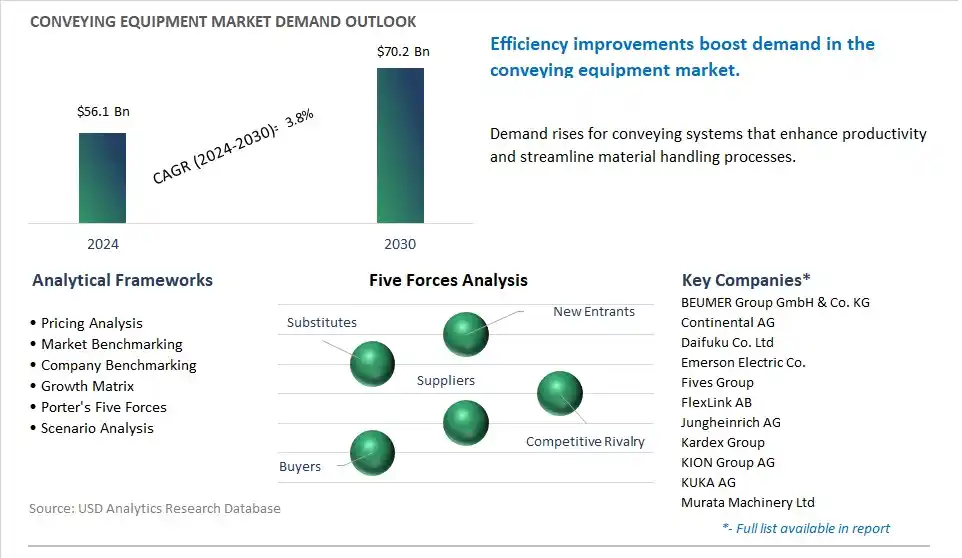
The market report analyses the leading companies in the industry including BEUMER Group GmbH & Co. KG, Continental AG, Daifuku Co. Ltd, Emerson Electric Co., Fives Group, FlexLink AB, Jungheinrich AG, Kardex Group, KION Group AG, KUKA AG, Murata Machinery Ltd, Phoenix Conveyor Belt Systems GmbH, Siemens AG, TGW Logistics Group GmbH.
One prominent trend in the conveying equipment market is the integration of automation and robotics into conveying systems. As industries seek to improve efficiency, reduce labor costs, and enhance production flexibility, there is a growing demand for conveying equipment that can seamlessly integrate with automated processes and robotic operations. Automated conveying systems equipped with robotics offer advantages such as increased throughput, precise material handling, and adaptability to diverse production environments. These systems utilize technologies such as sensors, vision systems, and artificial intelligence to optimize material flow, minimize downtime, and improve overall productivity. The trend towards automation and robotics integration is driven by the need for streamlined manufacturing processes, rapid product changeovers, and the adoption of Industry 4.0 principles, shaping the conveying equipment market towards more intelligent and interconnected solutions.
A primary driver shaping the conveying equipment market is the expansion of e-commerce and logistics industries worldwide. With the growth of online retailing, fulfillment centers, and distribution networks, there is a significant demand for conveying systems that can efficiently handle the movement and sorting of packages, parcels, and goods in warehouses and fulfillment centers. Conveying equipment plays a critical role in optimizing material flow, order fulfillment, and logistics operations, enabling faster order processing, accurate tracking, and timely delivery of products to consumers. Additionally, as e-commerce companies and logistics providers strive to meet customer expectations for fast and reliable shipping, there is a need for conveying solutions that offer scalability, modularity, and adaptability to accommodate fluctuating demand and changing product profiles. The expansion of e-commerce and logistics industries drives market demand for conveying equipment as an essential component of modern supply chain infrastructure, stimulating innovation and investment in conveying technologies.
An opportunity within the conveying equipment market lies in the development of energy-efficient and sustainable conveying solutions. With increasing emphasis on environmental sustainability, energy conservation, and corporate responsibility, there is a demand for conveying equipment that reduces energy consumption, minimizes carbon footprint, and optimizes resource usage throughout the product lifecycle. Manufacturers can capitalize on this opportunity by designing conveying systems with features such as variable-speed drives, regenerative braking, and energy-efficient motors to reduce power consumption and operating costs. Additionally, the use of lightweight materials, recyclable components, and eco-friendly lubricants in conveying equipment contributes to sustainability goals and aligns with corporate sustainability initiatives. By innovating energy-efficient and sustainable conveying solutions, manufacturers can differentiate their products, attract environmentally conscious customers, and create value in the increasingly competitive market for conveying equipment.
The belt conveyors segment is the largest segment in the Conveying Equipment Market due to diverse key factors. The belt conveyors are versatile and widely used in various industries for transporting bulk materials, goods, and components over long distances or between different process stages. Their ability to handle a wide range of materials, including grains, aggregates, ores, chemicals, and packaged goods, makes them indispensable in industries such as mining, agriculture, manufacturing, logistics, and food processing. Additionally, belt conveyors offer flexibility in design and configuration, allowing for customization to suit specific application requirements, such as inclined or declined conveying, horizontal or curved routes, and variable speeds. In addition, belt conveyors are cost-effective and efficient, with low maintenance requirements and high reliability, resulting in reduced downtime and operational costs for end-users. Further, advancements in belt conveyor technology, such as improved belt materials, drive systems, and automation features, have enhanced performance, throughput, and safety, further driving their adoption in various industries. Over the forecast period, the dominance of the belt conveyors segment in the Conveying Equipment Market is attributed to its versatility, efficiency, reliability, cost-effectiveness, and widespread applicability across diverse industries and material handling applications.
The unit handling segment is the fastest-growing segment in the Conveying Equipment Market due to diverse compelling reasons. The the rise of e-commerce and the shift towards automated material handling solutions have increased the demand for unit handling conveyors in warehousing, distribution centers, and fulfillment operations. Unit handling conveyors are designed to transport individual items or unit loads, such as boxes, totes, cartons, and packages, making them essential for order fulfillment, sorting, and distribution tasks in modern logistics operations. Additionally, the growing trend towards lean manufacturing and just-in-time (JIT) inventory management practices has led to the adoption of unit handling conveyors in manufacturing facilities for assembly lines, packaging lines, and work-in-progress handling. In addition, advancements in unit handling conveyor technology, such as modular designs, flexible configurations, and integration with robotics and automation systems, have improved efficiency, throughput, and flexibility, further driving their adoption in various industries. Further, the COVID-19 pandemic has accelerated the adoption of unit handling conveyors as businesses seek to minimize human contact, improve worker safety, and optimize operational efficiency in response to changing market dynamics and supply chain disruptions. Over the forecast period, the rapid growth of the unit handling segment in the Conveying Equipment Market is driven by the increasing demand for automated material handling solutions, e-commerce growth, lean manufacturing practices, technological advancements, and the need for operational agility and resilience in a rapidly evolving business environment.
The warehouse and distribution segment is the fastest-growing segment in the Conveying Equipment Market due to diverse compelling reasons. The the rapid growth of e-commerce and the shift towards omni-channel retailing have led to an increased demand for automated material handling solutions in warehouses and distribution centers. As consumer expectations for faster delivery times and order accuracy continue to rise, warehouse operators are investing in conveyor systems to streamline order fulfillment processes, improve operational efficiency, and meet growing customer demands. Additionally, the COVID-19 pandemic has accelerated the adoption of e-commerce and driven a surge in online shopping, further fueling the demand for automated conveyor systems in warehouses and distribution centers. In addition, advancements in conveying equipment technology, such as the integration of robotics, artificial intelligence, and machine learning, have improved the speed, accuracy, and flexibility of material handling operations, making them indispensable for modern warehouse operations. Further, the trend towards lean inventory management practices and just-in-time (JIT) logistics has increased the need for efficient and responsive material handling solutions in warehouses and distribution centers to minimize inventory carrying costs and optimize supply chain efficiency. Over the forecast period, the rapid growth of the warehouse and distribution segment in the Conveying Equipment Market is driven by the increasing demand for automated material handling solutions, e-commerce growth, technological advancements, and the need for operational agility and efficiency in response to changing market dynamics and consumer expectations.
By Type
Belt
Roller
Pallet
Overhead
Chain Conveyors
Others
By Product
Unit Handling
Bulk Handling
Parts & Attachments
By Application
Food & Beverage
Warehouse & Distribution
Automotive
Airport
Mining
Electronics
Others
Regions Included
North America (US, Canada, Mexico)
Europe (Germany, UK, France, Spain, Italy, Russia, Rest of Europe)
Asia Pacific (China, India, Japan, South Korea, Australia, South East Asia, Rest of Asia)
South America (Brazil, Argentina, Rest of South America)
Middle East and Africa (Saudi Arabia, UAE, Rest of Middle East, South Africa, Egypt, Rest of Africa)
BEUMER Group GmbH & Co. KG
Continental AG
Daifuku Co. Ltd
Emerson Electric Co.
Fives Group
FlexLink AB
Jungheinrich AG
Kardex Group
KION Group AG
KUKA AG
Murata Machinery Ltd
Phoenix Conveyor Belt Systems GmbH
Siemens AG
TGW Logistics Group GmbH
*- List Not Exhaustive
TABLE OF CONTENTS
1 Introduction to 2024 Conveying Equipment Market
1.1 Market Overview
1.2 Quick Facts
1.3 Scope/Objective of the Study
1.4 Market Definition
1.5 Countries and Regions Covered
1.6 Units, Currency, and Conversions
1.7 Industry Value Chain
2 Research Methodology
2.1 Market Size Estimation
2.2 Sources and Research Methodology
2.3 Data Triangulation
2.4 Assumptions and Limitations
3 Executive Summary
3.1 Global Conveying Equipment Market Size Outlook, $ Million, 2021 to 2030
3.2 Conveying Equipment Market Outlook by Type, $ Million, 2021 to 2030
3.3 Conveying Equipment Market Outlook by Product, $ Million, 2021 to 2030
3.4 Conveying Equipment Market Outlook by Application, $ Million, 2021 to 2030
3.5 Conveying Equipment Market Outlook by Key Countries, $ Million, 2021 to 2030
4 Market Dynamics
4.1 Key Driving Forces of Conveying Equipment Industry
4.2 Key Market Trends in Conveying Equipment Industry
4.3 Potential Opportunities in Conveying Equipment Industry
4.4 Key Challenges in Conveying Equipment Industry
5 Market Factor Analysis
5.1 Value Chain Analysis
5.2 Competitive Landscape
5.2.1 Global Conveying Equipment Market Share by Company (%), 2023
5.2.2 Product Offerings by Company
5.3 Porter’s Five Forces Analysis
5.4 Pricing Analysis and Outlook
6 Growth Outlook Across Scenarios
6.1 Growth Analysis-Case Scenario Definitions
6.2 Low Growth Scenario Forecasts
6.3 Reference Growth Scenario Forecasts
6.4 High Growth Scenario Forecasts
7 Global Conveying Equipment Market Outlook by Segments
7.1 Conveying Equipment Market Outlook by Segments, $ Million, 2021- 2030
By Type
Belt
Roller
Pallet
Overhead
Chain Conveyors
Others
By Product
Unit Handling
Bulk Handling
Parts & Attachments
By Application
Food & Beverage
Warehouse & Distribution
Automotive
Airport
Mining
Electronics
Others
8 North America Conveying Equipment Market Analysis and Outlook To 2030
8.1 Introduction to North America Conveying Equipment Markets in 2024
8.2 North America Conveying Equipment Market Size Outlook by Country, 2021-2030
8.2.1 United States
8.2.2 Canada
8.2.3 Mexico
8.3 North America Conveying Equipment Market size Outlook by Segments, 2021-2030
By Type
Belt
Roller
Pallet
Overhead
Chain Conveyors
Others
By Product
Unit Handling
Bulk Handling
Parts & Attachments
By Application
Food & Beverage
Warehouse & Distribution
Automotive
Airport
Mining
Electronics
Others
9 Europe Conveying Equipment Market Analysis and Outlook To 2030
9.1 Introduction to Europe Conveying Equipment Markets in 2024
9.2 Europe Conveying Equipment Market Size Outlook by Country, 2021-2030
9.2.1 Germany
9.2.2 France
9.2.3 Spain
9.2.4 United Kingdom
9.2.4 Italy
9.2.5 Russia
9.2.6 Norway
9.2.7 Rest of Europe
9.3 Europe Conveying Equipment Market Size Outlook by Segments, 2021-2030
By Type
Belt
Roller
Pallet
Overhead
Chain Conveyors
Others
By Product
Unit Handling
Bulk Handling
Parts & Attachments
By Application
Food & Beverage
Warehouse & Distribution
Automotive
Airport
Mining
Electronics
Others
10 Asia Pacific Conveying Equipment Market Analysis and Outlook To 2030
10.1 Introduction to Asia Pacific Conveying Equipment Markets in 2024
10.2 Asia Pacific Conveying Equipment Market Size Outlook by Country, 2021-2030
10.2.1 China
10.2.2 India
10.2.3 Japan
10.2.4 South Korea
10.2.5 Indonesia
10.2.6 Malaysia
10.2.7 Australia
10.2.8 Rest of Asia Pacific
10.3 Asia Pacific Conveying Equipment Market size Outlook by Segments, 2021-2030
By Type
Belt
Roller
Pallet
Overhead
Chain Conveyors
Others
By Product
Unit Handling
Bulk Handling
Parts & Attachments
By Application
Food & Beverage
Warehouse & Distribution
Automotive
Airport
Mining
Electronics
Others
11 South America Conveying Equipment Market Analysis and Outlook To 2030
11.1 Introduction to South America Conveying Equipment Markets in 2024
11.2 South America Conveying Equipment Market Size Outlook by Country, 2021-2030
11.2.1 Brazil
11.2.2 Argentina
11.2.3 Rest of South America
11.3 South America Conveying Equipment Market size Outlook by Segments, 2021-2030
By Type
Belt
Roller
Pallet
Overhead
Chain Conveyors
Others
By Product
Unit Handling
Bulk Handling
Parts & Attachments
By Application
Food & Beverage
Warehouse & Distribution
Automotive
Airport
Mining
Electronics
Others
12 Middle East and Africa Conveying Equipment Market Analysis and Outlook To 2030
12.1 Introduction to Middle East and Africa Conveying Equipment Markets in 2024
12.2 Middle East and Africa Conveying Equipment Market Size Outlook by Country, 2021-2030
12.2.1 Saudi Arabia
12.2.2 UAE
12.2.3 Oman
12.2.4 Rest of Middle East
12.2.5 Egypt
12.2.6 Nigeria
12.2.7 South Africa
12.2.8 Rest of Africa
12.3 Middle East and Africa Conveying Equipment Market size Outlook by Segments, 2021-2030
By Type
Belt
Roller
Pallet
Overhead
Chain Conveyors
Others
By Product
Unit Handling
Bulk Handling
Parts & Attachments
By Application
Food & Beverage
Warehouse & Distribution
Automotive
Airport
Mining
Electronics
Others
13 Company Profiles
13.1 Company Snapshot
13.2 SWOT Profiles
13.3 Products and Services
13.4 Recent Developments
13.5 Financial Profile
BEUMER Group GmbH & Co. KG
Continental AG
Daifuku Co. Ltd
Emerson Electric Co.
Fives Group
FlexLink AB
Jungheinrich AG
Kardex Group
KION Group AG
KUKA AG
Murata Machinery Ltd
Phoenix Conveyor Belt Systems GmbH
Siemens AG
TGW Logistics Group GmbH
14 Appendix
14.1 Customization Offerings
14.2 Subscription Services
14.3 Related Reports
14.4 Publisher Expertise
By Type
Belt
Roller
Pallet
Overhead
Chain Conveyors
Others
By Product
Unit Handling
Bulk Handling
Parts & Attachments
By Application
Food & Beverage
Warehouse & Distribution
Automotive
Airport
Mining
Electronics
Others
Countries Analyzed
North America (US, Canada, Mexico)
Europe (Germany, UK, France, Spain, Italy, Russia, Rest of Europe)
Asia Pacific (China, India, Japan, South Korea, Australia, South East Asia, Rest of Asia)
South America (Brazil, Argentina, Rest of South America)
Middle East and Africa (Saudi Arabia, UAE, Rest of Middle East, South Africa, Egypt, Rest of Africa)
Global Conveying Equipment is forecast to reach $70.2 Billion in 2030 from $56.1 Billion in 2024, registering a CAGR of 3.8%
Emerging Markets across Asia Pacific, Europe, and Americas present robust growth prospects.
BEUMER Group GmbH & Co. KG, Continental AG, Daifuku Co. Ltd, Emerson Electric Co., Fives Group, FlexLink AB, Jungheinrich AG, Kardex Group, KION Group AG, KUKA AG, Murata Machinery Ltd, Phoenix Conveyor Belt Systems GmbH, Siemens AG, TGW Logistics Group GmbH
Base Year- 2023; Estimated Year- 2024; Historic Period- 2018-2023; Forecast period- 2024 to 2030; Currency: Revenue (USD); Volume