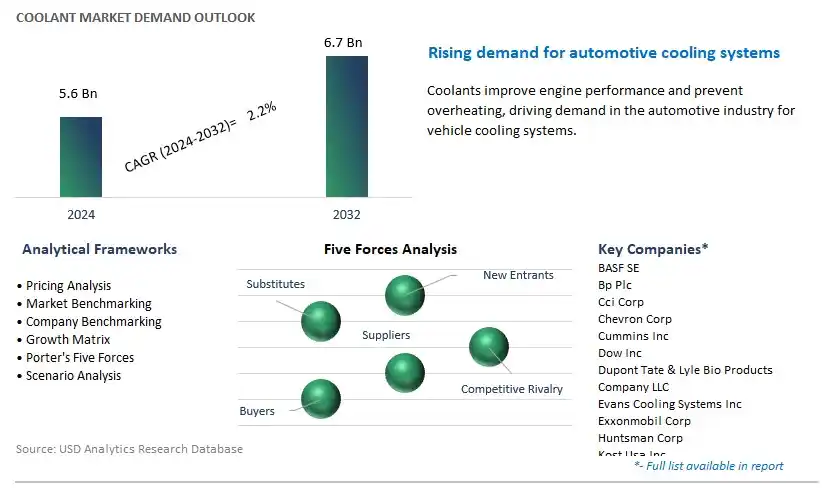
Global Coolant Market Size is valued at $5.6 Billion in 2024 and is forecast to register a growth rate (CAGR) of 2.2% to reach $6.7 Billion by 2032.
The global Coolant Market Study analyzes and forecasts the market size across 6 regions and 24 countries for diverse segments -By Base Fluid (EG, PG, Glycerine), By Technology (OAT, HOAT, IAT), By Application (Automotive, Industrial, Others).
An Introduction to Coolant Market in 2024
Coolants are fluids or substances used to remove heat from machinery, engines, and industrial processes to maintain optimal operating temperatures and prevent overheating. The market for coolants is driven by the need to improve thermal management, extend equipment life, and enhance efficiency in various industries, including automotive, aerospace, manufacturing, and power generation. Coolants absorb heat from equipment and machinery and dissipate it through heat exchangers or radiators, thereby preventing overheating and maintaining stable operating temperatures. Common types of coolants include water-based coolants, oil-based coolants, and synthetic coolants, each offering specific properties such as thermal conductivity, corrosion resistance, and viscosity suitable for different applications and operating conditions. Further, advancements in coolant formulations, additives, and recycling technologies are driving innovation and market growth within the coolant industry. As industries strive to improve energy efficiency, reduce environmental impact, and comply with regulatory standards, coolants play a crucial role in optimizing equipment performance and ensuring reliable operation in diverse operating environments.
Coolant Market Competitive Landscape
The market report analyses the leading companies in the industry including BASF SE, Bp Plc, Cci Corp, Chevron Corp, Cummins Inc, Dow Inc, Dupont Tate & Lyle Bio Products Company LLC, Evans Cooling Systems Inc, Exxonmobil Corp, Huntsman Corp, Kost Usa Inc, Lukoil, Motul S.A., Petronas, Prestone Products Corp, Products Offered, Recochem Inc, Royal Dutch Shell Plc, Sinopec Corp, TotalEnergies SE, Valvoline Inc, and others.
Coolant Market Dynamics
Market Trend: Transition Towards Environmentally-Friendly Coolant Formulations
A significant trend in the coolant market is the transition towards environmentally-friendly coolant formulations. With increasing environmental regulations and growing concerns about pollution and toxicity, there is a rising demand for coolants that are non-toxic, biodegradable, and have minimal environmental impact. Manufacturers are shifting towards developing coolant formulations that use safer chemicals and additives, such as propylene glycol-based coolants instead of ethylene glycol, to reduce the risk of environmental contamination. Additionally, there is a trend towards coolant recycling and reclamation processes to minimize waste and promote sustainable practices in coolant management. This trend is reshaping the coolant industry, driving investments in research and development to innovate new eco-friendly coolant formulations that meet regulatory requirements and address the sustainability concerns of customers and end-users.
Market Driver: Growth in Automotive and Industrial Sectors
The market for coolants is driven by the growth in automotive and industrial sectors worldwide. Coolants play a critical role in maintaining optimal operating temperatures and preventing overheating in engines, machinery, and equipment in automotive, manufacturing, power generation, and other industrial applications. As economies grow and industrial activities expand, there is a rising demand for reliable and high-performance coolants to ensure the efficient operation and longevity of engines and equipment. Additionally, advancements in automotive technology, such as electrification and hybridization, drive the demand for specialized coolants for electric vehicle battery cooling systems and thermal management solutions. The expansion of automotive production, industrial manufacturing, and infrastructure development projects drives the demand for coolants as manufacturers and operators seek efficient and cost-effective solutions to meet their cooling needs.
Market Opportunity: Development of Advanced Thermal Management Solutions
An opportunity for market expansion in the coolant industry lies in the development of advanced thermal management solutions. While traditional coolants primarily focus on heat dissipation and thermal regulation, there is potential to explore new applications and technologies that offer enhanced performance and functionality. For example, there is an opportunity to penetrate the electronics cooling market, where specialized coolants are used for cooling electronic components in data centers, computers, and telecommunications equipment. Additionally, there is potential to diversify into the aerospace and defense industries, where coolants are used for thermal management in aircraft engines, avionics systems, and missile guidance systems. By investing in research and development and collaborating with industry partners, manufacturers of coolants can develop advanced thermal management solutions that cater to emerging market needs, expand their product portfolios, and gain a competitive edge in the dynamic coolant market.
Coolant Market Share Analysis: EG (Ethylene Glycol) segment generated the highest revenue in 2024
In the coolant market, the EG (Ethylene Glycol) segment is the largest segment, commanding a significant share of the market. In particular, ethylene glycol-based coolants have been widely used for decades in various industries including automotive, aerospace, HVAC (Heating, Ventilation, and Air Conditioning), and industrial processes. Ethylene glycol offers excellent thermal conductivity and heat transfer properties, making it highly effective in dissipating heat and maintaining optimal operating temperatures in engines, machinery, and equipment. Additionally, ethylene glycol-based coolants provide excellent freeze protection, preventing engine components and cooling systems from freezing in cold climates, which is essential for reliable performance in automotive and industrial applications. Moreover, ethylene glycol coolants are cost-effective and readily available, making them a preferred choice for manufacturers, fleet operators, and consumers alike. Furthermore, ethylene glycol-based coolants can be formulated with corrosion inhibitors and additives to provide protection against rust, scale, and corrosion, extending the lifespan of cooling systems and equipment. As industries continue to prioritize efficiency, reliability, and performance in their cooling systems, the EG segment is expected to maintain its leading position in the coolant market.
Coolant Market Share Analysis: OAT (Organic Acid Technology) is poised to register the fastest CAGR over the forecast period
In the coolant market, the OAT (Organic Acid Technology) segment is the fastest-growing segment. In particular, OAT coolants offer superior corrosion protection and extended service life compared to traditional coolant technologies such as HOAT (Hybrid Organic Acid Technology) and IAT (Inorganic Acid Technology). OAT coolants contain organic acid inhibitors that form a protective barrier on metal surfaces, preventing corrosion and erosion in cooling systems. Additionally, OAT coolants are compatible with a wide range of metals including aluminum, cast iron, copper, and brass, providing versatility and flexibility in cooling system applications. Moreover, OAT coolants are less prone to degradation and chemical breakdown over time, resulting in longer intervals between coolant flushes and replacements, which reduces maintenance costs and downtime for equipment and vehicles. Furthermore, OAT coolants are environmentally friendly and biodegradable, containing fewer hazardous chemicals compared to traditional coolant formulations, which aligns with the growing emphasis on sustainability and eco-friendly products in the automotive and industrial sectors. As manufacturers and end-users seek coolant solutions that offer superior performance, durability, and environmental responsibility, the OAT segment is expected to experience rapid growth and adoption in the coolant market.
Coolant Market Share Analysis: Automotive segment generated the highest revenue in 2024
In the coolant market, the automotive segment is the largest segment, commanding a significant share of the market. In particular, automotive applications represent a substantial portion of the overall coolant market, driven by the widespread use of coolant fluids in internal combustion engines to regulate engine temperature and prevent overheating. Coolants play a critical role in automotive cooling systems by absorbing heat generated during engine operation and dissipating it through the radiator, ensuring optimal engine performance and preventing damage from excessive heat. Additionally, the automotive industry's large-scale production of vehicles, including passenger cars, trucks, buses, and commercial vehicles, generates significant demand for coolant fluids across various vehicle types and brands. Moreover, advancements in automotive technology, including the development of high-performance engines, turbocharged engines, and electric vehicles, further increase the demand for specialized coolant formulations capable of meeting the unique cooling requirements of modern automotive systems. Furthermore, stringent regulatory standards and environmental regulations drive the automotive industry's adoption of advanced coolant technologies, such as organic acid-based coolants, to comply with emission standards and improve fuel efficiency. As automotive manufacturers and consumers prioritize engine reliability, durability, and environmental sustainability, the automotive segment is expected to maintain its leading position in the coolant market.
Coolant Market
By Base Fluid
EG
PG
Glycerine
By Technology
OAT
HOAT
IAT
By Application
Automotive
Industrial
Others
Countries Analyzed
North America (US, Canada, Mexico)
Europe (Germany, UK, France, Spain, Italy, Russia, Rest of Europe)
Asia Pacific (China, India, Japan, South Korea, Australia, South East Asia, Rest of Asia)
South America (Brazil, Argentina, Rest of South America)
Middle East and Africa (Saudi Arabia, UAE, Rest of Middle East, South Africa, Egypt, Rest of Africa)
Coolant Companies Profiled in the Study
BASF SE
Bp Plc
Cci Corp
Chevron Corp
Cummins Inc
Dow Inc
Dupont Tate & Lyle Bio Products Company LLC
Evans Cooling Systems Inc
Exxonmobil Corp
Huntsman Corp
Kost Usa Inc
Lukoil
Motul S.A.
Petronas
Prestone Products Corp
Products Offered
Recochem Inc
Royal Dutch Shell Plc
Sinopec Corp
TotalEnergies SE
Valvoline Inc
*- List Not Exhaustive
TABLE OF CONTENTS
1 Introduction to 2024 Coolant Market
1.1 Market Overview
1.2 Quick Facts
1.3 Scope/Objective of the Study
1.4 Market Definition
1.5 Countries and Regions Covered
1.6 Units, Currency, and Conversions
1.7 Industry Value Chain
2 Research Methodology
2.1 Market Size Estimation
2.2 Sources and Research Methodology
2.3 Data Triangulation
2.4 Assumptions and Limitations
3 Executive Summary
3.1 Global Coolant Market Size Outlook, $ Million, 2021 to 2032
3.2 Coolant Market Outlook by Type, $ Million, 2021 to 2032
3.3 Coolant Market Outlook by Product, $ Million, 2021 to 2032
3.4 Coolant Market Outlook by Application, $ Million, 2021 to 2032
3.5 Coolant Market Outlook by Key Countries, $ Million, 2021 to 2032
4 Market Dynamics
4.1 Key Driving Forces of Coolant Industry
4.2 Key Market Trends in Coolant Industry
4.3 Potential Opportunities in Coolant Industry
4.4 Key Challenges in Coolant Industry
5 Market Factor Analysis
5.1 Value Chain Analysis
5.2 Competitive Landscape
5.2.1 Global Coolant Market Share by Company (%), 2023
5.2.2 Product Offerings by Company
5.3 Porter’s Five Forces Analysis
5.4 Pricing Analysis and Outlook
6 Growth Outlook Across Scenarios
6.1 Growth Analysis-Case Scenario Definitions
6.2 Low Growth Scenario Forecasts
6.3 Reference Growth Scenario Forecasts
6.4 High Growth Scenario Forecasts
7 Global Coolant Market Outlook by Segments
7.1 Coolant Market Outlook by Segments, $ Million, 2021- 2032
By Base Fluid
EG
PG
Glycerine
By Technology
OAT
HOAT
IAT
By Application
Automotive
Industrial
Others
8 North America Coolant Market Analysis and Outlook To 2032
8.1 Introduction to North America Coolant Markets in 2024
8.2 North America Coolant Market Size Outlook by Country, 2021-2032
8.2.1 United States
8.2.2 Canada
8.2.3 Mexico
8.3 North America Coolant Market size Outlook by Segments, 2021-2032
By Base Fluid
EG
PG
Glycerine
By Technology
OAT
HOAT
IAT
By Application
Automotive
Industrial
Others
9 Europe Coolant Market Analysis and Outlook To 2032
9.1 Introduction to Europe Coolant Markets in 2024
9.2 Europe Coolant Market Size Outlook by Country, 2021-2032
9.2.1 Germany
9.2.2 France
9.2.3 Spain
9.2.4 United Kingdom
9.2.4 Italy
9.2.5 Russia
9.2.6 Norway
9.2.7 Rest of Europe
9.3 Europe Coolant Market Size Outlook by Segments, 2021-2032
By Base Fluid
EG
PG
Glycerine
By Technology
OAT
HOAT
IAT
By Application
Automotive
Industrial
Others
10 Asia Pacific Coolant Market Analysis and Outlook To 2032
10.1 Introduction to Asia Pacific Coolant Markets in 2024
10.2 Asia Pacific Coolant Market Size Outlook by Country, 2021-2032
10.2.1 China
10.2.2 India
10.2.3 Japan
10.2.4 South Korea
10.2.5 Indonesia
10.2.6 Malaysia
10.2.7 Australia
10.2.8 Rest of Asia Pacific
10.3 Asia Pacific Coolant Market size Outlook by Segments, 2021-2032
By Base Fluid
EG
PG
Glycerine
By Technology
OAT
HOAT
IAT
By Application
Automotive
Industrial
Others
11 South America Coolant Market Analysis and Outlook To 2032
11.1 Introduction to South America Coolant Markets in 2024
11.2 South America Coolant Market Size Outlook by Country, 2021-2032
11.2.1 Brazil
11.2.2 Argentina
11.2.3 Rest of South America
11.3 South America Coolant Market size Outlook by Segments, 2021-2032
By Base Fluid
EG
PG
Glycerine
By Technology
OAT
HOAT
IAT
By Application
Automotive
Industrial
Others
12 Middle East and Africa Coolant Market Analysis and Outlook To 2032
12.1 Introduction to Middle East and Africa Coolant Markets in 2024
12.2 Middle East and Africa Coolant Market Size Outlook by Country, 2021-2032
12.2.1 Saudi Arabia
12.2.2 UAE
12.2.3 Oman
12.2.4 Rest of Middle East
12.2.5 Egypt
12.2.6 Nigeria
12.2.7 South Africa
12.2.8 Rest of Africa
12.3 Middle East and Africa Coolant Market size Outlook by Segments, 2021-2032
By Base Fluid
EG
PG
Glycerine
By Technology
OAT
HOAT
IAT
By Application
Automotive
Industrial
Others
13 Company Profiles
13.1 Company Snapshot
13.2 SWOT Profiles
13.3 Products and Services
13.4 Recent Developments
13.5 Financial Profile
BASF SE
Bp Plc
Cci Corp
Chevron Corp
Cummins Inc
Dow Inc
Dupont Tate & Lyle Bio Products Company LLC
Evans Cooling Systems Inc
Exxonmobil Corp
Huntsman Corp
Kost Usa Inc
Lukoil
Motul S.A.
Petronas
Prestone Products Corp
Products Offered
Recochem Inc
Royal Dutch Shell Plc
Sinopec Corp
TotalEnergies SE
Valvoline Inc
14 Appendix
14.1 Customization Offerings
14.2 Subscription Services
14.3 Related Reports
14.4 Publisher Expertise
By Base Fluid
EG
PG
Glycerine
By Technology
OAT
HOAT
IAT
By Application
Automotive
Industrial
Others
Countries Analyzed
North America (US, Canada, Mexico)
Europe (Germany, UK, France, Spain, Italy, Russia, Rest of Europe)
Asia Pacific (China, India, Japan, South Korea, Australia, South East Asia, Rest of Asia)
South America (Brazil, Argentina, Rest of South America)
Middle East and Africa (Saudi Arabia, UAE, Rest of Middle East, South Africa, Egypt, Rest of Africa)
