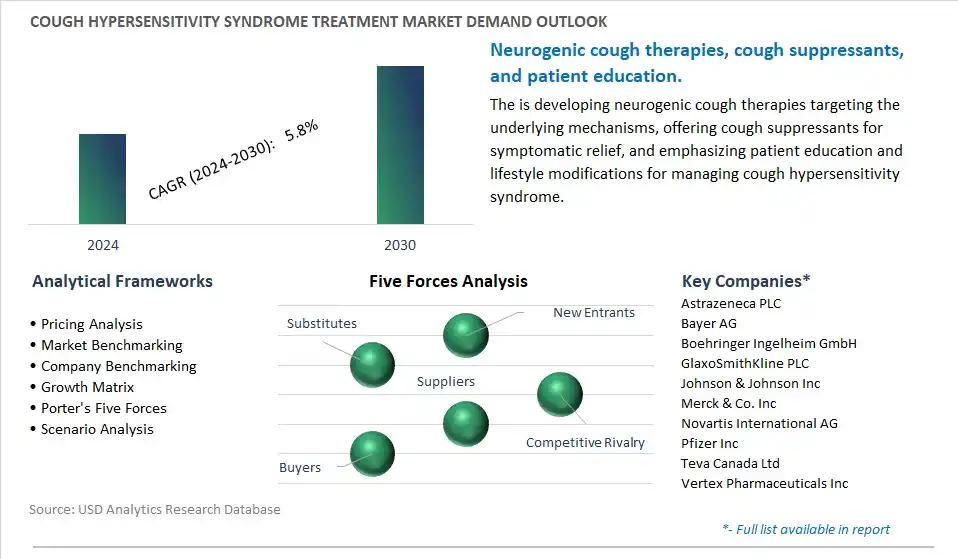
Cough Hypersensitivity Syndrome Treatment Market is estimated to increase at a Compounded Annual Growth Rate of 5.8% CAGR over the forecast period from 2024 to 2030
The Cough Hypersensitivity Syndrome Treatment Market study analyzes and forecasts the market size across 6 regions and 24 countries for diverse segments- By Drug Class (Antitussive Agents, Inhaled Corticosteroids (ICS), Short Acting Beta2-Agonists (SABA), Anti-cholinergics, Antihistamines, Proton Pump Inhibitors, Others), By End-User (Hospital Pharmacies, Retail Pharmacies, Online Pharmacies).
An Introduction to Cough Hypersensitivity Syndrome Treatment Market in 2024
In 2024, the market for cough hypersensitivity syndrome treatment addresses the therapeutic needs of individuals suffering from chronic cough, a common respiratory symptom characterized by persistent coughing without an underlying respiratory infection or airway obstruction. Cough hypersensitivity syndrome, also known as chronic refractory cough or sensory neuropathic cough, involves heightened cough reflex sensitivity and aberrant sensory processing in the cough pathways of the central nervous system, leading to frequent, persistent coughing episodes that significantly impact quality of life and functional impairment. Treatment approaches for cough hypersensitivity syndrome focus on addressing underlying mechanisms of cough hypersensitivity, reducing cough frequency and severity, and improving patient symptom control and quality of life. Therapeutic interventions may include cough suppressants, neuromodulators, behavioral therapies, and cough reflex desensitization techniques, tailored to individual patient needs, comorbidities, and treatment response. With a focus on multidisciplinary care, patient education, and symptom management, cough hypersensitivity syndrome treatment aims to alleviate cough-related distress, improve sleep quality, and restore respiratory health and well-being in individuals affected by this challenging respiratory condition.
Market Trend: Focus on Targeted Therapies for Cough Hypersensitivity Syndrome
A significant trend in the Cough Hypersensitivity Syndrome Treatment market is the increasing focus on targeted therapies. As our understanding of cough hypersensitivity syndrome (CHS) deepens, there's a growing recognition of the need for treatments that specifically target the underlying mechanisms driving hypersensitive cough reflexes. Pharmaceutical companies and researchers are exploring novel drug targets, such as neurogenic inflammation, sensory nerve pathways, and central nervous system modulation, to develop more effective and selective therapies for CHS. This trend reflects a shift away from symptomatic relief towards disease-modifying treatments aimed at addressing the root cause of cough hypersensitivity, thereby improving patient outcomes and quality of life.
Market Driver: Rising Prevalence and Awareness of Chronic Cough Conditions
An important driver fueling the Cough Hypersensitivity Syndrome Treatment market is the rising prevalence and awareness of chronic cough conditions. Chronic cough, characterized by persistent coughing lasting for more than eight weeks, is a common symptom of various underlying conditions, including CHS, asthma, gastroesophageal reflux disease (GERD), and postnasal drip. As awareness of chronic cough as a distinct clinical entity grows among healthcare professionals and the general population, there's an increasing demand for effective treatments to manage this debilitating symptom. The prevalence of chronic cough is also on the rise due to factors such as aging populations, environmental pollutants, and lifestyle habits, driving the need for targeted therapies and personalized treatment approaches to address the diverse etiologies contributing to chronic cough syndromes.
Market Opportunity: Development of Novel Therapeutics and Personalized Treatment Approaches
A significant opportunity within the Cough Hypersensitivity Syndrome Treatment market lies in the development of novel therapeutics and personalized treatment approaches. With the complex and multifactorial nature of CHS, there's a need for innovative drugs and therapies that target specific pathophysiological pathways involved in cough hypersensitivity. Opportunities exist for pharmaceutical companies to invest in research and development efforts aimed at identifying new drug targets, repurposing existing medications, and developing innovative formulations, such as inhalable therapies or targeted biologics, for the treatment of CHS. Additionally, personalized treatment approaches, including biomarker testing, phenotyping, and individualized treatment algorithms, can help optimize therapeutic outcomes and improve patient response rates. By addressing the unmet needs of patients with CHS through the development of novel therapeutics and personalized treatment strategies, stakeholders in the Cough Hypersensitivity Syndrome Treatment market can capitalize on the opportunity to make significant contributions to improving cough management and enhancing patient quality of life.
Cough Hypersensitivity Syndrome Treatment Market Share Analysis: Antitussive Agents
Among the various drug classes in the cough hypersensitivity syndrome treatment market, antitussive agents are experiencing the fastest growth. Antitussive agents are medications specifically designed to suppress or relieve coughing, providing symptomatic relief for individuals with cough hypersensitivity syndrome. The rapid growth of antitussive agents in the market can be attributed to several factors. Firstly, cough hypersensitivity syndrome, characterized by a heightened sensitivity of the cough reflex, is increasingly recognized as a distinct clinical entity that significantly impacts patients' quality of life. Antitussive agents offer targeted relief from cough symptoms by suppressing the urge to cough, reducing cough frequency and severity, and improving overall respiratory comfort. Secondly, the availability of a diverse range of antitussive medications, including both prescription and over-the-counter formulations, provides flexibility and choice for patients and healthcare providers in selecting the most appropriate treatment option based on individual preferences and clinical considerations. Antitussive agents may include opioid and non-opioid medications, such as codeine, dextromethorphan, and benzonatate, as well as combination formulations with other cough-relieving ingredients. Additionally, advancements in pharmaceutical research and development have led to the introduction of novel antitussive agents with improved efficacy, safety profiles, and tolerability, addressing the unmet needs of patients with cough hypersensitivity syndrome. These advancements include the development of targeted therapies that selectively modulate cough pathways and receptors, providing more precise and effective symptom control. Furthermore, the expanding distribution channels for pharmaceutical products, including hospital pharmacies, retail pharmacies, and online pharmacies, enhance the accessibility and availability of antitussive agents to patients with cough hypersensitivity syndrome, facilitating timely treatment initiation and management. As a result, antitussive agents emerge in the cough hypersensitivity syndrome treatment market, offering significant opportunities for pharmaceutical companies, healthcare providers, and patients seeking effective symptomatic relief from cough symptoms associated with cough hypersensitivity syndrome.
Cough Hypersensitivity Syndrome Treatment Competitive Analysis
The market research study provides in-depth insights into leading companies including the SWOT analyses, product profile, financial details, and recent developments acrossAstrazeneca PLC, Bayer AG, Boehringer Ingelheim GmbH, GlaxoSmithKline PLC, Johnson & Johnson Inc, Merck & Co. Inc, Novartis International AG, Pfizer Inc, Teva Canada Ltd, Vertex Pharmaceuticals Inc
Cough Hypersensitivity Syndrome Treatment Market Segmentation
By Drug Class
Antitussive Agents
Inhaled Corticosteroids (ICS)
Short Acting Beta2-Agonists (SABA)
Anti-cholinergics
Antihistamines
Proton Pump Inhibitors
Others
By End-User
Hospital Pharmacies
Retail Pharmacies
Online Pharmacies
Geographical Analysis
North America (United States, Canada, Mexico)
Europe (Germany, France, United Kingdom, Spain, Italy, Rest of Europe)
Asia Pacific (China, India, Japan, South Korea, Rest of Asia Pacific)
South America (Brazil, Argentina, Rest of South America)
Middle East and Africa (Saudi Arabia, UAE, Rest of Middle East, South Africa, Egypt, Rest of Africa)
Cough Hypersensitivity Syndrome Treatment Market Companies
Astrazeneca PLC
Bayer AG
Boehringer Ingelheim GmbH
GlaxoSmithKline PLC
Johnson & Johnson Inc
Merck & Co. Inc
Novartis International AG
Pfizer Inc
Teva Canada Ltd
Vertex Pharmaceuticals Inc
Reasons to Buy the Cough Hypersensitivity Syndrome Treatment Market Study
• Deepen your industry insights and navigate uncertainties for strategy formulation, CAPEX, and Operational decisions
• Gain access to detailed insights on the Cough Hypersensitivity Syndrome Treatment Market, encompassing current market size, growth trends, and forecasts till 2030.
• Access detailed competitor analysis, enabling competitive advantage through a thorough understanding of market players, strategies, and potential differentiation opportunities
• Stay ahead of the curve with insights on technological advancements, innovations, and upcoming trends
• Identify lucrative investment avenues and expansion opportunities within the Cough Hypersensitivity Syndrome Treatment Market industry, guided by robust, data-backed analysis.
• Understand regional and global markets through country-wise analysis, regional market potential, regulatory nuances, and dynamics
• Execute strategies with confidence and speed through information, analytics, and insights on the industry value chain
• Corporate leaders, strategists, financial experts, shareholders, asset managers, and governmental representatives can make long-term planning scenarios and build an integrated and timely understanding of market dynamics
• Benefit from tailored solutions and expert consultation based on report insights, providing personalized strategies aligned with specific business needs.
TABLE OF CONTENTS
1 Introduction to 2024 Cough Hypersensitivity Syndrome Treatment Market
1.1 Market Overview
1.2 Quick Facts
1.3 Scope/Objective of the Study
1.4 Market Definition
1.5 Countries and Regions Covered
1.6 Units, Currency, and Conversions
1.7 Industry Value Chain
2 Research Methodology
2.1 Market Size Estimation
2.2 Sources and Research Methodology
2.3 Data Triangulation
2.4 Assumptions and Limitations
3 Executive Summary
3.1 Global Cough Hypersensitivity Syndrome Treatment Market Size Outlook, $ Million, 2021 to 2030
3.2 Cough Hypersensitivity Syndrome Treatment Market Outlook by Type, $ Million, 2021 to 2030
3.3 Cough Hypersensitivity Syndrome Treatment Market Outlook by Product, $ Million, 2021 to 2030
3.4 Cough Hypersensitivity Syndrome Treatment Market Outlook by Application, $ Million, 2021 to 2030
3.5 Cough Hypersensitivity Syndrome Treatment Market Outlook by Key Countries, $ Million, 2021 to 2030
4 Market Dynamics
4.1 Key Driving Forces of Cough Hypersensitivity Syndrome Treatment Industry
4.2 Key Market Trends in Cough Hypersensitivity Syndrome Treatment Industry
4.3 Potential Opportunities in Cough Hypersensitivity Syndrome Treatment Industry
4.4 Key Challenges in Cough Hypersensitivity Syndrome Treatment Industry
5 Market Factor Analysis
5.1 Value Chain Analysis
5.2 Competitive Landscape
5.2.1 Global Cough Hypersensitivity Syndrome Treatment Market Share by Company (%), 2023
5.2.2 Product Offerings by Company
5.3 Porter’s Five Forces Analysis
5.4 Pricing Analysis and Outlook
6 Growth Outlook Across Scenarios
6.1 Growth Analysis-Case Scenario Definitions
6.2 Low Growth Scenario Forecasts
6.3 Reference Growth Scenario Forecasts
6.4 High Growth Scenario Forecasts
7 Global Cough Hypersensitivity Syndrome Treatment Market Outlook by Segments
7.1 Cough Hypersensitivity Syndrome Treatment Market Outlook by Segments, $ Million, 2021- 2030
By Drug Class
Antitussive Agents
Inhaled Corticosteroids (ICS)
Short Acting Beta2-Agonists (SABA)
Anti-cholinergics
Antihistamines
Proton Pump Inhibitors
Others
By End-User
Hospital Pharmacies
Retail Pharmacies
Online Pharmacies
8 North America Cough Hypersensitivity Syndrome Treatment Market Analysis and Outlook To 2030
8.1 Introduction to North America Cough Hypersensitivity Syndrome Treatment Markets in 2024
8.2 North America Cough Hypersensitivity Syndrome Treatment Market Size Outlook by Country, 2021-2030
8.2.1 United States
8.2.2 Canada
8.2.3 Mexico
8.3 North America Cough Hypersensitivity Syndrome Treatment Market size Outlook by Segments, 2021-2030
By Drug Class
Antitussive Agents
Inhaled Corticosteroids (ICS)
Short Acting Beta2-Agonists (SABA)
Anti-cholinergics
Antihistamines
Proton Pump Inhibitors
Others
By End-User
Hospital Pharmacies
Retail Pharmacies
Online Pharmacies
9 Europe Cough Hypersensitivity Syndrome Treatment Market Analysis and Outlook To 2030
9.1 Introduction to Europe Cough Hypersensitivity Syndrome Treatment Markets in 2024
9.2 Europe Cough Hypersensitivity Syndrome Treatment Market Size Outlook by Country, 2021-2030
9.2.1 Germany
9.2.2 France
9.2.3 Spain
9.2.4 United Kingdom
9.2.4 Italy
9.2.5 Russia
9.2.6 Norway
9.2.7 Rest of Europe
9.3 Europe Cough Hypersensitivity Syndrome Treatment Market Size Outlook by Segments, 2021-2030
By Drug Class
Antitussive Agents
Inhaled Corticosteroids (ICS)
Short Acting Beta2-Agonists (SABA)
Anti-cholinergics
Antihistamines
Proton Pump Inhibitors
Others
By End-User
Hospital Pharmacies
Retail Pharmacies
Online Pharmacies
10 Asia Pacific Cough Hypersensitivity Syndrome Treatment Market Analysis and Outlook To 2030
10.1 Introduction to Asia Pacific Cough Hypersensitivity Syndrome Treatment Markets in 2024
10.2 Asia Pacific Cough Hypersensitivity Syndrome Treatment Market Size Outlook by Country, 2021-2030
10.2.1 China
10.2.2 India
10.2.3 Japan
10.2.4 South Korea
10.2.5 Indonesia
10.2.6 Malaysia
10.2.7 Australia
10.2.8 Rest of Asia Pacific
10.3 Asia Pacific Cough Hypersensitivity Syndrome Treatment Market size Outlook by Segments, 2021-2030
By Drug Class
Antitussive Agents
Inhaled Corticosteroids (ICS)
Short Acting Beta2-Agonists (SABA)
Anti-cholinergics
Antihistamines
Proton Pump Inhibitors
Others
By End-User
Hospital Pharmacies
Retail Pharmacies
Online Pharmacies
11 South America Cough Hypersensitivity Syndrome Treatment Market Analysis and Outlook To 2030
11.1 Introduction to South America Cough Hypersensitivity Syndrome Treatment Markets in 2024
11.2 South America Cough Hypersensitivity Syndrome Treatment Market Size Outlook by Country, 2021-2030
11.2.1 Brazil
11.2.2 Argentina
11.2.3 Rest of South America
11.3 South America Cough Hypersensitivity Syndrome Treatment Market size Outlook by Segments, 2021-2030
By Drug Class
Antitussive Agents
Inhaled Corticosteroids (ICS)
Short Acting Beta2-Agonists (SABA)
Anti-cholinergics
Antihistamines
Proton Pump Inhibitors
Others
By End-User
Hospital Pharmacies
Retail Pharmacies
Online Pharmacies
12 Middle East and Africa Cough Hypersensitivity Syndrome Treatment Market Analysis and Outlook To 2030
12.1 Introduction to Middle East and Africa Cough Hypersensitivity Syndrome Treatment Markets in 2024
12.2 Middle East and Africa Cough Hypersensitivity Syndrome Treatment Market Size Outlook by Country, 2021-2030
12.2.1 Saudi Arabia
12.2.2 UAE
12.2.3 Oman
12.2.4 Rest of Middle East
12.2.5 Egypt
12.2.6 Nigeria
12.2.7 South Africa
12.2.8 Rest of Africa
12.3 Middle East and Africa Cough Hypersensitivity Syndrome Treatment Market size Outlook by Segments, 2021-2030
By Drug Class
Antitussive Agents
Inhaled Corticosteroids (ICS)
Short Acting Beta2-Agonists (SABA)
Anti-cholinergics
Antihistamines
Proton Pump Inhibitors
Others
By End-User
Hospital Pharmacies
Retail Pharmacies
Online Pharmacies
13 Company Profiles
13.1 Company Snapshot
13.2 SWOT Profiles
13.3 Products and Services
13.4 Recent Developments
13.5 Financial Profile
List of Companies
Astrazeneca PLC
Bayer AG
Boehringer Ingelheim GmbH
GlaxoSmithKline PLC
Johnson & Johnson Inc
Merck & Co. Inc
Novartis International AG
Pfizer Inc
Teva Canada Ltd
Vertex Pharmaceuticals Inc
14 Appendix
14.1 Customization Offerings
14.2 Subscription Services
14.3 Related Reports
14.4 Publisher Expertise
By Drug Class
Antitussive Agents
Inhaled Corticosteroids (ICS)
Short Acting Beta2-Agonists (SABA)
Anti-cholinergics
Antihistamines
Proton Pump Inhibitors
Others
By End-User
Hospital Pharmacies
Retail Pharmacies
Online Pharmacies
Countries Analyzed
North America (United States, Canada, Mexico)
Europe (Germany, France, United Kingdom, Spain, Italy, Rest of Europe)
Asia Pacific (China, India, Japan, South Korea, Rest of Asia Pacific)
South America (Brazil, Argentina, Rest of South America)
Middle East and Africa (Saudi Arabia, UAE, Rest of Middle East, South Africa, Egypt, Rest of Africa)
