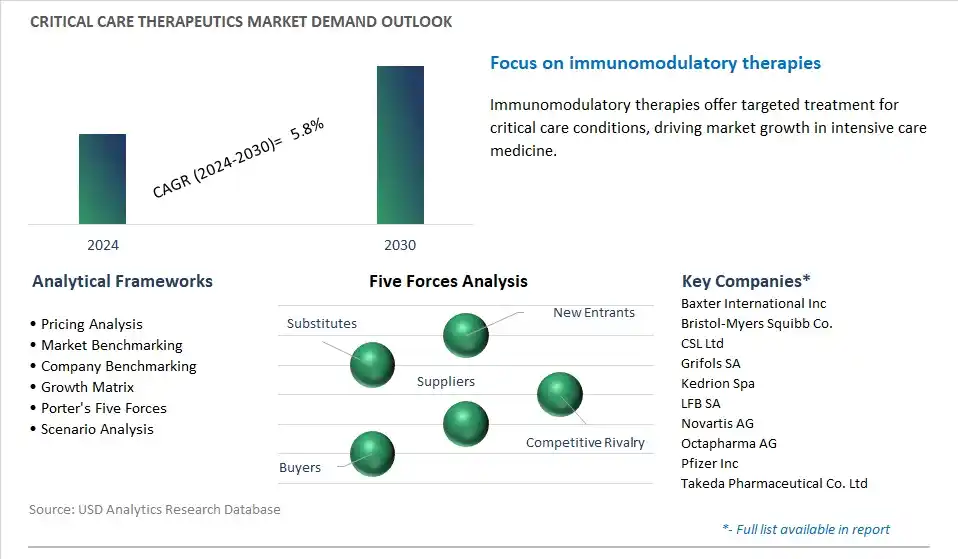
Critical Care Therapeutics Market is estimated to increase at a growth rate of 5.8% CAGR over the forecast period from 2024 to 2030.
The global Critical Care Therapeutics Market Study analyzes and forecasts the market size across 6 regions and 24 countries for diverse segments including By Drug Class (Albumin, Antithrombin, Prothrombin Complex, Factor Xiii, Fibrinogen).
An Introduction to Critical Care Therapeutics Market in 2024
The Critical Care Therapeutics Market encompasses pharmaceuticals and biologics used for the treatment of life-threatening conditions, severe infections, organ failure, trauma, and medical emergencies in critical care settings such as intensive care units (ICUs), emergency departments, and critical care transport. Critical care therapeutics include antibiotics, antivirals, antifungals, vasopressors, sedatives, analgesics, immunomodulators, blood products, and respiratory therapies, aiming to stabilize vital functions, support organ systems, and improve patient outcomes in critically ill patients. Market growth is driven by the rising incidence of critical illnesses, demand for emergency and intensive care treatments, advancements in critical care medicine, and the development of targeted therapies for complex medical conditions.
Critical Care Therapeutics Market Competitive Landscape
The global Critical Care Therapeutics Industry is highly competitive with a large number of companies focusing on niche market segments. Amidst intense competitive conditions, Critical Care Therapeutics Companies are investing in new product launches and strengthening distribution channels. Key companies operating in the Critical Care Therapeutics Industry include- Baxter International Inc, Bristol-Myers Squibb Co., CSL Ltd, Grifols SA, Kedrion Spa, LFB SA, Novartis AG, Octapharma AG, Pfizer Inc, Takeda Pharmaceutical Co. Ltd.
Critical Care Therapeutics Market Trend: Increased Focus on Precision Medicine and Personalized Treatment
A prominent trend in the critical care therapeutics market is the increased focus on precision medicine and personalized treatment approaches, driven by advancements in pharmacogenomics, biomarker discovery, and targeted drug development. Critical care conditions often require urgent and tailored interventions to address individual patient needs, considering factors such as genetic variability, comorbidities, and pharmacokinetics/pharmacodynamics. Pharmaceutical companies are investing in research and development of novel therapeutics that target specific molecular pathways implicated in critical illnesses, such as sepsis, acute respiratory distress syndrome (ARDS), and multi-organ failure. Additionally, the integration of data analytics and artificial intelligence enables healthcare providers to analyze patient data in real-time, identify predictive biomarkers, and optimize therapeutic strategies for improved outcomes. As precision medicine approaches gain traction in critical care settings, there is growing demand for innovative therapeutics that offer personalized treatment options, driving market growth and innovation in critical care therapeutics.
Critical Care Therapeutics Market Driver: Rising Incidence of Critical Illnesses and Intensive Care Unit Admissions
A key driver propelling the critical care therapeutics market is the rising incidence of critical illnesses and intensive care unit (ICU) admissions worldwide, driven by aging populations, increasing prevalence of chronic diseases, and emerging infectious threats. Critical care encompasses a spectrum of life-threatening conditions that require immediate medical attention and intensive monitoring, including sepsis, respiratory failure, cardiac arrest, and traumatic injuries. The growing burden of critical illness places significant demand on healthcare systems, leading to expanded ICU capacities, advancements in medical technology, and adoption of evidence-based therapeutic interventions. Pharmaceutical companies are developing targeted therapies and supportive care interventions to address the complex needs of critically ill patients, aiming to improve survival rates, reduce complications, and enhance quality of life in the ICU. Additionally, healthcare providers are implementing multidisciplinary approaches, early intervention protocols, and quality improvement initiatives to optimize critical care delivery and patient outcomes. As the prevalence of critical illnesses continues to rise, there is increasing demand for effective therapeutics and supportive care solutions, driving market growth and investment in critical care therapeutics.
Critical Care Therapeutics Market Opportunity: Development of Innovative Biomarker-Based Therapeutics
An emerging opportunity in the critical care therapeutics market lies in the development of innovative biomarker-based therapeutics for early diagnosis, risk stratification, and targeted treatment of critical illnesses. Biomarkers play a crucial role in identifying patients at high risk of adverse outcomes, monitoring disease progression, and guiding therapeutic interventions in critical care settings. Pharmaceutical companies and biotech startups are leveraging advances in molecular diagnostics, proteomics, and genomics to discover and validate novel biomarkers associated with critical illnesses, inflammatory responses, organ dysfunction, and treatment response. By integrating biomarker data with clinical parameters and predictive analytics, researchers can develop precision medicine approaches that tailor treatment regimens to individual patient profiles, optimize drug dosing, and minimize adverse effects. Additionally, the identification of biomarker signatures for specific critical care syndromes, such as sepsis, acute kidney injury, and acute respiratory distress syndrome, presents opportunities for targeted drug development and clinical trial design. By capitalizing on biomarker-based therapeutics, companies can differentiate their product portfolios, accelerate regulatory approval, and address unmet needs in critical care management, contributing to improved patient outcomes and healthcare efficiency.
Market Share Analysis: Albumin for Critical Care Therapeutics is the fastest growing segment in the Critical Care Therapeutics industry
Among critical care therapeutics drug classes, albumin emerges as the fastest-growing segment. This growth can be attributed to the essential role albumin plays in maintaining plasma volume and oncotic pressure, crucial for stabilizing patients with critical conditions such as sepsis, shock, and liver disease. Albumin administration is integral in managing hypovolemia and improving tissue perfusion, thereby enhancing patient outcomes in critical care settings. Additionally, advancements in albumin formulations and increased understanding of its therapeutic benefits have contributed to its growing adoption in critical care protocols. With the rising incidence of complex medical conditions requiring intensive care interventions and the emphasis on evidence-based treatment strategies, the demand for albumin as a critical care therapeutic is projected to continue rising steadily, driving significant growth in this segment of the pharmaceutical market.
Critical Care Therapeutics Market Segmentation
By Drug Class
Albumin
Antithrombin
Prothrombin Complex
Factor Xiii
Fibrinogen
Geographical Analysis
North America (United States, Canada, Mexico)
Europe (Germany, France, United Kingdom, Spain, Italy, Rest of Europe)
Asia Pacific (China, India, Japan, South Korea, Rest of Asia Pacific)
South America (Brazil, Argentina, Rest of South America)
Middle East and Africa (Saudi Arabia, UAE, Rest of Middle East, South Africa, Egypt, Rest of Africa)
Critical Care Therapeutics Companies
Baxter International Inc
Bristol-Myers Squibb Co.
CSL Ltd
Grifols SA
Kedrion Spa
LFB SA
Novartis AG
Octapharma AG
Pfizer Inc
Takeda Pharmaceutical Co. Ltd
* List not Exhaustive
Reasons to Buy the Critical Care Therapeutics Market Study
• Deepen your industry insights and navigate uncertainties for strategy formulation, CAPEX, and Operational decisions
• Gain access to detailed insights on the Critical Care Therapeutics Market, encompassing current market size, growth trends, and forecasts till 2030.
• Access detailed competitor analysis, enabling competitive advantage through a thorough understanding of market players, strategies, and potential differentiation opportunities
• Stay ahead of the curve with insights on technological advancements, innovations, and upcoming trends
• Identify lucrative investment avenues and expansion opportunities within the Critical Care Therapeutics Industry, guided by robust, data-backed analysis.
• Understand regional and global markets through country-wise analysis, regional market potential, regulatory nuances, and dynamics
• Execute strategies with confidence and speed through information, analytics, and insights on the industry value chain
• Corporate leaders, strategists, financial experts, shareholders, asset managers, and governmental representatives can make long-term planning scenarios and build an integrated and timely understanding of market dynamics
• Benefit from tailored solutions and expert consultation based on report insights, providing personalized strategies aligned with specific business needs.
TABLE OF CONTENTS
1 Introduction to 2024 Critical Care Therapeutics Market
1.1 Market Overview
1.2 Quick Facts
1.3 Scope/Objective of the Study
1.4 Market Definition
1.5 Countries and Regions Analyzed
1.6 Units, Currency, and Conversions
1.7 Industry Value Chain
2 Research Methodology
2.1 Market Size Estimation
2.2 Sources and Research Methodology
2.3 Data Triangulation
2.4 Assumptions and Limitations
3 Executive Summary
3.1 Global Critical Care Therapeutics Market Size Outlook, $ Million, 2021 to 2030
3.2 Critical Care Therapeutics Market Outlook by Type, $ Million, 2021 to 2030
3.3 Critical Care Therapeutics Market Outlook by Product, $ Million, 2021 to 2030
3.4 Critical Care Therapeutics Market Outlook by Application, $ Million, 2021 to 2030
3.5 Critical Care Therapeutics Market Outlook by Key Countries, $ Million, 2021 to 2030
4 Market Dynamics
4.1 Key Driving Forces of Critical Care Therapeutics Industry
4.2 Key Market Trends in Critical Care Therapeutics Industry
4.3 Potential Opportunities in Critical Care Therapeutics Industry
4.4 Key Challenges in Critical Care Therapeutics Industry
5 Market Factor Analysis
5.1 Value Chain Analysis
5.2 Competitive Landscape
5.2.1 Global Critical Care Therapeutics Market Share by Company (%), 2023
5.2.2 Product Offerings by Company
5.3 Porter’s Five Forces Analysis
5.4 Pricing Analysis and Outlook
6 Growth Outlook Across Scenarios
6.1 Growth Analysis-Case Scenario Definitions
6.2 Low Growth Scenario Forecasts
6.3 Reference Growth Scenario Forecasts
6.4 High Growth Scenario Forecasts
7 Global Critical Care Therapeutics Market Outlook by Segments
7.1 Critical Care Therapeutics Market Outlook by Segments, $ Million, 2021- 2030
By Drug Class
Albumin
Antithrombin
Prothrombin Complex
Factor Xiii
Fibrinogen
8 North America Critical Care Therapeutics Market Analysis and Outlook To 2030
8.1 Introduction to North America Critical Care Therapeutics Markets in 2024
8.2 North America Critical Care Therapeutics Market Size Outlook by Country, 2021-2030
8.2.1 United States
8.2.2 Canada
8.2.3 Mexico
8.3 North America Critical Care Therapeutics Market size Outlook by Segments, 2021-2030
By Drug Class
Albumin
Antithrombin
Prothrombin Complex
Factor Xiii
Fibrinogen
9 Europe Critical Care Therapeutics Market Analysis and Outlook To 2030
9.1 Introduction to Europe Critical Care Therapeutics Markets in 2024
9.2 Europe Critical Care Therapeutics Market Size Outlook by Country, 2021-2030
9.2.1 Germany
9.2.2 France
9.2.3 Spain
9.2.4 United Kingdom
9.2.4 Italy
9.2.5 Russia
9.2.6 Norway
9.2.7 Rest of Europe
9.3 Europe Critical Care Therapeutics Market Size Outlook by Segments, 2021-2030
By Drug Class
Albumin
Antithrombin
Prothrombin Complex
Factor Xiii
Fibrinogen
10 Asia Pacific Critical Care Therapeutics Market Analysis and Outlook To 2030
10.1 Introduction to Asia Pacific Critical Care Therapeutics Markets in 2024
10.2 Asia Pacific Critical Care Therapeutics Market Size Outlook by Country, 2021-2030
10.2.1 China
10.2.2 India
10.2.3 Japan
10.2.4 South Korea
10.2.5 Indonesia
10.2.6 Malaysia
10.2.7 Australia
10.2.8 Rest of Asia Pacific
10.3 Asia Pacific Critical Care Therapeutics Market size Outlook by Segments, 2021-2030
By Drug Class
Albumin
Antithrombin
Prothrombin Complex
Factor Xiii
Fibrinogen
11 South America Critical Care Therapeutics Market Analysis and Outlook To 2030
11.1 Introduction to South America Critical Care Therapeutics Markets in 2024
11.2 South America Critical Care Therapeutics Market Size Outlook by Country, 2021-2030
11.2.1 Brazil
11.2.2 Argentina
11.2.3 Rest of South America
11.3 South America Critical Care Therapeutics Market size Outlook by Segments, 2021-2030
By Drug Class
Albumin
Antithrombin
Prothrombin Complex
Factor Xiii
Fibrinogen
12 Middle East and Africa Critical Care Therapeutics Market Analysis and Outlook To 2030
12.1 Introduction to Middle East and Africa Critical Care Therapeutics Markets in 2024
12.2 Middle East and Africa Critical Care Therapeutics Market Size Outlook by Country, 2021-2030
12.2.1 Saudi Arabia
12.2.2 UAE
12.2.3 Oman
12.2.4 Rest of Middle East
12.2.5 Egypt
12.2.6 Nigeria
12.2.7 South Africa
12.2.8 Rest of Africa
12.3 Middle East and Africa Critical Care Therapeutics Market size Outlook by Segments, 2021-2030
By Drug Class
Albumin
Antithrombin
Prothrombin Complex
Factor Xiii
Fibrinogen
13 Company Profiles
13.1 Company Snapshot
13.2 SWOT Profiles
13.3 Products and Services
13.4 Recent Developments
13.5 Financial Profile
List of Companies
Baxter International Inc
Bristol-Myers Squibb Co.
CSL Ltd
Grifols SA
Kedrion Spa
LFB SA
Novartis AG
Octapharma AG
Pfizer Inc
Takeda Pharmaceutical Co. Ltd
14 Appendix
14.1 Customization Offerings
14.2 Subscription Services
14.3 Related Reports
14.4 Publisher Expertise
