The global Crop Oil Concentrates Market is poised to register a 4.3% CAGR from $234 Million in 2024 to $301.2 Million in 2030.
The global Crop Oil Concentrates Market Study analyzes and forecasts the market size across 6 regions and 24 countries for diverse segments -By Application (Herbicides, Insecticides, Fungicides, Others), By Crop (Cereals & grains, Oilseeds & pulses, Fruits & vegetables, Others), By Surfactant Concentration (Less than 15%, Between 15% and 25%, Greater than 25%).
An Introduction to Global Crop Oil Concentrates Market in 2024
The market for crop oil concentrates (COCs) is experiencing growth, driven by the increasing demand for effective adjuvants to enhance the performance of agrochemicals such as herbicides, insecticides, and fungicides in crop protection and management. Key trends shaping the future of the industry include advancements in formulation chemistry, emulsification technology, and sustainability initiatives to meet the evolving needs of farmers for safe, efficient, and environmentally friendly crop oil concentrates. Manufacturers are focusing on developing COCs with improved spreading, wetting, and penetration properties to enhance the efficacy and uptake of pesticides on plant surfaces while minimizing off-target drift, runoff, and environmental impact. Additionally, there is a growing emphasis on eco-friendly ingredients, biodegradable solvents, and low-VOC (volatile organic compound) formulations in COC production, driven by regulatory pressures, consumer preferences, and sustainability goals. Moreover, advancements in precision agriculture, digital farming, and integrated pest management are driving innovation in crop oil concentrates, enabling farmers to optimize spray applications, reduce pesticide usage, and maximize crop yields while minimizing environmental risks and ecological footprint. Furthermore, collaborations between agrochemical companies, research institutions, and agricultural extension services are shaping the development of best practices, application guidelines, and stewardship programs that promote responsible use, proper handling, and effective management of crop oil concentrates in sustainable crop production systems. Overall, the future of crop oil concentrates lies in continuous innovation, collaboration, and sustainability initiatives to address emerging market needs, regulatory requirements, and environmental concerns while supporting the productivity, profitability, and sustainability of agriculture worldwide.
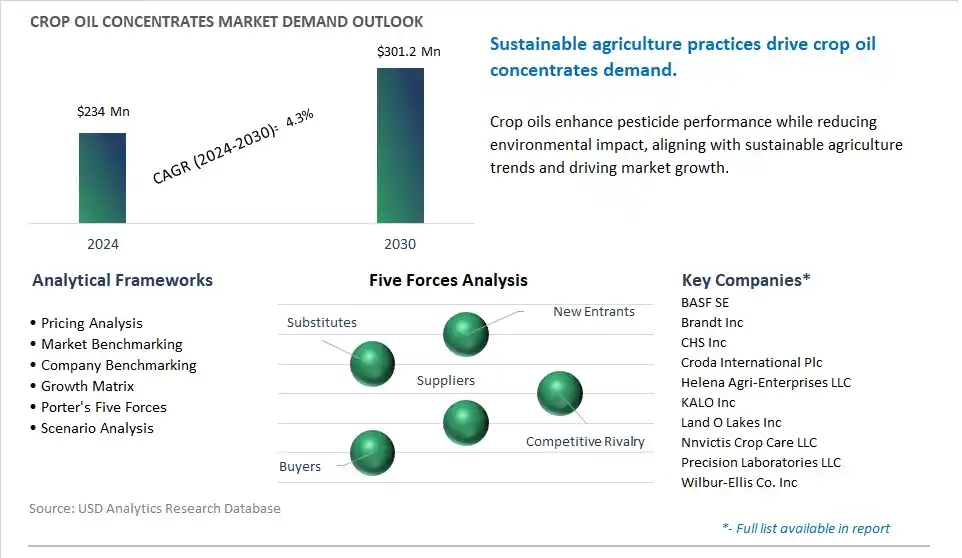
Crop Oil Concentrates Market Competitive Landscape
The market report analyses the leading companies in the industry including BASF SE, Brandt Inc, CHS Inc, Croda International Plc, Helena Agri-Enterprises LLC, KALO Inc, Land O Lakes Inc, Nnvictis Crop Care LLC, Precision Laboratories LLC, Wilbur-Ellis Co. Inc.
Crop Oil Concentrates Market Dynamics
Crop Oil Concentrates Market Trend: Increasing Adoption of Precision Agriculture Practices
In the Crop Oil Concentrates market, a prominent trend is the increasing adoption of precision agriculture practices. Farmers are increasingly embracing technologies and techniques that enable them to optimize crop yields while minimizing inputs such as pesticides and fertilizers. Crop oil concentrates play a vital role in precision agriculture by enhancing the efficacy of herbicides and pesticides, improving their coverage and penetration into plant tissues. This trend is driven by factors such as the need to improve agricultural productivity to meet growing food demand, environmental concerns related to chemical runoff, and advancements in agricultural machinery and digital farming technologies. As farmers seek to maximize the efficiency and sustainability of their operations, there's a rising market demand for crop oil concentrates that offer superior performance and compatibility with precision application systems, driving growth and innovation in the market.
Crop Oil Concentrates Market Driver: Expansion of Herbicide-Tolerant Crop Cultivation
A significant driver in the Crop Oil Concentrates market is the expansion of herbicide-tolerant crop cultivation. Herbicide-tolerant crops, such as genetically modified varieties engineered to withstand specific herbicides, have gained popularity among farmers due to their ability to control weeds effectively and reduce labor and chemical costs. Crop oil concentrates are commonly used as adjuvants to improve the performance of herbicides, particularly in applications where tank-mix compatibility and drift reduction are essential. This driver is fueled by factors such as the increasing adoption of herbicide-tolerant crop varieties, the prevalence of weed resistance to traditional herbicides, and the desire for simplified weed management practices. As herbicide-tolerant crop acreage continues to expand globally, there's a corresponding market demand for crop oil concentrates that enhance herbicide efficacy and maximize weed control, driving steady demand and investment in the market.
Crop Oil Concentrates Market Opportunity: Development of Eco-friendly Formulations and Adjuvants
A promising opportunity within the Crop Oil Concentrates market lies in the development of eco-friendly formulations and adjuvants. Opportunities exist for manufacturers to innovate and introduce crop oil concentrates that are derived from renewable sources, biodegradable, and environmentally friendly. Additionally, there's potential for growth in the development of adjuvants with enhanced environmental profiles, such as drift reduction agents, spray retention aids, and surfactants that minimize off-target movement and environmental impact. By focusing on sustainability and environmental stewardship, crop oil concentrate manufacturers can differentiate their products in the market, meet regulatory requirements, and address the evolving needs of environmentally conscious farmers, driving market growth and long-term sustainability.
Crop Oil Concentrates Market Share Analysis: The Herbicides generated the highest revenue in 2024
the largest segment in the Crop Oil Concentrates Market is the Herbicides segment. Herbicides are widely used in agriculture to control and manage weed populations, which can compete with crops for resources such as nutrients, water, and sunlight, leading to reduced yields and crop quality. Crop oil concentrates (COCs) are commonly used as adjuvants in herbicide formulations to enhance their effectiveness by improving coverage, penetration, and uptake of the active ingredients into plant tissues. Additionally, COCs help reduce spray drift and increase the rainfastness of herbicides, ensuring their efficacy under various environmental conditions. Due to the widespread adoption of herbicides in modern agriculture and the consistent demand for weed management solutions to optimize crop production, the herbicides segment is the largest in the Crop Oil concentrate market.
Crop Oil Concentrates Market Share Analysis: The Fruits & vegetables segment is poised to register the fastest growth rate (CAGR) over the forecast period to 2030
The fastest-growing segment in the Crop Oil Concentrates Market is the Fruits & vegetables segment. There are Diverse factors contributing to the rapid growth of crop oil concentrates (COCs) in this segment. fruits and vegetables are high-value crops that require effective pest management solutions to ensure optimal yields and quality. COCs are commonly used as adjuvants in pesticide formulations to enhance the performance of insecticides, fungicides, and herbicides applied to fruits and vegetables. They help improve the coverage, penetration, and retention of pesticides on plant surfaces, ensuring better pest control and disease management. Additionally, the growing consumer demand for high-quality, residue-free fruits and vegetables drives the adoption of advanced crop protection technologies, including COCs, to minimize pesticide residues and ensure food safety. Further, the increasing adoption of integrated pest management (IPM) practices and sustainable agriculture techniques further boosts the demand for COCs in fruit and vegetable cultivation, as they help reduce the reliance on synthetic pesticides while maintaining effective pest control. As farmers seek to optimize crop yields, minimize environmental impact, and meet stringent regulatory requirements, the demand for COCs in the fruits and vegetables segment is expected to experience rapid growth, making it the fastest-growing segment in the Crop Oil Concentrates Market.
Crop Oil Concentrates Market Share Analysis: The Greater than 25% surfactant concentration segment is poised to register the fastest growth rate (CAGR) over the forecast period to 2030
The fastest-growing segment in the Crop Oil Concentrates Market is the Greater than 25% surfactant concentration segment. Surfactants play a crucial role in crop oil concentrates (COCs) by reducing surface tension and improving the spreading and wetting of pesticide solutions on plant surfaces. COCs with higher surfactant concentrations (>25%) offer enhanced efficacy and performance compared to those with lower concentrations. They provide superior coverage, penetration, and adhesion of pesticides to plant surfaces, resulting in improved pest control and disease management. Additionally, COCs with higher surfactant concentrations are often formulated with advanced adjuvant technologies and proprietary formulations that enhance the overall performance and compatibility with a wide range of pesticide-active ingredients. Further, as agricultural practices evolve, and farmers seek to optimize crop protection strategies, there is a growing demand for high-performance COCs with greater than 25% surfactant concentration to ensure efficient and reliable pest control while minimizing environmental impact. Therefore, the segment with greater than 25% surfactant concentration is expected to experience rapid growth, making it the fastest-growing segment in the Crop Oil Concentrates Market.
Crop Oil Concentrates Market Report Segmentation
By Application
Herbicides
Insecticides
Fungicides
Others
By Crop
Cereals & grains
Oilseeds & pulses
Fruits & vegetables
Others
By Surfactant Concentration
Less than 15%
Between 15% and 25%
Greater than 25%
Regions Included
North America (US, Canada, Mexico)
Europe (Germany, UK, France, Spain, Italy, Russia, Rest of Europe)
Asia Pacific (China, India, Japan, South Korea, Australia, South East Asia, Rest of Asia)
South America (Brazil, Argentina, Rest of South America)
Middle East and Africa (Saudi Arabia, UAE, Rest of Middle East, South Africa, Egypt, Rest of Africa)
Crop Oil Concentrates Companies Profiled in the Market Study
BASF SE
Brandt Inc
CHS Inc
Croda International Plc
Helena Agri-Enterprises LLC
KALO Inc
Land O Lakes Inc
Nnvictis Crop Care LLC
Precision Laboratories LLC
Wilbur-Ellis Co. Inc
*- List Not Exhaustive
TABLE OF CONTENTS
1 Introduction to 2024 Crop Oil Concentrates Market
1.1 Market Overview
1.2 Quick Facts
1.3 Scope/Objective of the Study
1.4 Market Definition
1.5 Countries and Regions Covered
1.6 Units, Currency, and Conversions
1.7 Industry Value Chain
2 Research Methodology
2.1 Market Size Estimation
2.2 Sources and Research Methodology
2.3 Data Triangulation
2.4 Assumptions and Limitations
3 Executive Summary
3.1 Global Crop Oil Concentrates Market Size Outlook, $ Million, 2021 to 2030
3.2 Crop Oil Concentrates Market Outlook by Type, $ Million, 2021 to 2030
3.3 Crop Oil Concentrates Market Outlook by Product, $ Million, 2021 to 2030
3.4 Crop Oil Concentrates Market Outlook by Application, $ Million, 2021 to 2030
3.5 Crop Oil Concentrates Market Outlook by Key Countries, $ Million, 2021 to 2030
4 Market Dynamics
4.1 Key Driving Forces of Crop Oil Concentrates Industry
4.2 Key Market Trends in Crop Oil Concentrates Industry
4.3 Potential Opportunities in Crop Oil Concentrates Industry
4.4 Key Challenges in Crop Oil Concentrates Industry
5 Market Factor Analysis
5.1 Value Chain Analysis
5.2 Competitive Landscape
5.2.1 Global Crop Oil Concentrates Market Share by Company (%), 2023
5.2.2 Product Offerings by Company
5.3 Porter’s Five Forces Analysis
5.4 Pricing Analysis and Outlook
6 Growth Outlook Across Scenarios
6.1 Growth Analysis-Case Scenario Definitions
6.2 Low Growth Scenario Forecasts
6.3 Reference Growth Scenario Forecasts
6.4 High Growth Scenario Forecasts
7 Global Crop Oil Concentrates Market Outlook by Segments
7.1 Crop Oil Concentrates Market Outlook by Segments, $ Million, 2021- 2030
By Application
Herbicides
Insecticides
Fungicides
Others
By Crop
Cereals & grains
Oilseeds & pulses
Fruits & vegetables
Others
By Surfactant Concentration
Less than 15%
Between 15% and 25%
Greater than 25%
8 North America Crop Oil Concentrates Market Analysis and Outlook To 2030
8.1 Introduction to North America Crop Oil Concentrates Markets in 2024
8.2 North America Crop Oil Concentrates Market Size Outlook by Country, 2021-2030
8.2.1 United States
8.2.2 Canada
8.2.3 Mexico
8.3 North America Crop Oil Concentrates Market size Outlook by Segments, 2021-2030
By Application
Herbicides
Insecticides
Fungicides
Others
By Crop
Cereals & grains
Oilseeds & pulses
Fruits & vegetables
Others
By Surfactant Concentration
Less than 15%
Between 15% and 25%
Greater than 25%
9 Europe Crop Oil Concentrates Market Analysis and Outlook To 2030
9.1 Introduction to Europe Crop Oil Concentrates Markets in 2024
9.2 Europe Crop Oil Concentrates Market Size Outlook by Country, 2021-2030
9.2.1 Germany
9.2.2 France
9.2.3 Spain
9.2.4 United Kingdom
9.2.4 Italy
9.2.5 Russia
9.2.6 Norway
9.2.7 Rest of Europe
9.3 Europe Crop Oil Concentrates Market Size Outlook by Segments, 2021-2030
By Application
Herbicides
Insecticides
Fungicides
Others
By Crop
Cereals & grains
Oilseeds & pulses
Fruits & vegetables
Others
By Surfactant Concentration
Less than 15%
Between 15% and 25%
Greater than 25%
10 Asia Pacific Crop Oil Concentrates Market Analysis and Outlook To 2030
10.1 Introduction to Asia Pacific Crop Oil Concentrates Markets in 2024
10.2 Asia Pacific Crop Oil Concentrates Market Size Outlook by Country, 2021-2030
10.2.1 China
10.2.2 India
10.2.3 Japan
10.2.4 South Korea
10.2.5 Indonesia
10.2.6 Malaysia
10.2.7 Australia
10.2.8 Rest of Asia Pacific
10.3 Asia Pacific Crop Oil Concentrates Market size Outlook by Segments, 2021-2030
By Application
Herbicides
Insecticides
Fungicides
Others
By Crop
Cereals & grains
Oilseeds & pulses
Fruits & vegetables
Others
By Surfactant Concentration
Less than 15%
Between 15% and 25%
Greater than 25%
11 South America Crop Oil Concentrates Market Analysis and Outlook To 2030
11.1 Introduction to South America Crop Oil Concentrates Markets in 2024
11.2 South America Crop Oil Concentrates Market Size Outlook by Country, 2021-2030
11.2.1 Brazil
11.2.2 Argentina
11.2.3 Rest of South America
11.3 South America Crop Oil Concentrates Market size Outlook by Segments, 2021-2030
By Application
Herbicides
Insecticides
Fungicides
Others
By Crop
Cereals & grains
Oilseeds & pulses
Fruits & vegetables
Others
By Surfactant Concentration
Less than 15%
Between 15% and 25%
Greater than 25%
12 Middle East and Africa Crop Oil Concentrates Market Analysis and Outlook To 2030
12.1 Introduction to Middle East and Africa Crop Oil Concentrates Markets in 2024
12.2 Middle East and Africa Crop Oil Concentrates Market Size Outlook by Country, 2021-2030
12.2.1 Saudi Arabia
12.2.2 UAE
12.2.3 Oman
12.2.4 Rest of Middle East
12.2.5 Egypt
12.2.6 Nigeria
12.2.7 South Africa
12.2.8 Rest of Africa
12.3 Middle East and Africa Crop Oil Concentrates Market size Outlook by Segments, 2021-2030
By Application
Herbicides
Insecticides
Fungicides
Others
By Crop
Cereals & grains
Oilseeds & pulses
Fruits & vegetables
Others
By Surfactant Concentration
Less than 15%
Between 15% and 25%
Greater than 25%
13 Company Profiles
13.1 Company Snapshot
13.2 SWOT Profiles
13.3 Products and Services
13.4 Recent Developments
13.5 Financial Profile
BASF SE
Brandt Inc
CHS Inc
Croda International Plc
Helena Agri-Enterprises LLC
KALO Inc
Land O Lakes Inc
Nnvictis Crop Care LLC
Precision Laboratories LLC
Wilbur-Ellis Co. Inc
14 Appendix
14.1 Customization Offerings
14.2 Subscription Services
14.3 Related Reports
14.4 Publisher Expertise
By Application
Herbicides
Insecticides
Fungicides
Others
By Crop
Cereals & grains
Oilseeds & pulses
Fruits & vegetables
Others
By Surfactant Concentration
Less than 15%
Between 15% and 25%
Greater than 25%
Countries Analyzed
North America (US, Canada, Mexico)
Europe (Germany, UK, France, Spain, Italy, Russia, Rest of Europe)
Asia Pacific (China, India, Japan, South Korea, Australia, South East Asia, Rest of Asia)
South America (Brazil, Argentina, Rest of South America)
Middle East and Africa (Saudi Arabia, UAE, Rest of Middle East, South Africa, Egypt, Rest of Africa)
