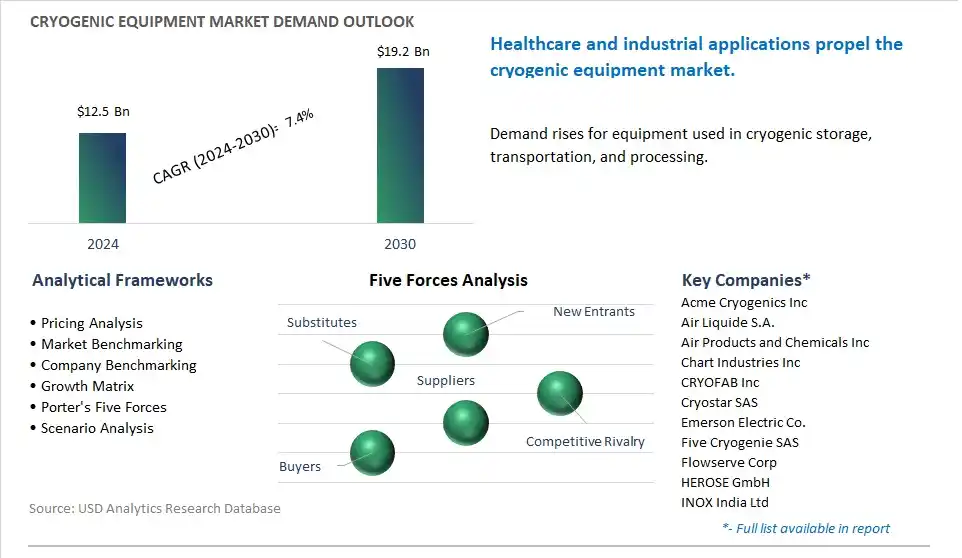
The global Cryogenic Equipment Market is poised to register a 7.4% CAGR from $12.5 Billion in 2024 to $19.2 Billion in 2030.
The global Cryogenic Equipment Market Study analyzes and forecasts the market size across 6 regions and 24 countries for diverse segments -By Equipment (Tanks, Valves, Vaporizers, Pumps, Others), By Cryogen (Nitrogen, Oxygen, Argon, LNG, Hydrogen, Others), By End-User (Metallurgy, Energy & Power, Chemical, Electronics, Transportation, Others), By Application (CASU, Non-CASU), By System (Storage System, Handling System, Supply System, Others).
An Introduction to Global Cryogenic Equipment Market in 2024
The cryogenic equipment market is witnessing significant growth driven by the expanding applications of cryogenics in industries such as healthcare, food processing, electronics, and aerospace. Key trends shaping the future of the industry include the increasing demand for cryogenic storage and transportation solutions for liquefied gases such as nitrogen, oxygen, argon, and LNG (liquefied natural gas). As industries seek to leverage the benefits of cryogenic temperatures for preserving biological samples, processing temperature-sensitive materials, and generating renewable energy, there's a growing need for cryogenic equipment that offers reliability, safety, and energy efficiency. Moreover, advancements in cryogenic insulation, materials science, and cryocooling technologies are driving market expansion by improving thermal performance, system reliability, and operational flexibility of cryogenic equipment. Additionally, the growing investments in LNG infrastructure, cold chain logistics, and space exploration programs are fueling demand for cryogenic storage tanks, vaporizers, and transfer systems in the energy, logistics, and aerospace sectors. Furthermore, the integration of digital monitoring, remote control, and predictive maintenance solutions is enhancing the efficiency, safety, and sustainability of cryogenic operations, driving innovation and market growth in the cryogenic equipment industry.
Cryogenic Equipment Market Competitive Landscape
The market report analyses the leading companies in the industry including Acme Cryogenics Inc, Air Liquide S.A., Air Products and Chemicals Inc, Chart Industries Inc, CRYOFAB Inc, Cryostar SAS, Emerson Electric Co., Five Cryogenie SAS, Flowserve Corp, HEROSE GmbH, INOX India Ltd, Linde plc, Nikkiso Co. Ltd, Parker-Hannifin Corp, PHPK Technologies, Shell-N-Tube, Sulzer Ltd, Sumitomo Heavy Industries Cryogenics Co. Ltd, Taylor-Wharton International LLC, Wessington Cryogenics Ltd.
Cryogenic Equipment Market Dynamics
Cryogenic Equipment Market Trend: Growing Demand for Liquefied Natural Gas (LNG) and Industrial Gases
One prominent trend in the cryogenic equipment market is the growing demand for liquefied natural gas (LNG) and industrial gases. As energy consumption patterns shift towards cleaner fuels and industries expand their use of industrial gases for various applications, there is an increasing need for cryogenic equipment to handle and store these low-temperature fluids. The rise in LNG production and transportation, driven by its cleaner-burning properties and versatility as a fuel source, fuels market demand for cryogenic storage tanks, vaporizers, and other equipment. Additionally, industries such as healthcare, food processing, and electronics rely on cryogenic equipment for the storage and distribution of gases like oxygen, nitrogen, and argon, further contributing to market growth.
Cryogenic Equipment Market Driver: Expansion of Energy Infrastructure and Industrial Facilities
A primary driver shaping the cryogenic equipment market is the expansion of energy infrastructure and industrial facilities globally. With increasing energy demand, population growth, and urbanization, there is a need for investments in LNG terminals, liquefaction plants, and distribution networks to meet growing demand for natural gas as a cleaner energy source. Similarly, industries such as steel manufacturing, chemical processing, and electronics production require cryogenic equipment for the handling, storage, and transport of industrial gases essential for their operations. The driver behind the expansion of energy infrastructure and industrial facilities stimulates market demand for cryogenic equipment as critical components in the supply chain for energy and industrial gases, driving investment in new projects and equipment upgrades.
Cryogenic Equipment Market Opportunity: Innovation in Cryogenic Technologies and Applications
An opportunity within the cryogenic equipment market lies in innovation in cryogenic technologies and applications to address evolving industry needs and market demands. By investing in research and development, companies can develop advanced cryogenic equipment with improved efficiency, safety, and environmental performance. This includes innovations in materials science, insulation technologies, and equipment design to enhance thermal efficiency, reduce heat loss, and minimize environmental impact. Furthermore, there is potential to explore new applications for cryogenic equipment in emerging sectors such as healthcare, biotechnology, and space exploration, where cryogenic temperatures play a crucial role in preserving biological samples, conducting medical procedures, and propelling spacecraft. By seizing opportunities for innovation, companies can differentiate their products, expand market reach, and capitalize on the growing demand for cryogenic equipment in diverse industries and applications.
Cryogenic Equipment Market Share Analysis: Tanks segment generated the highest revenue in the industry
The tanks segment is the largest segment in the Cryogenic Equipment Market due to diverse key factors. The cryogenic tanks are essential components in the storage and transportation of liquefied gases, such as oxygen, nitrogen, argon, and liquefied natural gas (LNG), at extremely low temperatures. These tanks are specifically designed to withstand the extreme conditions associated with cryogenic fluids, including low temperatures and high pressures, ensuring the safe containment and preservation of the liquefied gases. Additionally, cryogenic tanks come in various sizes and configurations to accommodate different storage capacities and applications, ranging from small-scale laboratory storage to large-scale industrial facilities. In addition, the increasing demand for cryogenic gases in various industries such as healthcare, electronics, metallurgy, energy, and food and beverage drives the need for reliable and efficient storage solutions, further boosting the demand for cryogenic tanks. Further, technological advancements in tank design, insulation materials, and safety features have improved the performance, durability, and cost-effectiveness of cryogenic tanks, making them indispensable assets in the cryogenic industry. Additionally, the growing adoption of LNG as a cleaner alternative fuel for transportation and power generation applications has led to significant investments in LNG infrastructure, including storage and transportation facilities, further driving the demand for cryogenic tanks. Over the forecast period, the dominance of the tanks segment in the Cryogenic Equipment Market is attributed to the critical role of cryogenic tanks in the storage and transportation of liquefied gases, their widespread use across various industries, and continuous advancements in tank technology, making them the largest segment in the market.
Cryogenic Equipment Market Share Analysis: LNG Segment is poised to register the fastest growth rate (CAGR) over the forecast period to 2030
The LNG (Liquefied Natural Gas) segment is the fastest-growing segment in the Cryogenic Equipment Market due to diverse compelling reasons. The LNG is gaining increasing traction as a cleaner and more environmentally friendly alternative to traditional fossil fuels such as coal and oil. With growing concerns about climate change and air pollution, there is a global push towards reducing greenhouse gas emissions and transitioning to cleaner energy sources. LNG, which is primarily composed of methane, offers significant environmental benefits, including lower carbon dioxide emissions and reduced air pollutants such as sulfur dioxide and particulate matter compared to conventional fuels. Consequently, there is a surge in LNG production, infrastructure development, and consumption across various sectors, including transportation, power generation, and industrial applications. Secondly, the globalization of LNG trade and the expansion of LNG supply chains have led to the construction of new LNG liquefaction plants, storage facilities, and distribution networks worldwide. These infrastructure projects require advanced cryogenic equipment, including tanks, pumps, valves, and vaporizers, to handle the liquefaction, storage, transportation, and regasification of LNG safely and efficiently. Additionally, technological advancements in LNG processing, liquefaction, and storage technologies have improved the efficiency, reliability, and cost-effectiveness of LNG production and distribution, further driving the demand for cryogenic equipment. Further, supportive government policies, incentives, and investments in LNG infrastructure, particularly in emerging markets, are facilitating the growth of the LNG sector and driving the demand for cryogenic equipment. Over the forecast period, the rapid growth of the LNG segment in the Cryogenic Equipment Market is driven by the increasing demand for clean and sustainable energy, expanding LNG infrastructure, technological advancements, and supportive government policies, positioning it as the fastest-growing segment in the market.
Cryogenic Equipment Market Share Analysis: Energy & Power Segment is poised to register the fastest growth rate (CAGR) over the forecast period to 2030
The Energy & Power segment is the fastest-growing segment in the Cryogenic Equipment Market due to diverse compelling reasons. The there is a growing global demand for clean and sustainable energy sources to reduce greenhouse gas emissions and mitigate climate change. Cryogenic equipment plays a vital role in various energy and power applications, particularly in the production, storage, and distribution of liquefied natural gas (LNG) and liquid hydrogen (LH2). LNG is increasingly being used as a cleaner alternative to traditional fossil fuels in power generation, transportation, and industrial applications, driving the need for cryogenic equipment such as LNG tanks, pumps, valves, and vaporizers. Additionally, liquid hydrogen is gaining attention as a promising energy carrier for fuel cell vehicles, electricity generation, and energy storage applications, necessitating the development of cryogenic infrastructure and equipment for its production, storage, and distribution. Secondly, advancements in cryogenic technologies, including liquefaction processes, insulation materials, and safety systems, have improved the efficiency, reliability, and cost-effectiveness of cryogenic equipment, further driving its adoption in the energy and power sector. In addition, supportive government policies, incentives, and investments in renewable energy, clean transportation, and hydrogen infrastructure are accelerating the deployment of cryogenic equipment in the energy and power industry, fostering market growth. Further, the increasing integration of renewable energy sources such as wind and solar into the power grid necessitates the development of energy storage solutions, where cryogenic energy storage systems, such as liquid air energy storage (LAES), offer promising opportunities for grid-scale energy storage and grid balancing. Over the forecast period, the rapid growth of the Energy & Power segment in the Cryogenic Equipment Market is driven by the transition towards clean and sustainable energy sources, technological advancements, supportive government policies, and the increasing demand for energy storage solutions, positioning it as the fastest-growing segment in the market.
Cryogenic Equipment Market Report Segmentation
By Equipment
Tanks
Valves
Vaporizers
Pumps
Others
By Cryogen
Nitrogen
Oxygen
Argon
LNG
Hydrogen
Others
By End-User
Metallurgy
Energy & Power
Chemical
Electronics
Transportation
Others
By Application
CASU
Non-CASU
By System
Storage System
Handling System
Supply System
Others
Regions Included
North America (US, Canada, Mexico)
Europe (Germany, UK, France, Spain, Italy, Russia, Rest of Europe)
Asia Pacific (China, India, Japan, South Korea, Australia, South East Asia, Rest of Asia)
South America (Brazil, Argentina, Rest of South America)
Middle East and Africa (Saudi Arabia, UAE, Rest of Middle East, South Africa, Egypt, Rest of Africa)
Cryogenic Equipment Companies Profiled in the Market Study
Acme Cryogenics Inc
Air Liquide S.A.
Air Products and Chemicals Inc
Chart Industries Inc
CRYOFAB Inc
Cryostar SAS
Emerson Electric Co.
Five Cryogenie SAS
Flowserve Corp
HEROSE GmbH
INOX India Ltd
Linde plc
Nikkiso Co. Ltd
Parker-Hannifin Corp
PHPK Technologies
Shell-N-Tube
Sulzer Ltd
Sumitomo Heavy Industries Cryogenics Co. Ltd
Taylor-Wharton International LLC
Wessington Cryogenics Ltd
*- List Not Exhaustive
