Data Center Power Distribution and UPS Market Overview: AI Infrastructure Expansion, Critical Power Protection and High-Density Electrical Systems
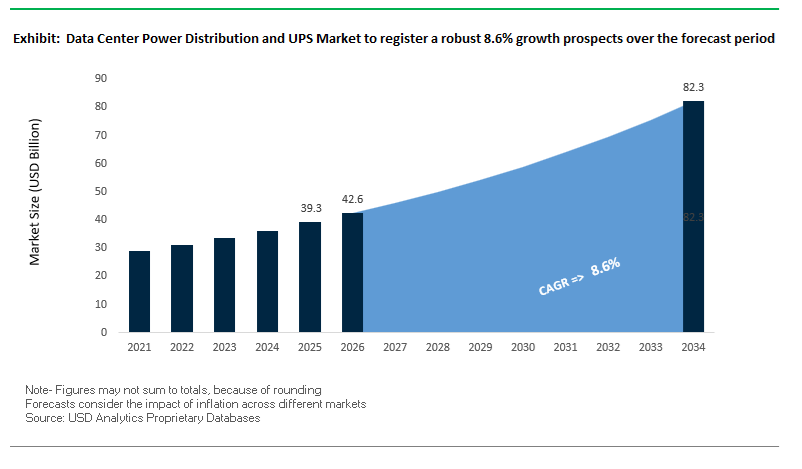
The global Data Center Power Distribution and UPS Market is valued at USD 42.6 billion in 2026 and is projected to reach USD 82.4 billion by 2034, registering a CAGR of 8.6% during the forecast period. The market encompasses electrical infrastructure responsible for distributing, protecting, monitoring and maintaining continuous power delivery across hyperscale data centers, colocation facilities, enterprise data centers and AI computing infrastructure. Major equipment categories include uninterruptible power supply (UPS) systems, medium-voltage and low-voltage switchgear, power distribution units (PDUs), busway systems, static transfer switches, remote power panels and associated electrical distribution equipment. Three-phase online double-conversion UPS systems, modular power protection architectures and battery-backed infrastructure constitute important technology categories, supporting uninterrupted operation of mission-critical computing equipment. Equipment specifications vary according to facility power capacity, electrical redundancy, backup autonomy, load characteristics and distribution architecture, with integrated monitoring and lifecycle service capabilities contributing to supplier differentiation.
The expansion of AI data centers, hyperscale cloud infrastructure and high-performance computing (HPC) is increasing demand for high-capacity electrical distribution and advanced UPS technologies. According to the International Energy Agency, global data center electricity consumption reached approximately 485 TWh in 2025 and is projected to approach 950 TWh by 2030, reflecting substantial growth in computing-related power requirements. AI accelerator clusters introduce rapidly fluctuating electrical loads alongside increasing rack power density, creating additional requirements for UPS transient response, input power smoothing, battery management and upstream grid stability. These operating characteristics are influencing the development of megawatt-scale modular UPS systems, high-current busways, intelligent rack PDUs, medium-voltage distribution networks and advanced power monitoring platforms. Electrical infrastructure is also evolving toward higher-voltage distribution and coordinated power-conversion architectures as AI computing platforms move toward increasingly concentrated power demand.
The competitive structure of the data center critical power infrastructure market includes integrated electrical equipment manufacturers, UPS specialists, power conversion technology providers, switchgear suppliers and data center infrastructure integrators. Commercial differentiation is associated with power conversion efficiency, system availability, redundancy configurations, electrical footprint, modular scalability, battery service life and total cost of ownership (TCO). Hyperscale and AI-focused facilities increasingly incorporate prefabricated power modules, intelligent electrical distribution and coordinated power-cooling infrastructure, while colocation and enterprise operators maintain demand for scalable UPS installations and electrical infrastructure upgrades. The growing application of lithium-ion battery systems, digital condition monitoring and grid-interactive power architectures is broadening competition across equipment supply, commissioning and maintenance services. Regional market development also reflects differences in utility connection capacity, electrical equipment manufacturing availability, data center construction activity and grid infrastructure constraints.
Key Insights: Data Center Power Distribution and UPS Market
- Market Growth: The global market is valued at USD 42.6 billion in 2026 and is projected to reach USD 82.4 billion by 2034, registering an 8.6% CAGR.
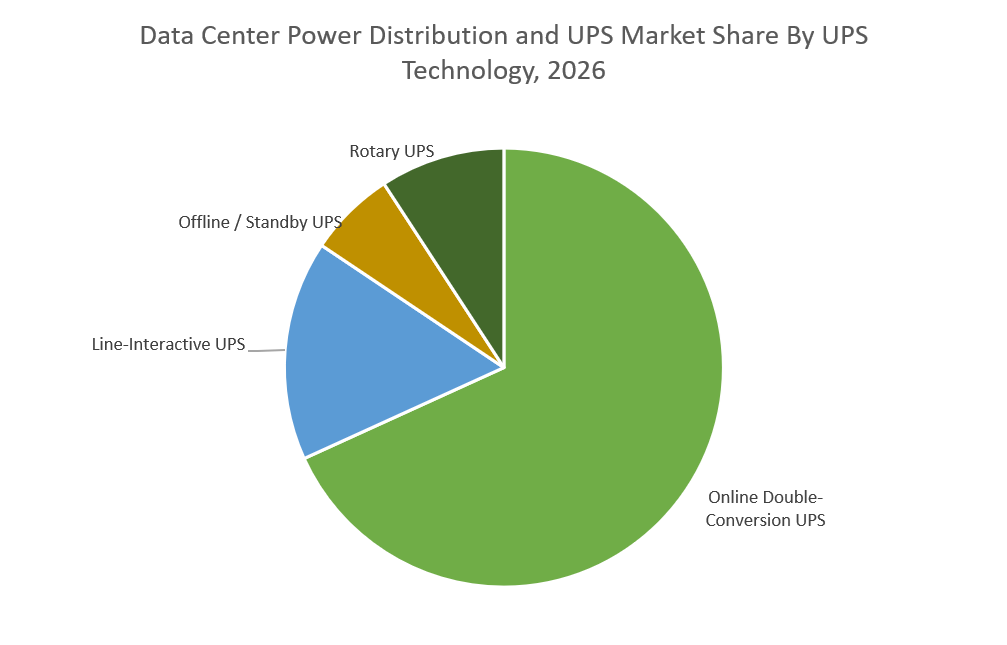
- Leading UPS Technology: Online Double-Conversion UPS dominates critical power protection, supported by high-availability requirements in AI, hyperscale and enterprise data centers.
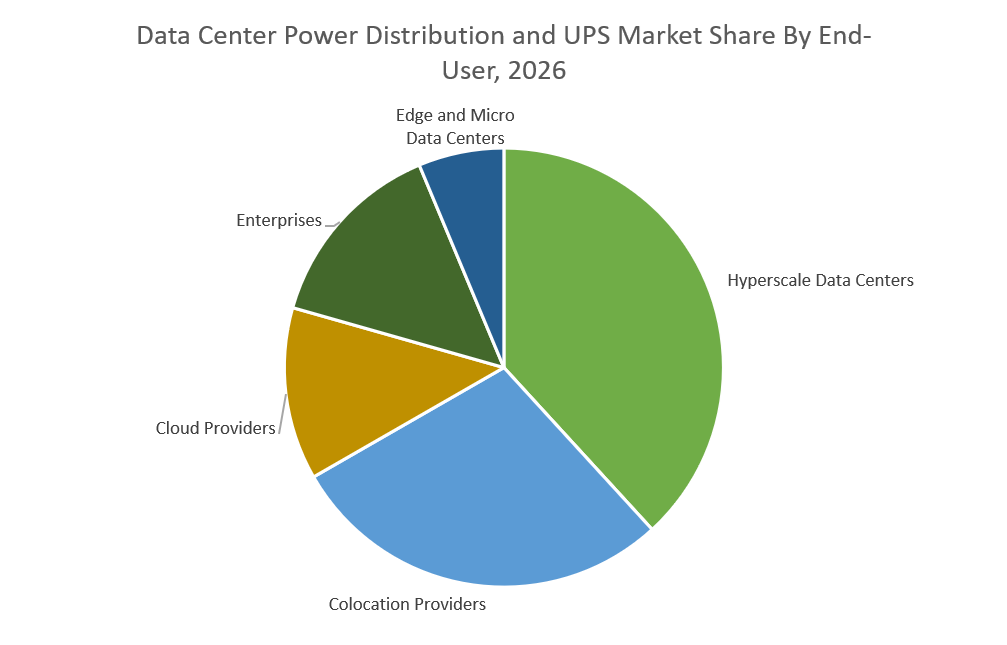
- Largest End-User: Hyperscale Data Centers lead demand, while colocation providers represent another major segment for modular UPS and intelligent power distribution systems.
- Emerging Technology: Megawatt-scale modular UPS systems, software-defined switchgear and 800 V DC power architectures are expanding electrical infrastructure capabilities for AI computing.
- Market Opportunity: Grid-interactive UPS, lithium-ion battery storage and prefabricated power modules are expanding applications in data center resilience, grid integration and electrical infrastructure modernization.
Recent Developments and Company Strategies in the Data Center Power Distribution and UPS Market
Recent developments in the Data Center Power Distribution and UPS Market reflect increasing commercialization of high-density power protection systems, software-defined electrical distribution and prefabricated infrastructure designed for AI computing facilities. In September 2026, Schneider Electric introduced a software-defined medium-voltage switchgear architecture, with a pilot already operating in an Equinix colocation data center. The company reported that its standardized configuration can reduce ordering and manufacturing timelines by up to three times and commissioning time by up to two times compared with conventional engineered-to-order arrangements, based on its published comparative assessment. Schneider Electric also announced the RM AirSeT 38 platform, extending SF₆-free medium-voltage switchgear technology to 38 kV, with initial deliveries planned for 2028. Earlier in September, the company introduced prefabricated electrical power modules offering 2–2.5 MW capacity, incorporating Galaxy VXL UPS technology for hyperscale, neocloud and colocation facilities. These developments highlight competition around electrical infrastructure deployment timelines, power density, equipment standardization and facility expansion flexibility.
Product development in high-capacity uninterruptible power supply systems is increasingly addressing the dynamic electrical characteristics of GPU-intensive AI workloads. In August 2026, Vertiv expanded its PowerUPS 9000 portfolio with a 1.8 MW UPS model, introducing advanced controls for rapid power-load fluctuations and battery availability management. The system incorporates Battery Shield and Input Power Smoothing technologies intended to limit unnecessary battery cycling and stabilize upstream power requirements. In March 2026, ABB expanded its MegaFlex DPA UPS portfolio to cover 1–2 MW configurations, reporting voltage and frequency independent (VFI) efficiency of up to 97.6%. The platform supports modular power protection across hyperscale, colocation and specialized AI cloud infrastructure. These product developments demonstrate increasing emphasis on megawatt-scale UPS capacity, conversion efficiency, intelligent battery management and resilient electrical power delivery rather than UPS capacity expansion alone.
Development of medium-voltage power distribution and high-voltage direct-current architectures is also progressing across the data center electrical infrastructure supply chain. In April 2026, ABB introduced its 34.5 kV HiPerGuard medium-voltage UPS architecture, designed to connect directly to medium-voltage grid infrastructure while reducing intermediate voltage-conversion requirements. The system achieved UL 9540 certification, providing independent safety validation for its integrated energy-storage configuration. During the same month, Siemens expanded its direct-current protection portfolio with semiconductor circuit breakers and solid-state switching technologies for data centers and other high-performance electrical applications. In March 2026, Siemens and Rittal announced a partnership to develop standardized power distribution infrastructure, including next-generation sidecar power racks designed for high-density AI computing environments. These initiatives align with wider industry development of 800 V DC electrical distribution architectures, although full-scale commercialization of NVIDIA's associated infrastructure architecture is targeted from 2027 rather than representing established market-wide adoption in 2026.
Manufacturing capacity expansion and electrical infrastructure integration have become prominent features of supplier activity. In April 2026, Eaton announced more than USD 30 million in manufacturing expenditure for a new 370,000-square-foot medium-voltage switchgear facility near Omaha, Nebraska, with production scheduled to begin in 2027. The project follows Eaton's previously announced expansion of power distribution equipment manufacturing in Virginia. In August 2026, Eaton and Trane Technologies introduced a coordinated electrical and thermal-management reference design aligned with NVIDIA AI Factory architecture, integrating medium-voltage power distribution with facility cooling systems. The companies reported modeled potential improvements in system efficiency, installation costs and copper consumption relative to conventional configurations, with actual performance dependent on project design. In September 2026, Eaton also signed an agreement to acquire COL Group, a European supplier of medium-voltage distribution equipment, SF₆-free switchgear and modular electrical systems. The transaction remained an announced agreement rather than a completed acquisition as of the disclosure.
Corporate portfolio expansion is additionally extending competition into microgrid controls, behind-the-meter electrical infrastructure and integrated power availability services. In September 2026, Vertiv announced an agreement to acquire UtilityInnovation Group for approximately USD 1.45 billion in cash at closing, with additional contingent consideration linked to future performance. The proposed transaction encompasses microgrid controls, onsite generation coordination and specialized switchgear for data center power infrastructure. Alongside these developments, manufacturers are expanding integrated offerings that combine UPS equipment, transformers, power distribution systems, intelligent monitoring and energy-storage interfaces. Competitive activity increasingly encompasses electrical equipment manufacturing capacity, qualification for AI workload characteristics, modular power-system engineering and coordination between data center electrical architecture and utility infrastructure.
Data Center Power Distribution and UPS Market Drivers
AI Data Center Power Density and Dynamic GPU Loads Accelerate High-Capacity UPS Demand
The expansion of AI data centers, hyperscale computing facilities and GPU-intensive workloads is increasing demand for high-capacity uninterruptible power supply (UPS) systems and advanced electrical distribution infrastructure. The International Energy Agency projects global data center electricity consumption to reach approximately 950 TWh by 2030, compared with 485 TWh in 2025, reflecting rising power requirements across accelerated computing environments. AI processor clusters also generate rapid load fluctuations, introducing additional demands on UPS transient response, battery cycling, power conditioning and upstream electrical stability. These operating characteristics are expanding applications for megawatt-scale modular UPS systems, intelligent power distribution units (PDUs), high-current busways and medium-voltage switchgear. Vertiv's PowerUPS 9000 architecture incorporates Input Power Smoothing and Battery Shield technologies to manage variable AI workloads, demonstrating the increasing commercial relevance of dynamic load management, electrical resilience and battery availability in high-density computing facilities.
Grid Connection Constraints and Critical Power Reliability Drive Data Center Electrical Infrastructure Demand
Grid connection limitations, electrical equipment availability and critical power reliability are influencing the development of hyperscale and colocation data center infrastructure. The International Energy Agency estimates that grid constraints could delay approximately 20% of planned global data center capacity additions through 2030 under its assessed scenario. Extended utility connection timelines, transformer supply constraints and localized electricity network congestion affect the scheduling and configuration of large data center projects. At the facility level, demand for redundant UPS architectures, medium-voltage switchgear, transformers, automatic transfer switches and power monitoring systems is associated with high-availability computing operations and service-level commitments. Electrical infrastructure configurations incorporating N+1, 2N and distributed redundancy address different fault-tolerance and maintenance requirements. Equipment lead times, system commissioning, electrical protection coordination and replacement-part availability also influence the commercial positioning of critical power infrastructure suppliers.
Emerging Trends in the Data Center Power Distribution and UPS Market
Modular UPS Systems and Prefabricated Power Distribution Infrastructure Gain Momentum
The Data Center Power Distribution and UPS Market is experiencing increasing commercialization of modular UPS platforms, factory-assembled electrical power modules and high-density distribution systems. Modular architectures accommodate incremental capacity expansion through standardized power blocks, while prefabricated power skids integrate UPS equipment, switchgear, transformers and distribution components within factory-tested assemblies. In September 2026, Schneider Electric introduced prefabricated power modules rated at 2–2.5 MW, with standardized configurations designed for hyperscale, neocloud and colocation facilities. The company reported deployment timelines as short as six months for applicable designs. High-capacity UPS platforms from Vertiv and ABB further demonstrate competition around electrical footprint, power conversion efficiency, redundancy and maintainability. Alongside modular equipment, overhead busway systems and intelligent rack PDUs are expanding distribution flexibility in AI-ready data halls where rack power density, electrical space and phased capacity requirements influence infrastructure configuration.
Selected 2026 High-Capacity UPS and Prefabricated Power Infrastructure
|
Manufacturer / Platform
|
Rated Capacity
|
Key Characteristics
|
|
Vertiv PowerUPS 9000
|
1.8 MW
|
Modular UPS, AI load smoothing, battery protection
|
|
ABB MegaFlex DPA
|
1–2 MW
|
Modular UPS, VFI efficiency up to 97.6%
|
|
Schneider Electric Prefabricated Power Modules
|
2–2.5 MW
|
Factory-integrated electrical infrastructure incorporating Galaxy VXL UPS
|
Source: Official manufacturer specifications and 2026 product announcements. Ratings represent different equipment boundaries; the prefabricated module capacity is not directly comparable with individual UPS ratings.
Lithium-Ion Batteries and Alternative Energy Storage Technologies Reshape Data Center UPS Systems
The transition toward lithium-ion UPS batteries, lithium iron phosphate (LFP) systems and alternative short-duration energy storage technologies is expanding competition in data center backup power infrastructure. Compared with conventional valve-regulated lead-acid (VRLA) batteries, lithium-ion configurations can provide higher energy density, reduced equipment footprint, faster recharge and longer service intervals, depending on battery chemistry and operating conditions. Manufacturers including Eaton, Schneider Electric and Vertiv offer lithium-ion-compatible UPS platforms supported by battery management systems that monitor cell voltage, temperature and state of charge. Nickel-zinc batteries and flywheel systems provide alternative technologies for selected high-power, short-duration backup applications. Commercial evaluation encompasses battery replacement intervals, fire protection, thermal management, discharge capability, floor-space utilization and total cost of ownership. VRLA systems remain commercially relevant where established maintenance practices, initial equipment costs and application-specific backup requirements influence technology selection.
Software-Defined Switchgear and 800 V DC Power Architectures Advance AI Data Center Distribution
Development of software-defined medium-voltage switchgear, intelligent electrical distribution and 800 V DC power architectures is changing the technical requirements of next-generation AI computing infrastructure. In September 2026, Schneider Electric disclosed a software-defined medium-voltage switchgear architecture undergoing operational pilot testing with Equinix, separating configurable protection and control functions from selected hardware arrangements. The company reported potential reductions in manufacturing and commissioning timelines compared with conventional engineered-to-order configurations. Separately, Google, Microsoft and NVIDIA are collaborating through the Open Compute Project on standardized 800 V DC distribution interfaces for high-density AI systems. Higher-voltage DC distribution can reduce conductor current for a given power transfer and support alternative power-conversion architectures. Commercial development encompasses solid-state transformers, semiconductor circuit breakers, sidecar power racks, intelligent monitoring and electrical protection coordination. Broader deployment remains dependent on equipment interoperability, safety qualification and infrastructure compatibility.
Data Center Power Distribution and UPS Market Opportunities
Brownfield Data Center Power Upgrades Expand Demand for Modular UPS and Intelligent PDUs
Modernization of existing enterprise and colocation facilities represents a developing application area for modular UPS replacements, high-density busway systems and intelligent power distribution units. Older electrical distribution architectures may have limited spare capacity, constrained electrical-room space and circuit arrangements developed for lower-density computing equipment. AI server deployments introduce higher rack power requirements, creating demand for electrical capacity upgrades, improved monitoring and enhanced distribution flexibility within operating facilities. Modular UPS systems enable phased equipment replacement and incremental capacity additions, while overhead busways and rack-level metering support changing power distribution requirements without equivalent expansion of floor-mounted distribution equipment. Eaton's modular power assemblies illustrate configurations combining UPS equipment, switchgear and transformers in factory-integrated systems suitable for existing data center upgrades. Commercial activity includes UPS modernization, electrical protection coordination, rack power monitoring, distribution retrofits and commissioning services, with deployment characteristics determined by existing facility infrastructure and available utility capacity.
Grid-Interactive UPS, Battery Energy Storage and Microgrids Expand Critical Power Applications
Integration of grid-interactive UPS systems, battery energy storage systems (BESS) and microgrid controls is extending data center electrical infrastructure beyond conventional emergency power protection. Grid-interactive architectures combine UPS power electronics, battery storage and supervisory controls to support selected demand-response, frequency regulation and power management applications while maintaining critical-load protection. Eaton and Microsoft have demonstrated the application of lithium-ion UPS systems for fast frequency response, establishing a commercial precedent for coordinated data center backup power and electricity grid services. Medium-voltage UPS platforms and microgrid-compatible electrical infrastructure are also expanding integration options for onsite generation, energy storage and utility connections. Commercial characteristics include battery discharge availability, inverter response time, power quality, energy management software and electrical system interoperability. Participation in grid services depends on local electricity market rules, interconnection arrangements, battery operating constraints and the backup capacity reserved for mission-critical computing loads.
Regulatory, Electrical Safety and Technical Standards for Data Center Power Distribution and UPS Systems
UPS Safety, Performance and Electrical Distribution Standards
The Data Center Power Distribution and UPS Market is governed by electrical safety requirements, equipment certification frameworks and technical standards addressing power continuity, distribution reliability and energy conversion efficiency. IEC 62040-1:2017, incorporating its 2021 and 2022 amendments, establishes UPS safety requirements covering electrical shock, fire, thermal and mechanical hazards. The international IEC 62040-3:2021 standard specifies UPS performance classification, testing procedures and efficiency assessment, supporting comparable equipment qualification. For electrical distribution assemblies, IEC 61439-2:2020 establishes requirements for low-voltage power switchgear and controlgear assemblies, including temperature-rise verification and electrical protection characteristics.
Electrical Installation, Battery Safety and Environmental Compliance
In the United States, the 2026 National Electrical Code (NFPA 70) provides the current national model for electrical installations, with legally enforceable requirements determined by state and local adoption. UL 1778 addresses UPS equipment safety, while IEC 62619:2022 establishes safety requirements for industrial lithium batteries, including stationary UPS applications. Equipment evaluation encompasses short-circuit protection, grounding, battery installation, thermal management and electrical fault isolation. Certification requirements vary according to voltage ratings, equipment configuration, installation conditions and jurisdiction.
Environmental regulation also influences medium-voltage equipment selection. Under EU Regulation 2024/573 on fluorinated greenhouse gases, restrictions on commissioning electrical switchgear using fluorinated gases began on January 1, 2026, for applicable medium-voltage equipment up to 24 kV, with additional voltage classes subject to later implementation dates and specified exemptions. This framework is relevant to SF₆-free switchgear, vacuum interruption and alternative insulation technologies used in data center electrical distribution. International technical standards remain voluntary unless incorporated into applicable legislation, equipment certification requirements or contractual specifications.
Data Center Power Distribution and UPS Market Share Analysis by UPS Technology and End-User
By UPS Technology: Online Double-Conversion UPS Dominates Critical Data Center Power Protection
Online Double-Conversion UPS dominates the Data Center UPS Market, accounting for an estimated 78% share of UPS equipment revenue in 2026, supported by extensive deployment across hyperscale data centers, AI computing infrastructure and mission-critical IT facilities. Its leading position reflects continuous power conditioning, zero transfer time to battery operation and protection against voltage fluctuations, frequency disturbances and power interruptions. Increasing demand for three-phase UPS systems, megawatt-scale modular UPS architectures and high-efficiency power protection reinforces the technology's commercial significance in high-density computing environments. Advanced UPS platforms increasingly incorporate lithium-ion battery systems, intelligent power monitoring and load-management capabilities for AI accelerator clusters. Line-interactive UPS systems maintain relevance in smaller enterprise and edge computing installations, while offline and rotary UPS technologies serve specialized backup-power applications.
By End-User: Hyperscale Data Centers Lead Power Infrastructure Demand, Followed by Colocation Providers
Hyperscale Data Centers represent the largest end-user segment, accounting for an estimated 38% market share in 2026, driven by large-scale AI infrastructure expansion, cloud computing capacity and increasing electrical power requirements of GPU-intensive workloads. These facilities generate substantial demand for high-capacity UPS systems, medium-voltage switchgear, intelligent power distribution units (PDUs), busway systems and modular electrical infrastructure supporting high-availability computing operations. Colocation Providers account for an estimated 28% share, reflecting demand for AI-ready data halls, redundant power distribution and scalable electrical infrastructure across multi-tenant facilities. Cloud providers contribute through specialized GPU-as-a-service and accelerated computing platforms, while enterprise and edge data centers maintain demand for UPS modernization, distributed power protection and remotely monitored electrical systems.
Data Center Power Distribution and UPS Market Competitive Landscape: Critical Power Infrastructure, Modular UPS and AI-Ready Electrical Distribution
The global Data Center Power Distribution and UPS Market is characterized by competition among integrated electrical infrastructure manufacturers, critical power protection specialists and intelligent power distribution technology providers. Schneider Electric, Eaton, Vertiv, ABB and Siemens maintain extensive portfolios covering high-capacity uninterruptible power supply (UPS) systems, medium-voltage and low-voltage switchgear, electrical distribution equipment and digital power monitoring. Competitive differentiation increasingly centers on megawatt-scale UPS capacity, power conversion efficiency, electrical redundancy, modular scalability and total cost of ownership. The expansion of hyperscale AI data centers and GPU-intensive computing infrastructure is strengthening demand for integrated electrical architectures capable of managing rapid load variations, high-current distribution and mission-critical power availability.
Competition in modular UPS systems, three-phase online double-conversion UPS and battery-backed power protection includes Delta Electronics, Huawei Digital Power, Socomec, Riello UPS, Mitsubishi Electric, Toshiba and Piller Power Systems. These manufacturers address varying capacity and reliability requirements across hyperscale facilities, colocation data centers, enterprise computing infrastructure and edge installations. Socomec's DELPHYS XM platform covers 300–800 kVA configurations, while Riello UPS offers scalable modular systems reaching 1,600 kVA per unit. Piller specializes in rotary UPS, flywheel energy storage and diesel rotary power protection architectures. Supplier differentiation encompasses lithium-ion battery compatibility, transient load response, UPS operating efficiency, equipment footprint, redundancy configurations and maintenance characteristics, with increasing emphasis on high-density power protection for AI workloads.
Within the data center electrical distribution equipment market, Legrand, Rittal and Hitachi Energy compete through specialized power distribution, intelligent rack infrastructure and transformer technologies. Legrand's Raritan, Server Technology and Starline portfolios cover intelligent rack PDUs, busway systems and electrical power monitoring, while Rittal develops modular power distribution infrastructure and high-density AI power rack integration. Hitachi Energy participates through medium-voltage and low-voltage transformers, digital monitoring and grid-to-data-center electrical infrastructure. Competition across this segment increasingly involves high-amperage rack PDUs, overhead busway distribution, prefabricated electrical modules, transformer availability and real-time power monitoring, reflecting changing requirements for electrical capacity allocation across AI-ready and multi-tenant facilities.
The competitive environment is also influenced by the convergence of UPS technology, energy storage, intelligent switchgear and grid-interactive power management. Manufacturers are expanding modular power architectures, factory-tested electrical assemblies and software-enabled monitoring capabilities to address installation complexity, electrical space constraints and operational reliability. Emerging 800 V DC distribution technologies and medium-voltage UPS configurations introduce additional differentiation in power conversion architecture and equipment interoperability. Across the data center critical power infrastructure value chain, supplier positioning is associated with product qualification, regional manufacturing capacity, equipment lead times, electrical system integration, service availability and lifecycle operating expenditure, particularly for hyperscale and colocation developments requiring phased megawatt-scale deployment.
Data Center Power Distribution and UPS Market Geographical Analysis: AI Infrastructure Expansion and Regional Critical Power Demand
United States Data Center Power Distribution and UPS Market: Hyperscale AI Infrastructure and Critical Power Manufacturing
The United States Data Center Power Distribution and UPS Market is supported by hyperscale AI data center expansion, increasing electrical capacity requirements and established critical power equipment manufacturing. In May 2026, Schneider Electric reported phased delivery of more than USD 290 million in combined power and cooling infrastructure for TeraWulf's Lake Mariner campus in New York, incorporating Galaxy VX UPS systems, lithium-ion batteries and integrated electrical monitoring. The campus has a projected full-buildout power demand of 750 MW. Eaton also announced a 370,000-square-foot medium-voltage switchgear manufacturing facility in Nebraska, with production scheduled for 2027. Commercial demand encompasses megawatt-scale UPS systems, medium-voltage switchgear, modular power distribution, intelligent PDUs and grid-connected electrical infrastructure, particularly across hyperscale AI facilities and large colocation developments.
China Data Center Power Distribution and UPS Market: AI Computing Expansion and Intelligent Electrical Infrastructure
China's Data Center Power Distribution and UPS Market is characterized by large-scale computing infrastructure, domestic electrical equipment manufacturing and increasing integration of intelligent power management technologies. China's National Energy Administration reported approximately 170 TWh of data center electricity consumption in 2025, reflecting substantial power demand from computing facilities. In 2026, Huawei Digital Power introduced its grid-interactive AI data center architecture, incorporating next-generation UPS systems, SmartLi 5.0 battery technology and PowerPOD electrical infrastructure. Its FusionPower9000 platform supports manufacturer-rated power distribution capacity of up to 3.2 MW per container. Domestic competition involving Huawei, Delta Electronics and other electrical infrastructure suppliers spans high-efficiency UPS systems, battery energy storage, prefabricated power modules and intelligent distribution technologies serving cloud computing and AI data center installations.
Germany Data Center Power Distribution and UPS Market: Switchgear Manufacturing and High-Availability Colocation Infrastructure
Germany's Data Center Power Distribution and UPS Market benefits from established electrical engineering capabilities, expanding colocation infrastructure and growing demand for energy-efficient critical power systems. In July 2026, Siemens announced EUR 300 million in manufacturing expansion across Frankfurt and Offenbach, covering electrical distribution equipment for data centers and other applications. Its collaboration with Rittal also addresses standardized power distribution and sidecar power racks for high-density AI computing environments. Meanwhile, maincubes' FRA03 data center near Frankfurt entered its initial operational phase in June 2026, with a planned total IT capacity of 16 MW. Competition encompasses medium-voltage switchgear, modular UPS systems, transformers, intelligent busway distribution and redundant power infrastructure, supported by Germany's concentration of electrical equipment manufacturers and high-availability colocation facilities.
Japan Data Center Power Distribution and UPS Market: High-Capacity UPS Technology and Electrical Reliability
Japan's Data Center Power Distribution and UPS Market is supported by advanced electrical equipment manufacturing, high-availability computing infrastructure and demand for reliable power conversion technologies. In May 2026, Hitachi detailed enhancements to its UNIPARA 1,000–2,400 kVA UPS systems, incorporating an eco-unit mode for improved efficiency under low-load conditions and a recovery drive mode for automatic restoration following eligible converter faults. These developments address power conversion losses and availability requirements in large data center installations. Hitachi, Mitsubishi Electric, Toshiba and other domestic electrical technology suppliers participate across high-capacity UPS equipment, power conditioning and critical electrical systems. Market competition focuses on three-phase UPS systems, modular redundancy, conversion efficiency, power quality and lifecycle reliability, particularly across enterprise, cloud and high-performance computing facilities.
Singapore Data Center Power Distribution and UPS Market: AI-Ready Colocation and High-Density Electrical Systems
Singapore's Data Center Power Distribution and UPS Market is influenced by expanding AI-ready colocation capacity, high electrical power density and constraints on land and energy resources. In February 2026, Nxera, Singtel's data center business, opened its 58 MW DC Tuas facility, increasing its operational data center capacity in Singapore to 120 MW. More than 90% of the new facility's capacity was committed before opening, reflecting substantial demand for high-density digital infrastructure. In August 2026, Vertiv expanded its regional PowerUPS 9000 portfolio with a 1.8 MW UPS configuration designed to manage dynamic AI computing loads. Commercial activity encompasses high-efficiency modular UPS systems, intelligent rack PDUs, redundant electrical distribution, battery-backed power protection and digital power monitoring, supporting Singapore's hyperscale and multi-tenant data center infrastructure.
India Data Center Power Distribution and UPS Market: Capacity Expansion and Domestic Electrical Equipment Manufacturing
India's Data Center Power Distribution and UPS Market is expanding alongside cloud infrastructure, colocation development and sovereign AI computing projects. According to the Ministry of Electronics and Information Technology, installed data center power capacity increased from 375 MW in 2020 to approximately 1,575 MW by August 2026. In February 2026, NxtGen AI and Vertiv announced an AI infrastructure deployment involving more than 4,000 NVIDIA Blackwell GPUs, supported by UPS systems, distribution transformers, switchboards and rack-level power distribution equipment. Schneider Electric also announced a 500,000-square-foot manufacturing facility in Hosur for products including UPS systems, PDUs and battery management equipment. Industry activity spans three-phase UPS systems, lithium-ion backup power, prefabricated electrical infrastructure, intelligent power distribution and locally manufactured critical power equipment for hyperscale and enterprise data centers.
Data Center Power Distribution and UPS Market Report Scope
Data Center Power Distribution and UPS Market Report Scope, Segmentation and Technology Coverage (2026–2034)
|
Parameter
|
Details
|
|
Market Size (2026)
|
USD 42.6 Billion
|
|
Market Size (2034)
|
USD 82.4 Billion
|
|
Market Growth Rate
|
CAGR of 8.6%
|
|
Segments
|
By Component: UPS Systems, Switchgear, Power Distribution Units (PDUs), Busway and Busduct Systems, Transfer Switches, Transformers and Switchboards, Power Monitoring Systems, Services; By UPS Technology: Online Double-Conversion, Line-Interactive, Offline/Standby, Rotary; By UPS Configuration: Modular, Monolithic; By UPS Power Capacity: Up to 100 kVA, Above 100–500 kVA, Above 500–1,000 kVA, Above 1,000 kVA; By End-User: Hyperscale Data Centers, Colocation Providers, Cloud Providers, Enterprises, Edge and Micro Data Centers
|
|
Study Period
|
Historical: 2020–2025; Forecast: 2026–2034
|
|
Units
|
Revenue (USD Billion)
|
|
Technology Coverage
|
Modular UPS, High-Efficiency Double-Conversion UPS, Lithium-Ion Battery Systems, Grid-Interactive UPS, Intelligent PDUs, Prefabricated Power Modules, Medium-Voltage UPS and Emerging 800 V DC Distribution
|
|
Qualitative Analysis
|
Porter's Five Forces, SWOT Profiles, Market Share Analysis, Market Dynamics, Industry Benchmarking, Competitive Landscape, Market Ecosystem, Technology Trends and Regional Outlook
|
|
Regulatory & Standards Coverage
|
IEC 62040 (UPS Safety and Performance), IEC 61439 (Low-Voltage Switchgear Assemblies), IEC 62619 (Industrial Lithium Battery Safety), UL 1778 (UPS Safety), NFPA 70 (Electrical Installations), EU Energy Efficiency Directive and EU F-Gas Regulation
|
|
Companies
|
Schneider Electric, Eaton, Vertiv, ABB, Siemens, Legrand, Delta Electronics, Huawei Digital Power, Socomec, Riello UPS, Piller Power Systems, Mitsubishi Electric, Toshiba, Rittal, Hitachi Energy
|
|
Countries
|
US, Canada, Mexico, Germany, France, Spain, Italy, UK, Russia, China, India, Japan, South Korea, Australia, Southeast Asia, Brazil, Argentina, Middle East, Africa
|
Data Center Power Distribution and UPS Market Segmentation
By Component
- Solutions / Equipment
- Uninterruptible Power Supply (UPS) Systems
- Power Distribution Equipment
- Services
- Design and Consulting
- Installation and Commissioning
- Maintenance and Support
By UPS Technology
- Online Double-Conversion UPS
- Line-Interactive UPS
- Offline / Standby UPS
- Rotary UPS
By UPS Configuration
- Modular UPS
- Monolithic UPS
By Power Rating / Capacity
- Up to 100 kVA (Edge Data Centers & Distributed Nodes)
- 101 kVA to 500 kVA (Medium Enterprise & Modular Facilities)
- 501 kVA to 1,000 kVA (Colocation & Multi-Tenant Facilities)
- Above 1,000 kVA / Multi-Megawatt Blocks (Hyperscale & Heavy AI Training Clusters)
By End-User
- Hyperscale Data Centers
- Colocation Providers
- Cloud Providers
- Enterprises
- Edge and Micro Data Centers
Countries Analyzed
- North America (US, Canada, Mexico)
- Europe (Germany, UK, France, Spain, Italy, Russia, Rest of Europe)
- Asia Pacific (China, India, Japan, South Korea, Australia, South East Asia, Rest of Asia)
- South America (Brazil, Argentina, Rest of South America)
- Middle East and Africa (Saudi Arabia, UAE, Rest of Middle East, South Africa, Egypt, Rest of Africa)
Leading Players in the Data Center Power Distribution and UPS Industry
- Schneider Electric SE
- Eaton Corporation plc
- Vertiv Holdings Co.
- ABB Ltd.
- Siemens AG
- Legrand SA
- Delta Electronics Inc.
- Huawei Digital Power Technologies Co., Ltd.
- Socomec Group
- Riello UPS (Riello Elettronica Group)
- Piller Power Systems (Piller Group GmbH)
- Mitsubishi Electric Corporation
- Toshiba Corporation (Toshiba International Corporation)
- Rittal GmbH & Co. KG
- Hitachi Energy Ltd.
List not exhaustive.
Data Center Power Distribution and UPS Market Research Methodology
The Data Center Power Distribution and UPS Market research incorporates a structured assessment of electrical infrastructure demand, critical power technologies, competitive developments and regional industry activity. Secondary research draws on company annual reports, investor disclosures, official product specifications, government publications, international standards organizations and industry associations. The analysis covers uninterruptible power supply (UPS) systems, switchgear, power distribution units (PDUs), busway systems, battery-backed infrastructure and associated services, with emphasis on hyperscale AI facilities, colocation data centers and mission-critical power applications.
Market sizing and forecasting are structured around supply-side and demand-side assessment, revenue allocation and data triangulation across UPS technologies, equipment categories, end-users and geographical markets. The analytical framework considers data center capacity expansion, AI computing power requirements, UPS equipment adoption, electrical infrastructure expenditure and regional manufacturing developments. Forecast assumptions incorporate power reliability requirements, modular infrastructure deployment, energy efficiency and technology commercialization, maintaining consistency with USDAnalytics market definitions and the 2026–2034 forecast period.
Deliverables:
- Comprehensive Market Research Report (PDF and Excel) with detailed tables, charts, and interactive visualizations.
- Country-Specific Forecasts & Analysis.
- Segment-Wise Revenue Forecasts (2025–2034).
- Competitive Analysis, Benchmarking, and SWOT Profiles.
- Recent Developments & Innovation Tracker.
- Executive Summary & Analyst Commentary.
- Post-Purchase Analyst Support for Client-Specific Questions and Custom Data Requirements.
Table of Contents: Data Center Power Distribution and UPS Market (2026–2034)
1. Executive Summary
1.1. Global Data Center Power Distribution and UPS Market Highlights
1.2. Key Market Insights and Industry Developments
1.3. Global Market Snapshot and Growth Projections
1.4. AI Data Center Electrical Infrastructure Demand
1.5. Leading UPS Technologies and Power Distribution Equipment
1.6. Regional Market Outlook and Competitive Landscape
2. Data Center Power Distribution and UPS Market Outlook (2026–2034)
2.1. Introduction to the Global Data Center Critical Power Infrastructure Market
2.2. Market Definition, Scope and Industry Coverage
2.3. Global Market Valuation and Growth Projections
2.3.1. Market Size in 2026: USD 42.6 Billion
2.3.2. Forecast Market Size in 2034: USD 82.4 Billion
2.3.3. Compound Annual Growth Rate (CAGR): 8.6%
2.4. Data Center Electrical Infrastructure Value Chain
2.5. UPS Systems, Power Distribution Equipment and Battery Technologies
2.6. AI Data Center Power Architecture and Electrical Capacity Requirements
2.7. Hyperscale, Cloud, Colocation and Enterprise Data Center Applications
2.8. Market Growth Factors, Commercial Characteristics and Demand Outlook
3. Data Center Power Distribution and UPS Market Dynamics
3.1. Key Market Drivers
3.1.1. AI Data Center Power Density and Dynamic GPU Loads Accelerate High-Capacity UPS Demand
3.1.2. Grid Connection Constraints and Critical Power Reliability Drive Data Center Electrical Infrastructure Demand
3.2. Emerging Market Trends
3.2.1. Modular UPS Systems and Prefabricated Power Distribution Infrastructure Gain Momentum
3.2.2. Lithium-Ion Batteries and Alternative Energy Storage Technologies Reshape Data Center UPS Systems
3.2.3. Software-Defined Switchgear and 800 V DC Power Architectures Advance AI Data Center Distribution
3.2.4. High-Capacity UPS and Prefabricated Power Infrastructure Comparison
3.3. Emerging Market Opportunities
3.3.1. Brownfield Data Center Power Upgrades and Intelligent Power Distribution Units
3.3.2. Grid-Interactive UPS, Battery Energy Storage and Microgrid Integration
3.4. Market Restraints and Industry Challenges
3.4.1. Electrical Equipment Lead Times and Transformer Supply Constraints
3.4.2. Grid Interconnection Delays and Power Availability Limitations
3.4.3. UPS Infrastructure Costs and Battery Lifecycle Expenditure
3.4.4. Electrical System Integration and Commissioning Complexity
4. Recent Developments, Industry Standards and Technology Advancements
4.1. Recent Developments in Data Center Power Distribution and UPS Systems (2024–2026)
4.1.1. High-Capacity UPS Product Launches and Commercialization
4.1.2. Medium-Voltage and Low-Voltage Switchgear Developments
4.1.3. Intelligent Power Distribution and Digital Monitoring Technologies
4.1.4. Prefabricated Electrical Modules and Integrated Power Infrastructure
4.1.5. Manufacturing Expansions and Supply-Chain Developments
4.1.6. Industry Partnerships, Acquisitions and Technology Collaborations
4.2. UPS Safety and Performance Standards
4.2.1. IEC 62040 UPS Safety and Performance Standards
4.2.2. UL 1778 UPS Safety Certification
4.2.3. IEC 61439 Electrical Distribution Equipment Requirements
4.3. Battery Storage and Electrical Infrastructure Safety
4.3.1. Lithium-Ion Battery Safety and IEC 62619
4.3.2. NFPA 70 Electrical Installation Requirements
4.3.3. Battery Management, Electrical Protection and System Reliability
4.4. Environmental and Energy Efficiency Framework
4.4.1. European Union Data Center Energy Efficiency Requirements
4.4.2. UPS Conversion Efficiency and Power Usage Effectiveness
4.4.3. SF₆-Free Switchgear and EU F-Gas Regulation
4.5. Data Center Power Availability and Redundancy Architectures
4.5.1. Tier I and Tier II Infrastructure
4.5.2. Tier III Concurrently Maintainable Infrastructure
4.5.3. Tier IV Fault-Tolerant Infrastructure
4.5.4. N+1, 2N and Distributed Redundancy Systems
5. Data Center Power Distribution and UPS Market Competitive Landscape
5.1. Global Critical Power Infrastructure Competitive Structure
5.2. Leading UPS and Power Distribution Equipment Manufacturers
5.3. Modular UPS and Three-Phase Double-Conversion Technology Suppliers
5.4. Medium-Voltage Switchgear and Intelligent Power Distribution Manufacturers
5.5. Battery Storage and Grid-Interactive UPS Technology Providers
5.6. Competitive Benchmarking and Equipment Portfolio Comparison
5.6.1. UPS Capacity and Conversion Efficiency
5.6.2. Modular Design and Power Distribution Architecture
5.6.3. Battery Compatibility and Energy Storage Integration
5.6.4. Manufacturing Capacity and Regional Supply Networks
5.6.5. Equipment Reliability and Lifecycle Service Capabilities
5.7. Industry Partnerships, Acquisitions and Product Portfolio Developments
5.8. Competitive Positioning and Market Share Analysis
6. Data Center Power Distribution and UPS Market Segmentation Analysis
6.1. Global Market Revenue and Segment Forecast, 2026–2034
6.2. Market Size and Share by Component
6.2.1. Solutions / Equipment
6.2.1.1. Uninterruptible Power Supply (UPS) Systems
6.2.1.2. Medium-Voltage and Low-Voltage Switchgear
6.2.1.3. Power Distribution Units (PDUs)
6.2.1.4. Busway and Busduct Systems
6.2.1.5. Static and Automatic Transfer Switches
6.2.1.6. Transformers, Switchboards and Remote Power Panels
6.2.1.7. Power Monitoring and Control Systems
6.2.2. Services
6.2.2.1. Design and Consulting
6.2.2.2. Installation and Commissioning
6.2.2.3. Maintenance and Support
6.3. UPS Market by Technology
6.3.1. Online Double-Conversion UPS
6.3.2. Line-Interactive UPS
6.3.3. Offline / Standby UPS
6.3.4. Rotary UPS
6.4. UPS Market by Configuration
6.4.1. Modular UPS
6.4.2. Monolithic UPS
6.5. UPS Market by Power Capacity / Output Rating
6.5.1. Up to 100 kVA
6.5.2. Above 100–500 kVA
6.5.3. Above 500–1,000 kVA
6.5.4. Above 1,000 kVA / Multi-Megawatt Systems
6.6. Market Size and Share by End-User
6.6.1. Hyperscale Data Centers
6.6.2. Colocation Providers
6.6.3. Cloud Providers
6.6.4. Enterprises
6.6.5. Edge and Micro Data Centers
6.7. Segment-Wise Market Share Analysis
6.7.1. Online Double-Conversion UPS Market Position
6.7.2. Modular UPS and High-Capacity Power Protection Demand
6.7.3. Hyperscale Data Center Electrical Infrastructure Market Share
6.7.4. Colocation and Cloud Provider Power Distribution Demand
6.7.5. Edge and Enterprise UPS Technology Outlook
7. Data Center Power Distribution and UPS Market Country Analysis and Outlook
7.1. North America Data Center Power Distribution and UPS Market
7.1.1. United States: Hyperscale AI Infrastructure and Critical Power Manufacturing
7.1.2. Canada: Cloud Data Centers and Electrical Infrastructure Expansion
7.1.3. Mexico: Colocation Development and Industrial Data Center Power Demand
7.2. Europe Data Center Power Distribution and UPS Market
7.2.1. Germany: Switchgear Manufacturing and High-Availability Colocation
7.2.2. United Kingdom: Hyperscale Data Centers and Critical Power Reliability
7.2.3. France: Digital Infrastructure Expansion and Energy-Efficient UPS Systems
7.2.4. Spain: Colocation Capacity and Electrical Distribution Infrastructure
7.2.5. Italy: Enterprise Data Centers and Modular Power Protection
7.2.6. Russia: Domestic UPS Systems and Data Center Electrical Infrastructure
7.3. Asia Pacific Data Center Power Distribution and UPS Market
7.3.1. China: AI Computing Expansion and Intelligent Electrical Infrastructure
7.3.2. India: Data Center Capacity Expansion and Domestic UPS Manufacturing
7.3.3. Japan: High-Capacity UPS Systems and Electrical Reliability
7.3.4. South Korea: AI Data Centers and Advanced Power Distribution
7.3.5. Australia: Hyperscale Cloud Infrastructure and Grid-Connected Data Centers
7.3.6. Southeast Asia: Regional Colocation and AI Data Center Expansion
7.3.6.1. Singapore: High-Density UPS and AI-Ready Colocation Infrastructure
7.3.6.2. Other Southeast Asian Data Center Markets
7.4. South America Data Center Power Distribution and UPS Market
7.4.1. Brazil: Hyperscale Data Center Infrastructure and Power Distribution
7.4.2. Argentina: Enterprise Computing and Critical Power Systems
7.5. Middle East and Africa Data Center Power Distribution and UPS Market
7.5.1. Middle East: Hyperscale and Digital Infrastructure Expansion
7.5.1.1. Saudi Arabia Data Center Power Distribution and UPS Market
7.5.1.2. United Arab Emirates Data Center Power Distribution and UPS Market
7.5.1.3. Rest of Middle East
7.5.2. Africa: Data Center Development and Electrical Power Reliability
7.5.2.1. South Africa Data Center Power Distribution and UPS Market
7.5.2.2. Egypt Data Center Power Distribution and UPS Market
7.5.2.3. Rest of Africa
8. Data Center Power Distribution and UPS Market Size Outlook by Region (2026–2034)
8.1. North America Data Center Power Distribution and UPS Market Size Outlook
8.1.1. Revenue Forecast by Component
8.1.2. UPS Revenue Forecast by Technology
8.1.3. UPS Revenue Forecast by Configuration
8.1.4. UPS Revenue Forecast by Power Capacity
8.1.5. Revenue Forecast by End-User
8.1.6. Country-Level Revenue Forecasts: United States, Canada and Mexico
8.2. Europe Data Center Power Distribution and UPS Market Size Outlook
8.2.1. Revenue Forecast by Component
8.2.2. UPS Revenue Forecast by Technology
8.2.3. UPS Revenue Forecast by Configuration
8.2.4. UPS Revenue Forecast by Power Capacity
8.2.5. Revenue Forecast by End-User
8.2.6. Country-Level Revenue Forecasts: Germany, United Kingdom, France, Spain, Italy, Russia and Rest of Europe
8.3. Asia Pacific Data Center Power Distribution and UPS Market Size Outlook
8.3.1. Revenue Forecast by Component
8.3.2. UPS Revenue Forecast by Technology
8.3.3. UPS Revenue Forecast by Configuration
8.3.4. UPS Revenue Forecast by Power Capacity
8.3.5. Revenue Forecast by End-User
8.3.6. Country-Level Revenue Forecasts: China, India, Japan, South Korea, Australia, Southeast Asia and Rest of Asia Pacific
8.4. South America Data Center Power Distribution and UPS Market Size Outlook
8.4.1. Revenue Forecast by Component
8.4.2. UPS Revenue Forecast by Technology
8.4.3. Revenue Forecast by End-User
8.4.4. Country-Level Revenue Forecasts: Brazil, Argentina and Rest of South America
8.5. Middle East and Africa Data Center Power Distribution and UPS Market Size Outlook
8.5.1. Revenue Forecast by Component
8.5.2. UPS Revenue Forecast by Technology
8.5.3. Revenue Forecast by End-User
8.5.4. Middle East Outlook: Saudi Arabia, UAE and Rest of Middle East
8.5.5. Africa Outlook: South Africa, Egypt and Rest of Africa
9. Company Profiles: Leading Data Center Power Distribution and UPS Market Players
9.1. Schneider Electric SE
9.2. Eaton Corporation plc
9.3. Vertiv Holdings Co.
9.4. ABB Ltd.
9.5. Siemens AG
9.6. Legrand SA
9.7. Delta Electronics Inc.
9.8. Huawei Digital Power Technologies Co., Ltd.
9.9. Socomec Group
9.10. Riello UPS
9.11. Piller Power Systems
9.12. Mitsubishi Electric Corporation
9.13. Toshiba Corporation
9.14. Rittal GmbH & Co. KG
9.15. Hitachi Energy Ltd.
9.16. Company Profile Framework
9.16.1. Company Overview and Business Operations
9.16.2. UPS and Power Distribution Product Portfolio
9.16.3. Equipment Specifications and Technology Capabilities
9.16.4. Manufacturing Facilities and Geographical Presence
9.16.5. Recent Product Launches and Corporate Developments
9.16.6. Competitive Positioning and SWOT Analysis
10. Research Methodology
10.1. Research Scope and Market Definition
10.2. Primary and Secondary Research Approach
10.3. Market Sizing and Forecasting Model
10.4. Supply-Side and Demand-Side Market Assessment
10.5. Revenue Segmentation and Technology Classification
10.6. UPS Power Capacity and Configuration Assessment
10.7. Country-Level Market Estimation
10.8. Regional Market Forecasting and Data Triangulation
10.9. Research Assumptions and Limitations
10.10. Research Coverage and Deliverables
11. Appendix
11.1. Acronyms and Abbreviations
11.2. List of Tables
11.3. List of Figures
11.4. Market Segmentation Definitions
11.5. UPS Technology and Power Rating Definitions
11.6. Data Sources and Research Notes
11.7. Related Data Center Infrastructure Market Research