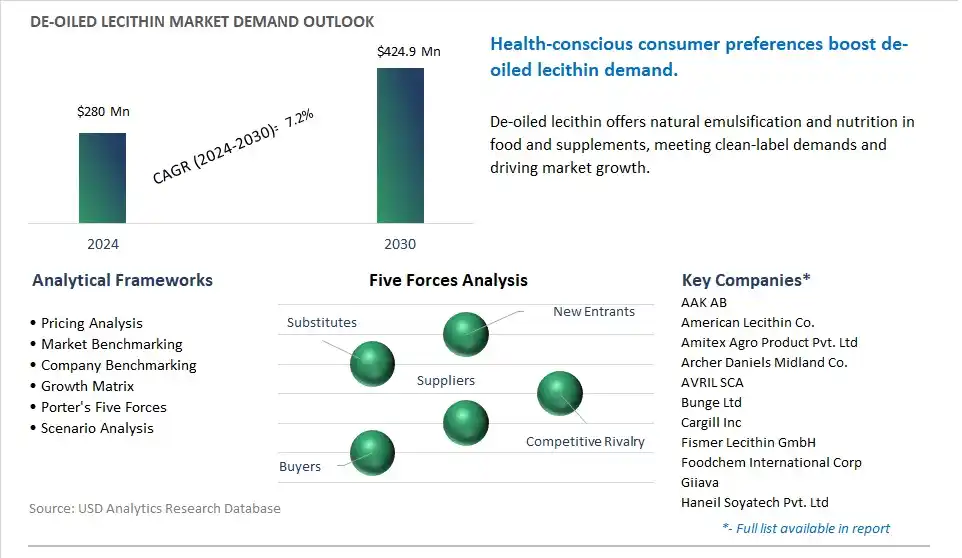
The global De-oiled Lecithin Market is poised to register a 7.2% CAGR from $280 Million in 2024 to $424.9 Million in 2030.
The global De-oiled Lecithin Market Study analyzes and forecasts the market size across 6 regions and 24 countries for diverse segments -By Source (Soybean, Sunflower, Rapeseed & Canola, Eggs, Others), By Nature (GMO, NON-GMO), By Extraction Method (Acetone Extraction, Carbon Dioxide Extraction, Ultrafiltration Process), By Form (Powder, Granules), By Application (Food & beverages, Feed, Industrial, Health care products, Others).
An Introduction to Global De oiled Lecithin Market in 2024
The market for deoiled lecithin is experiencing growth, driven by the increasing demand for natural emulsifiers and functional ingredients in the food, feed, pharmaceutical, and personal care industries. Key trends shaping the future of the industry include advancements in lecithin extraction technology, purification processes, and application versatility to meet the evolving needs of manufacturers for clean-label, non-GMO, and allergen-free lecithin products. Manufacturers are focusing on developing deoiled lecithin with enhanced functionality, such as emulsification, foaming, and dispersibility, to replace synthetic emulsifiers and improve texture, stability, and shelf life in various food and beverage formulations. Additionally, there is a growing emphasis on sustainability, traceability, and transparency in lecithin sourcing and production, driven by consumer demand for ethical and environmentally friendly ingredients. Moreover, advancements in enzymatic hydrolysis, membrane filtration, and solvent-free extraction are driving innovation in deoiled lecithin processing, enabling the production of high-quality lecithin fractions with specific functionalities and nutritional profiles for different applications. Furthermore, collaborations between lecithin producers, food manufacturers, and regulatory agencies are shaping the development of industry standards, quality assurance protocols, and safety guidelines that ensure the purity, safety, and efficacy of deoiled lecithin products in various end-use applications. Overall, the future of deoiled lecithin lies in continuous innovation, collaboration, and sustainability initiatives to address emerging market trends, consumer preferences, and regulatory requirements while meeting the diverse needs of manufacturers for natural, functional, and versatile ingredients that enhance the quality and nutritional value of food, feed, and personal care products.
De-oiled Lecithin Market Competitive Landscape
The market report analyses the leading companies in the industry including AAK AB, American Lecithin Co., Amitex Agro Product Pvt. Ltd, Archer Daniels Midland Co., AVRIL SCA, Bunge Ltd, Cargill Inc, Fismer Lecithin GmbH, Foodchem International Corp, Giiava, Haneil Soyatech Pvt. Ltd, Kriti Nutrients Ltd, Lecilite Ingredients Pvt. Ltd, Lipoid GmbH, Matrix Life Science Inc, Prestige Group, Sonic Biochem Extraction Pvt. Ltd, Sternchemie GmbH and Co. KG, VAV Life Sciences Pvt. Ltd, Wilmar International Ltd.
De-oiled Lecithin Market Dynamics
De-oiled Lecithin Market Trend: Growing Demand for Natural and Non-GMO Ingredients
In the De-oiled Lecithin market, a prominent trend is the growing demand for natural and non-GMO ingredients in food, pharmaceuticals, and cosmetic products. De-oiled lecithin, derived from soybeans or sunflower seeds, is prized for its emulsifying, dispersing, and stabilizing properties, making it a valuable ingredient in various applications. This trend is driven by consumer preferences for clean label products, as well as regulatory requirements mandating the use of natural ingredients. As food manufacturers, pharmaceutical companies, and cosmetic brands seek to meet consumer demand for healthier and more sustainable products, there's a rising market demand for de-oiled lecithin sourced from non-genetically modified organisms (GMOs) and produced through environmentally friendly processes, driving growth and innovation in the market.
De-oiled Lecithin Market Driver: Expansion of Functional Food and Nutraceutical Industries
A significant driver in the De-oiled Lecithin market is the expansion of the functional food and nutraceutical industries. De-oiled lecithin is widely used as an emulsifier and stabilizer in functional food products, dietary supplements, and nutritional formulations due to its ability to improve texture, shelf life, and bioavailability of active ingredients. With the growing consumer interest in health and wellness, there's an increasing demand for functional foods and supplements enriched with vitamins, minerals, and bioactive compounds. This driver is fueled by factors such as aging populations, rising health consciousness, and the desire for convenient and accessible ways to support overall well-being. As the functional food and nutraceutical sectors continue to grow globally, there's a corresponding market demand for high-quality de-oiled lecithin that meets regulatory standards and delivers functional benefits, driving market expansion and investment.
De-oiled Lecithin Market Opportunity: Development of Specialized Formulations and Applications
A promising opportunity within the De-oiled Lecithin market lies in the development of specialized formulations and applications tailored to specific industry needs. Opportunities exist for manufacturers to innovate and introduce de-oiled lecithin products with enhanced functionalities, such as improved dispersibility, flavor masking, and nutritional fortification. Additionally, there's potential for growth in applications such as pharmaceutical formulations, animal feed additives, and personal care products, where de-oiled lecithin can offer unique benefits such as enhanced bioavailability, texture enhancement, and skin conditioning properties. By leveraging their technical expertise and collaborating with industry partners, de-oiled lecithin manufacturers can unlock new opportunities, expand their product portfolios, and capture a larger share of the market.
De-oiled Lecithin Market Share Analysis: The Soybean generated the highest revenue in 2024
the largest segment in the De-oiled Lecithin Market is the Soybean segment. Soybean is one of the most widely cultivated oilseeds globally and serves as a primary source of lecithin production. Soybean-derived de-oiled lecithin is highly versatile and finds extensive applications in various industries, including food and beverage, pharmaceuticals, cosmetics, and animal feed. Soybean lecithin contains phospholipids, triglycerides, fatty acids, and other beneficial compounds, making it a valuable ingredient with emulsifying, stabilizing, and antioxidant properties. It is commonly used as an emulsifier in food products such as chocolates, margarine, baked goods, and salad dressings, where it improves texture, shelf-life, and flavor stability. Additionally, soybean lecithin is preferred by many manufacturers due to its abundant availability, consistent quality, and cost-effectiveness compared to other sources. Further, soybean lecithin is non-GMO and allergen-free, catering to consumer preferences for natural and clean-label ingredients. Over the forecast period, the widespread availability, versatility, and favorable properties of soybean-derived de-oiled lecithin contribute to its dominance as the largest segment in the De-oiled Lecithin Market.
De-oiled Lecithin Market Share Analysis: The Ultrafiltration Process segment is poised to register the fastest growth rate (CAGR) over the forecast period to 2030
The fastest-growing segment in the De-oiled Lecithin Market is the Ultrafiltration Process extraction method. Ultrafiltration is gaining popularity due to its efficiency, cost-effectiveness, and sustainability compared to traditional extraction methods such as acetone extraction and carbon dioxide extraction. In the ultrafiltration process, lecithin is separated from crude soybean oil using membranes with specific pore sizes, allowing only lecithin molecules to pass through while retaining other components like triglycerides and fatty acids. This gentle separation process preserves the natural properties and functionalities of lecithin, resulting in a high-quality product suitable for various applications in food, pharmaceuticals, and cosmetics. Further, ultrafiltration offers advantages such as lower solvent usage, reduced energy consumption, and minimal environmental impact, aligning with industry trends toward sustainability and green manufacturing practices. As manufacturers seek efficient and environmentally friendly extraction methods, the demand for de-oiled lecithin produced through the ultrafiltration process is expected to experience rapid growth, making it the fastest-growing segment in the De-oiled Lecithin Market.
De-oiled Lecithin Market Report Segmentation
By Source
Soybean
Sunflower
Rapeseed & Canola
Eggs
Others
By Nature
GMO
NON-GMO
By Extraction Method
Acetone Extraction
Carbon Dioxide Extraction
Ultrafiltration Process
By Form
Powder
Granules
By Application
Food & beverages
Feed
Industrial
Health care products
Others
Regions Included
North America (US, Canada, Mexico)
Europe (Germany, UK, France, Spain, Italy, Russia, Rest of Europe)
Asia Pacific (China, India, Japan, South Korea, Australia, South East Asia, Rest of Asia)
South America (Brazil, Argentina, Rest of South America)
Middle East and Africa (Saudi Arabia, UAE, Rest of Middle East, South Africa, Egypt, Rest of Africa)
De-oiled Lecithin Companies Profiled in the Market Study
AAK AB
American Lecithin Co.
Amitex Agro Product Pvt. Ltd
Archer Daniels Midland Co.
AVRIL SCA
Bunge Ltd
Cargill Inc
Fismer Lecithin GmbH
Foodchem International Corp
Giiava
Haneil Soyatech Pvt. Ltd
Kriti Nutrients Ltd
Lecilite Ingredients Pvt. Ltd
Lipoid GmbH
Matrix Life Science Inc
Prestige Group
Sonic Biochem Extraction Pvt. Ltd
Sternchemie GmbH and Co. KG
VAV Life Sciences Pvt. Ltd
Wilmar International Ltd
*- List Not Exhaustive
TABLE OF CONTENTS
1 Introduction to 2024 De-oiled Lecithin Market
1.1 Market Overview
1.2 Quick Facts
1.3 Scope/Objective of the Study
1.4 Market Definition
1.5 Countries and Regions Covered
1.6 Units, Currency, and Conversions
1.7 Industry Value Chain
2 Research Methodology
2.1 Market Size Estimation
2.2 Sources and Research Methodology
2.3 Data Triangulation
2.4 Assumptions and Limitations
3 Executive Summary
3.1 Global De-oiled Lecithin Market Size Outlook, $ Million, 2021 to 2030
3.2 De-oiled Lecithin Market Outlook by Type, $ Million, 2021 to 2030
3.3 De-oiled Lecithin Market Outlook by Product, $ Million, 2021 to 2030
3.4 De-oiled Lecithin Market Outlook by Application, $ Million, 2021 to 2030
3.5 De-oiled Lecithin Market Outlook by Key Countries, $ Million, 2021 to 2030
4 Market Dynamics
4.1 Key Driving Forces of De-oiled Lecithin Industry
4.2 Key Market Trends in De-oiled Lecithin Industry
4.3 Potential Opportunities in De-oiled Lecithin Industry
4.4 Key Challenges in De-oiled Lecithin Industry
5 Market Factor Analysis
5.1 Value Chain Analysis
5.2 Competitive Landscape
5.2.1 Global De-oiled Lecithin Market Share by Company (%), 2023
5.2.2 Product Offerings by Company
5.3 Porter’s Five Forces Analysis
5.4 Pricing Analysis and Outlook
6 Growth Outlook Across Scenarios
6.1 Growth Analysis-Case Scenario Definitions
6.2 Low Growth Scenario Forecasts
6.3 Reference Growth Scenario Forecasts
6.4 High Growth Scenario Forecasts
7 Global De-oiled Lecithin Market Outlook by Segments
7.1 De-oiled Lecithin Market Outlook by Segments, $ Million, 2021- 2030
By Source
Soybean
Sunflower
Rapeseed & Canola
Eggs
Others
By Nature
GMO
NON-GMO
By Extraction Method
Acetone Extraction
Carbon Dioxide Extraction
Ultrafiltration Process
By Form
Powder
Granules
By Application
Food & beverages
Feed
Industrial
Health care products
Others
8 North America De-oiled Lecithin Market Analysis and Outlook To 2030
8.1 Introduction to North America De-oiled Lecithin Markets in 2024
8.2 North America De-oiled Lecithin Market Size Outlook by Country, 2021-2030
8.2.1 United States
8.2.2 Canada
8.2.3 Mexico
8.3 North America De-oiled Lecithin Market size Outlook by Segments, 2021-2030
By Source
Soybean
Sunflower
Rapeseed & Canola
Eggs
Others
By Nature
GMO
NON-GMO
By Extraction Method
Acetone Extraction
Carbon Dioxide Extraction
Ultrafiltration Process
By Form
Powder
Granules
By Application
Food & beverages
Feed
Industrial
Health care products
Others
9 Europe De-oiled Lecithin Market Analysis and Outlook To 2030
9.1 Introduction to Europe De-oiled Lecithin Markets in 2024
9.2 Europe De-oiled Lecithin Market Size Outlook by Country, 2021-2030
9.2.1 Germany
9.2.2 France
9.2.3 Spain
9.2.4 United Kingdom
9.2.4 Italy
9.2.5 Russia
9.2.6 Norway
9.2.7 Rest of Europe
9.3 Europe De-oiled Lecithin Market Size Outlook by Segments, 2021-2030
By Source
Soybean
Sunflower
Rapeseed & Canola
Eggs
Others
By Nature
GMO
NON-GMO
By Extraction Method
Acetone Extraction
Carbon Dioxide Extraction
Ultrafiltration Process
By Form
Powder
Granules
By Application
Food & beverages
Feed
Industrial
Health care products
Others
10 Asia Pacific De-oiled Lecithin Market Analysis and Outlook To 2030
10.1 Introduction to Asia Pacific De-oiled Lecithin Markets in 2024
10.2 Asia Pacific De-oiled Lecithin Market Size Outlook by Country, 2021-2030
10.2.1 China
10.2.2 India
10.2.3 Japan
10.2.4 South Korea
10.2.5 Indonesia
10.2.6 Malaysia
10.2.7 Australia
10.2.8 Rest of Asia Pacific
10.3 Asia Pacific De-oiled Lecithin Market size Outlook by Segments, 2021-2030
By Source
Soybean
Sunflower
Rapeseed & Canola
Eggs
Others
By Nature
GMO
NON-GMO
By Extraction Method
Acetone Extraction
Carbon Dioxide Extraction
Ultrafiltration Process
By Form
Powder
Granules
By Application
Food & beverages
Feed
Industrial
Health care products
Others
11 South America De-oiled Lecithin Market Analysis and Outlook To 2030
11.1 Introduction to South America De-oiled Lecithin Markets in 2024
11.2 South America De-oiled Lecithin Market Size Outlook by Country, 2021-2030
11.2.1 Brazil
11.2.2 Argentina
11.2.3 Rest of South America
11.3 South America De-oiled Lecithin Market size Outlook by Segments, 2021-2030
By Source
Soybean
Sunflower
Rapeseed & Canola
Eggs
Others
By Nature
GMO
NON-GMO
By Extraction Method
Acetone Extraction
Carbon Dioxide Extraction
Ultrafiltration Process
By Form
Powder
Granules
By Application
Food & beverages
Feed
Industrial
Health care products
Others
12 Middle East and Africa De-oiled Lecithin Market Analysis and Outlook To 2030
12.1 Introduction to Middle East and Africa De-oiled Lecithin Markets in 2024
12.2 Middle East and Africa De-oiled Lecithin Market Size Outlook by Country, 2021-2030
12.2.1 Saudi Arabia
12.2.2 UAE
12.2.3 Oman
12.2.4 Rest of Middle East
12.2.5 Egypt
12.2.6 Nigeria
12.2.7 South Africa
12.2.8 Rest of Africa
12.3 Middle East and Africa De-oiled Lecithin Market size Outlook by Segments, 2021-2030
By Source
Soybean
Sunflower
Rapeseed & Canola
Eggs
Others
By Nature
GMO
NON-GMO
By Extraction Method
Acetone Extraction
Carbon Dioxide Extraction
Ultrafiltration Process
By Form
Powder
Granules
By Application
Food & beverages
Feed
Industrial
Health care products
Others
13 Company Profiles
13.1 Company Snapshot
13.2 SWOT Profiles
13.3 Products and Services
13.4 Recent Developments
13.5 Financial Profile
AAK AB
American Lecithin Co.
Amitex Agro Product Pvt. Ltd
Archer Daniels Midland Co.
AVRIL SCA
Bunge Ltd
Cargill Inc
Fismer Lecithin GmbH
Foodchem International Corp
Giiava
Haneil Soyatech Pvt. Ltd
Kriti Nutrients Ltd
Lecilite Ingredients Pvt. Ltd
Lipoid GmbH
Matrix Life Science Inc
Prestige Group
Sonic Biochem Extraction Pvt. Ltd
Sternchemie GmbH and Co. KG
VAV Life Sciences Pvt. Ltd
Wilmar International Ltd
14 Appendix
14.1 Customization Offerings
14.2 Subscription Services
14.3 Related Reports
14.4 Publisher Expertise
By Source
Soybean
Sunflower
Rapeseed & Canola
Eggs
Others
By Nature
GMO
NON-GMO
By Extraction Method
Acetone Extraction
Carbon Dioxide Extraction
Ultrafiltration Process
By Form
Powder
Granules
By Application
Food & beverages
Feed
Industrial
Health care products
Others
Countries Analyzed
North America (US, Canada, Mexico)
Europe (Germany, UK, France, Spain, Italy, Russia, Rest of Europe)
Asia Pacific (China, India, Japan, South Korea, Australia, South East Asia, Rest of Asia)
South America (Brazil, Argentina, Rest of South America)
Middle East and Africa (Saudi Arabia, UAE, Rest of Middle East, South Africa, Egypt, Rest of Africa)
