The global Dehumidifier Market is poised to register a 6.3% CAGR from $3.6 Billion in 2024 to $5.2 Billion in 2030.
The global Dehumidifier Market Study analyzes and forecasts the market size across 6 regions and 24 countries for diverse segments -By Technology (Refrigerative Dehumidifier, Desiccant Dehumidifier, Heat Pump Dehumidifier), By Product (Portable Dehumidifier, Fixed Dehumidifier), By Application (Residential, Commercial, Industrial).
An Introduction to Global Dehumidifier Market in 2024
The dehumidifier market is experiencing significant growth driven by the increasing awareness of indoor air quality, moisture control, and health concerns related to mold, mildew, and allergens. Key trends shaping the future of the industry include the rising demand for energy-efficient, quiet, and smart dehumidifiers that offer effective humidity control, air purification, and convenience for residential, commercial, and industrial applications. As consumers seek solutions to improve comfort, prevent property damage, and mitigate health risks associated with excessive humidity levels, there's a growing need for dehumidifiers with advanced features such as programmable settings, intelligent sensors, and Wi-Fi connectivity for remote monitoring and control. Moreover, advancements in dehumidifier technology such as refrigeration, desiccant, and hybrid systems are driving market expansion by improving energy efficiency, moisture removal capacity, and performance reliability of dehumidification solutions. Additionally, the growing adoption of dehumidifiers in niche applications such as indoor swimming pools, wine cellars, and archival storage facilities is fueling market growth by addressing specific humidity control requirements and environmental conditions. Furthermore, the integration of air quality sensors, filtration systems, and IoT connectivity is driving innovation and market growth in the dehumidifier industry, enabling personalized comfort, energy savings, and improved indoor environments.
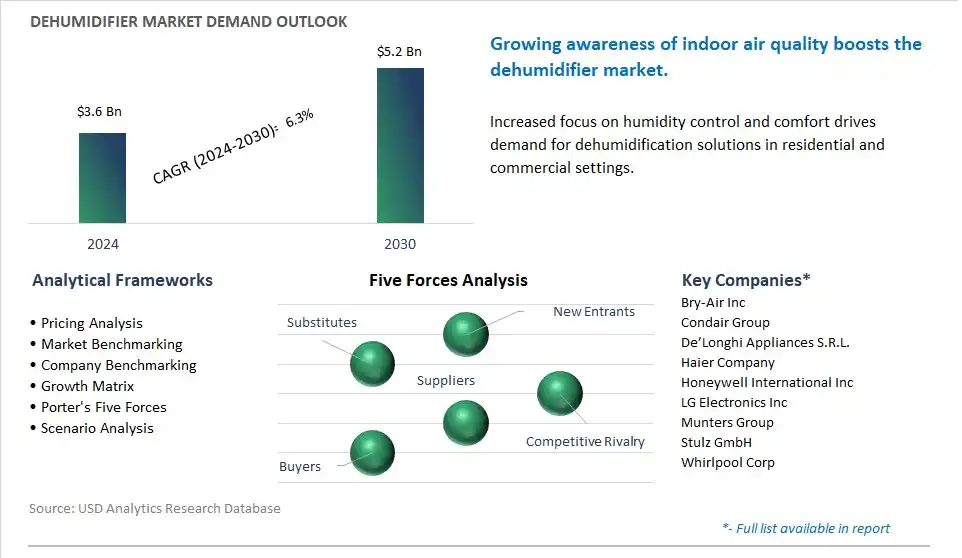
Dehumidifier Market Competitive Landscape
The market report analyses the leading companies in the industry including Bry-Air Inc, Condair Group, De’Longhi Appliances S.R.L., Haier Company, Honeywell International Inc, LG Electronics Inc, Munters Group, Stulz GmbH, Whirlpool Corp.
Dehumidifier Market Dynamics
Dehumidifier Market Trend: Increased Focus on Indoor Air Quality and Comfort
One prominent trend in the dehumidifier market is the increased focus on indoor air quality and comfort. As people spend more time indoors, especially in residential, commercial, and industrial settings, there is growing awareness about the importance of maintaining optimal humidity levels for health, comfort, and productivity. Dehumidifiers play a crucial role in removing excess moisture from the air, reducing the risk of mold growth, allergen accumulation, and respiratory issues. The trend towards improving indoor air quality and comfort drives market demand for dehumidifiers across various applications, including homes, offices, healthcare facilities, and manufacturing plants.
Dehumidifier Market Driver: Rising Concerns about Mold, Mildew, and Moisture-related Issues
A primary driver shaping the dehumidifier market is the rising concerns about mold, mildew, and moisture-related issues in indoor environments. Excess humidity can lead to the proliferation of mold and mildew, causing property damage, respiratory problems, and allergic reactions. Additionally, high humidity levels can adversely affect electronic equipment, furniture, and sensitive materials in industrial settings. The driver behind rising concerns about mold, mildew, and moisture-related issues stimulates demand for dehumidifiers as effective solutions for controlling humidity levels and mitigating the risks associated with indoor moisture accumulation.
Dehumidifier Market Opportunity: Integration of Smart Features and Energy Efficiency
An opportunity within the dehumidifier market lies in the integration of smart features and energy efficiency to enhance product performance and consumer appeal. By leveraging advances in technology such as IoT connectivity, sensors, and automation, manufacturers can develop smart dehumidifiers that offer remote monitoring, control, and diagnostics capabilities. Smart features such as mobile app connectivity, voice control, and predictive maintenance alerts enhance user experience and convenience. Furthermore, there is potential to improve energy efficiency through the use of advanced compressor technologies, refrigerants, and dehumidification algorithms, reducing operating costs and environmental impact. By embracing opportunities in smart technology and energy efficiency, companies can differentiate their products, meet evolving consumer preferences, and drive market growth in the dehumidifier industry.
Dehumidifier Market Share Analysis: Refrigerative Dehumidifier segment generated the highest revenue in the industry
The Refrigerative Dehumidifier segment is the largest segment in the Dehumidifier Market due to diverse key factors. The refrigerative dehumidifiers utilize a widely adopted technology that effectively removes excess moisture from the air by condensing it into water, which is then collected and drained away. This technology is well-suited for a broad range of applications, including residential, commercial, and industrial settings, where humidity control is essential for maintaining comfort, preserving indoor air quality, and protecting sensitive equipment or materials. Refrigerative dehumidifiers are capable of achieving relatively low dew points and can handle large volumes of air, making them suitable for use in spaces of varying sizes, from small rooms to large warehouses or industrial facilities. Secondly, refrigerative dehumidifiers are generally more energy-efficient and cost-effective compared to other dehumidification technologies, such as desiccant or heat pump dehumidifiers. They operate using a refrigeration cycle similar to that of air conditioners, leveraging the latent heat of condensation to remove moisture from the air without significantly impacting room temperature. This efficiency and cost-effectiveness make refrigerative dehumidifiers the preferred choice for many consumers, businesses, and industries seeking reliable and economical humidity control solutions. In addition, refrigerative dehumidifiers are available in a variety of configurations, including portable units, wall-mounted systems, and integrated HVAC (heating, ventilation, and air conditioning) solutions, providing flexibility and versatility to meet diverse application needs. Additionally, advancements in refrigerative dehumidifier technology, such as the integration of smart controls, energy-saving features, and environmentally friendly refrigerants, further enhance their appeal and market dominance. Over the forecast period, the dominance of the Refrigerative Dehumidifier segment in the Dehumidifier Market is attributed to its widespread adoption, versatility, energy efficiency, cost-effectiveness, and continuous technological innovations, making it the largest segment in the market.
Dehumidifier Market Share Analysis: Portable Dehumidifier Segment is poised to register the fastest growth rate (CAGR) over the forecast period to 2030
The portable dehumidifier segment is the fastest-growing segment in the dehumidifier market. This surge in popularity can be attributed to diverse factors. The portability offers unmatched convenience, allowing users to easily move the dehumidifier between rooms or even different locations, addressing specific humidity issues as needed. Additionally, advancements in technology have led to the development of compact yet powerful portable dehumidifiers, capable of efficiently extracting moisture from the air in smaller spaces such as bedrooms, offices, or apartments. In addition, with increasing awareness about the health hazards associated with excessive moisture, particularly mold and mildew growth, consumers are increasingly investing in portable dehumidifiers as a proactive measure to maintain a healthy indoor environment. The flexibility, efficiency, and effectiveness of portable dehumidifiers make them a preferred choice for residential and commercial applications alike, thereby driving significant growth in this segment of the market.
Dehumidifier Market Share Analysis: Commercial Dehumidifiers Segment is poised to register the fastest growth rate (CAGR) over the forecast period to 2030
Among the segments in the dehumidifier market, the commercial sector is experiencing remarkable growth, making commercial dehumidifiers the fastest-growing segment. This surge can be attributed to various factors. The as businesses strive to maintain optimal conditions in their premises, particularly in sectors like hospitality, healthcare, and food processing, the demand for dehumidifiers to control humidity levels is escalating. Commercial spaces often encounter high humidity due to factors such as large occupancy, frequent use of water, or specific industrial processes, necessitating effective dehumidification solutions. In addition, stringent regulations regarding indoor air quality and hygiene in commercial establishments drive the adoption of dehumidifiers to prevent mold growth, enhance occupant comfort, and safeguard equipment and inventory. Additionally, advancements in technology have led to the development of energy-efficient and high-capacity commercial dehumidifiers capable of catering to large spaces effectively. The increasing awareness about the importance of humidity control for maintaining a healthy and productive environment further fuels the demand for commercial dehumidifiers, contributing significantly to the segment's rapid growth in the market.
Dehumidifier Market Report Segmentation
By Technology
Refrigerative Dehumidifier
Desiccant Dehumidifier
Heat Pump Dehumidifier
By Product
Portable Dehumidifier
Fixed Dehumidifier
By Application
Residential
Commercial
Industrial
Regions Included
North America (US, Canada, Mexico)
Europe (Germany, UK, France, Spain, Italy, Russia, Rest of Europe)
Asia Pacific (China, India, Japan, South Korea, Australia, South East Asia, Rest of Asia)
South America (Brazil, Argentina, Rest of South America)
Middle East and Africa (Saudi Arabia, UAE, Rest of Middle East, South Africa, Egypt, Rest of Africa)
Dehumidifier Companies Profiled in the Market Study
Bry-Air Inc
Condair Group
De’Longhi Appliances S.R.L.
Haier Company
Honeywell International Inc
LG Electronics Inc
Munters Group
Stulz GmbH
Whirlpool Corp
*- List Not Exhaustive
TABLE OF CONTENTS
1 Introduction to 2024 Dehumidifier Market
1.1 Market Overview
1.2 Quick Facts
1.3 Scope/Objective of the Study
1.4 Market Definition
1.5 Countries and Regions Covered
1.6 Units, Currency, and Conversions
1.7 Industry Value Chain
2 Research Methodology
2.1 Market Size Estimation
2.2 Sources and Research Methodology
2.3 Data Triangulation
2.4 Assumptions and Limitations
3 Executive Summary
3.1 Global Dehumidifier Market Size Outlook, $ Million, 2021 to 2030
3.2 Dehumidifier Market Outlook by Type, $ Million, 2021 to 2030
3.3 Dehumidifier Market Outlook by Product, $ Million, 2021 to 2030
3.4 Dehumidifier Market Outlook by Application, $ Million, 2021 to 2030
3.5 Dehumidifier Market Outlook by Key Countries, $ Million, 2021 to 2030
4 Market Dynamics
4.1 Key Driving Forces of Dehumidifier Industry
4.2 Key Market Trends in Dehumidifier Industry
4.3 Potential Opportunities in Dehumidifier Industry
4.4 Key Challenges in Dehumidifier Industry
5 Market Factor Analysis
5.1 Value Chain Analysis
5.2 Competitive Landscape
5.2.1 Global Dehumidifier Market Share by Company (%), 2023
5.2.2 Product Offerings by Company
5.3 Porter’s Five Forces Analysis
5.4 Pricing Analysis and Outlook
6 Growth Outlook Across Scenarios
6.1 Growth Analysis-Case Scenario Definitions
6.2 Low Growth Scenario Forecasts
6.3 Reference Growth Scenario Forecasts
6.4 High Growth Scenario Forecasts
7 Global Dehumidifier Market Outlook by Segments
7.1 Dehumidifier Market Outlook by Segments, $ Million, 2021- 2030
By Technology
Refrigerative Dehumidifier
Desiccant Dehumidifier
Heat Pump Dehumidifier
By Product
Portable Dehumidifier
Fixed Dehumidifier
By Application
Residential
Commercial
Industrial
8 North America Dehumidifier Market Analysis and Outlook To 2030
8.1 Introduction to North America Dehumidifier Markets in 2024
8.2 North America Dehumidifier Market Size Outlook by Country, 2021-2030
8.2.1 United States
8.2.2 Canada
8.2.3 Mexico
8.3 North America Dehumidifier Market size Outlook by Segments, 2021-2030
By Technology
Refrigerative Dehumidifier
Desiccant Dehumidifier
Heat Pump Dehumidifier
By Product
Portable Dehumidifier
Fixed Dehumidifier
By Application
Residential
Commercial
Industrial
9 Europe Dehumidifier Market Analysis and Outlook To 2030
9.1 Introduction to Europe Dehumidifier Markets in 2024
9.2 Europe Dehumidifier Market Size Outlook by Country, 2021-2030
9.2.1 Germany
9.2.2 France
9.2.3 Spain
9.2.4 United Kingdom
9.2.4 Italy
9.2.5 Russia
9.2.6 Norway
9.2.7 Rest of Europe
9.3 Europe Dehumidifier Market Size Outlook by Segments, 2021-2030
By Technology
Refrigerative Dehumidifier
Desiccant Dehumidifier
Heat Pump Dehumidifier
By Product
Portable Dehumidifier
Fixed Dehumidifier
By Application
Residential
Commercial
Industrial
10 Asia Pacific Dehumidifier Market Analysis and Outlook To 2030
10.1 Introduction to Asia Pacific Dehumidifier Markets in 2024
10.2 Asia Pacific Dehumidifier Market Size Outlook by Country, 2021-2030
10.2.1 China
10.2.2 India
10.2.3 Japan
10.2.4 South Korea
10.2.5 Indonesia
10.2.6 Malaysia
10.2.7 Australia
10.2.8 Rest of Asia Pacific
10.3 Asia Pacific Dehumidifier Market size Outlook by Segments, 2021-2030
By Technology
Refrigerative Dehumidifier
Desiccant Dehumidifier
Heat Pump Dehumidifier
By Product
Portable Dehumidifier
Fixed Dehumidifier
By Application
Residential
Commercial
Industrial
11 South America Dehumidifier Market Analysis and Outlook To 2030
11.1 Introduction to South America Dehumidifier Markets in 2024
11.2 South America Dehumidifier Market Size Outlook by Country, 2021-2030
11.2.1 Brazil
11.2.2 Argentina
11.2.3 Rest of South America
11.3 South America Dehumidifier Market size Outlook by Segments, 2021-2030
By Technology
Refrigerative Dehumidifier
Desiccant Dehumidifier
Heat Pump Dehumidifier
By Product
Portable Dehumidifier
Fixed Dehumidifier
By Application
Residential
Commercial
Industrial
12 Middle East and Africa Dehumidifier Market Analysis and Outlook To 2030
12.1 Introduction to Middle East and Africa Dehumidifier Markets in 2024
12.2 Middle East and Africa Dehumidifier Market Size Outlook by Country, 2021-2030
12.2.1 Saudi Arabia
12.2.2 UAE
12.2.3 Oman
12.2.4 Rest of Middle East
12.2.5 Egypt
12.2.6 Nigeria
12.2.7 South Africa
12.2.8 Rest of Africa
12.3 Middle East and Africa Dehumidifier Market size Outlook by Segments, 2021-2030
By Technology
Refrigerative Dehumidifier
Desiccant Dehumidifier
Heat Pump Dehumidifier
By Product
Portable Dehumidifier
Fixed Dehumidifier
By Application
Residential
Commercial
Industrial
13 Company Profiles
13.1 Company Snapshot
13.2 SWOT Profiles
13.3 Products and Services
13.4 Recent Developments
13.5 Financial Profile
Bry-Air Inc
Condair Group
De’Longhi Appliances S.R.L.
Haier Company
Honeywell International Inc
LG Electronics Inc
Munters Group
Stulz GmbH
Whirlpool Corp
14 Appendix
14.1 Customization Offerings
14.2 Subscription Services
14.3 Related Reports
14.4 Publisher Expertise
By Technology
Refrigerative Dehumidifier
Desiccant Dehumidifier
Heat Pump Dehumidifier
By Product
Portable Dehumidifier
Fixed Dehumidifier
By Application
Residential
Commercial
Industrial
Countries Analyzed
North America (US, Canada, Mexico)
Europe (Germany, UK, France, Spain, Italy, Russia, Rest of Europe)
Asia Pacific (China, India, Japan, South Korea, Australia, South East Asia, Rest of Asia)
South America (Brazil, Argentina, Rest of South America)
Middle East and Africa (Saudi Arabia, UAE, Rest of Middle East, South Africa, Egypt, Rest of Africa)
