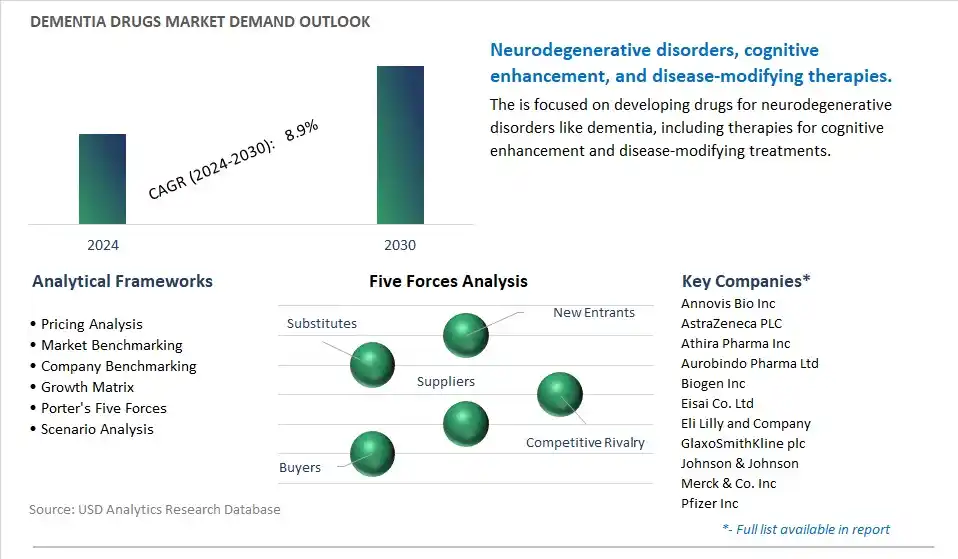
Dementia Drugs Market is estimated to increase at a Compounded Annual Growth Rate of 8.9% CAGR over the forecast period from 2024 to 2030
The Dementia Drugs Market study analyzes and forecasts the market size across 6 regions and 24 countries for diverse segments- By Indication (Lewy Body Dementia, Parkinsons Disease Dementia, Alzheimers Disease, Vascular Dementia, Others), By Drug Class (Cholinesterase Inhibitors, NMDA Antagonists, Others), By Distribution Channel (Retail Pharmacies, Hospital Pharmacies, Online Pharmacies).
An Introduction to Dementia Drugs Market in 2024
In 2024, the market for dementia drugs addresses the therapeutic challenges of Alzheimer's disease and other forms of dementia, offering pharmacological treatments, disease-modifying therapies, and symptomatic management strategies for improving cognitive function, behavioral symptoms, and quality of life in patients with dementia-related disorders. Dementia encompasses a spectrum of neurodegenerative conditions characterized by progressive cognitive decline, memory impairment, and functional impairment, with Alzheimer's disease representing the most common cause of dementia worldwide. Dementia drugs target various pathological mechanisms involved in neurodegeneration, including amyloid-beta aggregation, tau protein hyperphosphorylation, neurotransmitter imbalances, and neuroinflammation, with the goal of slowing disease progression, preserving cognitive function, and alleviating neuropsychiatric symptoms. Therapeutic options for dementia include cholinesterase inhibitors, N-methyl-D-aspartate (NMDA) receptor antagonists, selective serotonin reuptake inhibitors (SSRIs), and investigational disease-modifying agents undergoing clinical development. With a focus on early intervention, personalized treatment approaches, and multidisciplinary care, dementia drug therapy aims to optimize treatment outcomes, enhance patient and caregiver support, and delay institutionalization in individuals affected by dementia-related disorders. Moreover, with advancements in neuroimaging biomarkers, precision medicine approaches, and combination therapies, the dementia drugs market supports ongoing research efforts and clinical trials aimed at identifying novel therapeutic targets, disease-modifying strategies, and personalized treatment algorithms for improving dementia care and addressing the growing burden of dementia on global public health.
Market Trend: Rising Focus on Disease-Modifying Therapies
A significant trend in the Dementia Drugs market is the increasing focus on disease-modifying therapies. With the growing prevalence of dementia, including Alzheimer's disease and other neurodegenerative disorders, there's a pressing need for treatments that not only alleviate symptoms but also target the underlying pathological processes and slow disease progression. Pharmaceutical companies and researchers are increasingly investing in the development of disease-modifying drugs that aim to modify the course of dementia by targeting specific molecular pathways involved in neurodegeneration, such as amyloid-beta and tau protein aggregation, neuroinflammation, and synaptic dysfunction. This trend reflects a paradigm shift in dementia treatment strategies, moving beyond symptomatic management towards therapies that address the root causes of the disease, offering hope for improved outcomes and quality of life for patients and caregivers.
Market Driver: Aging Population and Increasing Disease Burden
An important driver fueling the Dementia Drugs market is the aging population and the increasing burden of dementia-related disorders. As the global population ages, the prevalence of dementia continues to rise, with millions of individuals affected worldwide. Aging is the primary risk factor for dementia, and as life expectancy increases, so does the incidence of age-related neurodegenerative conditions such as Alzheimer's disease. The socioeconomic impact of dementia is substantial, placing a significant burden on healthcare systems, caregivers, and society as a whole. In response to the growing disease burden and unmet medical needs, there's a heightened demand for effective pharmacological interventions that can delay disease onset, slow progression, and improve cognitive function and quality of life for individuals living with dementia. This demographic trend underscores the urgency for continued research and innovation in dementia drug development to address the escalating healthcare challenge posed by neurodegenerative disorders.
Market Opportunity: Exploration of Novel Therapeutic Targets and Drug Modalities
A significant opportunity within the Dementia Drugs market lies in the exploration of novel therapeutic targets and drug modalities. Despite extensive research efforts, current pharmacotherapies for dementia offer limited efficacy and primarily focus on symptomatic relief. There's potential for pharmaceutical companies and biotechnology firms to identify and validate novel molecular targets implicated in dementia pathogenesis, paving the way for the development of innovative drug candidates with disease-modifying properties. Opportunities also exist for exploring alternative drug modalities, including monoclonal antibodies, small molecules, gene therapies, and neuroprotective agents, that target different aspects of the neurodegenerative process and offer complementary mechanisms of action. By embracing a diverse range of therapeutic approaches and leveraging advances in neuroscience, genomics, and drug delivery technologies, stakeholders in the Dementia Drugs market can unlock new opportunities for drug discovery and development, ultimately advancing the quest for effective treatments for dementia and related disorders.
Dementia Drugs Market Share Analysis: Alzheimer's Disease Indication
Among the various indications in the Dementia Drugs market, the Alzheimer's Disease indication is experiencing the fastest growth. The rapid expansion of the Alzheimer's Disease segment in the Dementia Drugs market can be attributed to several factors. Firstly, Alzheimer's Disease represents the most common cause of dementia, accounting for a significant proportion of dementia cases globally. The increasing prevalence of Alzheimer's Disease, driven by aging populations and rising life expectancy, underscores the urgent need for effective pharmacological interventions to manage symptoms and slow disease progression. Secondly, advancements in our understanding of the pathophysiology of Alzheimer's Disease have led to the development of targeted therapeutic approaches aimed at addressing underlying disease mechanisms, such as the accumulation of beta-amyloid plaques and tau protein tangles in the brain. Cholinesterase inhibitors and NMDA antagonists, the main classes of drugs approved for Alzheimer's Disease, have demonstrated efficacy in improving cognitive function, behavior, and activities of daily living in patients with mild to moderate forms of the disease. Additionally, ongoing research efforts focus on the development of disease-modifying therapies that target specific molecular pathways implicated in Alzheimer's Disease pathology, offering promising prospects for future treatment options. Furthermore, the expanding elderly population, coupled with the increasing awareness and diagnosis of Alzheimer's Disease, drives the demand for dementia drugs targeting this indication. Healthcare providers, including neurologists, geriatricians, and primary care physicians, play a pivotal role in the diagnosis and management of Alzheimer's Disease, prescribing pharmacological interventions based on disease severity, patient preferences, and treatment goals. Moreover, the availability of dementia drugs through various distribution channels, including retail pharmacies, hospital pharmacies, and online pharmacies, enhances accessibility and convenience for patients and caregivers seeking treatment for Alzheimer's Disease. As a result, the Alzheimer's Disease indication emerges as the Dementia Drugs market, offering significant opportunities for pharmaceutical companies, healthcare providers, and stakeholders involved in Alzheimer's Disease research and clinical practice.
Dementia Drugs Competitive Analysis
The market research study provides in-depth insights into leading companies including the SWOT analyses, product profile, financial details, and recent developments acrossAnnovis Bio Inc, AstraZeneca PLC, Athira Pharma Inc, Aurobindo Pharma Ltd, Biogen Inc, Eisai Co. Ltd, Eli Lilly and Company, GlaxoSmithKline plc, Johnson & Johnson, Merck & Co. Inc, Pfizer Inc, SK Capital Partners LP, Teva Pharmaceutical Industries Ltd, Zydus Cadila
Dementia Drugs Market Segmentation
By Indication
Lewy Body Dementia
Parkinsons Disease Dementia
Alzheimers Disease
Vascular Dementia
Others
By Drug Class
Cholinesterase Inhibitors
NMDA Antagonists
Others
By Distribution Channel
Retail Pharmacies
Hospital Pharmacies
Online Pharmacies
Geographical Analysis
North America (United States, Canada, Mexico)
Europe (Germany, France, United Kingdom, Spain, Italy, Rest of Europe)
Asia Pacific (China, India, Japan, South Korea, Rest of Asia Pacific)
South America (Brazil, Argentina, Rest of South America)
Middle East and Africa (Saudi Arabia, UAE, Rest of Middle East, South Africa, Egypt, Rest of Africa)
Dementia Drugs Market Companies
Annovis Bio Inc
AstraZeneca PLC
Athira Pharma Inc
Aurobindo Pharma Ltd
Biogen Inc
Eisai Co. Ltd
Eli Lilly and Company
GlaxoSmithKline plc
Johnson & Johnson
Merck & Co. Inc
Pfizer Inc
SK Capital Partners LP
Teva Pharmaceutical Industries Ltd
Zydus Cadila
Reasons to Buy the Dementia Drugs Market Study
• Deepen your industry insights and navigate uncertainties for strategy formulation, CAPEX, and Operational decisions
• Gain access to detailed insights on the Dementia Drugs Market, encompassing current market size, growth trends, and forecasts till 2030.
• Access detailed competitor analysis, enabling competitive advantage through a thorough understanding of market players, strategies, and potential differentiation opportunities
• Stay ahead of the curve with insights on technological advancements, innovations, and upcoming trends
• Identify lucrative investment avenues and expansion opportunities within the Dementia Drugs Market industry, guided by robust, data-backed analysis.
• Understand regional and global markets through country-wise analysis, regional market potential, regulatory nuances, and dynamics
• Execute strategies with confidence and speed through information, analytics, and insights on the industry value chain
• Corporate leaders, strategists, financial experts, shareholders, asset managers, and governmental representatives can make long-term planning scenarios and build an integrated and timely understanding of market dynamics
• Benefit from tailored solutions and expert consultation based on report insights, providing personalized strategies aligned with specific business needs.
TABLE OF CONTENTS
1 Introduction to 2024 Dementia Drugs Market
1.1 Market Overview
1.2 Quick Facts
1.3 Scope/Objective of the Study
1.4 Market Definition
1.5 Countries and Regions Covered
1.6 Units, Currency, and Conversions
1.7 Industry Value Chain
2 Research Methodology
2.1 Market Size Estimation
2.2 Sources and Research Methodology
2.3 Data Triangulation
2.4 Assumptions and Limitations
3 Executive Summary
3.1 Global Dementia Drugs Market Size Outlook, $ Million, 2021 to 2030
3.2 Dementia Drugs Market Outlook by Type, $ Million, 2021 to 2030
3.3 Dementia Drugs Market Outlook by Product, $ Million, 2021 to 2030
3.4 Dementia Drugs Market Outlook by Application, $ Million, 2021 to 2030
3.5 Dementia Drugs Market Outlook by Key Countries, $ Million, 2021 to 2030
4 Market Dynamics
4.1 Key Driving Forces of Dementia Drugs Industry
4.2 Key Market Trends in Dementia Drugs Industry
4.3 Potential Opportunities in Dementia Drugs Industry
4.4 Key Challenges in Dementia Drugs Industry
5 Market Factor Analysis
5.1 Value Chain Analysis
5.2 Competitive Landscape
5.2.1 Global Dementia Drugs Market Share by Company (%), 2023
5.2.2 Product Offerings by Company
5.3 Porter’s Five Forces Analysis
5.4 Pricing Analysis and Outlook
6 Growth Outlook Across Scenarios
6.1 Growth Analysis-Case Scenario Definitions
6.2 Low Growth Scenario Forecasts
6.3 Reference Growth Scenario Forecasts
6.4 High Growth Scenario Forecasts
7 Global Dementia Drugs Market Outlook by Segments
7.1 Dementia Drugs Market Outlook by Segments, $ Million, 2021- 2030
By Indication
Lewy Body Dementia
Parkinsons Disease Dementia
Alzheimers Disease
Vascular Dementia
Others
By Drug Class
Cholinesterase Inhibitors
NMDA Antagonists
Others
By Distribution Channel
Retail Pharmacies
Hospital Pharmacies
Online Pharmacies
8 North America Dementia Drugs Market Analysis and Outlook To 2030
8.1 Introduction to North America Dementia Drugs Markets in 2024
8.2 North America Dementia Drugs Market Size Outlook by Country, 2021-2030
8.2.1 United States
8.2.2 Canada
8.2.3 Mexico
8.3 North America Dementia Drugs Market size Outlook by Segments, 2021-2030
By Indication
Lewy Body Dementia
Parkinsons Disease Dementia
Alzheimers Disease
Vascular Dementia
Others
By Drug Class
Cholinesterase Inhibitors
NMDA Antagonists
Others
By Distribution Channel
Retail Pharmacies
Hospital Pharmacies
Online Pharmacies
9 Europe Dementia Drugs Market Analysis and Outlook To 2030
9.1 Introduction to Europe Dementia Drugs Markets in 2024
9.2 Europe Dementia Drugs Market Size Outlook by Country, 2021-2030
9.2.1 Germany
9.2.2 France
9.2.3 Spain
9.2.4 United Kingdom
9.2.4 Italy
9.2.5 Russia
9.2.6 Norway
9.2.7 Rest of Europe
9.3 Europe Dementia Drugs Market Size Outlook by Segments, 2021-2030
By Indication
Lewy Body Dementia
Parkinsons Disease Dementia
Alzheimers Disease
Vascular Dementia
Others
By Drug Class
Cholinesterase Inhibitors
NMDA Antagonists
Others
By Distribution Channel
Retail Pharmacies
Hospital Pharmacies
Online Pharmacies
10 Asia Pacific Dementia Drugs Market Analysis and Outlook To 2030
10.1 Introduction to Asia Pacific Dementia Drugs Markets in 2024
10.2 Asia Pacific Dementia Drugs Market Size Outlook by Country, 2021-2030
10.2.1 China
10.2.2 India
10.2.3 Japan
10.2.4 South Korea
10.2.5 Indonesia
10.2.6 Malaysia
10.2.7 Australia
10.2.8 Rest of Asia Pacific
10.3 Asia Pacific Dementia Drugs Market size Outlook by Segments, 2021-2030
By Indication
Lewy Body Dementia
Parkinsons Disease Dementia
Alzheimers Disease
Vascular Dementia
Others
By Drug Class
Cholinesterase Inhibitors
NMDA Antagonists
Others
By Distribution Channel
Retail Pharmacies
Hospital Pharmacies
Online Pharmacies
11 South America Dementia Drugs Market Analysis and Outlook To 2030
11.1 Introduction to South America Dementia Drugs Markets in 2024
11.2 South America Dementia Drugs Market Size Outlook by Country, 2021-2030
11.2.1 Brazil
11.2.2 Argentina
11.2.3 Rest of South America
11.3 South America Dementia Drugs Market size Outlook by Segments, 2021-2030
By Indication
Lewy Body Dementia
Parkinsons Disease Dementia
Alzheimers Disease
Vascular Dementia
Others
By Drug Class
Cholinesterase Inhibitors
NMDA Antagonists
Others
By Distribution Channel
Retail Pharmacies
Hospital Pharmacies
Online Pharmacies
12 Middle East and Africa Dementia Drugs Market Analysis and Outlook To 2030
12.1 Introduction to Middle East and Africa Dementia Drugs Markets in 2024
12.2 Middle East and Africa Dementia Drugs Market Size Outlook by Country, 2021-2030
12.2.1 Saudi Arabia
12.2.2 UAE
12.2.3 Oman
12.2.4 Rest of Middle East
12.2.5 Egypt
12.2.6 Nigeria
12.2.7 South Africa
12.2.8 Rest of Africa
12.3 Middle East and Africa Dementia Drugs Market size Outlook by Segments, 2021-2030
By Indication
Lewy Body Dementia
Parkinsons Disease Dementia
Alzheimers Disease
Vascular Dementia
Others
By Drug Class
Cholinesterase Inhibitors
NMDA Antagonists
Others
By Distribution Channel
Retail Pharmacies
Hospital Pharmacies
Online Pharmacies
13 Company Profiles
13.1 Company Snapshot
13.2 SWOT Profiles
13.3 Products and Services
13.4 Recent Developments
13.5 Financial Profile
List of Companies
Annovis Bio Inc
AstraZeneca PLC
Athira Pharma Inc
Aurobindo Pharma Ltd
Biogen Inc
Eisai Co. Ltd
Eli Lilly and Company
GlaxoSmithKline plc
Johnson & Johnson
Merck & Co. Inc
Pfizer Inc
SK Capital Partners LP
Teva Pharmaceutical Industries Ltd
Zydus Cadila
14 Appendix
14.1 Customization Offerings
14.2 Subscription Services
14.3 Related Reports
14.4 Publisher Expertise
By Indication
Lewy Body Dementia
Parkinsons Disease Dementia
Alzheimers Disease
Vascular Dementia
Others
By Drug Class
Cholinesterase Inhibitors
NMDA Antagonists
Others
By Distribution Channel
Retail Pharmacies
Hospital Pharmacies
Online Pharmacies
Countries Analyzed
North America (United States, Canada, Mexico)
Europe (Germany, France, United Kingdom, Spain, Italy, Rest of Europe)
Asia Pacific (China, India, Japan, South Korea, Rest of Asia Pacific)
South America (Brazil, Argentina, Rest of South America)
Middle East and Africa (Saudi Arabia, UAE, Rest of Middle East, South Africa, Egypt, Rest of Africa)
