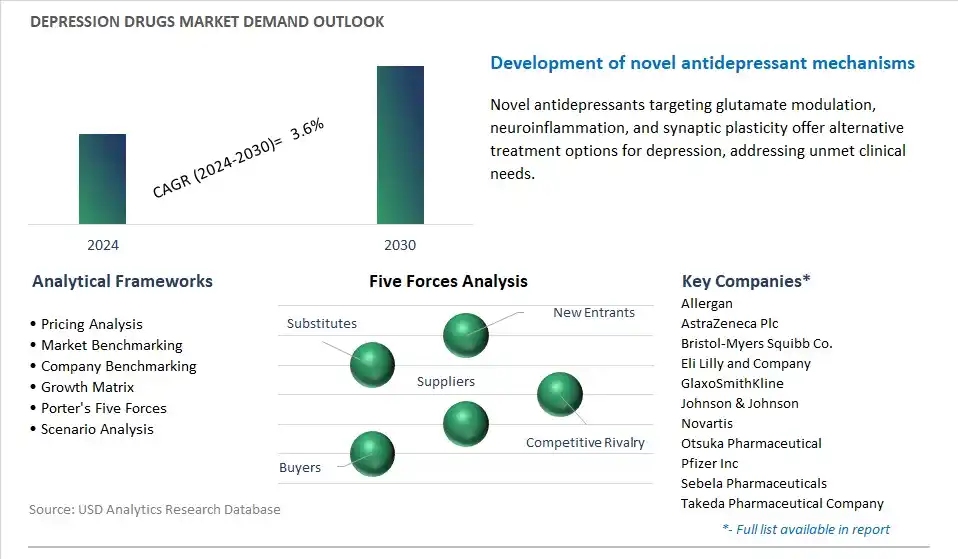
Depression Drugs Market is estimated to increase at a growth rate of 3.6% CAGR over the forecast period from 2024 to 2030.
The global Depression Drugs Market Study analyzes and forecasts the market size across 6 regions and 24 countries for diverse segments including By Drug Class (Atypical Antipsychotics, Serotonin-Norepinephrine Reuptake Inhibitors (SNRIs), Selective Serotonin Reuptake Inhibitors (SSRIs), Central Nervous System (CNS) Stimulants, Tricyclic Antidepressants, Monoamine Oxidase Inhibitors, Others), By Disorder (Major Depressive Disorder, Obsessive-Compulsive Disorder, Generalized Anxiety Disorder, Panic Disorder, Others), By Drug (Generic Drugs, Branded Drugs), By Distribution Channel (Hospital Pharmacies, Retail Pharmacies, Online Pharmacies, Others).
An Introduction to Depression Drugs Market in 2024
The Depression Drugs Market focuses on pharmaceuticals and medications used for the treatment of depression, mood disorders, and mental health conditions affecting emotional well-being, cognitive function, and behavior. Depression drugs include antidepressants, selective serotonin reuptake inhibitors (SSRIs), serotonin-norepinephrine reuptake inhibitors (SNRIs), tricyclic antidepressants (TCAs), and atypical antidepressants prescribed to manage depressive symptoms, improve mood stability, and enhance quality of life for patients with depression disorders.
Depression Drugs Market Competitive Landscape
The global Depression Drugs Industry is highly competitive with a large number of companies focusing on niche market segments. Amidst intense competitive conditions, Depression Drugs Companies are investing in new product launches and strengthening distribution channels. Key companies operating in the Depression Drugs Industry include- Allergan, AstraZeneca Plc, Bristol-Myers Squibb Co., Eli Lilly and Company, GlaxoSmithKline, Johnson & Johnson, Novartis, Otsuka Pharmaceutical, Pfizer Inc, Sebela Pharmaceuticals, Takeda Pharmaceutical Company, Zhejiang NHU Company Ltd.
Depression Drugs Market Trend: Rising Adoption of Novel Therapies and Personalized Medicine Approaches
One Market Trend in the depression drugs market is the rising adoption of novel therapies and personalized medicine approaches. Pharmaceutical companies and healthcare providers are exploring innovative drug candidates, including novel mechanisms of action, biologics, and digital therapeutics, to address the diverse needs of patients with depression. Additionally, there is a growing emphasis on personalized medicine approaches that consider individual patient characteristics, biomarkers, and genetic factors to optimize treatment outcomes. This trend reflects the evolving landscape of depression treatment towards more targeted and effective therapeutic interventions.
Depression Drugs Market Driver: Increasing Awareness and Recognition of Mental Health Disorders
The driver behind the demand for depression drugs is the increasing awareness and recognition of mental health disorders, including depression, on a global scale. With growing efforts to reduce stigma and improve mental health literacy, more individuals are seeking diagnosis and treatment for depression. Additionally, healthcare providers are becoming better equipped to identify and address mental health issues, leading to increased diagnosis rates and treatment-seeking behavior among patients. This heightened awareness of depression as a significant public health concern is driving the demand for pharmacological interventions and contributing to market growth in the depression drugs segment.
Depression Drugs Market Opportunity: Development of Targeted Therapies and Biomarker-Based Treatments
An opportunity exists for pharmaceutical companies to develop targeted therapies and biomarker-based treatments for depression, offering more precise and personalized treatment options for patients. By identifying specific molecular targets and biomarkers associated with different subtypes of depression, researchers can develop drugs that are more effective and better tolerated than traditional antidepressants. Additionally, integrating biomarker testing into clinical practice can enable healthcare providers to tailor treatment strategies based on individual patient characteristics, improving treatment response rates and reducing the risk of adverse effects. By capitalizing on this opportunity, pharmaceutical companies can address unmet needs in depression treatment, enhance patient outcomes, and differentiate their products in the competitive depression drugs market.
Market Share Analysis: Depression Drugs for Serotonin-Norepinephrine Reuptake Inhibitors (SNRIs) is the fastest growing segment in the Depression Drugs industry
Among the various drug classes for depression, Serotonin-Norepinephrine Reuptake Inhibitors (SNRIs) are experiencing the fastest growth. This surge is propelled by several factors, including their efficacy in treating depression, anxiety disorders, and chronic pain conditions, as well as their favorable side effect profile compared to older antidepressant medications. SNRIs work by increasing the levels of serotonin and norepinephrine in the brain, which are neurotransmitters involved in mood regulation and pain perception. Their dual mechanism of action provides a broader spectrum of therapeutic effects, making them particularly beneficial for individuals with comorbid depression and chronic pain. Moreover, SNRIs are well-tolerated by most patients and are associated with fewer side effects such as weight gain and sexual dysfunction compared to some other classes of antidepressants. As healthcare providers increasingly recognize the efficacy and tolerability of SNRIs in managing depression and related disorders, the demand for these medications continues to grow. With advancements in drug formulation and expanded indications for SNRIs, they remain a cornerstone in the pharmacological treatment of depression, offering patients relief from symptoms and improved quality of life.
Depression Drugs Market Segmentation
By Drug Class
Atypical Antipsychotics
Serotonin-Norepinephrine Reuptake Inhibitors (SNRIs)
Selective Serotonin Reuptake Inhibitors (SSRIs)
Central Nervous System (CNS) Stimulants
Tricyclic Antidepressants
Monoamine Oxidase Inhibitors
Others
By Disorder
Major Depressive Disorder
Obsessive-Compulsive Disorder
Generalized Anxiety Disorder
Panic Disorder
Others
By Drug
Generic Drugs
Branded Drugs
By Distribution Channel
Hospital Pharmacies
Retail Pharmacies
Online Pharmacies
Others
Geographical Analysis
North America (United States, Canada, Mexico)
Europe (Germany, France, United Kingdom, Spain, Italy, Rest of Europe)
Asia Pacific (China, India, Japan, South Korea, Rest of Asia Pacific)
South America (Brazil, Argentina, Rest of South America)
Middle East and Africa (Saudi Arabia, UAE, Rest of Middle East, South Africa, Egypt, Rest of Africa)
Depression Drugs Companies
Allergan
AstraZeneca Plc
Bristol-Myers Squibb Co.
Eli Lilly and Company
GlaxoSmithKline
Johnson & Johnson
Novartis
Otsuka Pharmaceutical
Pfizer Inc
Sebela Pharmaceuticals
Takeda Pharmaceutical Company
Zhejiang NHU Company Ltd
* List not Exhaustive
Reasons to Buy the Depression Drugs Market Study
• Deepen your industry insights and navigate uncertainties for strategy formulation, CAPEX, and Operational decisions
• Gain access to detailed insights on the Depression Drugs Market, encompassing current market size, growth trends, and forecasts till 2030.
• Access detailed competitor analysis, enabling competitive advantage through a thorough understanding of market players, strategies, and potential differentiation opportunities
• Stay ahead of the curve with insights on technological advancements, innovations, and upcoming trends
• Identify lucrative investment avenues and expansion opportunities within the Depression Drugs Industry, guided by robust, data-backed analysis.
• Understand regional and global markets through country-wise analysis, regional market potential, regulatory nuances, and dynamics
• Execute strategies with confidence and speed through information, analytics, and insights on the industry value chain
• Corporate leaders, strategists, financial experts, shareholders, asset managers, and governmental representatives can make long-term planning scenarios and build an integrated and timely understanding of market dynamics
• Benefit from tailored solutions and expert consultation based on report insights, providing personalized strategies aligned with specific business needs.
TABLE OF CONTENTS
1 Introduction to 2024 Depression Drugs Market
1.1 Market Overview
1.2 Quick Facts
1.3 Scope/Objective of the Study
1.4 Market Definition
1.5 Countries and Regions Analyzed
1.6 Units, Currency, and Conversions
1.7 Industry Value Chain
2 Research Methodology
2.1 Market Size Estimation
2.2 Sources and Research Methodology
2.3 Data Triangulation
2.4 Assumptions and Limitations
3 Executive Summary
3.1 Global Depression Drugs Market Size Outlook, $ Million, 2021 to 2030
3.2 Depression Drugs Market Outlook by Type, $ Million, 2021 to 2030
3.3 Depression Drugs Market Outlook by Product, $ Million, 2021 to 2030
3.4 Depression Drugs Market Outlook by Application, $ Million, 2021 to 2030
3.5 Depression Drugs Market Outlook by Key Countries, $ Million, 2021 to 2030
4 Market Dynamics
4.1 Key Driving Forces of Depression Drugs Industry
4.2 Key Market Trends in Depression Drugs Industry
4.3 Potential Opportunities in Depression Drugs Industry
4.4 Key Challenges in Depression Drugs Industry
5 Market Factor Analysis
5.1 Value Chain Analysis
5.2 Competitive Landscape
5.2.1 Global Depression Drugs Market Share by Company (%), 2023
5.2.2 Product Offerings by Company
5.3 Porter’s Five Forces Analysis
5.4 Pricing Analysis and Outlook
6 Growth Outlook Across Scenarios
6.1 Growth Analysis-Case Scenario Definitions
6.2 Low Growth Scenario Forecasts
6.3 Reference Growth Scenario Forecasts
6.4 High Growth Scenario Forecasts
7 Global Depression Drugs Market Outlook by Segments
7.1 Depression Drugs Market Outlook by Segments, $ Million, 2021- 2030
By Drug Class
Atypical Antipsychotics
Serotonin-Norepinephrine Reuptake Inhibitors (SNRIs)
Selective Serotonin Reuptake Inhibitors (SSRIs)
Central Nervous System (CNS) Stimulants
Tricyclic Antidepressants
Monoamine Oxidase Inhibitors
Others
By Disorder
Major Depressive Disorder
Obsessive-Compulsive Disorder
Generalized Anxiety Disorder
Panic Disorder
Others
By Drug
Generic Drugs
Branded Drugs
By Distribution Channel
Hospital Pharmacies
Retail Pharmacies
Online Pharmacies
Others
8 North America Depression Drugs Market Analysis and Outlook To 2030
8.1 Introduction to North America Depression Drugs Markets in 2024
8.2 North America Depression Drugs Market Size Outlook by Country, 2021-2030
8.2.1 United States
8.2.2 Canada
8.2.3 Mexico
8.3 North America Depression Drugs Market size Outlook by Segments, 2021-2030
By Drug Class
Atypical Antipsychotics
Serotonin-Norepinephrine Reuptake Inhibitors (SNRIs)
Selective Serotonin Reuptake Inhibitors (SSRIs)
Central Nervous System (CNS) Stimulants
Tricyclic Antidepressants
Monoamine Oxidase Inhibitors
Others
By Disorder
Major Depressive Disorder
Obsessive-Compulsive Disorder
Generalized Anxiety Disorder
Panic Disorder
Others
By Drug
Generic Drugs
Branded Drugs
By Distribution Channel
Hospital Pharmacies
Retail Pharmacies
Online Pharmacies
Others
9 Europe Depression Drugs Market Analysis and Outlook To 2030
9.1 Introduction to Europe Depression Drugs Markets in 2024
9.2 Europe Depression Drugs Market Size Outlook by Country, 2021-2030
9.2.1 Germany
9.2.2 France
9.2.3 Spain
9.2.4 United Kingdom
9.2.4 Italy
9.2.5 Russia
9.2.6 Norway
9.2.7 Rest of Europe
9.3 Europe Depression Drugs Market Size Outlook by Segments, 2021-2030
By Drug Class
Atypical Antipsychotics
Serotonin-Norepinephrine Reuptake Inhibitors (SNRIs)
Selective Serotonin Reuptake Inhibitors (SSRIs)
Central Nervous System (CNS) Stimulants
Tricyclic Antidepressants
Monoamine Oxidase Inhibitors
Others
By Disorder
Major Depressive Disorder
Obsessive-Compulsive Disorder
Generalized Anxiety Disorder
Panic Disorder
Others
By Drug
Generic Drugs
Branded Drugs
By Distribution Channel
Hospital Pharmacies
Retail Pharmacies
Online Pharmacies
Others
10 Asia Pacific Depression Drugs Market Analysis and Outlook To 2030
10.1 Introduction to Asia Pacific Depression Drugs Markets in 2024
10.2 Asia Pacific Depression Drugs Market Size Outlook by Country, 2021-2030
10.2.1 China
10.2.2 India
10.2.3 Japan
10.2.4 South Korea
10.2.5 Indonesia
10.2.6 Malaysia
10.2.7 Australia
10.2.8 Rest of Asia Pacific
10.3 Asia Pacific Depression Drugs Market size Outlook by Segments, 2021-2030
By Drug Class
Atypical Antipsychotics
Serotonin-Norepinephrine Reuptake Inhibitors (SNRIs)
Selective Serotonin Reuptake Inhibitors (SSRIs)
Central Nervous System (CNS) Stimulants
Tricyclic Antidepressants
Monoamine Oxidase Inhibitors
Others
By Disorder
Major Depressive Disorder
Obsessive-Compulsive Disorder
Generalized Anxiety Disorder
Panic Disorder
Others
By Drug
Generic Drugs
Branded Drugs
By Distribution Channel
Hospital Pharmacies
Retail Pharmacies
Online Pharmacies
Others
11 South America Depression Drugs Market Analysis and Outlook To 2030
11.1 Introduction to South America Depression Drugs Markets in 2024
11.2 South America Depression Drugs Market Size Outlook by Country, 2021-2030
11.2.1 Brazil
11.2.2 Argentina
11.2.3 Rest of South America
11.3 South America Depression Drugs Market size Outlook by Segments, 2021-2030
By Drug Class
Atypical Antipsychotics
Serotonin-Norepinephrine Reuptake Inhibitors (SNRIs)
Selective Serotonin Reuptake Inhibitors (SSRIs)
Central Nervous System (CNS) Stimulants
Tricyclic Antidepressants
Monoamine Oxidase Inhibitors
Others
By Disorder
Major Depressive Disorder
Obsessive-Compulsive Disorder
Generalized Anxiety Disorder
Panic Disorder
Others
By Drug
Generic Drugs
Branded Drugs
By Distribution Channel
Hospital Pharmacies
Retail Pharmacies
Online Pharmacies
Others
12 Middle East and Africa Depression Drugs Market Analysis and Outlook To 2030
12.1 Introduction to Middle East and Africa Depression Drugs Markets in 2024
12.2 Middle East and Africa Depression Drugs Market Size Outlook by Country, 2021-2030
12.2.1 Saudi Arabia
12.2.2 UAE
12.2.3 Oman
12.2.4 Rest of Middle East
12.2.5 Egypt
12.2.6 Nigeria
12.2.7 South Africa
12.2.8 Rest of Africa
12.3 Middle East and Africa Depression Drugs Market size Outlook by Segments, 2021-2030
By Drug Class
Atypical Antipsychotics
Serotonin-Norepinephrine Reuptake Inhibitors (SNRIs)
Selective Serotonin Reuptake Inhibitors (SSRIs)
Central Nervous System (CNS) Stimulants
Tricyclic Antidepressants
Monoamine Oxidase Inhibitors
Others
By Disorder
Major Depressive Disorder
Obsessive-Compulsive Disorder
Generalized Anxiety Disorder
Panic Disorder
Others
By Drug
Generic Drugs
Branded Drugs
By Distribution Channel
Hospital Pharmacies
Retail Pharmacies
Online Pharmacies
Others
13 Company Profiles
13.1 Company Snapshot
13.2 SWOT Profiles
13.3 Products and Services
13.4 Recent Developments
13.5 Financial Profile
List of Companies
Allergan
AstraZeneca Plc
Bristol-Myers Squibb Co.
Eli Lilly and Company
GlaxoSmithKline
Johnson & Johnson
Novartis
Otsuka Pharmaceutical
Pfizer Inc
Sebela Pharmaceuticals
Takeda Pharmaceutical Company
Zhejiang NHU Company Ltd
14 Appendix
14.1 Customization Offerings
14.2 Subscription Services
14.3 Related Reports
14.4 Publisher Expertise
