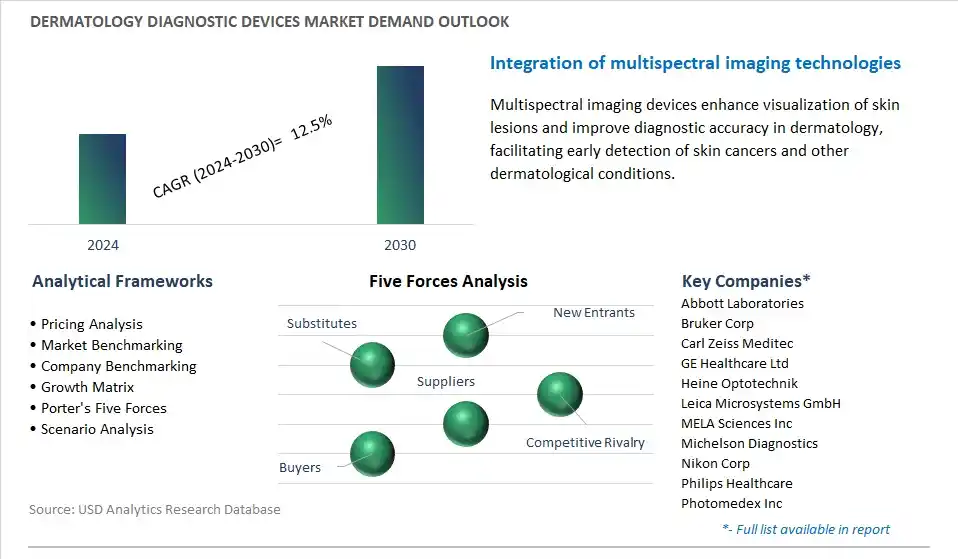
Dermatology Diagnostic Devices Market is estimated to increase at a growth rate of 12.5% CAGR over the forecast period from 2024 to 2030.
The global Dermatology Diagnostic Devices Market Study analyzes and forecasts the market size across 6 regions and 24 countries for diverse segments including By Product (Imaging Devices, Microscopes, Immunoassays, Molecular Diagnostics, Others), By End-User (Hospitals , Diagnostic Labs, Others).
An Introduction to Dermatology Diagnostic Devices Market in 2024
The Dermatology Diagnostic Devices Market involves diagnostic tools, imaging technologies, and devices used in dermatology for skin assessments, lesion evaluations, and dermatologic diagnoses. Dermatology diagnostic devices include dermatoscopes, skin imaging systems, mole mapping devices, and skin biopsies used to examine skin lesions, moles, and skin abnormalities, aiding dermatologists in early detection, skin cancer screening, and treatment planning for dermatological conditions.
Dermatology Diagnostic Devices Market Competitive Landscape
The global Dermatology Diagnostic Devices Industry is highly competitive with a large number of companies focusing on niche market segments. Amidst intense competitive conditions, Dermatology Diagnostic Devices Companies are investing in new product launches and strengthening distribution channels. Key companies operating in the Dermatology Diagnostic Devices Industry include- Abbott Laboratories , Bruker Corp, Carl Zeiss Meditec, GE Healthcare Ltd, Heine Optotechnik, Leica Microsystems GmbH, MELA Sciences Inc, Michelson Diagnostics , Nikon Corp, Philips Healthcare , Photomedex Inc, F. Hoffmann-La Roche Ltd, Siemens Healthcare Diagnostics Inc, Strata Skin Sciences, Toshiba Medical Systems Corp, Welch Allyn.
Dermatology Diagnostic Devices Market Trend: Advancements in Imaging Technologies and Digital Dermoscopy
One Market Trend in the dermatology diagnostic devices market is the advancements in imaging technologies and digital dermoscopy. Dermatology diagnostic devices are increasingly incorporating high-resolution imaging capabilities, such as confocal microscopy, multispectral imaging, and reflectance confocal microscopy, to provide detailed visualization of skin lesions and abnormalities. Digital dermoscopy systems, equipped with advanced software for image analysis and comparison, are also gaining popularity among dermatologists for non-invasive evaluation of pigmented lesions. This trend is driven by the growing demand for accurate and objective diagnostic tools that aid in the early detection of skin cancer and other dermatological conditions, leading to improved patient outcomes and treatment efficacy.
Dermatology Diagnostic Devices Market Driver: Rising Incidence of Skin Cancer and Dermatological Disorders
The driver behind the demand for dermatology diagnostic devices is the rising incidence of skin cancer and dermatological disorders worldwide. Factors such as sun exposure, environmental pollution, genetic predisposition, and lifestyle changes contribute to the prevalence of skin conditions such as melanoma, basal cell carcinoma, squamous cell carcinoma, and inflammatory skin disorders. With increasing awareness of skin health and the importance of early diagnosis, dermatologists and healthcare providers are investing in advanced diagnostic devices to facilitate accurate and timely detection of skin lesions, enabling prompt intervention and treatment. This growing demand for dermatology diagnostic devices is fueled by the need for effective tools to address the rising burden of skin cancer and dermatological diseases.
Dermatology Diagnostic Devices Market Opportunity: Development of Portable and Point-of-Care Diagnostic Devices
An opportunity exists for manufacturers of dermatology diagnostic devices to develop portable and point-of-care devices, offering convenient and accessible diagnostic solutions for healthcare providers and patients. By miniaturizing imaging technologies and incorporating wireless connectivity, manufacturers can create handheld devices that enable dermatologists to perform on-site evaluations, screenings, and follow-up assessments in various clinical settings, including primary care offices, dermatology clinics, and mobile healthcare units. Additionally, developing user-friendly interfaces and automated diagnostic algorithms can empower non-specialists, such as primary care physicians and nurse practitioners, to perform dermatological evaluations and triage patients efficiently. By capitalizing on this opportunity, manufacturers can expand their market reach, improve healthcare access, and enhance patient outcomes in dermatology practice.
Market Share Analysis: Dermatology Diagnostic Devices for Molecular Diagnostics is the fastest growing segment in the Dermatology Diagnostic Devices industry
Among the various dermatology diagnostic devices, Molecular Diagnostics is experiencing the fastest growth. This surge is driven by several factors, including the increasing demand for accurate and rapid diagnostic methods in dermatology, advancements in molecular biology techniques, and the expanding understanding of the genetic basis of dermatological conditions. Molecular diagnostics offer the capability to detect and analyze specific DNA or RNA sequences associated with various dermatological diseases, allowing for precise diagnosis, prognosis, and personalized treatment approaches. These techniques enable dermatologists to identify genetic mutations, biomarkers, and infectious agents implicated in skin disorders such as melanoma, skin cancer, and infectious dermatitis with high sensitivity and specificity. Additionally, the growing adoption of molecular diagnostic devices in hospital settings, diagnostic labs, and specialized dermatology clinics further propels the market growth. As the field of dermatology continues to embrace molecular diagnostic technologies for enhanced patient care and treatment outcomes, the market for molecular diagnostic devices is expected to continue its rapid expansion in the foreseeable future.
Dermatology Diagnostic Devices Market Segmentation
By Product
Imaging Devices
Microscopes
Immunoassays
Molecular Diagnostics
Others
By End User
Hospitals
Diagnostic Labs
Others
Geographical Analysis
North America (United States, Canada, Mexico)
Europe (Germany, France, United Kingdom, Spain, Italy, Rest of Europe)
Asia Pacific (China, India, Japan, South Korea, Rest of Asia Pacific)
South America (Brazil, Argentina, Rest of South America)
Middle East and Africa (Saudi Arabia, UAE, Rest of Middle East, South Africa, Egypt, Rest of Africa)
Dermatology Diagnostic Devices Companies
Abbott Laboratories
Bruker Corp
Carl Zeiss Meditec
GE Healthcare Ltd
Heine Optotechnik
Leica Microsystems GmbH
MELA Sciences Inc
Michelson Diagnostics
Nikon Corp
Philips Healthcare
Photomedex Inc
F. Hoffmann-La Roche Ltd
Siemens Healthcare Diagnostics Inc
Strata Skin Sciences
Toshiba Medical Systems Corp
Welch Allyn
* List not Exhaustive
Reasons to Buy the Dermatology Diagnostic Devices Market Study
• Deepen your industry insights and navigate uncertainties for strategy formulation, CAPEX, and Operational decisions
• Gain access to detailed insights on the Dermatology Diagnostic Devices Market, encompassing current market size, growth trends, and forecasts till 2030.
• Access detailed competitor analysis, enabling competitive advantage through a thorough understanding of market players, strategies, and potential differentiation opportunities
• Stay ahead of the curve with insights on technological advancements, innovations, and upcoming trends
• Identify lucrative investment avenues and expansion opportunities within the Dermatology Diagnostic Devices Industry, guided by robust, data-backed analysis.
• Understand regional and global markets through country-wise analysis, regional market potential, regulatory nuances, and dynamics
• Execute strategies with confidence and speed through information, analytics, and insights on the industry value chain
• Corporate leaders, strategists, financial experts, shareholders, asset managers, and governmental representatives can make long-term planning scenarios and build an integrated and timely understanding of market dynamics
• Benefit from tailored solutions and expert consultation based on report insights, providing personalized strategies aligned with specific business needs.
TABLE OF CONTENTS
1 Introduction to 2024 Dermatology Diagnostic Devices Market
1.1 Market Overview
1.2 Quick Facts
1.3 Scope/Objective of the Study
1.4 Market Definition
1.5 Countries and Regions Analyzed
1.6 Units, Currency, and Conversions
1.7 Industry Value Chain
2 Research Methodology
2.1 Market Size Estimation
2.2 Sources and Research Methodology
2.3 Data Triangulation
2.4 Assumptions and Limitations
3 Executive Summary
3.1 Global Dermatology Diagnostic Devices Market Size Outlook, $ Million, 2021 to 2030
3.2 Dermatology Diagnostic Devices Market Outlook by Type, $ Million, 2021 to 2030
3.3 Dermatology Diagnostic Devices Market Outlook by Product, $ Million, 2021 to 2030
3.4 Dermatology Diagnostic Devices Market Outlook by Application, $ Million, 2021 to 2030
3.5 Dermatology Diagnostic Devices Market Outlook by Key Countries, $ Million, 2021 to 2030
4 Market Dynamics
4.1 Key Driving Forces of Dermatology Diagnostic Devices Industry
4.2 Key Market Trends in Dermatology Diagnostic Devices Industry
4.3 Potential Opportunities in Dermatology Diagnostic Devices Industry
4.4 Key Challenges in Dermatology Diagnostic Devices Industry
5 Market Factor Analysis
5.1 Value Chain Analysis
5.2 Competitive Landscape
5.2.1 Global Dermatology Diagnostic Devices Market Share by Company (%), 2023
5.2.2 Product Offerings by Company
5.3 Porter’s Five Forces Analysis
5.4 Pricing Analysis and Outlook
6 Growth Outlook Across Scenarios
6.1 Growth Analysis-Case Scenario Definitions
6.2 Low Growth Scenario Forecasts
6.3 Reference Growth Scenario Forecasts
6.4 High Growth Scenario Forecasts
7 Global Dermatology Diagnostic Devices Market Outlook by Segments
7.1 Dermatology Diagnostic Devices Market Outlook by Segments, $ Million, 2021- 2030
By Product
Imaging Devices
Microscopes
Immunoassays
Molecular Diagnostics
Others
By End User
Hospitals
Diagnostic Labs
Others
8 North America Dermatology Diagnostic Devices Market Analysis and Outlook To 2030
8.1 Introduction to North America Dermatology Diagnostic Devices Markets in 2024
8.2 North America Dermatology Diagnostic Devices Market Size Outlook by Country, 2021-2030
8.2.1 United States
8.2.2 Canada
8.2.3 Mexico
8.3 North America Dermatology Diagnostic Devices Market size Outlook by Segments, 2021-2030
By Product
Imaging Devices
Microscopes
Immunoassays
Molecular Diagnostics
Others
By End User
Hospitals
Diagnostic Labs
Others
9 Europe Dermatology Diagnostic Devices Market Analysis and Outlook To 2030
9.1 Introduction to Europe Dermatology Diagnostic Devices Markets in 2024
9.2 Europe Dermatology Diagnostic Devices Market Size Outlook by Country, 2021-2030
9.2.1 Germany
9.2.2 France
9.2.3 Spain
9.2.4 United Kingdom
9.2.4 Italy
9.2.5 Russia
9.2.6 Norway
9.2.7 Rest of Europe
9.3 Europe Dermatology Diagnostic Devices Market Size Outlook by Segments, 2021-2030
By Product
Imaging Devices
Microscopes
Immunoassays
Molecular Diagnostics
Others
By End User
Hospitals
Diagnostic Labs
Others
10 Asia Pacific Dermatology Diagnostic Devices Market Analysis and Outlook To 2030
10.1 Introduction to Asia Pacific Dermatology Diagnostic Devices Markets in 2024
10.2 Asia Pacific Dermatology Diagnostic Devices Market Size Outlook by Country, 2021-2030
10.2.1 China
10.2.2 India
10.2.3 Japan
10.2.4 South Korea
10.2.5 Indonesia
10.2.6 Malaysia
10.2.7 Australia
10.2.8 Rest of Asia Pacific
10.3 Asia Pacific Dermatology Diagnostic Devices Market size Outlook by Segments, 2021-2030
By Product
Imaging Devices
Microscopes
Immunoassays
Molecular Diagnostics
Others
By End User
Hospitals
Diagnostic Labs
Others
11 South America Dermatology Diagnostic Devices Market Analysis and Outlook To 2030
11.1 Introduction to South America Dermatology Diagnostic Devices Markets in 2024
11.2 South America Dermatology Diagnostic Devices Market Size Outlook by Country, 2021-2030
11.2.1 Brazil
11.2.2 Argentina
11.2.3 Rest of South America
11.3 South America Dermatology Diagnostic Devices Market size Outlook by Segments, 2021-2030
By Product
Imaging Devices
Microscopes
Immunoassays
Molecular Diagnostics
Others
By End User
Hospitals
Diagnostic Labs
Others
12 Middle East and Africa Dermatology Diagnostic Devices Market Analysis and Outlook To 2030
12.1 Introduction to Middle East and Africa Dermatology Diagnostic Devices Markets in 2024
12.2 Middle East and Africa Dermatology Diagnostic Devices Market Size Outlook by Country, 2021-2030
12.2.1 Saudi Arabia
12.2.2 UAE
12.2.3 Oman
12.2.4 Rest of Middle East
12.2.5 Egypt
12.2.6 Nigeria
12.2.7 South Africa
12.2.8 Rest of Africa
12.3 Middle East and Africa Dermatology Diagnostic Devices Market size Outlook by Segments, 2021-2030
By Product
Imaging Devices
Microscopes
Immunoassays
Molecular Diagnostics
Others
By End User
Hospitals
Diagnostic Labs
Others
13 Company Profiles
13.1 Company Snapshot
13.2 SWOT Profiles
13.3 Products and Services
13.4 Recent Developments
13.5 Financial Profile
List of Companies
Abbott Laboratories
Bruker Corp
Carl Zeiss Meditec
GE Healthcare Ltd
Heine Optotechnik
Leica Microsystems GmbH
MELA Sciences Inc
Michelson Diagnostics
Nikon Corp
Philips Healthcare
Photomedex Inc
F. Hoffmann-La Roche Ltd
Siemens Healthcare Diagnostics Inc
Strata Skin Sciences
Toshiba Medical Systems Corp
Welch Allyn
14 Appendix
14.1 Customization Offerings
14.2 Subscription Services
14.3 Related Reports
14.4 Publisher Expertise
