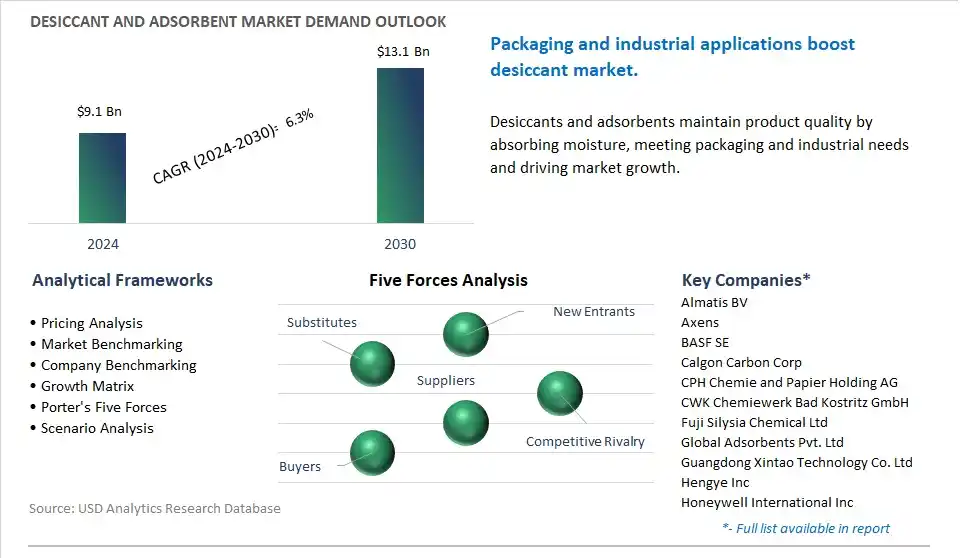
The global Desiccant and Adsorbent Market is poised to register a 6.3% CAGR from $9.1 Billion in 2024 to $13.1 Billion in 2030.
The global Desiccant and Adsorbent Market Study analyzes and forecasts the market size across 6 regions and 24 countries for diverse segments -By Product (Activated Carbon, Silica Gel, Ceramic Balls, Others).
An Introduction to Global Desiccant and Adsorbent Market in 2024
The market for desiccants and adsorbents is witnessing growth, driven by the increasing demand for moisture control, odor elimination, and gas purification solutions in various industrial, pharmaceutical, food, and consumer applications. Key trends shaping the future of the industry include advancements in desiccant materials, manufacturing processes, and application technologies to meet the evolving needs of end-users for efficient, safe, and sustainable moisture management solutions. Manufacturers are focusing on developing desiccants and adsorbents with high adsorption capacity, rapid kinetics, and regenerability to maintain product quality, extend shelf life, and enhance performance in sensitive products and environments. Additionally, there is a growing emphasis on eco-friendly, reusable, and recyclable desiccant options, driven by regulatory requirements, environmental concerns, and consumer preferences for sustainable packaging and product protection solutions. Moreover, advancements in nanotechnology, surface modification, and functionalization are driving innovation in desiccant and adsorbent materials, enabling the development of tailored solutions for specific applications such as humidity control, gas separation, and VOC (volatile organic compound) removal. Furthermore, collaborations between desiccant manufacturers, packaging companies, and end-users are shaping the development of integrated packaging solutions, moisture barrier materials, and moisture-sensitive product protection strategies that optimize product performance, reduce waste, and enhance sustainability throughout the supply chain. Overall, the future of desiccants and adsorbents lies in continuous innovation, collaboration, and sustainability initiatives to address emerging market needs, technological challenges, and environmental concerns while providing effective and efficient solutions for moisture management, odor control, and gas purification in diverse industries and applications.
Desiccant and Adsorbent Market Competitive Landscape
The market report analyses the leading companies in the industry including Almatis BV, Axens, BASF SE, Calgon Carbon Corp, CPH Chemie and Papier Holding AG, CWK Chemiewerk Bad Kostritz GmbH, Fuji Silysia Chemical Ltd, Global Adsorbents Pvt. Ltd, Guangdong Xintao Technology Co. Ltd, Hengye Inc, Honeywell International Inc, KNT Group, Merck KGaA, Osaka Gas Chemicals Co. Ltd, Shanghai Jiuzhou Chemicals Co. Ltd, Standard Industries Inc, XINTAO Network Studio, Zeolites and Allied Products Pvt. Ltd, Zhongbao molecular sieve Co. Ltd, ZR Catalyst Co. Ltd.
Desiccant and Adsorbent Market Dynamics
Desiccant and Adsorbent Market Trend: Increasing Focus on Sustainability and Eco-friendly Solutions
In the Desiccant and Adsorbent market, a prominent trend is the increasing focus on sustainability and eco-friendly solutions. As environmental concerns grow and regulations become stricter, industries are seeking alternatives to traditional desiccants and adsorbents that are derived from non-renewable resources or contain harmful chemicals. This trend is driven by consumer demand for environmentally conscious products, as well as corporate sustainability initiatives aimed at reducing carbon footprint and minimizing waste. Manufacturers in the desiccant and adsorbent industry are responding by developing innovative solutions made from renewable materials, such as silica gel, activated carbon, and natural zeolites, as well as by implementing eco-friendly production processes. As sustainability becomes a key consideration for businesses across various sectors, there's a rising market demand for green desiccants and adsorbents that offer effective moisture and odor control while minimizing environmental impact, driving growth and differentiation in the market.
Desiccant and Adsorbent Market Driver: Growth in Pharmaceutical and Food Packaging Industries
A significant driver in the Desiccant and Adsorbent market is the growth in the pharmaceutical and food packaging industries. Desiccants and adsorbents play a critical role in maintaining product quality and extending shelf life by controlling moisture, odor, and gas levels in packaging environments. With increasing consumer demand for safe and fresh products, pharmaceutical and food manufacturers are investing in advanced packaging solutions that ensure product integrity and compliance with regulatory standards. This driver is fueled by factors such as population growth, urbanization, and changing consumer lifestyles, which drive demand for packaged foods, pharmaceuticals, and healthcare products. As pharmaceutical and food packaging regulations become more stringent, there's a growing market demand for high-performance desiccants and adsorbents that meet specific moisture and odor control requirements, driving innovation and adoption in the market.
Desiccant and Adsorbent Market Opportunity: Expansion into Emerging Applications and Industries
A promising opportunity within the Desiccant and Adsorbent market lies in the expansion into emerging applications and industries. Opportunities exist for manufacturers to diversify their product portfolios and target new sectors where moisture and odor control are critical, such as electronics, automotive, and renewable energy. For example, in the electronics industry, desiccants are used to protect sensitive electronic components from moisture damage during storage and transportation. In the automotive industry, adsorbents are utilized in cabin air filtration systems to remove harmful gases and odors from vehicle interiors. Additionally, with the growing adoption of renewable energy technologies, such as fuel cells and lithium-ion batteries, there's a need for desiccants and adsorbents to ensure optimal performance and longevity. By identifying emerging applications and industries that require moisture and odor control solutions, manufacturers can capitalize on untapped market opportunities, expand their customer base, and drive revenue growth in the market.
Desiccant and Adsorbent Market Share Analysis: The Silica Gel generated the highest revenue in 2024
The largest segment in the Desiccant and Adsorbent Market is the Silica Gel category. Silica gel is a highly effective desiccant and adsorbent widely used in various industries due to its exceptional moisture-absorbing properties, stability, and versatility. It consists of porous silica particles that have a high surface area, allowing them to adsorb and retain moisture molecules effectively. Silica gel is commonly utilized in applications where moisture control is critical, such as pharmaceuticals, electronics, food packaging, and storage of sensitive materials. Its ability to maintain low humidity levels helps prevent moisture-related damage, degradation, and spoilage of products during transportation and storage. Further, silica gel is non-toxic, inert, and environmentally friendly, making it suitable for use in consumer products and applications where safety and regulatory compliance are paramount. As industries continue to prioritize moisture control and product protection, the demand for silica gel desiccants and adsorbents is expected to remain robust, maintaining its status as the largest segment in the Desiccant and Adsorbent Market.
Desiccant and Adsorbent Market Report Segmentation
By Product
Activated Carbon
Silica Gel
Ceramic Balls
Others
Regions Included
North America (US, Canada, Mexico)
Europe (Germany, UK, France, Spain, Italy, Russia, Rest of Europe)
Asia Pacific (China, India, Japan, South Korea, Australia, South East Asia, Rest of Asia)
South America (Brazil, Argentina, Rest of South America)
Middle East and Africa (Saudi Arabia, UAE, Rest of Middle East, South Africa, Egypt, Rest of Africa)
Desiccant and Adsorbent Companies Profiled in the Market Study
Almatis BV
Axens
BASF SE
Calgon Carbon Corp
CPH Chemie and Papier Holding AG
CWK Chemiewerk Bad Kostritz GmbH
Fuji Silysia Chemical Ltd
Global Adsorbents Pvt. Ltd
Guangdong Xintao Technology Co. Ltd
Hengye Inc
Honeywell International Inc
KNT Group
Merck KGaA
Osaka Gas Chemicals Co. Ltd
Shanghai Jiuzhou Chemicals Co. Ltd
Standard Industries Inc
XINTAO Network Studio
Zeolites and Allied Products Pvt. Ltd
Zhongbao molecular sieve Co. Ltd
ZR Catalyst Co. Ltd
*- List Not Exhaustive
TABLE OF CONTENTS
1 Introduction to 2024 Desiccant and Adsorbent Market
1.1 Market Overview
1.2 Quick Facts
1.3 Scope/Objective of the Study
1.4 Market Definition
1.5 Countries and Regions Covered
1.6 Units, Currency, and Conversions
1.7 Industry Value Chain
2 Research Methodology
2.1 Market Size Estimation
2.2 Sources and Research Methodology
2.3 Data Triangulation
2.4 Assumptions and Limitations
3 Executive Summary
3.1 Global Desiccant and Adsorbent Market Size Outlook, $ Million, 2021 to 2030
3.2 Desiccant and Adsorbent Market Outlook by Type, $ Million, 2021 to 2030
3.3 Desiccant and Adsorbent Market Outlook by Product, $ Million, 2021 to 2030
3.4 Desiccant and Adsorbent Market Outlook by Application, $ Million, 2021 to 2030
3.5 Desiccant and Adsorbent Market Outlook by Key Countries, $ Million, 2021 to 2030
4 Market Dynamics
4.1 Key Driving Forces of Desiccant and Adsorbent Industry
4.2 Key Market Trends in Desiccant and Adsorbent Industry
4.3 Potential Opportunities in Desiccant and Adsorbent Industry
4.4 Key Challenges in Desiccant and Adsorbent Industry
5 Market Factor Analysis
5.1 Value Chain Analysis
5.2 Competitive Landscape
5.2.1 Global Desiccant and Adsorbent Market Share by Company (%), 2023
5.2.2 Product Offerings by Company
5.3 Porter’s Five Forces Analysis
5.4 Pricing Analysis and Outlook
6 Growth Outlook Across Scenarios
6.1 Growth Analysis-Case Scenario Definitions
6.2 Low Growth Scenario Forecasts
6.3 Reference Growth Scenario Forecasts
6.4 High Growth Scenario Forecasts
7 Global Desiccant and Adsorbent Market Outlook by Segments
7.1 Desiccant and Adsorbent Market Outlook by Segments, $ Million, 2021- 2030
By Product
Activated Carbon
Silica Gel
Ceramic Balls
Others
8 North America Desiccant and Adsorbent Market Analysis and Outlook To 2030
8.1 Introduction to North America Desiccant and Adsorbent Markets in 2024
8.2 North America Desiccant and Adsorbent Market Size Outlook by Country, 2021-2030
8.2.1 United States
8.2.2 Canada
8.2.3 Mexico
8.3 North America Desiccant and Adsorbent Market size Outlook by Segments, 2021-2030
By Product
Activated Carbon
Silica Gel
Ceramic Balls
Others
9 Europe Desiccant and Adsorbent Market Analysis and Outlook To 2030
9.1 Introduction to Europe Desiccant and Adsorbent Markets in 2024
9.2 Europe Desiccant and Adsorbent Market Size Outlook by Country, 2021-2030
9.2.1 Germany
9.2.2 France
9.2.3 Spain
9.2.4 United Kingdom
9.2.4 Italy
9.2.5 Russia
9.2.6 Norway
9.2.7 Rest of Europe
9.3 Europe Desiccant and Adsorbent Market Size Outlook by Segments, 2021-2030
By Product
Activated Carbon
Silica Gel
Ceramic Balls
Others
10 Asia Pacific Desiccant and Adsorbent Market Analysis and Outlook To 2030
10.1 Introduction to Asia Pacific Desiccant and Adsorbent Markets in 2024
10.2 Asia Pacific Desiccant and Adsorbent Market Size Outlook by Country, 2021-2030
10.2.1 China
10.2.2 India
10.2.3 Japan
10.2.4 South Korea
10.2.5 Indonesia
10.2.6 Malaysia
10.2.7 Australia
10.2.8 Rest of Asia Pacific
10.3 Asia Pacific Desiccant and Adsorbent Market size Outlook by Segments, 2021-2030
By Product
Activated Carbon
Silica Gel
Ceramic Balls
Others
11 South America Desiccant and Adsorbent Market Analysis and Outlook To 2030
11.1 Introduction to South America Desiccant and Adsorbent Markets in 2024
11.2 South America Desiccant and Adsorbent Market Size Outlook by Country, 2021-2030
11.2.1 Brazil
11.2.2 Argentina
11.2.3 Rest of South America
11.3 South America Desiccant and Adsorbent Market size Outlook by Segments, 2021-2030
By Product
Activated Carbon
Silica Gel
Ceramic Balls
Others
12 Middle East and Africa Desiccant and Adsorbent Market Analysis and Outlook To 2030
12.1 Introduction to Middle East and Africa Desiccant and Adsorbent Markets in 2024
12.2 Middle East and Africa Desiccant and Adsorbent Market Size Outlook by Country, 2021-2030
12.2.1 Saudi Arabia
12.2.2 UAE
12.2.3 Oman
12.2.4 Rest of Middle East
12.2.5 Egypt
12.2.6 Nigeria
12.2.7 South Africa
12.2.8 Rest of Africa
12.3 Middle East and Africa Desiccant and Adsorbent Market size Outlook by Segments, 2021-2030
By Product
Activated Carbon
Silica Gel
Ceramic Balls
Others
13 Company Profiles
13.1 Company Snapshot
13.2 SWOT Profiles
13.3 Products and Services
13.4 Recent Developments
13.5 Financial Profile
Almatis BV
Axens
BASF SE
Calgon Carbon Corp
CPH Chemie and Papier Holding AG
CWK Chemiewerk Bad Kostritz GmbH
Fuji Silysia Chemical Ltd
Global Adsorbents Pvt. Ltd
Guangdong Xintao Technology Co. Ltd
Hengye Inc
Honeywell International Inc
KNT Group
Merck KGaA
Osaka Gas Chemicals Co. Ltd
Shanghai Jiuzhou Chemicals Co. Ltd
Standard Industries Inc
XINTAO Network Studio
Zeolites and Allied Products Pvt. Ltd
Zhongbao molecular sieve Co. Ltd
ZR Catalyst Co. Ltd
14 Appendix
14.1 Customization Offerings
14.2 Subscription Services
14.3 Related Reports
14.4 Publisher Expertise
By Product
Activated Carbon
Silica Gel
Ceramic Balls
Others
Countries Analyzed
North America (US, Canada, Mexico)
Europe (Germany, UK, France, Spain, Italy, Russia, Rest of Europe)
Asia Pacific (China, India, Japan, South Korea, Australia, South East Asia, Rest of Asia)
South America (Brazil, Argentina, Rest of South America)
Middle East and Africa (Saudi Arabia, UAE, Rest of Middle East, South Africa, Egypt, Rest of Africa)
