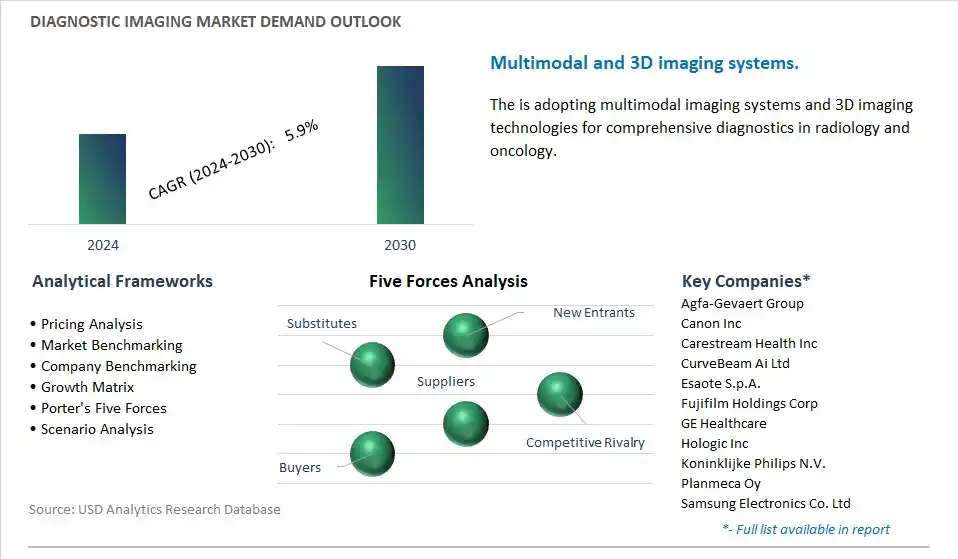
Diagnostic Imaging Market is estimated to increase at a Compounded Annual Growth Rate of 5.9% CAGR over the forecast period from 2024 to 2030
The Diagnostic Imaging Market study analyzes and forecasts the market size across 6 regions and 24 countries for diverse segments- By Modality (MRI, Computed Tomography, Ultrasound, X-Ray, Nuclear Imaging, Fluoroscopy, Mammography), By Application (Cardiology, Oncology, Neurology, Orthopedics, Gastroenterology, Gynecology, Others), By End-User (Hospital, Diagnostic Centers, Others).
An Introduction to Diagnostic Imaging Market in 2024
Diagnostic imaging encompasses a wide range of medical imaging techniques and modalities used to visualize internal structures and organs, diagnose diseases, and guide medical interventions. In 2024, diagnostic imaging plays a central role in clinical practice, providing healthcare providers with essential tools for accurate diagnosis, treatment planning, and monitoring of various medical conditions. Diagnostic imaging modalities include X-ray radiography, computed tomography (CT), magnetic resonance imaging (MRI), ultrasound, nuclear medicine imaging, and molecular imaging, each offering unique advantages for specific diagnostic scenarios and anatomical regions. These imaging techniques generate detailed images of the body's anatomy, physiology, and pathology, enabling healthcare providers to detect abnormalities, assess disease severity, and evaluate treatment responses. With advancements in imaging technology, software algorithms, and contrast agents, diagnostic imaging offers improved image quality, resolution, and diagnostic accuracy, enhancing the ability to detect and characterize diseases at earlier stages. Additionally, innovations such as artificial intelligence (AI), machine learning, and quantitative imaging analysis provide clinicians with advanced tools for image interpretation, risk prediction, and personalized treatment recommendations. By facilitating precise diagnosis and targeted interventions, diagnostic imaging contributes to improved patient outcomes, reduced healthcare costs, and enhanced quality of care across diverse medical specialties and healthcare settings.
Market Trend: Adoption of Artificial Intelligence (AI) and Machine Learning in Diagnostic Imaging
A significant trend in the diagnostic imaging market is the increasing adoption of artificial intelligence (AI) and machine learning technologies. AI algorithms are revolutionizing diagnostic imaging by enhancing image interpretation, enabling faster and more accurate diagnosis, and improving workflow efficiency. These advanced technologies can analyze medical images such as X-rays, CT scans, MRIs, and ultrasounds, detecting abnormalities, identifying patterns, and assisting radiologists in making diagnostic decisions. AI-powered diagnostic imaging solutions hold the potential to improve diagnostic accuracy, reduce interpretation errors, and optimize resource utilization in healthcare settings. The integration of AI and machine learning in diagnostic imaging represents a prominent trend driving innovation and growth in the field of medical imaging.
Market Driver: Aging Population and Increasing Disease Burden
A key driver fueling the diagnostic imaging market is the aging population and the consequent increase in the prevalence of chronic diseases. As the global population continues to age, there is a higher incidence of age-related conditions such as cardiovascular diseases, cancer, and neurological disorders, which require timely and accurate diagnostic imaging for early detection and management. Diagnostic imaging modalities such as MRI, CT, and PET scans play a crucial role in diagnosing and monitoring these conditions, facilitating treatment planning and improving patient outcomes. The growing disease burden and the need for comprehensive diagnostic evaluations drive the demand for advanced imaging technologies and imaging services, supporting market growth and investment in diagnostic imaging infrastructure worldwide.
Market Opportunity: Development of Point-of-Care and Portable Imaging Solutions
An opportunity within the diagnostic imaging market lies in the development of point-of-care and portable imaging solutions. Traditional diagnostic imaging systems are often bulky, expensive, and confined to specialized imaging centers or hospital settings, limiting their accessibility and usability in remote or resource-limited environments. There is a growing demand for compact, affordable, and portable imaging devices that can be used at the point of care, in ambulatory settings, or even in the field. Portable imaging solutions enable healthcare providers to perform imaging studies conveniently and rapidly at the patient's bedside, in outpatient clinics, or during medical missions in underserved communities. By developing point-of-care and portable imaging technologies, manufacturers can address unmet clinical needs, improve healthcare access, and expand market reach in diverse healthcare settings. This opportunity allows manufacturers to innovate and cater to the evolving demands of healthcare providers and patients for accessible and efficient diagnostic imaging solutions.
Diagnostic Imaging Market Share Analysis: Computed Tomography (CT) is the fastest growing segment over the forecast period to 2030
In the Diagnostic Imaging Market, the Computed Tomography (CT) segment emerges as the fastest-growing segment. This growth is propelled by several key factors. Firstly, CT imaging offers superior spatial resolution and tissue contrast, making it an indispensable tool for a wide range of diagnostic applications across various medical specialties. CT scanners generate detailed cross-sectional images of the body, enabling clinicians to visualize internal structures, organs, and pathological changes with exceptional clarity and precision. Additionally, advancements in CT technology, such as multidetector row CT (MDCT) scanners, dual-energy CT (DECT) scanners, and spectral CT imaging, have expanded the capabilities of CT imaging, allowing for faster scan times, improved image quality, and enhanced diagnostic accuracy. Moreover, CT imaging is versatile and can be used for diverse clinical indications, including trauma assessment, cancer staging, vascular imaging, musculoskeletal evaluation, and neuroimaging, among others. Furthermore, the growing prevalence of chronic diseases, such as cardiovascular disease, cancer, and neurological disorders, drives the demand for advanced diagnostic imaging modalities like CT scanning in hospitals, diagnostic centers, and other healthcare facilities. As clinicians increasingly rely on CT imaging for rapid and accurate diagnosis, treatment planning, and patient management, the Computed Tomography (CT) segment is experiencing rapid growth and is expected to continue expanding in the Diagnostic Imaging Market.
Diagnostic Imaging Competitive Analysis
The market research study provides in-depth insights into leading companies including the SWOT analyses, product profile, financial details, and recent developments acrossAgfa-Gevaert Group, Canon Inc, Carestream Health Inc, CurveBeam Ai Ltd, Esaote S.p.A., Fujifilm Holdings Corp, GE Healthcare, Hologic Inc, Koninklijke Philips N.V., Planmeca Oy, Samsung Electronics Co. Ltd, Shenzhen Mindray Bio-Medical Electronics Co. Ltd, Shimadzu Corp, Siemens Healthineers AG, SternMed GmbH
Diagnostic Imaging Market Segmentation
By Modality
MRI
Computed Tomography
Ultrasound
X-Ray
Nuclear Imaging
Fluoroscopy
Mammography
By Application
Cardiology
Oncology
Neurology
Orthopedics
Gastroenterology
Gynecology
Others
By End-User
Hospital
Diagnostic Centers
Others
Geographical Analysis
North America (United States, Canada, Mexico)
Europe (Germany, France, United Kingdom, Spain, Italy, Rest of Europe)
Asia Pacific (China, India, Japan, South Korea, Rest of Asia Pacific)
South America (Brazil, Argentina, Rest of South America)
Middle East and Africa (Saudi Arabia, UAE, Rest of Middle East, South Africa, Egypt, Rest of Africa)
Diagnostic Imaging Market Companies
Agfa-Gevaert Group
Canon Inc
Carestream Health Inc
CurveBeam Ai Ltd
Esaote S.p.A.
Fujifilm Holdings Corp
GE Healthcare
Hologic Inc
Koninklijke Philips N.V.
Planmeca Oy
Samsung Electronics Co. Ltd
Shenzhen Mindray Bio-Medical Electronics Co. Ltd
Shimadzu Corp
Siemens Healthineers AG
SternMed GmbH
Reasons to Buy the Diagnostic Imaging Market Study
• Deepen your industry insights and navigate uncertainties for strategy formulation, CAPEX, and Operational decisions
• Gain access to detailed insights on the Diagnostic Imaging Market, encompassing current market size, growth trends, and forecasts till 2030.
• Access detailed competitor analysis, enabling competitive advantage through a thorough understanding of market players, strategies, and potential differentiation opportunities
• Stay ahead of the curve with insights on technological advancements, innovations, and upcoming trends
• Identify lucrative investment avenues and expansion opportunities within the Diagnostic Imaging Market industry, guided by robust, data-backed analysis.
• Understand regional and global markets through country-wise analysis, regional market potential, regulatory nuances, and dynamics
• Execute strategies with confidence and speed through information, analytics, and insights on the industry value chain
• Corporate leaders, strategists, financial experts, shareholders, asset managers, and governmental representatives can make long-term planning scenarios and build an integrated and timely understanding of market dynamics
• Benefit from tailored solutions and expert consultation based on report insights, providing personalized strategies aligned with specific business needs.
TABLE OF CONTENTS
1 Introduction to 2024 Diagnostic Imaging Market
1.1 Market Overview
1.2 Quick Facts
1.3 Scope/Objective of the Study
1.4 Market Definition
1.5 Countries and Regions Covered
1.6 Units, Currency, and Conversions
1.7 Industry Value Chain
2 Research Methodology
2.1 Market Size Estimation
2.2 Sources and Research Methodology
2.3 Data Triangulation
2.4 Assumptions and Limitations
3 Executive Summary
3.1 Global Diagnostic Imaging Market Size Outlook, $ Million, 2021 to 2030
3.2 Diagnostic Imaging Market Outlook by Type, $ Million, 2021 to 2030
3.3 Diagnostic Imaging Market Outlook by Product, $ Million, 2021 to 2030
3.4 Diagnostic Imaging Market Outlook by Application, $ Million, 2021 to 2030
3.5 Diagnostic Imaging Market Outlook by Key Countries, $ Million, 2021 to 2030
4 Market Dynamics
4.1 Key Driving Forces of Diagnostic Imaging Industry
4.2 Key Market Trends in Diagnostic Imaging Industry
4.3 Potential Opportunities in Diagnostic Imaging Industry
4.4 Key Challenges in Diagnostic Imaging Industry
5 Market Factor Analysis
5.1 Value Chain Analysis
5.2 Competitive Landscape
5.2.1 Global Diagnostic Imaging Market Share by Company (%), 2023
5.2.2 Product Offerings by Company
5.3 Porter’s Five Forces Analysis
5.4 Pricing Analysis and Outlook
6 Growth Outlook Across Scenarios
6.1 Growth Analysis-Case Scenario Definitions
6.2 Low Growth Scenario Forecasts
6.3 Reference Growth Scenario Forecasts
6.4 High Growth Scenario Forecasts
7 Global Diagnostic Imaging Market Outlook by Segments
7.1 Diagnostic Imaging Market Outlook by Segments, $ Million, 2021- 2030
By Modality
MRI
Computed Tomography
Ultrasound
X-Ray
Nuclear Imaging
Fluoroscopy
Mammography
By Application
Cardiology
Oncology
Neurology
Orthopedics
Gastroenterology
Gynecology
Others
By End-User
Hospital
Diagnostic Centers
Others
8 North America Diagnostic Imaging Market Analysis and Outlook To 2030
8.1 Introduction to North America Diagnostic Imaging Markets in 2024
8.2 North America Diagnostic Imaging Market Size Outlook by Country, 2021-2030
8.2.1 United States
8.2.2 Canada
8.2.3 Mexico
8.3 North America Diagnostic Imaging Market size Outlook by Segments, 2021-2030
By Modality
MRI
Computed Tomography
Ultrasound
X-Ray
Nuclear Imaging
Fluoroscopy
Mammography
By Application
Cardiology
Oncology
Neurology
Orthopedics
Gastroenterology
Gynecology
Others
By End-User
Hospital
Diagnostic Centers
Others
9 Europe Diagnostic Imaging Market Analysis and Outlook To 2030
9.1 Introduction to Europe Diagnostic Imaging Markets in 2024
9.2 Europe Diagnostic Imaging Market Size Outlook by Country, 2021-2030
9.2.1 Germany
9.2.2 France
9.2.3 Spain
9.2.4 United Kingdom
9.2.4 Italy
9.2.5 Russia
9.2.6 Norway
9.2.7 Rest of Europe
9.3 Europe Diagnostic Imaging Market Size Outlook by Segments, 2021-2030
By Modality
MRI
Computed Tomography
Ultrasound
X-Ray
Nuclear Imaging
Fluoroscopy
Mammography
By Application
Cardiology
Oncology
Neurology
Orthopedics
Gastroenterology
Gynecology
Others
By End-User
Hospital
Diagnostic Centers
Others
10 Asia Pacific Diagnostic Imaging Market Analysis and Outlook To 2030
10.1 Introduction to Asia Pacific Diagnostic Imaging Markets in 2024
10.2 Asia Pacific Diagnostic Imaging Market Size Outlook by Country, 2021-2030
10.2.1 China
10.2.2 India
10.2.3 Japan
10.2.4 South Korea
10.2.5 Indonesia
10.2.6 Malaysia
10.2.7 Australia
10.2.8 Rest of Asia Pacific
10.3 Asia Pacific Diagnostic Imaging Market size Outlook by Segments, 2021-2030
By Modality
MRI
Computed Tomography
Ultrasound
X-Ray
Nuclear Imaging
Fluoroscopy
Mammography
By Application
Cardiology
Oncology
Neurology
Orthopedics
Gastroenterology
Gynecology
Others
By End-User
Hospital
Diagnostic Centers
Others
11 South America Diagnostic Imaging Market Analysis and Outlook To 2030
11.1 Introduction to South America Diagnostic Imaging Markets in 2024
11.2 South America Diagnostic Imaging Market Size Outlook by Country, 2021-2030
11.2.1 Brazil
11.2.2 Argentina
11.2.3 Rest of South America
11.3 South America Diagnostic Imaging Market size Outlook by Segments, 2021-2030
By Modality
MRI
Computed Tomography
Ultrasound
X-Ray
Nuclear Imaging
Fluoroscopy
Mammography
By Application
Cardiology
Oncology
Neurology
Orthopedics
Gastroenterology
Gynecology
Others
By End-User
Hospital
Diagnostic Centers
Others
12 Middle East and Africa Diagnostic Imaging Market Analysis and Outlook To 2030
12.1 Introduction to Middle East and Africa Diagnostic Imaging Markets in 2024
12.2 Middle East and Africa Diagnostic Imaging Market Size Outlook by Country, 2021-2030
12.2.1 Saudi Arabia
12.2.2 UAE
12.2.3 Oman
12.2.4 Rest of Middle East
12.2.5 Egypt
12.2.6 Nigeria
12.2.7 South Africa
12.2.8 Rest of Africa
12.3 Middle East and Africa Diagnostic Imaging Market size Outlook by Segments, 2021-2030
By Modality
MRI
Computed Tomography
Ultrasound
X-Ray
Nuclear Imaging
Fluoroscopy
Mammography
By Application
Cardiology
Oncology
Neurology
Orthopedics
Gastroenterology
Gynecology
Others
By End-User
Hospital
Diagnostic Centers
Others
13 Company Profiles
13.1 Company Snapshot
13.2 SWOT Profiles
13.3 Products and Services
13.4 Recent Developments
13.5 Financial Profile
List of Companies
Agfa-Gevaert Group
Canon Inc
Carestream Health Inc
CurveBeam Ai Ltd
Esaote S.p.A.
Fujifilm Holdings Corp
GE Healthcare
Hologic Inc
Koninklijke Philips N.V.
Planmeca Oy
Samsung Electronics Co. Ltd
Shenzhen Mindray Bio-Medical Electronics Co. Ltd
Shimadzu Corp
Siemens Healthineers AG
SternMed GmbH
14 Appendix
14.1 Customization Offerings
14.2 Subscription Services
14.3 Related Reports
14.4 Publisher Expertise
By Modality
MRI
Computed Tomography
Ultrasound
X-Ray
Nuclear Imaging
Fluoroscopy
Mammography
By Application
Cardiology
Oncology
Neurology
Orthopedics
Gastroenterology
Gynecology
Others
By End-User
Hospital
Diagnostic Centers
Others
Countries Analyzed
North America (United States, Canada, Mexico)
Europe (Germany, France, United Kingdom, Spain, Italy, Rest of Europe)
Asia Pacific (China, India, Japan, South Korea, Rest of Asia Pacific)
South America (Brazil, Argentina, Rest of South America)
Middle East and Africa (Saudi Arabia, UAE, Rest of Middle East, South Africa, Egypt, Rest of Africa)
