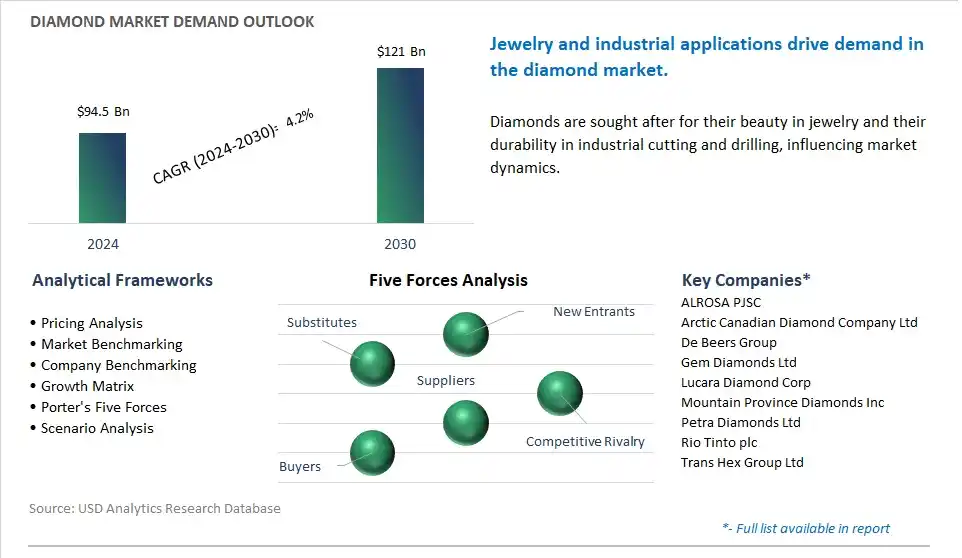
The global Diamond Market is poised to register a 4.2% CAGR from $94.5 Billion in 2024 to $121 Billion in 2030.
The global Diamond Market Study analyzes and forecasts the market size across 6 regions and 24 countries for diverse segments -By Type (Natural, Synthetic), By Application (Jewelry, Industrial, Others).
An Introduction to Global Diamond Market in 2024
The diamond market is witnessing steady growth driven by its applications in jewelry, industrial tools, electronics, and cutting-edge technologies such as quantum computing and biomedical imaging. Key trends shaping the future of the industry include the increasing demand for lab-grown diamonds as ethical, sustainable alternatives to mined diamonds, driven by consumer preferences for responsible sourcing and traceability. As consumers seek transparency, authenticity, and value in diamond products, there's a growing need for certification programs, blockchain technologies, and supply chain transparency initiatives that ensure the provenance and ethical production of diamonds. Moreover, advancements in diamond synthesis methods, cutting and polishing techniques, and material characterization are driving market expansion by improving quality, consistency, and affordability of lab-grown and natural diamonds. Additionally, the growing applications of diamonds in high-tech industries such as semiconductors, optics, and medical devices are fueling demand for engineered diamonds with tailored properties and performance characteristics. Furthermore, the integration of diamond-based materials, coatings, and nanotechnology is driving innovation and market growth in diverse applications, enabling breakthroughs in electronics, renewable energy, and healthcare technologies.
Diamond Market Competitive Landscape
The market report analyses the leading companies in the industry including ALROSA PJSC, Arctic Canadian Diamond Company Ltd, De Beers Group, Gem Diamonds Ltd, Lucara Diamond Corp, Mountain Province Diamonds Inc, Petra Diamonds Ltd, Rio Tinto plc, Trans Hex Group Ltd.
Diamond Market Dynamics
Diamond Market Trend: Increasing Demand for Industrial and Consumer Applications
One prominent trend in the diamond market is the increasing demand for both industrial and consumer applications. Diamonds are valued for their exceptional hardness, thermal conductivity, and optical properties, making them indispensable in various industries such as mining, construction, electronics, and healthcare. Additionally, diamonds hold significant cultural and symbolic significance and are sought after for use in jewelry, luxury goods, and fashion accessories. The trend towards increasing demand for diamonds across industrial and consumer sectors drives market growth and diversification in the diamond industry.
Diamond Market Driver: Growth in Emerging Economies and Urbanization
A primary driver shaping the diamond market is the growth in emerging economies and urbanization. As countries undergo rapid economic development, urbanization, and infrastructure expansion, there is an increased demand for diamonds in construction and manufacturing sectors for cutting, drilling, and grinding applications. Furthermore, rising disposable incomes and changing lifestyles in emerging markets contribute to the growing demand for diamonds in jewelry and luxury goods. The driver behind the growth in emerging economies and urbanization stimulates market demand for diamonds as essential materials and luxury items, driving investment and exploration in diamond production and distribution.
Diamond Market Opportunity: Development of Lab-grown Diamonds and Sustainable Sourcing Practices
An opportunity within the diamond market lies in the development of lab-grown diamonds and sustainable sourcing practices to meet ethical and environmental concerns. With growing awareness about the environmental and social impact of diamond mining, there is increasing interest in lab-grown diamonds as eco-friendly alternatives. Companies have the opportunity to invest in research and development to advance technology for producing high-quality lab-grown diamonds that are chemically and optically identical to natural diamonds. Additionally, there is potential to promote ethical and sustainable sourcing practices in the diamond supply chain, ensuring transparency, fair labor practices, and responsible environmental stewardship. By embracing opportunities in lab-grown diamonds and sustainable sourcing, companies can meet evolving consumer preferences, enhance brand reputation, and drive market growth in the diamond industry.
Diamond Market Share Analysis: Natural Diamonds segment generated the highest revenue in the industry
The natural diamonds segment is the largest in the diamond market, primarily due to diverse key factors. The natural diamonds have a long-established history of being prized for their rarity, beauty, and symbolic significance, making them highly desirable for various applications, including jewelry, industrial uses, and investment purposes. Their unique geological formation over millions of years under high pressure and temperature creates gems with distinct characteristics that cannot be replicated by synthetic alternatives. In addition, natural diamonds hold cultural and emotional value, often passed down through generations as heirlooms or used to commemorate significant milestones such as engagements and weddings. Additionally, the natural diamond industry has a well-established supply chain, encompassing mining, cutting, polishing, and distribution networks, which further contributes to its dominance in the market. Despite the emergence of synthetic diamonds as a viable alternative, the enduring allure and prestige associated with natural diamonds ensure their continued dominance in the diamond market.
Diamond Market Share Analysis: Industrial Diamonds Segment is poised to register the fastest growth rate (CAGR) over the forecast period to 2030
The industrial diamonds segment is the fastest-growing segment in the diamond market, driven by diverse key factors. The the increasing demand for industrial diamonds in various applications such as cutting, drilling, grinding, and polishing across sectors like construction, automotive, aerospace, and electronics fuels market growth. Industrial diamonds offer exceptional hardness, thermal conductivity, and abrasion resistance, making them indispensable in manufacturing processes that require precision and durability. In addition, advancements in technology have expanded the range of industrial applications for diamonds, including the production of cutting-edge semiconductor devices, synthetic diamonds for electronics, and high-performance tools for machining and mining operations. Additionally, the growing emphasis on sustainability and efficiency in industrial processes has led to the adoption of diamond-based solutions for their longevity, precision, and environmental benefits compared to traditional materials. With industries increasingly relying on diamond-based technologies to enhance productivity and quality, the industrial diamonds segment experiences rapid expansion in the diamond market.
Diamond Market Report Segmentation
By Type
Natural
Synthetic
By Application
Jewelry
Industrial
Others
Regions Included
North America (US, Canada, Mexico)
Europe (Germany, UK, France, Spain, Italy, Russia, Rest of Europe)
Asia Pacific (China, India, Japan, South Korea, Australia, South East Asia, Rest of Asia)
South America (Brazil, Argentina, Rest of South America)
Middle East and Africa (Saudi Arabia, UAE, Rest of Middle East, South Africa, Egypt, Rest of Africa)
Diamond Companies Profiled in the Market Study
ALROSA PJSC
Arctic Canadian Diamond Company Ltd
De Beers Group
Gem Diamonds Ltd
Lucara Diamond Corp
Mountain Province Diamonds Inc
Petra Diamonds Ltd
Rio Tinto plc
Trans Hex Group Ltd
*- List Not Exhaustive
TABLE OF CONTENTS
1 Introduction to 2024 Diamond Market
1.1 Market Overview
1.2 Quick Facts
1.3 Scope/Objective of the Study
1.4 Market Definition
1.5 Countries and Regions Covered
1.6 Units, Currency, and Conversions
1.7 Industry Value Chain
2 Research Methodology
2.1 Market Size Estimation
2.2 Sources and Research Methodology
2.3 Data Triangulation
2.4 Assumptions and Limitations
3 Executive Summary
3.1 Global Diamond Market Size Outlook, $ Million, 2021 to 2030
3.2 Diamond Market Outlook by Type, $ Million, 2021 to 2030
3.3 Diamond Market Outlook by Product, $ Million, 2021 to 2030
3.4 Diamond Market Outlook by Application, $ Million, 2021 to 2030
3.5 Diamond Market Outlook by Key Countries, $ Million, 2021 to 2030
4 Market Dynamics
4.1 Key Driving Forces of Diamond Industry
4.2 Key Market Trends in Diamond Industry
4.3 Potential Opportunities in Diamond Industry
4.4 Key Challenges in Diamond Industry
5 Market Factor Analysis
5.1 Value Chain Analysis
5.2 Competitive Landscape
5.2.1 Global Diamond Market Share by Company (%), 2023
5.2.2 Product Offerings by Company
5.3 Porter’s Five Forces Analysis
5.4 Pricing Analysis and Outlook
6 Growth Outlook Across Scenarios
6.1 Growth Analysis-Case Scenario Definitions
6.2 Low Growth Scenario Forecasts
6.3 Reference Growth Scenario Forecasts
6.4 High Growth Scenario Forecasts
7 Global Diamond Market Outlook by Segments
7.1 Diamond Market Outlook by Segments, $ Million, 2021- 2030
By Type
Natural
Synthetic
By Application
Jewelry
Industrial
Others
8 North America Diamond Market Analysis and Outlook To 2030
8.1 Introduction to North America Diamond Markets in 2024
8.2 North America Diamond Market Size Outlook by Country, 2021-2030
8.2.1 United States
8.2.2 Canada
8.2.3 Mexico
8.3 North America Diamond Market size Outlook by Segments, 2021-2030
By Type
Natural
Synthetic
By Application
Jewelry
Industrial
Others
9 Europe Diamond Market Analysis and Outlook To 2030
9.1 Introduction to Europe Diamond Markets in 2024
9.2 Europe Diamond Market Size Outlook by Country, 2021-2030
9.2.1 Germany
9.2.2 France
9.2.3 Spain
9.2.4 United Kingdom
9.2.4 Italy
9.2.5 Russia
9.2.6 Norway
9.2.7 Rest of Europe
9.3 Europe Diamond Market Size Outlook by Segments, 2021-2030
By Type
Natural
Synthetic
By Application
Jewelry
Industrial
Others
10 Asia Pacific Diamond Market Analysis and Outlook To 2030
10.1 Introduction to Asia Pacific Diamond Markets in 2024
10.2 Asia Pacific Diamond Market Size Outlook by Country, 2021-2030
10.2.1 China
10.2.2 India
10.2.3 Japan
10.2.4 South Korea
10.2.5 Indonesia
10.2.6 Malaysia
10.2.7 Australia
10.2.8 Rest of Asia Pacific
10.3 Asia Pacific Diamond Market size Outlook by Segments, 2021-2030
By Type
Natural
Synthetic
By Application
Jewelry
Industrial
Others
11 South America Diamond Market Analysis and Outlook To 2030
11.1 Introduction to South America Diamond Markets in 2024
11.2 South America Diamond Market Size Outlook by Country, 2021-2030
11.2.1 Brazil
11.2.2 Argentina
11.2.3 Rest of South America
11.3 South America Diamond Market size Outlook by Segments, 2021-2030
By Type
Natural
Synthetic
By Application
Jewelry
Industrial
Others
12 Middle East and Africa Diamond Market Analysis and Outlook To 2030
12.1 Introduction to Middle East and Africa Diamond Markets in 2024
12.2 Middle East and Africa Diamond Market Size Outlook by Country, 2021-2030
12.2.1 Saudi Arabia
12.2.2 UAE
12.2.3 Oman
12.2.4 Rest of Middle East
12.2.5 Egypt
12.2.6 Nigeria
12.2.7 South Africa
12.2.8 Rest of Africa
12.3 Middle East and Africa Diamond Market size Outlook by Segments, 2021-2030
By Type
Natural
Synthetic
By Application
Jewelry
Industrial
Others
13 Company Profiles
13.1 Company Snapshot
13.2 SWOT Profiles
13.3 Products and Services
13.4 Recent Developments
13.5 Financial Profile
ALROSA PJSC
Arctic Canadian Diamond Company Ltd
De Beers Group
Gem Diamonds Ltd
Lucara Diamond Corp
Mountain Province Diamonds Inc
Petra Diamonds Ltd
Rio Tinto plc
Trans Hex Group Ltd
14 Appendix
14.1 Customization Offerings
14.2 Subscription Services
14.3 Related Reports
14.4 Publisher Expertise
By Type
Natural
Synthetic
By Application
Jewelry
Industrial
Others
Countries Analyzed
North America (US, Canada, Mexico)
Europe (Germany, UK, France, Spain, Italy, Russia, Rest of Europe)
Asia Pacific (China, India, Japan, South Korea, Australia, South East Asia, Rest of Asia)
South America (Brazil, Argentina, Rest of South America)
Middle East and Africa (Saudi Arabia, UAE, Rest of Middle East, South Africa, Egypt, Rest of Africa)
