
The global Dicamba Market Study analyzes and forecasts the market size across 6 regions and 24 countries for diverse segments -By Form (Liquid, Dry), By Crop (Cereals & Grains, Oil seeds & Pulses, Pastures, Forage Crops), By Application (Agriculture, Lawn & turf, Others).
The dicamba market is experiencing growth driven by its applications as a broad-spectrum herbicide in agriculture, particularly for weed control in crops such as soybeans, corn, and cotton. Key trends shaping the future of the industry include innovations in dicamba formulations, herbicide resistance management strategies, and regulatory compliance to address environmental concerns and weed control challenges. Advanced dicamba formulations offer improved efficacy, volatility reduction, and crop safety, enabling farmers to manage tough-to-control weeds and maximize crop yields. Moreover, the integration of dicamba-tolerant crop varieties and tank mixtures with other herbicides provides effective weed management solutions while minimizing the risk of off-target movement and herbicide drift. Additionally, the growing emphasis on sustainable agriculture, integrated pest management, and herbicide stewardship drives market demand for dicamba as part of an integrated weed control strategy that includes cultural practices, crop rotation, and herbicide rotation. As farmers seek to overcome challenges posed by herbicide-resistant weeds and optimize weed control programs, the dicamba market is poised for continued growth and innovation as a key tool in modern agriculture.
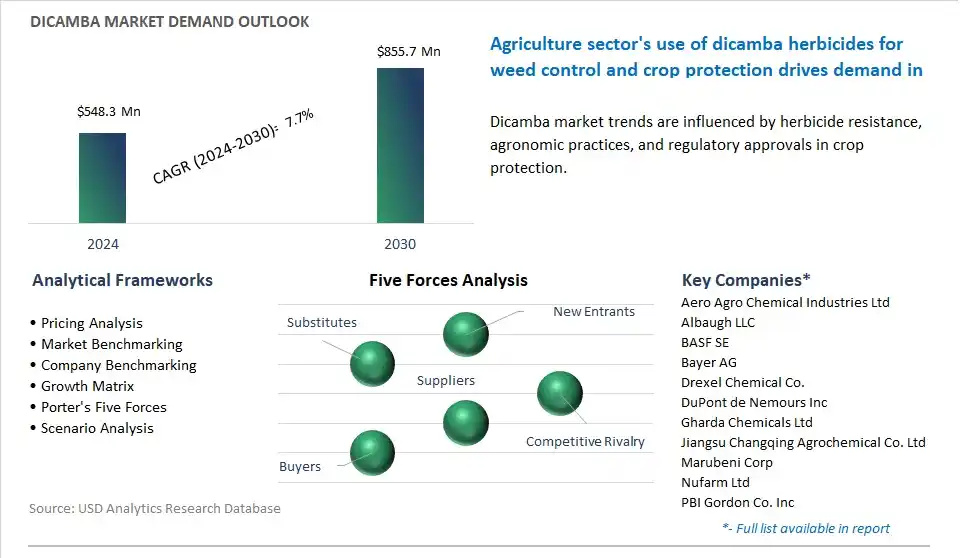
The market report analyses the leading companies in the industry including Aero Agro Chemical Industries Ltd, Albaugh LLC, BASF SE, Bayer AG, Drexel Chemical Co., DuPont de Nemours Inc, Gharda Chemicals Ltd, Jiangsu Changqing Agrochemical Co. Ltd, Marubeni Corp, Nufarm Ltd, PBI Gordon Co. Inc, Shanghai Bosman Industrial Co. Ltd, Sharda Cropchem Ltd, Sinochem Group Co. Ltd, Syngenta Crop Protection AG, Tagros Chemicals India Pvt. Ltd, The andersons Inc, UPL Ltd.
The most prominent trend in the dicamba market is its increased adoption in genetically modified (GM) crop cultivation, driven by the need for effective weed management and resistance management strategies. Dicamba-based herbicides are widely used in conjunction with dicamba-tolerant GM crops such as soybeans, cotton, and corn to control broadleaf weeds and manage herbicide-resistant weed populations. With the rise of herbicide-resistant weeds and the limitations of existing weed control methods, farmers are turning to dicamba-tolerant crops and dicamba formulations to maintain crop yields and profitability. This trend is expected to drive market growth in the dicamba sector as agriculture embraces biotechnology and integrated pest management practices.
A key driver in the dicamba market is the expansion of herbicide-tolerant crop acreage, fueled by the need for efficient weed control solutions and the adoption of GM crop technologies. Dicamba-tolerant crops offer farmers an additional tool for weed management, allowing for more flexibility and effectiveness in controlling problematic weed species. As herbicide-tolerant crop varieties become more widely available and agronomically beneficial, farmers are increasingly adopting dicamba-tolerant crop systems to enhance crop yields and reduce weed pressure. The expansion of herbicide-tolerant crop acreage drives demand for dicamba herbicides, sustaining market growth and driving innovation in dicamba formulations and application technologies.
The dicamba market presents a potential opportunity for the development of low-volatility formulations that offer effective weed control while minimizing off-target movement and environmental impact. Manufacturers can capitalize on this opportunity by innovating with dicamba formulations that exhibit reduced volatility, drift potential, and vaporization rates compared to traditional formulations. Low-volatility dicamba products can help address concerns about off-target damage to sensitive crops, vegetation, and neighboring properties, enhancing the sustainability and stewardship of dicamba-based weed control programs. By investing in research and development to develop low-volatility formulations, dicamba manufacturers can meet regulatory requirements, address grower concerns, and capture new market opportunities in the evolving landscape of herbicide technology and weed management.
The liquid segment is the largest segment in the Dicamba Market for diverse reasons. The liquid formulations of dicamba offer diverse advantages over dry formulations in terms of ease of handling, mixing, and application. Liquid dicamba formulations are available as concentrated solutions or emulsifiable concentrates, which can be easily diluted with water to achieve the desired concentration for spraying. Additionally, liquid formulations allow for precise and uniform application using various types of spraying equipment, including ground sprayers, aerial applicators, and irrigation systems. In addition, liquid dicamba formulations offer greater flexibility in adjusting application rates and timing to suit specific weed control needs and environmental conditions. Further, liquid formulations of dicamba are preferred by farmers, agronomists, and professional applicators due to their convenience, reliability, and effectiveness in controlling a wide range of broadleaf weeds in various crops such as soybeans, cotton, corn, and cereals. As a result of these advantages, the liquid segment dominates the Dicamba Market, solidifying its position as the largest segment.
The oilseeds & pulses segment is the fastest-growing segment in the Dicamba Market for diverse reasons. The dicamba is widely used in oilseed and pulse crops such as soybeans, cotton, canola, and pulses like lentils, chickpeas, and peas to control broadleaf weeds effectively. These crops are essential for food, feed, and biofuel production, and weed competition can significantly reduce yields and quality. Additionally, the adoption of genetically modified (GM) dicamba-tolerant varieties of crops, particularly soybeans and cotton, has increased the demand for dicamba herbicides in these crops. Farmers choose dicamba-tolerant varieties to combat herbicide-resistant weeds effectively, which are becoming increasingly prevalent across agricultural regions. In addition, dicamba offers residual control of weeds, reducing the need for multiple herbicide applications and providing cost-effective weed management solutions. Further, the expansion of oilseed and pulse production in regions such as North America, South America, and Asia-Pacific to meet growing demand for protein-rich foods, cooking oils, and biofuels drives the demand for dicamba herbicides in these crops. As a result of these factors, the oilseeds & pulses segment is expected to experience rapid growth in the Dicamba Market, solidifying its position as the fastest-growing segment.
The agriculture segment is the fastest-growing segment in the Dicamba Market for diverse reasons. The dicamba herbicides are extensively used in agriculture to control broadleaf weeds in various crops such as soybeans, cotton, corn, cereals, oilseeds, pulses, and specialty crops. Weeds compete with crops for nutrients, water, and sunlight, leading to yield losses and reduced crop quality. Additionally, the adoption of genetically modified (GM) dicamba-tolerant crop varieties, particularly soybeans and cotton, has increased the demand for dicamba herbicides in agriculture. These dicamba-tolerant crops allow farmers to apply dicamba herbicides post-emergence to control tough-to-manage weeds while minimizing crop injury. In addition, dicamba herbicides offer residual weed control, reducing the need for multiple herbicide applications and providing cost-effective weed management solutions. Further, the expansion of agriculture globally to meet growing food, feed, and biofuel demands drives the demand for dicamba herbicides in various cropping systems and agricultural regions. As farmers continue to seek effective and sustainable weed control solutions, the agriculture segment is expected to experience rapid growth in the Dicamba Market, solidifying its position as the fastest-growing segment.
By Form
Liquid
Dry
By Crop
Cereals & Grains
Oil seeds & Pulses
Pastures
Forage Crops
By Application
Agriculture
Lawn & turf
Others
Regions Included
North America (US, Canada, Mexico)
Europe (Germany, UK, France, Spain, Italy, Russia, Rest of Europe)
Asia Pacific (China, India, Japan, South Korea, Australia, South East Asia, Rest of Asia)
South America (Brazil, Argentina, Rest of South America)
Middle East and Africa (Saudi Arabia, UAE, Rest of Middle East, South Africa, Egypt, Rest of Africa)
Aero Agro Chemical Industries Ltd
Albaugh LLC
BASF SE
Bayer AG
Drexel Chemical Co.
DuPont de Nemours Inc
Gharda Chemicals Ltd
Jiangsu Changqing Agrochemical Co. Ltd
Marubeni Corp
Nufarm Ltd
PBI Gordon Co. Inc
Shanghai Bosman Industrial Co. Ltd
Sharda Cropchem Ltd
Sinochem Group Co. Ltd
Syngenta Crop Protection AG
Tagros Chemicals India Pvt. Ltd
The andersons Inc
UPL Ltd
*- List Not Exhaustive
TABLE OF CONTENTS
1 Introduction to 2024 Dicamba Market
1.1 Market Overview
1.2 Quick Facts
1.3 Scope/Objective of the Study
1.4 Market Definition
1.5 Countries and Regions Covered
1.6 Units, Currency, and Conversions
1.7 Industry Value Chain
2 Research Methodology
2.1 Market Size Estimation
2.2 Sources and Research Methodology
2.3 Data Triangulation
2.4 Assumptions and Limitations
3 Executive Summary
3.1 Global Dicamba Market Size Outlook, $ Million, 2021 to 2030
3.2 Dicamba Market Outlook by Type, $ Million, 2021 to 2030
3.3 Dicamba Market Outlook by Product, $ Million, 2021 to 2030
3.4 Dicamba Market Outlook by Application, $ Million, 2021 to 2030
3.5 Dicamba Market Outlook by Key Countries, $ Million, 2021 to 2030
4 Market Dynamics
4.1 Key Driving Forces of Dicamba Industry
4.2 Key Market Trends in Dicamba Industry
4.3 Potential Opportunities in Dicamba Industry
4.4 Key Challenges in Dicamba Industry
5 Market Factor Analysis
5.1 Value Chain Analysis
5.2 Competitive Landscape
5.2.1 Global Dicamba Market Share by Company (%), 2023
5.2.2 Product Offerings by Company
5.3 Porter’s Five Forces Analysis
5.4 Pricing Analysis and Outlook
6 Growth Outlook Across Scenarios
6.1 Growth Analysis-Case Scenario Definitions
6.2 Low Growth Scenario Forecasts
6.3 Reference Growth Scenario Forecasts
6.4 High Growth Scenario Forecasts
7 Global Dicamba Market Outlook by Segments
7.1 Dicamba Market Outlook by Segments, $ Million, 2021- 2030
By Form
Liquid
Dry
By Crop
Cereals & Grains
Oil seeds & Pulses
Pastures
Forage Crops
By Application
Agriculture
Lawn & turf
Others
8 North America Dicamba Market Analysis and Outlook To 2030
8.1 Introduction to North America Dicamba Markets in 2024
8.2 North America Dicamba Market Size Outlook by Country, 2021-2030
8.2.1 United States
8.2.2 Canada
8.2.3 Mexico
8.3 North America Dicamba Market size Outlook by Segments, 2021-2030
By Form
Liquid
Dry
By Crop
Cereals & Grains
Oil seeds & Pulses
Pastures
Forage Crops
By Application
Agriculture
Lawn & turf
Others
9 Europe Dicamba Market Analysis and Outlook To 2030
9.1 Introduction to Europe Dicamba Markets in 2024
9.2 Europe Dicamba Market Size Outlook by Country, 2021-2030
9.2.1 Germany
9.2.2 France
9.2.3 Spain
9.2.4 United Kingdom
9.2.4 Italy
9.2.5 Russia
9.2.6 Norway
9.2.7 Rest of Europe
9.3 Europe Dicamba Market Size Outlook by Segments, 2021-2030
By Form
Liquid
Dry
By Crop
Cereals & Grains
Oil seeds & Pulses
Pastures
Forage Crops
By Application
Agriculture
Lawn & turf
Others
10 Asia Pacific Dicamba Market Analysis and Outlook To 2030
10.1 Introduction to Asia Pacific Dicamba Markets in 2024
10.2 Asia Pacific Dicamba Market Size Outlook by Country, 2021-2030
10.2.1 China
10.2.2 India
10.2.3 Japan
10.2.4 South Korea
10.2.5 Indonesia
10.2.6 Malaysia
10.2.7 Australia
10.2.8 Rest of Asia Pacific
10.3 Asia Pacific Dicamba Market size Outlook by Segments, 2021-2030
By Form
Liquid
Dry
By Crop
Cereals & Grains
Oil seeds & Pulses
Pastures
Forage Crops
By Application
Agriculture
Lawn & turf
Others
11 South America Dicamba Market Analysis and Outlook To 2030
11.1 Introduction to South America Dicamba Markets in 2024
11.2 South America Dicamba Market Size Outlook by Country, 2021-2030
11.2.1 Brazil
11.2.2 Argentina
11.2.3 Rest of South America
11.3 South America Dicamba Market size Outlook by Segments, 2021-2030
By Form
Liquid
Dry
By Crop
Cereals & Grains
Oil seeds & Pulses
Pastures
Forage Crops
By Application
Agriculture
Lawn & turf
Others
12 Middle East and Africa Dicamba Market Analysis and Outlook To 2030
12.1 Introduction to Middle East and Africa Dicamba Markets in 2024
12.2 Middle East and Africa Dicamba Market Size Outlook by Country, 2021-2030
12.2.1 Saudi Arabia
12.2.2 UAE
12.2.3 Oman
12.2.4 Rest of Middle East
12.2.5 Egypt
12.2.6 Nigeria
12.2.7 South Africa
12.2.8 Rest of Africa
12.3 Middle East and Africa Dicamba Market size Outlook by Segments, 2021-2030
By Form
Liquid
Dry
By Crop
Cereals & Grains
Oil seeds & Pulses
Pastures
Forage Crops
By Application
Agriculture
Lawn & turf
Others
13 Company Profiles
13.1 Company Snapshot
13.2 SWOT Profiles
13.3 Products and Services
13.4 Recent Developments
13.5 Financial Profile
Aero Agro Chemical Industries Ltd
Albaugh LLC
BASF SE
Bayer AG
Drexel Chemical Co.
DuPont de Nemours Inc
Gharda Chemicals Ltd
Jiangsu Changqing Agrochemical Co. Ltd
Marubeni Corp
Nufarm Ltd
PBI Gordon Co. Inc
Shanghai Bosman Industrial Co. Ltd
Sharda Cropchem Ltd
Sinochem Group Co. Ltd
Syngenta Crop Protection AG
Tagros Chemicals India Pvt. Ltd
The andersons Inc
UPL Ltd
14 Appendix
14.1 Customization Offerings
14.2 Subscription Services
14.3 Related Reports
14.4 Publisher Expertise
By Form
Liquid
Dry
By Crop
Cereals & Grains
Oil seeds & Pulses
Pastures
Forage Crops
By Application
Agriculture
Lawn & turf
Others
Countries Analyzed
North America (US, Canada, Mexico)
Europe (Germany, UK, France, Spain, Italy, Russia, Rest of Europe)
Asia Pacific (China, India, Japan, South Korea, Australia, South East Asia, Rest of Asia)
South America (Brazil, Argentina, Rest of South America)
Middle East and Africa (Saudi Arabia, UAE, Rest of Middle East, South Africa, Egypt, Rest of Africa)
Global Dicamba is forecast to reach $855.7 Million in 2030 from $548.3 Million in 2024, registering a CAGR of 7.7%
Emerging Markets across Asia Pacific, Europe, and Americas present robust growth prospects.
Aero Agro Chemical Industries Ltd, Albaugh LLC, BASF SE, Bayer AG, Drexel Chemical Co., DuPont de Nemours Inc, Gharda Chemicals Ltd, Jiangsu Changqing Agrochemical Co. Ltd, Marubeni Corp, Nufarm Ltd, PBI Gordon Co. Inc, Shanghai Bosman Industrial Co. Ltd, Sharda Cropchem Ltd, Sinochem Group Co. Ltd, Syngenta Crop Protection AG, Tagros Chemicals India Pvt. Ltd, The andersons Inc, UPL Ltd
Base Year- 2023; Estimated Year- 2024; Historic Period- 2018-2023; Forecast period- 2024 to 2030; Currency: Revenue (USD); Volume