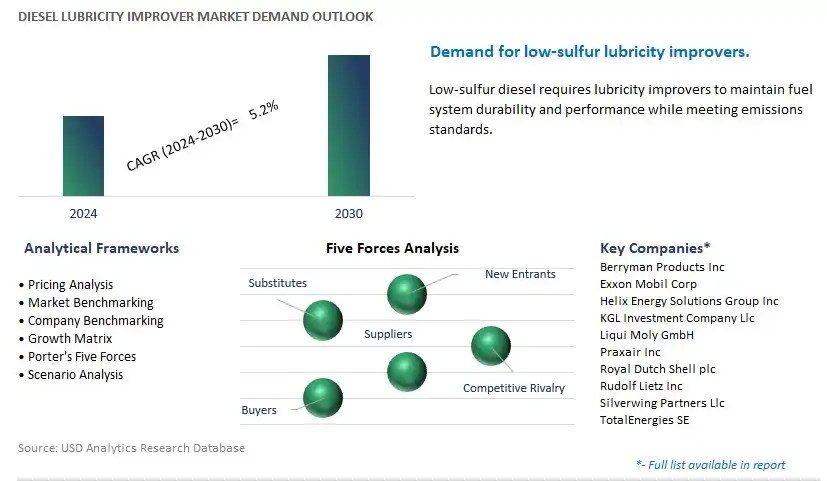
Diesel Lubricity Improver Market is estimated to increase at a growth rate of 5.2% CAGR over the forecast period from 2024 to 2030.
The global Diesel Lubricity Improver Market study analyzes and forecasts the market size across 6 regions and 24 countries for diverse segments including By Product (Synthetic Oil Improvers, Esters and Dimers), By Application (On-Highway Heavy Duty Truck, Off-Highway), By End-User (Transportation, Agriculture).
An Introduction to Global Diesel Lubricity Improver Market, 2024
The diesel lubricity improver market in 2024 addresses the need for enhanced lubrication properties in modern diesel fuels, particularly as engines become more advanced and emissions regulations become stricter. Lubricity improvers are additives designed to improve the lubricating properties of diesel fuel, preventing premature wear and damage to fuel system components such as injectors and pumps. As low-sulfur diesel fuels become more prevalent to comply with emissions standards, the lubricity of diesel fuels is often compromised, leading to increased friction and wear in fuel systems. Lubricity improvers mitigate this issue by forming a protective film on metal surfaces, reducing friction and extending the lifespan of fuel system components. With the demand for cleaner and more efficient diesel engines continuing to rise, the diesel lubricity improver market plays a crucial role in ensuring optimal performance and durability of diesel-powered vehicles and equipment.
Diesel Lubricity Improver Competitive Landscape
The global Diesel Lubricity Improver market is highly competitive with a large number of companies focusing on niche market segments. Amidst intense competitive conditions, Diesel Lubricity Improver Companies are investing in new product launches and strengthening distribution channels. Key companies operating in the Diesel Lubricity Improver Market Industry include- Berryman Products Inc, Exxon Mobil Corp, Helix Energy Solutions Group Inc, KGL Investment Company Llc, Liqui Moly GmbH, Praxair Inc, Royal Dutch Shell plc, Rudolf Lietz Inc, Silverwing Partners Llc, TotalEnergies SE.
Diesel Lubricity Improver Market Trend: Shift Towards Low-Sulfur Diesel Fuels and Ultra-Low Sulfur Diesel (ULSD)
A prominent trend in the diesel lubricity improver market is the shift towards low-sulfur diesel fuels and ultra-low sulfur diesel (ULSD). With increasing regulatory mandates aimed at reducing emissions and sulfur content in diesel fuels, there's a growing need for lubricity improvers to maintain the lubricating properties of diesel fuels. Low-sulfur and ULSD fuels, while beneficial for reducing emissions, often lack the lubricating properties necessary to protect fuel system components such as injectors and pumps. Therefore, the demand for diesel lubricity improvers is increasing as fuel refiners and distributors seek to comply with regulations while ensuring the performance and longevity of diesel engines. This trend towards low-sulfur diesel fuels and ULSD is driving market growth and innovation in the diesel lubricity improver segment.
Diesel Lubricity Improver Market Driver: Stringent Emission Regulations and Engine Performance Requirements
The driver for the diesel lubricity improver market is the stringent emission regulations and engine performance requirements. Governments worldwide are implementing regulations aimed at reducing harmful emissions from diesel engines, including sulfur content limits in diesel fuels. Additionally, engine manufacturers are continuously improving engine designs and performance standards, requiring diesel fuels with adequate lubricating properties to ensure optimal engine operation and durability. As a result, fuel refiners, distributors, and end-s are increasingly turning to diesel lubricity improvers to enhance the lubricating properties of low-sulfur and ULSD fuels, thus meeting regulatory requirements and engine performance needs. This demand for diesel lubricity improvers is a significant driver for market expansion in the segment.
Diesel Lubricity Improver Market Opportunity: Development of Bio-based and Sustainable Lubricity Improvers
An Market Opportunity for growth and development in the diesel lubricity improver market lies in the development of bio-based and sustainable lubricity improvers. With increasing emphasis on sustainability and environmental responsibility, there's a growing demand for bio-based alternatives to conventional petroleum-derived lubricity improvers. Bio-based lubricity improvers, derived from renewable feedstocks such as plant oils or animal fats, offer a more environmentally friendly solution while providing similar lubricating properties to petroleum-based counterparts. Moreover, bio-based lubricity improvers can help reduce dependence on fossil fuels and contribute to lower carbon emissions in the transportation sector. By investing in research and development of bio-based lubricity improvers, manufacturers can capitalize on this market Market Opportunity, meet the growing demand for sustainable solutions, and drive further growth in the diesel lubricity improver market.
Diesel Lubricity Improver Market Segmentation
By Product
Synthetic Oil Improvers
Esters and Dimers
By Application
On-Highway Heavy Duty Truck
Off-Highway
By End-User
Transportation
AgricultureGeographical Analysis
North America (United States, Canada, Mexico)
Europe (Germany, France, United Kingdom, Spain, Italy, Rest of Europe)
Asia Pacific (China, India, Japan, South Korea, Rest of Asia Pacific)
South America (Brazil, Argentina, Rest of South America)
Middle East and Africa (Saudi Arabia, UAE, Rest of Middle East, South Africa, Egypt, Rest of Africa
Diesel Lubricity Improver Companies
Berryman Products Inc
Exxon Mobil Corp
Helix Energy Solutions Group Inc
KGL Investment Company Llc
Liqui Moly GmbH
Praxair Inc
Royal Dutch Shell plc
Rudolf Lietz Inc
Silverwing Partners Llc
TotalEnergies SE
*- List not Exhaustive
TABLE OF CONTENTS
1 Introduction to 2024 Diesel Lubricity Improver Market
1.1 Market Overview
1.2 Quick Facts
1.3 Scope/Objective of the Study
1.4 Market Definition
1.5 Countries and Regions Analyzed
1.6 Units, Currency, and Conversions
1.7 Industry Value Chain
2 Research Methodology
2.1 Market Size Estimation
2.2 Sources and Research Methodology
2.3 Data Triangulation
2.4 Assumptions and Limitations
3 Executive Summary
3.1 Global Diesel Lubricity Improver Market Size Outlook, $ Million, 2021 to 2030
3.2 Diesel Lubricity Improver Market Outlook by Type, $ Million, 2021 to 2030
3.3 Diesel Lubricity Improver Market Outlook by Product, $ Million, 2021 to 2030
3.4 Diesel Lubricity Improver Market Outlook by Application, $ Million, 2021 to 2030
3.5 Diesel Lubricity Improver Market Outlook by Key Countries, $ Million, 2021 to 2030
4 Market Dynamics
4.1 Key Driving Forces of Diesel Lubricity Improver Industry
4.2 Key Market Trends in Diesel Lubricity Improver Industry
4.3 Potential Opportunities in Diesel Lubricity Improver Industry
4.4 Key Challenges in Diesel Lubricity Improver Industry
5 Market Factor Analysis
5.1 Value Chain Analysis
5.2 Competitive Landscape
5.2.1 Global Diesel Lubricity Improver Market Share by Company (%), 2023
5.2.2 Product Offerings by Company
5.3 Porter’s Five Forces Analysis
5.4 Pricing Analysis and Outlook
6 Growth Outlook Across Scenarios
6.1 Growth Analysis-Case Scenario Definitions
6.2 Low Growth Scenario Forecasts
6.3 Reference Growth Scenario Forecasts
6.4 High Growth Scenario Forecasts
7 Global Diesel Lubricity Improver Market Outlook by Segments
7.1 Diesel Lubricity Improver Market Outlook by Segments, $ Million, 2021- 2030
By Product
Synthetic Oil Improvers
Esters and Dimers
By Application
On-Highway Heavy Duty Truck
Off-Highway
By End-User
Transportation
Agriculture
8 North America Diesel Lubricity Improver Market Analysis and Outlook To 2030
8.1 Introduction to North America Diesel Lubricity Improver Markets in 2024
8.2 North America Diesel Lubricity Improver Market Size Outlook by Country, 2021-2030
8.2.1 United States
8.2.2 Canada
8.2.3 Mexico
8.3 North America Diesel Lubricity Improver Market size Outlook by Segments, 2021-2030
By Product
Synthetic Oil Improvers
Esters and Dimers
By Application
On-Highway Heavy Duty Truck
Off-Highway
By End-User
Transportation
Agriculture
9 Europe Diesel Lubricity Improver Market Analysis and Outlook To 2030
9.1 Introduction to Europe Diesel Lubricity Improver Markets in 2024
9.2 Europe Diesel Lubricity Improver Market Size Outlook by Country, 2021-2030
9.2.1 Germany
9.2.2 France
9.2.3 Spain
9.2.4 United Kingdom
9.2.4 Italy
9.2.5 Russia
9.2.6 Norway
9.2.7 Rest of Europe
9.3 Europe Diesel Lubricity Improver Market Size Outlook by Segments, 2021-2030
By Product
Synthetic Oil Improvers
Esters and Dimers
By Application
On-Highway Heavy Duty Truck
Off-Highway
By End-User
Transportation
Agriculture
10 Asia Pacific Diesel Lubricity Improver Market Analysis and Outlook To 2030
10.1 Introduction to Asia Pacific Diesel Lubricity Improver Markets in 2024
10.2 Asia Pacific Diesel Lubricity Improver Market Size Outlook by Country, 2021-2030
10.2.1 China
10.2.2 India
10.2.3 Japan
10.2.4 South Korea
10.2.5 Indonesia
10.2.6 Malaysia
10.2.7 Australia
10.2.8 Rest of Asia Pacific
10.3 Asia Pacific Diesel Lubricity Improver Market size Outlook by Segments, 2021-2030
By Product
Synthetic Oil Improvers
Esters and Dimers
By Application
On-Highway Heavy Duty Truck
Off-Highway
By End-User
Transportation
Agriculture
11 South America Diesel Lubricity Improver Market Analysis and Outlook To 2030
11.1 Introduction to South America Diesel Lubricity Improver Markets in 2024
11.2 South America Diesel Lubricity Improver Market Size Outlook by Country, 2021-2030
11.2.1 Brazil
11.2.2 Argentina
11.2.3 Rest of South America
11.3 South America Diesel Lubricity Improver Market size Outlook by Segments, 2021-2030
By Product
Synthetic Oil Improvers
Esters and Dimers
By Application
On-Highway Heavy Duty Truck
Off-Highway
By End-User
Transportation
Agriculture
12 Middle East and Africa Diesel Lubricity Improver Market Analysis and Outlook To 2030
12.1 Introduction to Middle East and Africa Diesel Lubricity Improver Markets in 2024
12.2 Middle East and Africa Diesel Lubricity Improver Market Size Outlook by Country, 2021-2030
12.2.1 Saudi Arabia
12.2.2 UAE
12.2.3 Oman
12.2.4 Rest of Middle East
12.2.5 Egypt
12.2.6 Nigeria
12.2.7 South Africa
12.2.8 Rest of Africa
12.3 Middle East and Africa Diesel Lubricity Improver Market size Outlook by Segments, 2021-2030
By Product
Synthetic Oil Improvers
Esters and Dimers
By Application
On-Highway Heavy Duty Truck
Off-Highway
By End-User
Transportation
Agriculture
13 Company Profiles
13.1 Company Snapshot
13.2 SWOT Profiles
13.3 Products and Services
13.4 Recent Developments
13.5 Financial Profile
List of Companies
Berryman Products Inc
Exxon Mobil Corp
Helix Energy Solutions Group Inc
KGL Investment Company Llc
Liqui Moly GmbH
Praxair Inc
Royal Dutch Shell plc
Rudolf Lietz Inc
Silverwing Partners Llc
TotalEnergies SE
14 Appendix
14.1 Customization Offerings
14.2 Subscription Services
14.3 Related Reports
14.4 Publisher Expertise
By Product
Synthetic Oil Improvers
Esters and Dimers
By Application
On-Highway Heavy Duty Truck
Off-Highway
By End-User
Transportation
Agriculture
